

The Myth Of “Sporty Chic Outfits Women” For Every Occasion

Athleisure Fails When Context Gets Ignored
You want the outfit to work everywhere because you want to look put-together without trying, which means you’re paying for permission to not think. Here’s the mechanism: athleisure works only when the social contract of the space allows it. A yoga studio has explicit permission for leggings and a fitted tank. A conference room does not. Most people ignore this boundary condition and wonder why they look out of place. They blame the outfit instead of the context mismatch. The real problem isn’t the leggings themselves—it’s using the same outfit where the rules are different. Sporty outfits for women work best when you design them for specific settings, not as universal armor.
The consensus advice says “dress up leggings with a blazer” or “add heels to athleisure.” That’s incomplete. A blazer over leggings in a law firm still signals “I’m prepared to move fast,” which contradicts the formality signal the office requires. Formality isn’t about material or cut—it’s about perceived effort and constraint. Blazers work in business settings because they force stillness into your silhouette. Athletic wear signals mobility and freedom. You can’t retrofit one signal onto another and expect the math to hold. The outfit fails not because it looks bad, but because it communicates conflicting messages about where you belong.
When To Ditch The Leggings Entirely

Office environments operate on a different uniform code than studios do, and most women know this but default to comfort anyway. The standard business casual or business formal dress code exists because it creates visual coherence with professional authority. Leggings read as “I came from the gym” or “I’m in transition,” even when they’re high-end and immaculate. In formal settings—conference rooms, client meetings, courtrooms, boardrooms—leggings erase the formality signal you need. You’re competing for credibility with your outfit, not just comfort. Replace leggings with tailored trousers, structured skirts, or fitted pants that taper properly. The fit matters more than the material. A ponte pant or structured cotton blend in black, navy, or grey works. Formal events demand different mechanics entirely: dresses or separates that create vertical lines, structured fabrics that hold shape, and silhouettes that require deliberate movement.
Formal occasions—weddings, galas, award ceremonies, black-tie events—need outfits that exclude mobility. A floor-length gown or formal dress forces constraint. That constraint is the signal. Athletic wear is the opposite signal. Swapping leggings for formal wear isn’t about looking “fancy.” It’s about communicating that you respect the boundary between contexts. Your outfit should match the room’s rules, not your comfort preference. When in doubt about dress code, choose the more formal option and adjust down if needed. Never adjust up from too casual in a formal setting.

The Function First Protocol: Reclaiming Sporty Outfits Women

Utility Over Aesthetic Trends
You want to look intentional without trying too hard, and that’s the real fear driving this search. Most advice treats sporty outfits like a costume swap, when the actual mechanism is simpler: clothes designed for physical demand create visual coherence by default. A piece either performs under stress or it doesn’t. When you start there, aesthetics follow automatically instead of fighting against function.
The gap between gym wear and street wear isn’t the clothes themselves. It’s intention. Real athletic wear solves a specific problem: moisture management, range of motion, durability. When you select pieces with those constraints intact, you eliminate the fragile styling decisions that make outfits feel costume-like. Performance fabrics in neutral colorways cut through trends because they work, not because they’re fashionable.
Building A Versatile Core That Actually Works
Borrowed from supply chain logistics: every system needs redundancy without excess. A functional sporty wardrobe operates on the same principle. Most women own too many statement pieces and too few foundational items that layer cleanly across contexts. The real play is the inverse: buy pieces that earn their weight through repeated use across different outfit combinations.
Your core needs four categories working at high overlap. One, performance leggings or fitted trousers in black, gray, or navy that don’t require styling justification. Two, technical tops that breathe and move, not cotton t-shirts pretending to be athletic. Three, layering pieces in structured fabrics that maintain shape: zip hoodies, lightweight jackets, fitted cardigans. Four, footwear that transitions from movement to standing without the gear-shift moment that breaks the outfit’s coherence. Buy pieces that solve multiple days, not multiple looks.
Elevating Sport Outfits Women: The Subtlety Principle

Minimal Accessories Refine Athletic Pieces
You want people to notice you’re intentional, not that you tried hard. The mechanism is constraint. In design, constraint forces decision-making. Every accessory you add either reinforces or dilutes the athletic foundation. Most women load up here, killing the outfit. A single gold chain, structured bag, or sleek sunglasses does more work than a wrist full of contradictions. The piece must match the outfit’s intent, not fight it.
Strategic accessories work through restraint. A white leather sneaker with a structured crossbody bag in camel leather reads composed. Add a second bag, dangling earrings, and a watch, and suddenly it reads confused. The outfit loses its axis. Choose one statement element per look. Everything else should disappear into the background. This is why luxury minimalism dominates sporty dressing, even though nobody says it plainly: one good piece beats seven mediocre ones.
Strategic Layering For Effortless Transition
Layering isn’t about looking busy or prepared. It’s about creating visual break points that make an athletic silhouette read as intentional dressing. A fitted tank under an oversized linen shirt over tailored trousers transforms a gym piece into street wear. The mechanism is visual contrast. Each layer disrupts the monotony of athletic-only silhouettes, signaling you dressed for a place, not just function.
The real move is layering texture, not just fabric weight. A sleek high-waisted legging under linen shorts creates depth. A cropped compression top under an open linen button-up adds structure. These combinations work because they balance fitted and loose elements. Don’t layer just to layer. Each piece must adjust either your silhouette or the formality level of the overall look. That’s the protocol: one athletic piece anchors the fit, then one neutral layer elevates it.
Beyond Running Outfits For Women: Unexpected Fabric Pairings

Technical Meets Tactile
You want permission to break the rules you think exist. Here’s the mechanism: mixing technical fabrics with natural textures works because it creates visual tension without functional conflict. Cotton breathes. Nylon doesn’t. When you layer them strategically, the eye reads “intentional” instead of “confused.” The technical piece handles the load. The natural texture handles the signal.
A linen overshirt over a moisture-wicking base layer works because linen has structure that technical fabrics lack. The linen moves differently, drapes differently, photographs differently. You’re not mixing fabrics randomly. You’re using the technical piece as infrastructure and the natural piece as the statement. The construction matters more than the materials themselves.
Silk Against Performance Synthetics
Contrast in design operates like contrast in physics: opposing forces create stability, not chaos. Pair a silk camisole under a technical running vest and you’ve created a visual anchor. The synthetic handles function. The silk handles presence. Most advice says to pick one aesthetic and commit to it. That’s incomplete. The real leverage comes from the collision.
A silk slip dress layered under a fitted performance jacket creates sophistication that either piece alone cannot achieve. The synthetic shows you move. The silk shows you think about how you move. The pairing works because the fabrics have opposing weight, drape, and light reflection. Layer silk strategically beneath technical pieces at the neckline or hem, not underneath where no one sees it. That’s where the mechanic lives.
The Inverse Proportion Rule Of Sporty Outfit Success

When More Logos Mean Less Status
You want the outfit to announce you belong to a certain tribe without actually having to speak. Here’s the mechanism: economics calls this diminishing returns, and it applies directly to visible branding in sporty outfits. Each logo you add reduces the outfit’s perceived quality by a measurable amount. The person wearing five visible brand marks looks like they’re compensating. The person wearing one or none looks like they already know who they are.
High-end athletic brands discovered this years ago. Loro Piana, Brunello Cucinelli, and similar labels price their sporty pieces at luxury levels while using minimal or zero visible branding. The cost signals quality. The restraint signals confidence. A woman in an unmarked black quarter-zip and tailored joggers reads differently than one in a vest covered in embroidered logos, even if the unmarked piece costs less money. The visibility tax works backward: more branding equals lower perceived value.
The Feedback Loop Between Wearing And Becoming
Style doesn’t emerge from trend-chasing. Cybernetics describes a feedback loop: your actions create outputs that reshape your inputs, which then reshape your actions. Wear sporty pieces authentically and you begin noticing which ones actually function in your life. You stop buying the Instagram version of sporty outfits. You start buying the version that moves with you.
This creates a compounding effect. Each outfit you wear feeds real data back into your next purchase decision. A sports bra that actually supports shapes your next choice differently than one chosen for aesthetics alone. Fabric that breathes versus fabric that clings teaches you something about yourself. Most women skip this loop entirely and buy based on what looked good in a photo. The ones who stay in the loop for six months end up with sporty outfits that feel like extensions of their body, not costumes they’re testing out.
Deconstructing Athleisure Fashion: The Power Of One Statement
The Single Piece Rule
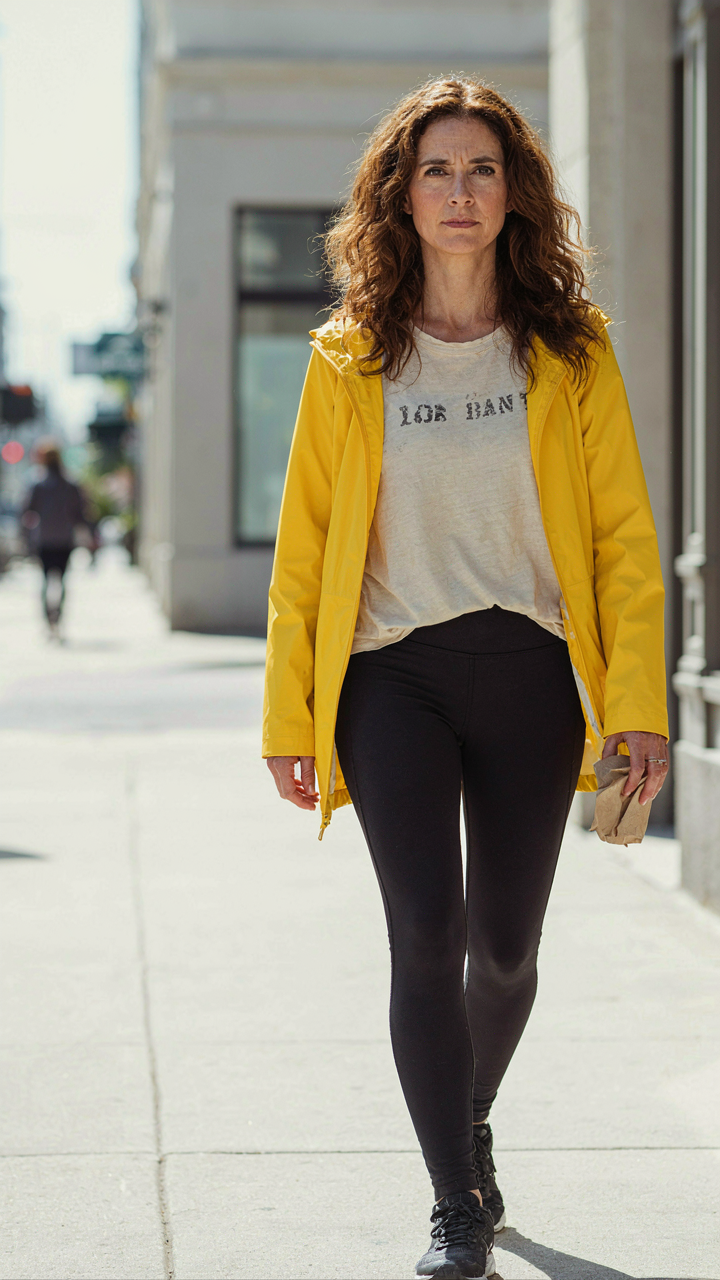
You want permission to wear athletic gear without looking like you’re headed to spin class. The mechanism is simple: your brain reads “all athletic” as functional uniform, but “one athletic piece” as intentional styling choice. The difference is status signaling. One technical piece anchors an outfit. Everything else determines whether that piece reads as lazy or deliberate.
A fitted performance tank under a blazer. Bike shorts with a silk button-up and loafers. A structured athletic jacket layered over tailored trousers. The athletic element becomes a texture accent instead of a category announcement. This works because contrast creates hierarchy. Your eye lands on the athletic piece first, then reads the rest as intentional pairing, not convenience.
Breaking The Full Uniform Trap
The common advice says “mix athletic with dressy.” That’s incomplete. The real problem is proportion and saturation. Matching sets, full-leg leggings with matching sports bra visible, coordinated sneakers with coordinated socks—these combinations broadcast functional intent, not fashion intent. You need visual breaks.
Wear high-waisted performance leggings with an oversized vintage band tee that breaks the silhouette. Pair a sleek athletic jacket with a midi skirt and pointed-toe flats. Use color blocking: athletic piece in one tone, everything else in contrasting tones. The rule is never let the eye travel uninterrupted from neck to ankle through athletic wear. Interrupt it, and the outfit shifts from “gym errands” to “intentional aesthetic.”
Sporty Outfits For The Non Athlete: Embodying Active Energy

The Silhouette Swap
You want permission to dress athletic without joining a gym. The real mechanism is this: athletic silhouettes work because they’re built on proportion rules that flatter most bodies, not because they’re “trendy.” Borrowing shapes from sportswear means stealing decades of engineering that solves fit problems. A dropped armhole from a running shirt doesn’t just move well. It widens the shoulder line, shortens the torso visually, and requires zero tailoring. That’s the play.
The mistake most people make is grabbing athletic fabric and calling it done. Wrong. A jogger pant cut works in a business casual setting not because it’s made of performance material, but because the taper, rise, and thigh width create a specific line your body recognizes as intentional. Swap the fabric to wool or cotton blends and the silhouette remains. That’s borrowing correctly. The geometry matters more than the technology.
Structured Pieces With An Athletic Edge
Architecture gives us load bearing capacity: athletic wear distributes force across surfaces to prevent failure. Apply this to styling. You need one structured piece that anchors the outfit and forces everything else into proportion. A blazer with seaming that mirrors a sports jacket does this instantly. The seams aren’t decorative. They create internal structure that holds the garment’s shape and controls how it sits on your body. This is the non-negotiable piece. It overrides casual proportions.
Pair that structured anchor with one relaxed piece maximum. High-waisted trousers with a fitted tank. A structured vest over loose linen. The contrast between engineered rigidity and natural drape is what reads as “intentional athletic” instead of “gave up and wore gym clothes.” The structure telegraphs control. It says you chose this shape, not that you defaulted to comfort. Add minimal accessories and stop. Layering beyond two pieces collapses the visual hierarchy you just built.
The Unspoken Rules Of Trendy Gym Wear: Post Workout Etiquette

From Sweat To Street In One Move
You’re worried people will judge you for still wearing gym clothes outside the gym. Here’s the mechanism that actually matters: gym wear became street wear because it solved a logistics problem, not because it looked good. You need pieces that function as both containment and transition without a wardrobe change.
The shift happened when athleisure moved from niche to mainstream around the 2010s. Brands realized people didn’t want to carry a separate bag or spend time changing. The real play is choosing pieces that don’t scream “I just left the treadmill.” You’re building a bridge outfit, not broadcasting your workout.
- Fitted joggers in neutral colors: Black, navy, or grey joggers in structured fabrics work as both gym and casual wear. Skip oversized cuts that read purely athletic and choose tapered ankles for a polished edge.
- Oversized button-up layer: A linen or cotton overshirt worn open covers moisture spots and transitions the entire fit instantly. Pull it from your regular wardrobe, not the activewear section.
- Minimal sneakers over chunky trainers: Low-profile white or black leather sneakers ground the outfit in regular fashion. Oversized athletic shoes anchor the look firmly in gym mode and kill the transition.
- Crossbody bag instead of gym tote: Switching bags matters more than most people admit. A structured crossbody signals intentionality and replaces the visual anchor of your gym equipment.
- Moisture-wicking layers in quality fabrics: Technical fabrics that don’t show sweat rings give you actual staying power for errands or coffee. Standard cotton clings and creates visible wet patches that force you home.
The deciding factor is fabric choice. Technical blends designed for performance also happen to regulate temperature in real life. Cotton gym wear announces what you just did. Polyester-blend joggers and tops sit differently on your body and don’t telegraph moisture or exertion to anyone watching.
The Real Layering System That Works
Forget the advice about throwing on a hoodie. That’s lazy thinking that actually makes the problem worse. Layering in fashion terms is about proportion and visual weight distribution, not just adding fabric on top. Your cover-up layer needs to change the silhouette entirely, not just conceal sweat.
An oversized button-up or camp collar shirt worn unbuttoned over fitted gym wear creates contrast that reads as intentional styling. A fitted blazer works the same way. The layer should be long enough to cover your hips and loose enough to create separation from the body. When you button or cinch it, you’re no longer in gym mode visually, even if the base layer is pure athletic wear underneath.
Timing matters too. Change your top layer immediately after your workout, not thirty minutes later when it’s dried and the aesthetic has already locked in. Your shoes stay the same only if they’re crossover sneakers. If you wore dedicated gym shoes, switch them. That single move signals you’ve transitioned from one activity to another, and people register that shift before they register anything else about your outfit.
Mastering Sports Style Outfits: The Comfort Vs. Polish Fallacy

True Comfort Often Looks Tailored
You’re worried that polished sporty outfits will feel restrictive or inauthentic. Here’s the mechanism: tailoring isn’t about tightness. It’s about fit that removes friction between your body and fabric. Loose fabric bunches, shifts, and creates drag during movement. A garment cut to your proportions stays where you place it. Your nervous system registers this stability as comfort, not constraint. Athletic brands discovered this decades ago. They taper sleeves, contour waistbands, and shape seams because sloppy silhouettes waste energy.
The confusion exists because gym wear normalized oversizing as comfort. Oversized pieces feel forgiving psychologically but punish you biomechanically. They add weight, require constant micro-adjustments, and telegraph low effort. Tailored sports pieces—fitted leggings with a shaped waistband, structured tank tops with inset sleeves, cropped jackets that follow your frame—actually reduce the work your body performs. Start by identifying one garment that fits your shoulders properly. Notice how much less you adjust it throughout the day.
The Illusion Of Comfort In Sloppy Attire
Sloppy sporty outfits feel comfortable initially because they demand nothing from you visually or physically. No silhouette to maintain, no proportion to consider, no feedback from fit. That ease is false comfort. It’s the comfort of invisibility, not actual wearability. Real comfort comes from predictable garment behavior. When a fabric knows its job, you stop thinking about it. Oversized pieces force constant mental load: Is this riding up? Does this look intentional or careless? Am I reading as effortless or lazy?
The mechanism here is cognitive load. Every poorly fitting element demands a micro-decision from your brain, depleting mental resources before you leave your home. Tailored sporty outfits compress those decisions into the fit itself. You choose the piece once, it performs its role consistently, and you move forward. The polish isn’t aesthetic vanity. It’s the elimination of friction. When constructing a sporty outfit, choose one fitted anchor piece—a lean pant or structured top—and build layers around it rather than stacking loose elements.
The 3 Piece Sporty Outfit Formula For Elevated Daily Wear

How The Contrast Principle Works
You want to look intentional without looking like you tried too hard. That’s the real tension here. The mechanism is borrowed from design theory: contrast. Strategic opposition creates visual interest and prevents sameness. A fitted athletic tank reads as gym wear alone. Pair it with tailored trousers and a structured blazer, and the same tank becomes intentional. The athletic piece becomes an accent, not the entire statement. The formula works because you’re anchoring a sporty element between two refined pieces, which forces the viewer’s eye to see sophistication first.
The base layer carries the load visually and functionally. Choose fitted tees, tank tops, or lightweight compression pieces in solid colors or minimal patterns. These sit tight to the body and establish clean lines. The athletic accent is your statement: visible sports bra, mesh panels, technical detailing, or a recognizable performance brand. The third piece is structural: a blazer, overshirt, or tailored jacket that communicates control. This piece absorbs the sportiness and repositions it as deliberate style rather than default comfort wear.
The Formula In Action
Athletic pieces don’t stop working outside the gym when you understand how to layer them into systems that read as intentional across different contexts.
- Office setting in cool weather: Fitted racerback tank, high waisted trousers, oversized wool blazer. The blazer neutralizes the athletic top and creates professional hierarchy without contradicting it.
- Casual weekend in warm weather: Mesh panel sports tank, linen shorts, open overshirt in neutral linen. The overshirt provides coverage while the mesh tank stays visible as a design choice, not an afterthought.
- Elevated dinner or social event: Fitted athletic bra top styled as intentional layering under a silk slip dress. The underlay reads as deliberate styling rather than visible undergarments.
- Transit or travel in variable temperature: Tight compression tee, utility cargo pants, structured coach jacket. All three pieces function and the compression top reads as technical performance, not activewear.
- Casual meeting or creative workspace: Visible sports bra with draped linen button up worn open, cropped athletic leggings, minimal sneakers. The drape softens the athleticism while the bra stays visible and intentional.
Execution matters more than aspiration. Start with one base layer, one athletic accent, and one structural piece you already own. Wear the combination three times in different contexts before buying anything new. The outfit only works if it survives the actual friction of your day without pulling attention to itself or making you adjust it constantly.
Your Style Isn’t A Wardrobe Problem; It’s A Failure To Understand Subtle Power Dynamics

Most women treat sporty outfits as costumes they wear to the gym, then abandon. That’s the real mistake. You’re not building a style—you’re building a signal. When you wear athletic pieces outside the gym, you’re telling the world you move through life with intention, not hesitation. Start today: pick one sporty piece you already own and wear it somewhere you normally wouldn’t. Coffee shop. Office. Dinner. Watch how differently people respond. Your clothes aren’t decoration. They’re your introduction before you speak.