
The Hanger Heresy: Why Your Closet Destroys Knitwear

Gravity’s Relentless Pull On Fibers
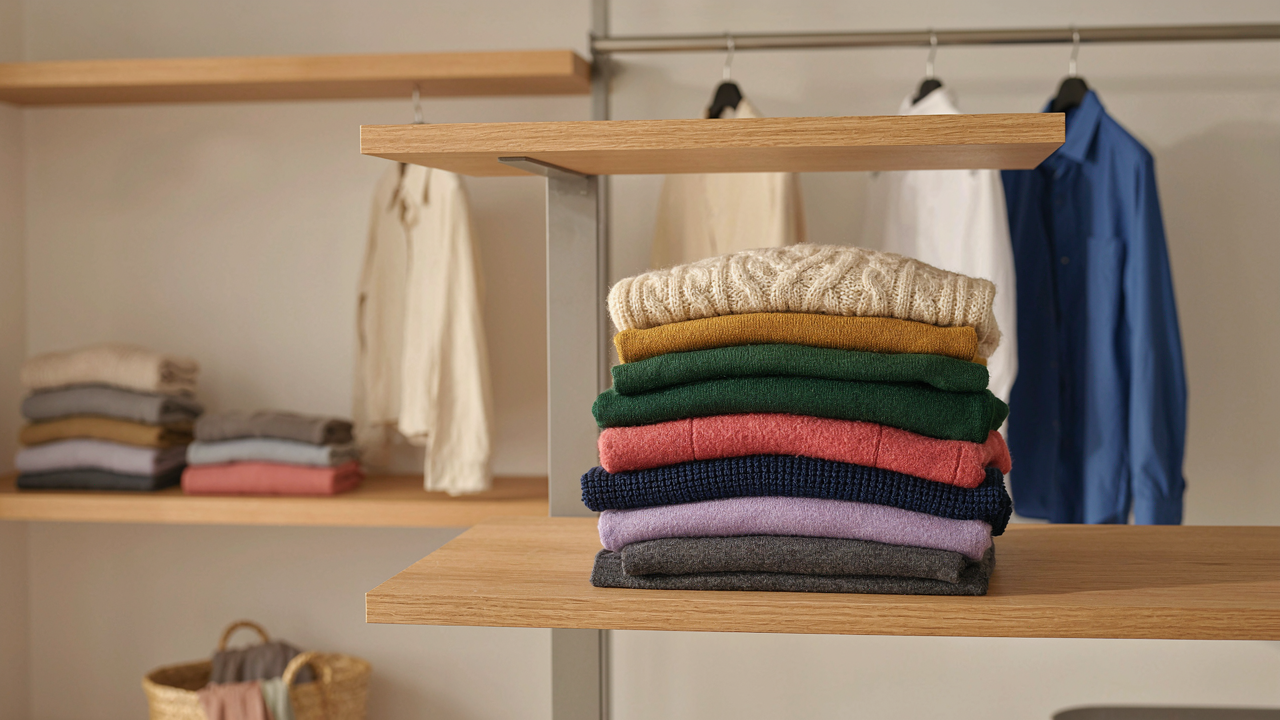
You care about this because a stretched-out sweater signals you don’t maintain what you own. Here’s the mechanism: gravity works like a load in structural engineering. The moment you hang a sweater, its own weight becomes a downward force that the fibers must support continuously. Cotton and wool fibers have elasticity limits. Hang a sweater for months and those fibers don’t bounce back. The neckline drops. The shoulders widen. You get permanent deformation that no wash reverses.
Hangers compound the problem by concentrating force at two points: the shoulders. This creates stress concentration, the same principle that makes bridges fail at their narrowest spans. The fibers directly under the hanger experience the most strain while the rest of the garment hangs slack below. Over time, those stressed fibers permanently elongate. Folding distributes weight across the entire bottom surface of the sweater, eliminating the stress concentration entirely. Store sweaters flat, not hung.
Stretch Deformation: A Slow, Preventable Death

The common advice says any hanger works if you’re gentle. That’s incomplete. The real problem isn’t the hanger’s material, it’s the sustained tension on stretched fibers. Once fibers elongate beyond their yield point, they stay elongated. This isn’t reversible through washing or steaming. The damage accumulates silently over weeks and months while you notice nothing until one day the sweater simply fits wrong.
Moisture amplifies this damage. Damp fibers lose rigidity and stretch more easily under the same weight. A sweater hanging in a humid closet degrades faster than one in dry conditions. The solution is immediate: fold sweaters and stack them horizontally on shelves or in drawers. If you must hang a sweater temporarily, never leave it hanging longer than a single wear cycle. Remove it within hours, not days.

The Material Mandate: Storing By Fiber Type, Not Sentiment

Wool And Cashmere Need Breathable, Folded Sanctuaries
You’re storing sweaters to protect an investment, but most people treat fiber like it’s all the same. It isn’t. Wool and cashmere operate on a moisture equilibrium principle borrowed from materials science: these fibers absorb and release moisture without structural damage, but only when air circulates around them. Stack them in plastic and you’ve created a humidity trap that accelerates pilling and mildew.
Fold wool and cashmere, never hang them. Hanging stretches the shoulder seams over time because the fibers lack the recovery speed of synthetic blends. Store them in breathable cotton containers or linen bags that allow air exchange. Cedar blocks or lavender sachets work because they repel moths through scent, not suffocation. Place heavier pieces on bottom shelves where gravity won’t add stress, and give each folded piece an inch of breathing room so fibers don’t compress against each other.
Synthetics And Blends Tolerate More Storage Flexibility
Synthetic fibers like polyester and acrylic don’t absorb moisture the way natural fibers do, which means they’re harder to damage through humidity alone. This is why they’re cheaper and why they show up in blends: they provide structural stability and durability. Your storage options multiply because you’re no longer fighting fiber degradation at the molecular level.
Hang synthetics and blends if your closet has stable temperature and humidity. You can use standard hangers without shoulder deformation because polyester has memory and snaps back to shape. Plastic storage containers work for synthetics without creating the condensation risk you’d face with wool. The trade-off: synthetics pill faster under friction, so avoid overcrowding. Store blended pieces in loose stacks if hanging isn’t possible, and rotate them monthly to prevent permanent creases.
The Compression Fallacy: Airflow Over Suffocation For Longevity
Breathing Room: Preventing Mildew And Odors
You want to believe tight storage saves space and looks organized. But you’re trading closet real estate for fiber death. Mildew needs three conditions: moisture, darkness, and no airflow. Remove the airflow variable and you’ve built a petri dish. Sweaters stored in vacuum bags or plastic bins create stagnant microclimates where moisture pools even in dry homes. Natural fibers like wool and cotton trap humidity against the yarn, triggering mold growth and permanent odor that washing won’t fix.
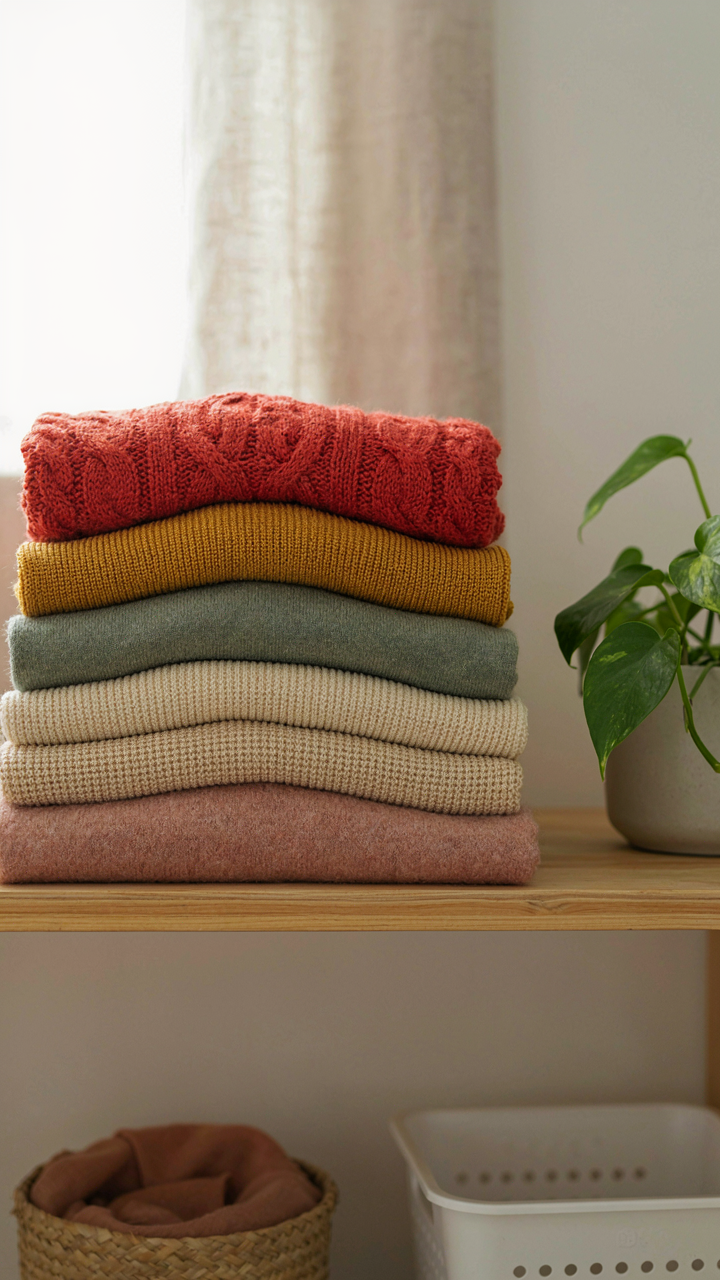
Store sweaters where air moves around them. Cedar blocks and cotton garment bags allow vapor to escape while protecting from dust and insects. The goal isn’t airtight—it’s breathable containment. Stack sweaters loosely on open shelves or hang them with space between each piece. If you use containers, leave them unsealed or drill small ventilation holes in the lids. Moisture evaporation prevents the chemical reaction that creates mildew. Air circulation is the cheapest insurance against storage failure.
Compacting’s Hidden Damage: Fiber Stress
Compression over time doesn’t just wrinkle fabric—it permanently deforms yarn structure. Think of fiber stress like material fatigue in engineering: repeated pressure causes microbreaking in the protein chains that give wool and cashmere their elasticity. Tightly rolled or vacuum-sealed sweaters develop creases and weakened zones that never fully recover. The damage compounds with each storage cycle.
Fold sweaters using the drawer method: lay flat, fold in thirds lengthwise, then fold in half or thirds widthwise depending on drawer depth. This distributes weight evenly across the entire piece instead of creating pressure points at folds or compression zones. Never hang heavy knits for extended storage—weight stretches the shoulder seams and neck opening. Folding keeps fibers relaxed while allowing you to access pieces without disturbing the rest. Check your stack every few months and refold slightly differently to prevent permanent crease lines from settling into the same spots.
The Seasonal Stash: Strategic Off Season Sweater Storage

Clean Before Storing
You’re worried about holes. Not the kind from wear, but the kind from moths eating through fiber while your sweater sits untouched for months. That’s the real mechanism at work here. Insects don’t target dirty sweaters randomly—they hunt protein residue. Sweat, dead skin, food particles, and body oils are larval food. A clean sweater starves them out completely.
Washing removes the biological attractant. Use cold water and gentle detergent, then dry fully before packing. Moisture trapped in fibers creates the exact environment pest larvae need to thrive. The sweater’s cleanliness is your first line of defense, not an optional step. Skip this and you’re funding an infestation for six months.
Temperature And Humidity Control
Storage conditions use the same biology as food preservation—you’re halting the life cycle of damaging organisms. Temperature stability matters more than absolute cold. Fluctuating temps between 60-75 degrees Fahrenheit trigger activity cycles in moths and mildew. Consistent cool storage keeps everything dormant. Humidity should stay between 30-50 percent. Above 50 percent, mold grows on fiber. Below 30 percent, static electricity damages delicate knits during handling.
Most people store sweaters in uninsulated attics or basements where temperature and humidity swing wildly with seasons. That’s why sweaters stored that way deteriorate faster than ones kept in climate-controlled closets or mid-story bedroom shelves. Find a space that holds steady conditions year-round, measure the actual humidity with a meter, and adjust with a dehumidifier if needed before packing anything away.
The Dan Koe Folding Protocol For Sweater Organization
Minimize Stress Points First
You care about this because sweaters cost money and losing their shape feels like failure. The real mechanism: folding creates creases, and creases become permanent stress points where fibers break. Fewer folds mean fewer failure zones. Most folding advice ignores this entirely, treating all folds as equal when they’re not. The minimalist fold uses exactly three directional folds instead of five or six, concentrating fiber strain in fewer spots and letting gravity work for you rather than against you.
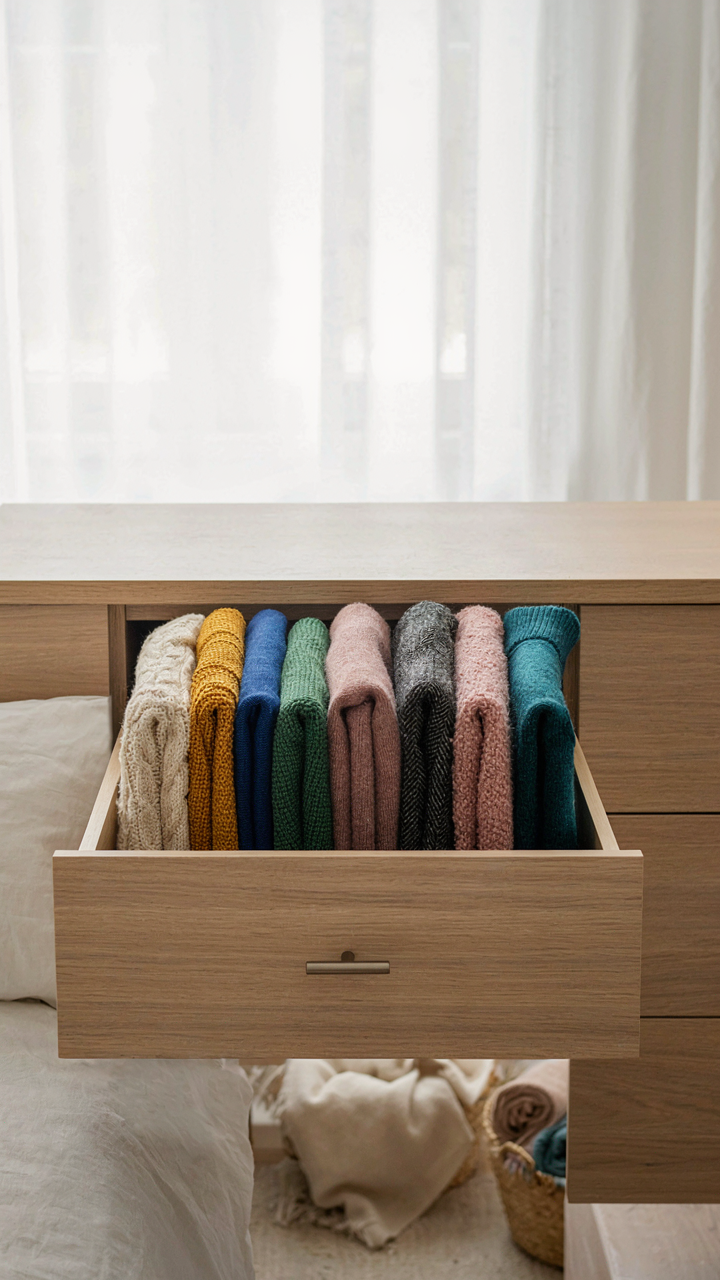
The technique works on knit structure itself. When you fold a sweater, you’re creating tension vectors across the weave. Cashmere, merino, and cotton handle this differently because their fiber density varies. The goal is one vertical fold down the center, then one horizontal fold at the midpoint. That’s it. No thirds. No quarters. Two folds establish the shape without multiplying the damage. Store the result in a drawer lying flat. The weight distributes evenly rather than hanging from one stressed seam.
Stack Vertically, Not Horizontally
Flat piles crush sweaters under compression weight. This is physics, not preference. When you stack sweaters flat, each one bears the load of every piece above it. The bottom sweater absorbs ten times the pressure it would experience standing upright. Vertical stacking reverses this by distributing weight along the full length of the fold, not concentrating it across the face. Sweaters compress less when stacked like files in a drawer than when piled like plates.
Vertical stacking also solves a hidden problem: you see what you own. You grab one sweater without disturbing the pile. Flat piles force you to excavate, shifting weight and reopening old folds. Most people default to flat stacking because drawers feel like the natural choice. Wrong. Sweater storage works best when you treat it like a filing system, not a closet. Stand each folded sweater upright in a drawer or shelf, spine forward, so you pull from the side rather than from the top. Rotation becomes automatic, preventing any single sweater from bearing sustained compression.
Beyond The Drawer: Innovative Sweater Closet Storage Solutions
Shelf Dividers Maintain Individual Sweater Integrity
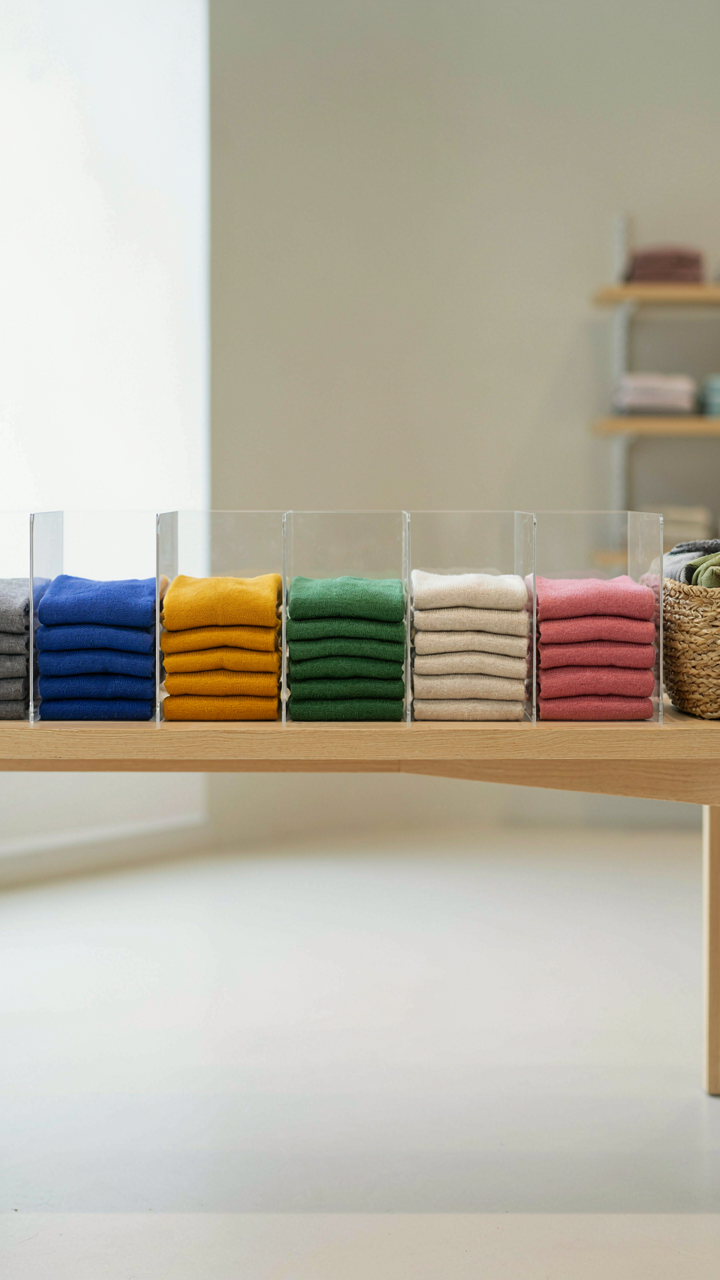
You want your sweaters to look expensive because you paid for them to look expensive. The real mechanism here is friction. Sweaters collapse when they compress against each other. Shelf dividers work because they create vertical barriers that prevent horizontal pressure. Each sweater gets its own compartment. The divider forces weight down instead of sideways. Most people stack sweaters and wonder why they flatten. The dividers don’t stop gravity, but they redirect the force away from the fabric itself.
The best dividers sit flush on the shelf and rise between four and six inches high. Metal or rigid plastic works better than fabric or foam because they don’t absorb moisture or shift under weight. Place dividers at intervals wide enough for your thickest sweaters. You’re not creating barriers for aesthetics. You’re creating load paths that protect the shape. Measure your shelf width first, then buy dividers that fit. Install them now before adding sweaters back.
Breathable Fabric Bins Contain Without Suffocation
Fabric bins beat plastic containers because plastics trap moisture through condensation. This is a ventilation problem borrowed from HVAC design: airflow prevents buildup. Sweaters need ambient air exchange. Plastic blocks it. Canvas, cotton, and linen bins let air circulate while blocking dust. The bin becomes a passive climate buffer instead of a sealed tomb.
Stack bins no more than two high to avoid crushing sweaters at the bottom. Label each bin by sweater weight or fiber type so you grab the right one. Don’t fill bins past three-quarters capacity. Compressed sweaters develop creases that take weeks to relax. Check bins twice yearly for moisture or odor. Breathable storage means you rotate through them instead of forgetting what’s inside.
The “Entropy Reversal” Method For Long Term Form Preservation
Minimizing Fiber Disorganization Through Environmental Control
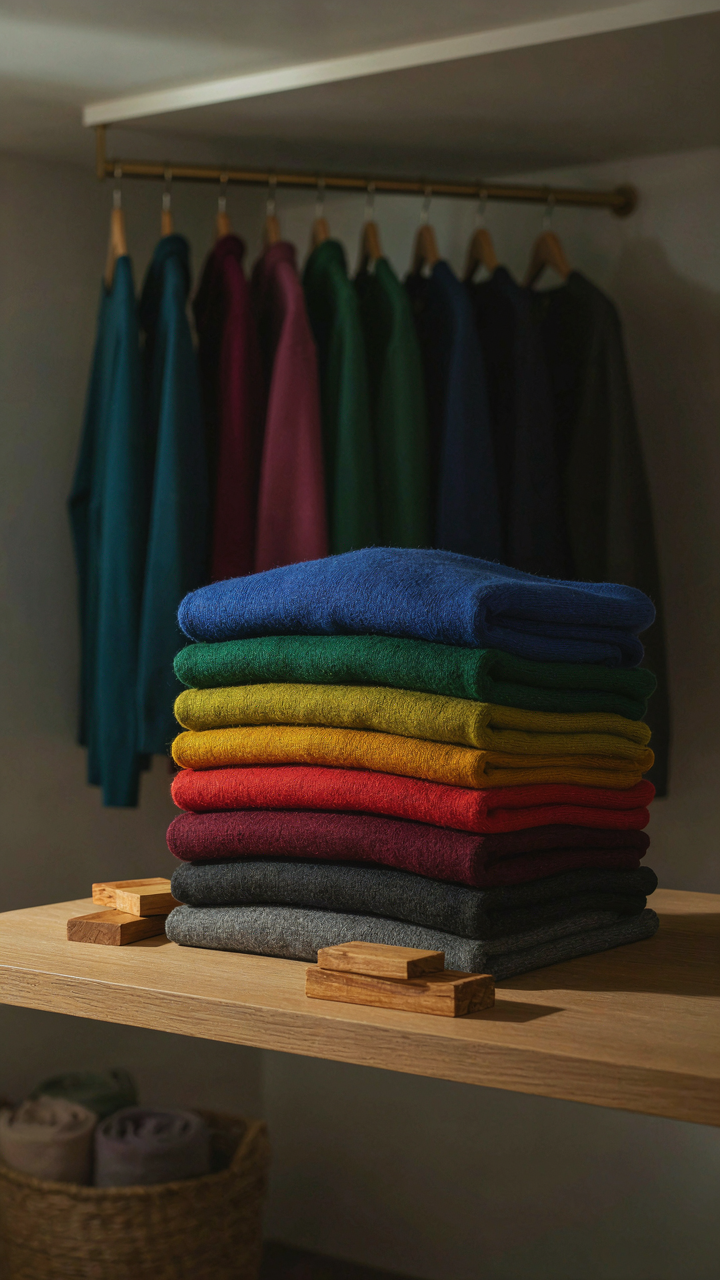
You care about this because a stretched-out sweater feels like money wasted, and admitting you don’t know how to prevent it feels stupid. Thermodynamics offers the real mechanism: entropy is the measure of disorder in a system, and fibers in knitwear naturally move toward maximum disorganization over time. Heat, humidity, and pressure accelerate this process. Folding and storing sweaters flat minimizes the gravitational force pulling fibers downward, which is the primary driver of stretch. Cold, dry environments slow molecular movement, keeping fibers locked in their original configuration longer.
The common advice to “just use a hanger” ignores the physics entirely. Hangers work against fiber memory by introducing constant tension at two points, forcing fibers into an elongated state. A sweater stored flat experiences uniform, minimal stress across all fibers. Cedar blocks and sealed containers don’t add mystical protection, they simply reduce air circulation and humidity fluctuation, which prevents fibers from cycling through expansion and contraction. Store sweaters folded in a cool, dry closet away from direct heat sources. This isn’t preference. It’s the only method that respects how fiber structure actually behaves.
How Fiber Memory Dictates Shape Retention
Fiber memory is a material property, not a myth. Knit fibers contain elastic chains that want to return to their original molecular configuration after being bent or stretched. Synthetic fibers like polyester and acrylic have stronger memory than natural fibers like cotton or wool, which is why a poly blend sweater holds its shape longer than pure merino. The memory degrades faster under heat, repeated stretching, and humidity swings. Washing frequency matters less than storage conditions because a sweater spends 90 percent of its life in storage, not being worn.
Wool’s reputation for shape retention comes from its unique surface structure: scales that allow fibers to lock into position more easily than smooth synthetics. But wool still loses memory when stored damp or warm. A sweater’s shape is already partially set the moment you fold it for storage, which means your initial fold determines whether that sweater will hold form for months or months. Fold the same way every time, in the same position, without compression from heavier items on top. The fibers conform to that geometry and resist deviation from it.
Combatting Creases: The Unseen Damage Of Improper Placement

Where Fold Lines Become Permanent
You care about this because a visible crease signals neglect. Most advice says fold sweaters carefully, which misses the real problem: folding itself creates stress lines that migrate into fiber memory. Think of it through material science. A fold operates like a stress concentration point. The fibers at the crease bend repeatedly, breaking polymer chains in the yarn. Over time, this damage becomes structural, not cosmetic.
The common recommendation to fold sweaters along the same lines every time actually worsens the problem. You’re reinforcing the same damage zone with each storage cycle. Instead, rotate your fold pattern every few rotations. Better yet, fold along different axes or use the hanging method for pieces prone to creasing. The goal is distributing stress across the entire garment rather than cementing one permanent weak point into the sweater’s shape.
Eliminate Pressure Point Damage
Smooth surfaces prevent the localized crushing that turns sweaters into stiff, distorted versions of themselves. Pressure points form when sweaters sit under weight, against rough edges, or beside hard objects inside a drawer. Each contact spot compresses fibers downward, and knitwear doesn’t bounce back like you’d expect. The damage compounds with time because the compressed zone never fully recovers.
Stack sweaters on a flat, clean surface with nothing pressing down on them except their own weight. Remove wire hangers from shelves. Avoid storing sweaters directly against wooden drawer bottoms or plastic storage bin edges. Use acid-free tissue paper between stacked garments if you stack more than four pieces. The protocol matters: smooth base, nothing rough touching the fabric, minimal weight, maximum air circulation around each piece.
The Enemy Within: Protecting Sweaters From Internal Breakdown

When Fibers Break Down
You’re worried about this because a destroyed sweater is money wasted and a gap in your rotation. The real mechanism is oxidation. Cellulose and protein fibers degrade when exposed to oxygen, heat, and light over time. This isn’t sudden. It happens across months and years, weakening the molecular bonds that hold the yarn together. A sweater stored in sunlight ages faster than one in darkness, but both age.
Natural fibers follow a predictable decay curve. Cotton loses tensile strength gradually. Wool becomes brittle. Cashmere sheds more fibers. The timeline depends on storage conditions, not the sweater’s quality. A premium merino in a humid closet degrades faster than mid-market wool in a climate-controlled drawer. The fiber type sets the upper limit. Your storage method determines where it actually lands on that timeline.
Handling Protocol For Longevity
Everyone says fold sweaters gently. That’s incomplete advice because it ignores the actual damage vector. Friction is what matters. Repeated handling, hanging, and folding creates micro-tears in the yarn structure. Each time you pull a sweater off a hanger or refold it, you’re fracturing fibers. The goal isn’t gentle handling. The goal is minimal handling.
Store sweaters flat and access them rarely. This cuts friction damage by removing the variable entirely. When you do handle them, wet hands cause swelling in wool fibers, making them more fragile. Dry hands create static that snaps loose fibers. Use a soft cloth barrier between your hands and the sweater. Reduce the number of times you pull it from storage. The fewer times you touch it, the longer it survives.
Mastering The Art Of Sweater Storage: A Checklist

Tools You Actually Need
You’re reading this because you’ve already lost a sweater to moths or stretching, and you want to avoid buying replacements. Here’s the mechanism: sweater damage happens through three vectors—humidity, pressure, and pests. You stop those three things, you stop the damage. Most storage advice skips the tools and jumps straight to folding. Wrong move.
- Cedar blocks or cedar oil: Cedar compounds kill moth larvae and eggs. Real cedar works. Synthetic cedar scent does not. Replace every six to twelve months as potency fades with time and exposure to air.
- Breathable storage containers: Plastic bins trap moisture and encourage mold growth. Use acid-free boxes or cotton bags. Air circulation prevents the damp environment that ruins fibers and attracts insects.
- Acid-free tissue paper: Acid degrades wool and cotton fibers over years. Regular tissue yellows and weakens sweaters. Acid-free tissue costs two dollars more per pack and prevents permanent damage.
- Flat storage space: Hanging sweaters stretches the neckline and shoulder seams under their own weight. A drawer, shelf, or bin provides the pressure-free environment knits require to hold their shape.
- Silica gel packets: These absorb excess moisture without adding chemical smell. Replace when they turn pink or blue. They cost under five dollars and prevent the humidity spike that causes mildew.
You don’t need fancy vacuum bags or cedar-lined closets. You need these five things. Get them in place before your next storage cycle, then source them again when they lose effectiveness. Replacement is cheaper than replacement sweaters.
The Weekly Audit Process
Skip the Instagram version of storage checks. You don’t need to unfold everything or photograph your closet. The real check targets the three damage vectors: you inspect for moth activity, moisture buildup, and pressure deformation every seven days.
Spend three minutes per storage area. Open the container and smell for mustiness or chemical odor, both signs of moisture or mold. Check cedar blocks for color fade. Look at the tissue wrapping for discoloration. Feel the air inside for dampness. Replace any cedar blocks that lost their scent. If moisture appears, add silica gel and crack the lid slightly for twenty-four hours. Moisture kills more sweaters than anything else. Check it weekly.
Your Fear Of Garment Decay Isn’t The Problem; Your Misunderstanding Of Textile Mechanics Is

You’ve been fighting gravity and fiber structure your entire life without knowing it. Sweaters don’t hold their shape because you hope hard enough. They hold their shape when you eliminate the forces crushing them. Stop buying expensive storage solutions. Buy wooden hangers today. Fold one sweater the wrong way and watch it crease for six months. Fold it right and it survives untouched. The difference between a ruined sweater and a pristine one isn’t luck. It’s physics you finally understand.