
Beyond Thrift: The True Cost Of Neglect

The Economics Of Replacement
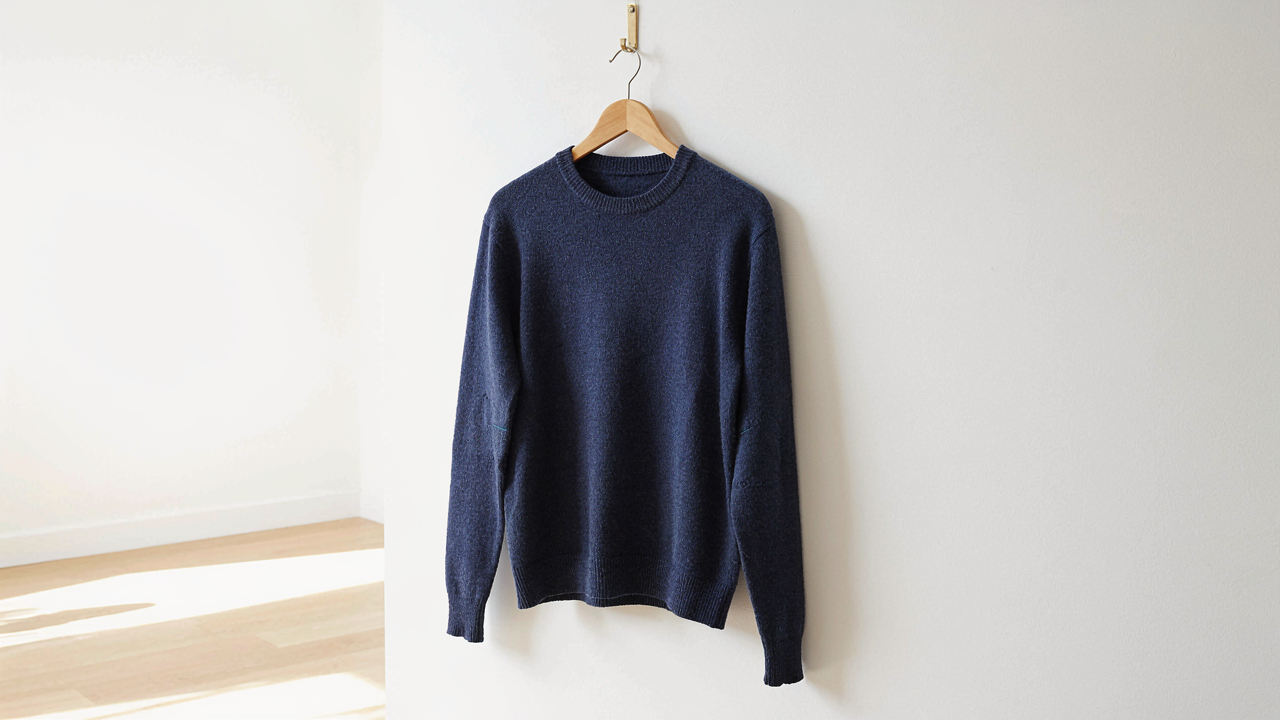
You don’t care about the sweater. You care about the money bleeding out of your closet without you noticing. Here’s the mechanism: a small hole in a quality sweater creates decision friction, and friction makes you buy a replacement instead of fixing what you own. One $15 darning job prevents a $80 to $200 replacement purchase. The math compounds across a wardrobe. Most people never calculate this because they’re trained to see clothes as disposable, not assets that respond to maintenance.
A single hole left unrepaired triggers mental exit. Your brain files the sweater under “broken” rather than “temporarily damaged.” You reach past it on laundry day. Within weeks you’ve moved it to a donation pile or the back of a drawer. Meanwhile, the $80 sweater from a quality maker costs nothing to repair if you catch it early. The economics of neglect are backwards: doing nothing costs more than acting.
Quality Versus Durability Theater

Fast fashion brands built their entire model on planned replacement cycles. They engineer sweaters to fail. A hole at the elbow isn’t a design flaw—it’s the business model working as intended. Enduring quality garments, by contrast, expect maintenance. Cashmere, merino, and quality wool blends were designed for darning before synthetic throwaway fabrics existed. The difference isn’t that good sweaters last longer without care. The difference is that good sweaters respond to care, while cheap sweaters don’t respond to anything except disposal.
The conventional wisdom says “buy better and it will last.” Incomplete. A $300 merino sweater with an ignored hole rots the same as a $30 synthetic. The sweater that lasts is the one you actively maintain. Darning is the protocol that separates ownership from consumption. When you darn a sweater, you’re not saving money—you’re practicing the skill that keeps quality garments functional for decades instead of seasons.

The Darning Imperative: Why Visible Mending Knitwear Matters

Rejecting Disposability Through Intentional Repair
You want to feel like you’re above throwaway culture without actually changing your purchasing habits. The real mechanism is this: darning sweaters forces a choice between the sunk cost fallacy and deliberate action. You own the hole. You either spend thirty minutes fixing it or spend money replacing it. One teaches agency. One teaches avoidance.
The math is brutal and simple. A quality sweater costs thirty to two hundred dollars. Darning takes thirty to sixty minutes. The needle and thread cost nothing. Replacing it costs the full price again. Most people choose replacement because the friction of learning to darn exceeds the friction of opening a browser. Darning sweaters rewires this calculation by making repair the path of least resistance once you know how.
The Repair As Statement, Not Compromise
Economics has a concept called “signaling.” The visible mend signals scarcity consciousness in an age of infinite consumption. A darned sweater doesn’t hide the fix. It announces it. The seam sits there. Everyone sees it. This flips the shame narrative.
The aesthetic shift happened in real design circles. Japanese shibori and kintsugi cultures normalized the visible repair decades ago. Western fashion eventually followed. A darned sweater now reads as intentional, not poor. The repair itself becomes the design detail. The mechanism is straightforward: expose the work, and the work becomes valuable. Conceal it, and it remains shameful. When you darn sweaters visibly, you control the narrative about what your clothes mean.
Deconstructing Damage: Understanding Knit Mending Before You Act
What Actually Breaks Inside Yarn
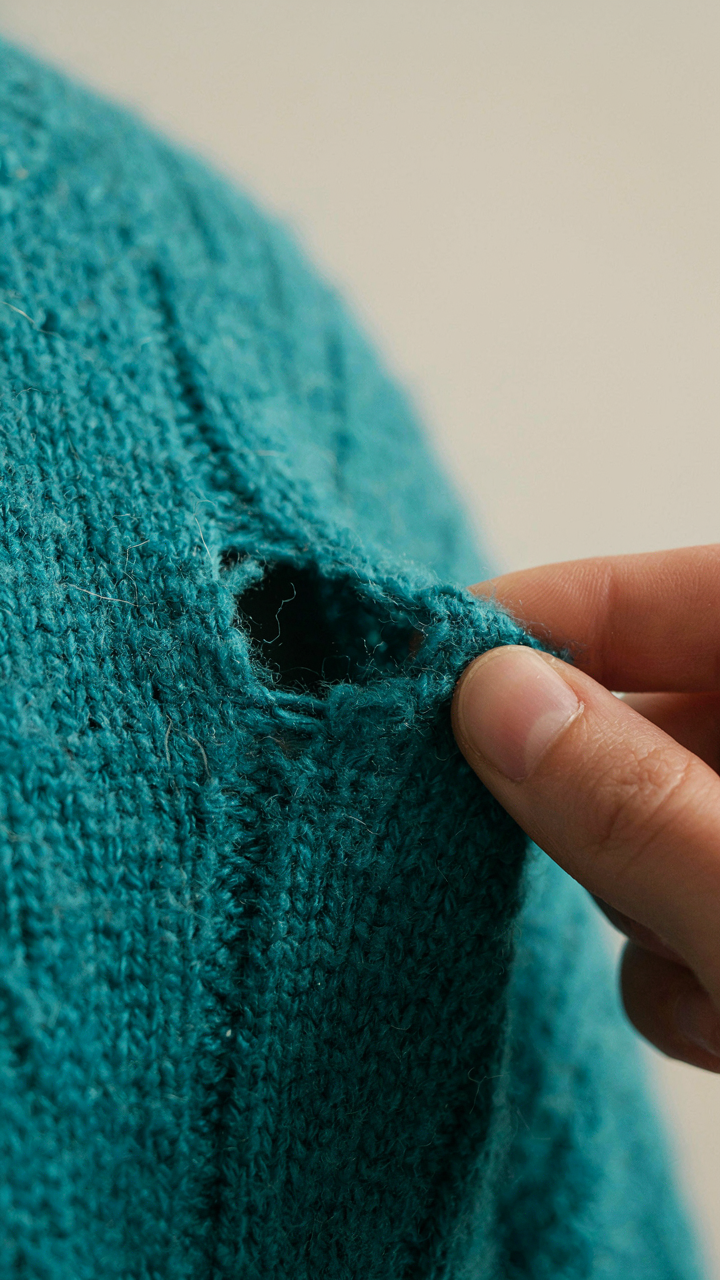
You’re reading this because you don’t want to throw away a sweater that cost money. That’s the real thing. The mechanism here is structural: knit fabrics fail like a chain where every loop depends on the ones next to it. When you get a hole, you’re not looking at isolated damage. You’re looking at broken loops that have already started unraveling or loops that never formed correctly in the first place.
The yarn type determines how fast this happens. Wool holds tension between loops better than synthetic blends do. Cotton sweaters tear cleaner and show damage more obviously. Cashmere pills and shreds instead of breaking. Each fiber has a specific breaking point based on its tensile strength, which is just the amount of force required before it snaps. Understanding your sweater’s fiber composition tells you whether the hole will spread in the next wash or stay contained.
When Darning Actually Works
Common advice says darn every hole you find. That’s incomplete. Darning only works when the surrounding fabric still has structural integrity. If the sweater has thin spots that feel papery, multiple holes in the same region, or pilling so dense it’s matted, darning buys you two washes, not two years.
Assess integrity by pinching the fabric around the hole. It should feel springy and return to shape immediately. If it feels limp or stays compressed, the fibers have already degraded beyond the visible hole. A single hole in otherwise solid fabric is a candidate for darning. Repeated damage in the same area, thin elbows, or stress points near seams mean the sweater has reached the end of its functional life and darning will fail.
The Weaver’s Gambit: Strategic Sweater Darning Techniques
Rebuilding Warp And Weft Structure
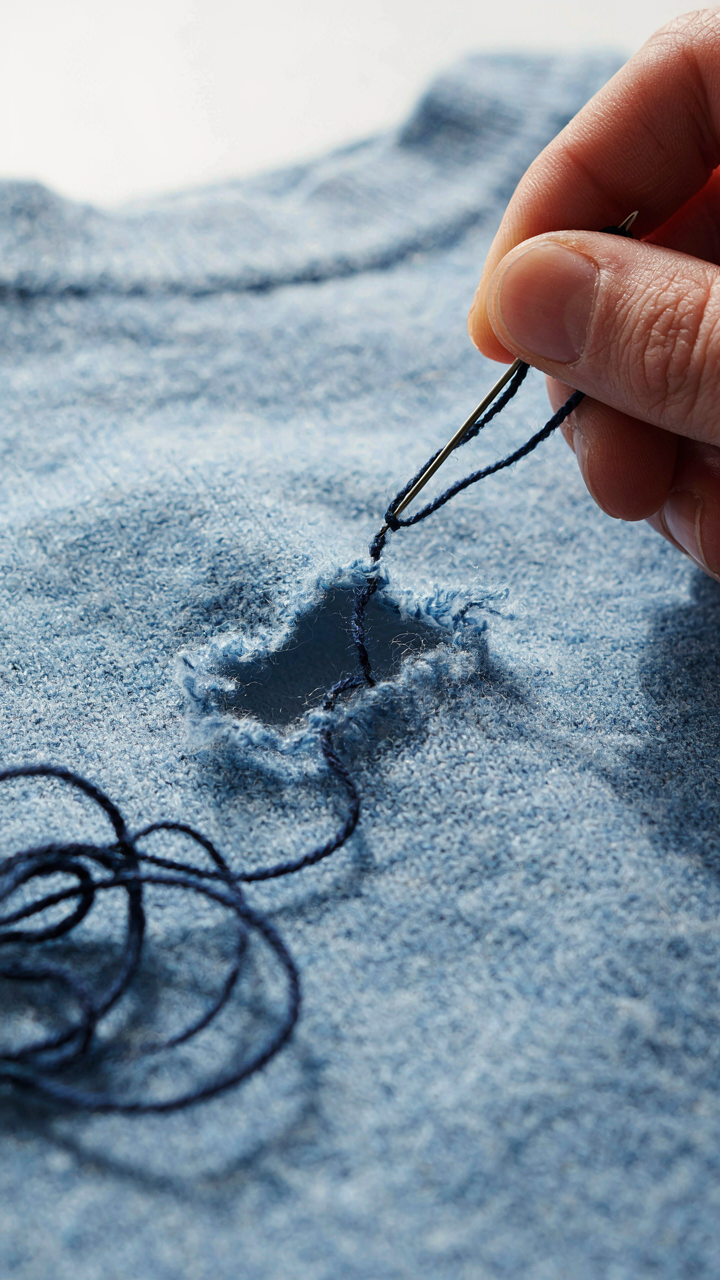
You want this repair invisible because a visible darn signals you can’t afford new clothes. The mechanism is simple: knit fabric has two perpendicular thread systems, and a hole means both are severed. You rebuild them in sequence. The warp runs vertically, the weft horizontally. Without restoring both directions, your repair fails under tension. Most people skip the vertical pass entirely, which is why their darns unravel.
Start by anchoring your thread into intact knit at least a quarter inch from the hole’s edge. Weave vertically through the columns of loops on one side, then horizontally across the gap, then vertically again on the other side. This mimics how the knit machine built the sweater originally. The hole closes because you’re rebuilding the actual structure, not papering over it. Tension matters less than sequence because the grid itself carries load.
Thread Tension Within The Repair Zone
Physics calls this stress distribution, and darning sweaters is an exercise in preventing it. Your thread must match the surrounding knit’s tautness or you create a weak point the moment someone wears the sweater. Too loose and the repair sags. Too tight and you compress the surrounding loops, creating a stiff patch that telegraphs the repair immediately.
The practical protocol: pull your thread snug enough that it mirrors the stretch of the intact sweater when you tug it gently. Your weaving shouldn’t distort the loops adjacent to the hole. Test this by pinching the repair and the intact fabric side by side. They should compress identically. This single check prevents 80 percent of repairs that look fine on the mannequin but fail after two wears.
The Anti Fragile Fiber Protocol: Making Your Sweater Stronger

Matching Thread Weight To Fabric Structure
You want your repair to outlast the original sweater. That’s the real motive here. The mechanism is simple: yarn thickness must match the gauge of your sweater’s knit. Thick thread on fine merino creates a hard lump that catches and tears. Thin thread on chunky knit leaves gaps where stress concentrates. You’re engineering load distribution, not just filling a hole.
The standard move is grabbing whatever thread exists in your drawer. Wrong. Count the plies in your sweater’s yarn, then match that structure in your darning yarn. A four-ply sweater needs four-ply thread. Single-ply thread splits and frays under tension. If your yarn is unavailable, buy the same weight in a neutral color and test it first on scrap fabric to confirm it moves with the knit, not against it.
Creating Stress Resistant Anchor Points
Military strategy teaches us about perimeter defense: you fortify the weak point by strengthening the zone around it. Apply this to darning. The hole isn’t your real problem. The surrounding fibers that allowed the hole to form are. You build resilience by distributing tension across a wider area than the damage itself requires.
Start your darn four rows above the hole, not at its edge. Work your anchor rows into intact fabric where fibers still have full tensile strength. This spreads the load across healthy knit structure instead of concentrating it at the tear’s boundary. The darn itself becomes a transition zone that bleeds stress gradually outward. Without this protocol, you’ve just created a different weak point adjacent to your repair.
Tools Of The Trade: Equipping Your Sweater Mending Arsenal

The Core Three You Actually Need
You want to feel like you have your life together, which means owning the right tools before you start. Here’s the mechanism: cheap tools waste time, and wasted time kills motivation. You need three things, and three things only, to darn most holes competently.
- Darning Needle: A blunt-tipped needle sized 18-22, typically 1.5 to 2 inches long. Works with yarn fibers without splitting them, unlike sharp sewing needles that pierce and damage individual strands.
- Yarn for Darning: Match fiber content and weight to your sweater. Use leftover yarn from the original garment if available, or find the closest alternative in color and thickness.
- Darning Egg or Mushroom: A smooth, rounded form you insert inside the sweater to create tension and a flat work surface. Wood or plastic, usually 2 to 3 inches in diameter.
- Embroidery Hoop: A 4 to 6 inch wooden or plastic hoop that stabilizes the hole’s perimeter and keeps tension even across the repair area during the weaving process.
- Fine-Tooth Comb: Removes fuzz and separates yarn strands after darning. Improves the finish’s appearance and prevents future snagging.
The darning egg is non-negotiable. Without it, you’re working on a soft surface that moves, and you’ll create loose, uneven tension that looks worse than the original hole. Insert it from inside the sweater, position the hole directly over the rounded top, and the egg becomes your anvil.
Where Precision Matters: The Specialist Tools
Most people stop at the basics and wonder why their repairs look amateur. The real gap isn’t in wanting better results, it’s in not understanding that different holes demand different approaches. Textile repair borrows from mechanical engineering the concept of load distribution: you must match your tool to the stress pattern the sweater experiences.
A small three-hole punch designed for leather works better than fingers for marking guide points on delicate fabric. Magnifying glasses aren’t vanity, they’re functional. Holes at stress points like elbows and cuffs require reinforcement yarn you can’t source from standard supplies, so you invest in specialized darning threads with higher ply counts. A blocking board lets you steam and set the repair to match the surrounding knit structure instead of leaving it raised and obvious. These tools aren’t upgrades. They’re solutions to specific failure modes that basic tools don’t address.
Mastering The Stitch: Darning Embroidery For Longevity
The Foundation Every Repair Needs
You want people to notice you fixed it yourself instead of replacing it. Here’s the mechanism: the basic darning stitch works because it mimics the original fabric structure. You’re not patching over a hole. You’re rebuilding the weave grid that was never there in the first place.
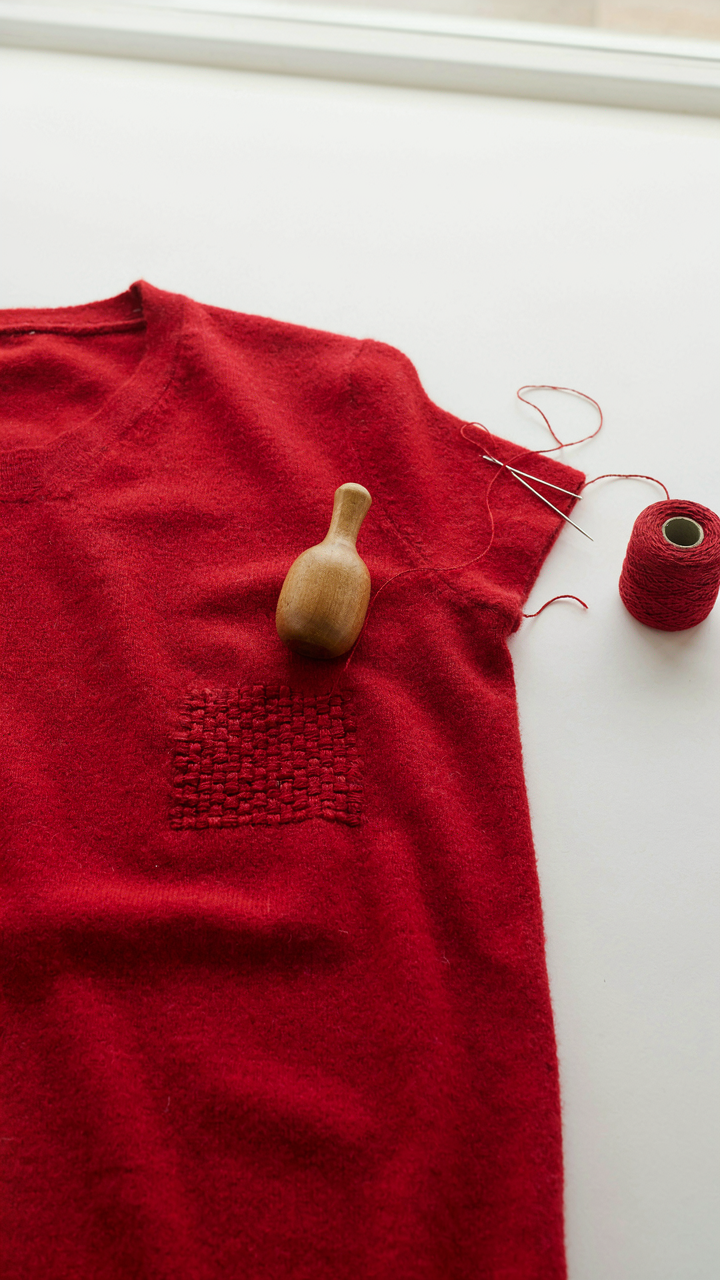
The simple darning stitch is a horizontal running stitch that bridges the hole by threading over and under existing yarn loops at the hole’s edge. You anchor your thread into intact fabric, then work back and forth in parallel lines, each pass overlapping slightly. This restores the vertical threads the damage removed. The stitch holds because tension distributes across multiple anchor points, not one weak seam.
Where Precision Matters Most
Common advice treats darning like it’s one technique. It’s not. The stitch you choose depends entirely on hole size and fiber type. Small holes in dense merino require a different entry and exit pattern than large holes in loosely knit mohair. Map this to weaving terminology: you’re choosing between plain weave patterns versus twill patterns based on your yarn’s count and ply.
For larger holes, use the crosshatch darning method where you lay horizontal runs first, then weave vertical passes through them, creating a grid. This works because you’re building structural support in both directions instead of one. Start your vertical passes from a different angle than your horizontal layer, which prevents the repair from sitting flat and visible. Thread tension stays consistent throughout because you’re spreading load across a matrix, not a line.
The Ecosystem Of Care: Extending Garment Life With Mending Clothes

Friction Points Before Holes Form
You want to believe a sweater lasts forever if you just buy quality. The mechanism is simpler: most damage happens during use, not storage. Pilling, snags, and eventual holes accelerate when fabric experiences repeated friction in the same zones. Your underarms, cuffs, and chest take the most contact. Slow this down and you defer darning by months or years.
Wear rotation is the actual lever here. Wearing the same sweater five days a week compresses a year of fiber fatigue into months. Alternate between three or four similar pieces and each garment recovers between wears. Fibers relax, moisture evaporates, and microscopic damage doesn’t compound. A sweater worn twice weekly outlasts one worn daily by a measurable margin.
Storage And Inspection As Prevention
Most people inspect sweaters after damage. This is backward. Fold sweaters horizontally instead of hanging them, which stretches necklines and shoulders under constant tension. Check for snags and pilling once monthly before they migrate into holes. You catch the problem at stage one when a single snag still sits on the surface, not stage three when it’s pulled an entire ladder of stitches loose.
Moisture and temperature consistency matter more than organization. Store sweaters in a cool, dry space away from direct heat and humidity fluctuations. Cedar blocks or lavender sachets deter moths without chemicals, but the real protection is simply moving your sweaters every few months to disrupt insect lifecycles. Inspect during rotation. This takes five minutes and replaces hours of darning work later.
Beyond The Needle: The Darning Mindset Shift

Repair Over Replacement
You want to believe you’re doing this for the environment, but what you’re really after is control. Control over your stuff. Control over the narrative that your possessions have expiration dates you didn’t authorize. Darning operates on economics, not ideology. When you learn to repair, you break the manufacturer’s lock on your wardrobe’s lifespan. The sweater stops being consumable. It becomes capital you maintain.
Most people never learn darning because admitting a hole can be fixed contradicts the entire system selling them new sweaters. The skill represents defection from planned obsolescence. Every darn you complete is a small act of economic independence. You’re not special for doing it. You’re just refusing an imposed cost structure. That shift in agency is what actually changes behavior.
Skill As Currency
Competence in a throwaway culture is rarer than people admit. The person who darts a sweater competently has done something most of their peer group cannot do. This isn’t virtue signaling territory. It’s friction in the system. When you hold a piece of knitwear and know exactly how to close a hole, you’ve moved from consumer to operator.
The power isn’t spiritual or moral. It’s mechanical. Knowing you can save a twenty or fifty dollar garment means you make different buying decisions. You buy better sweaters because you know you’ll keep them. You develop standards for fabric and construction because replacement isn’t automatic. Competence changes what you keep, what you discard, and what you’re willing to spend on entry. The darn itself is just the visible proof of a rewired decision tree.
The Real Obstacle Isn’t The Hole In Your Sweater, But The Hole In Your Consumerist Mindset

You don’t need a new sweater. You need to stop believing the lie that broken things belong in the trash. Darning sweaters rewires your brain to see repair as valuable, not as settling. Pull out that damaged sweater today. Spend an hour learning one basic stitch. Watch yourself choose to fix something instead of replace it. That single act compounds. You become someone who builds instead of burns through.