

The Myth Of Age Appropriate Outfits For Women Over 40

Fashion Rules That Aren’t Rules
You’re worried people are judging you for what you wear. That fear is what makes arbitrary rules stick around. The real mechanism: fashion gatekeepers sell restriction as wisdom. “Don’t wear this past 40” became gospel not because it’s true, but because it’s easy to repeat. The fashion industry profits when you shrink your choices. Rules about hemlines, colors, or silhouettes have no biological or logical basis. They’re inherited assumptions dressed up as etiquette.
Fashion rules originate from specific eras and marketing campaigns, not universal law. A sleeveless dress wasn’t “age-inappropriate” in 1920. Bright colors weren’t forbidden in 1980. These rules shift constantly because they’re invented, not discovered. What matters is whether a piece flatters your body, aligns with your life, and gets worn. The moment you chase someone else’s rule instead of your own standard, you’ve already lost the outfit.
Why Generic Advice Traps You

Most style advice for women over 40 operates like an economic scarcity model: convince you that your options are limited, then sell you a narrow product line. Stick to neutrals. Dress “elegantly.” Avoid trends. Each instruction reduces your agency and expands a brand’s market share. You don’t get wider choices. You get a smaller, safer box. The advice isn’t wrong about elegance or quality. It’s incomplete about who gets to decide what elegance looks like on your body.
The real cost isn’t the bad advice itself. It’s the wasted mental cycles deciding whether you’re “allowed” to wear something. Outfit decisions should take your body, schedule, and confidence into account. They shouldn’t require a permission slip from a decade. When you stop asking if something is age-appropriate and start asking if it works, your actual wardrobe possibilities expand immediately. Start here: pull one piece you love but think you shouldn’t wear, and wear it three times this week.

The Investment Portfolio Wardrobe: How To Dress In Your 40’s For Women

Core Pieces As Long Term Assets
You’re worried you’ll look invisible. That’s the real thing driving this search. The mechanism is simple: fast fashion accelerates decision fatigue, so you end up reaching for the same five pieces on rotation anyway. Women over 40 who dress well own fewer items that work harder. This isn’t minimalism as lifestyle branding. It’s economics. You buy pieces that don’t expire seasonally, that layer without bulk, and that work across contexts because your time is worth more than the square footage of your closet.
The foundation pieces work like bonds in a portfolio. A fitted crew neck in merino wool lasts five years if you buy quality. Dark indigo jeans cut straight or slightly tapered hold their shape because the weight of the fabric does the work for you, not elastic and synthetic stretch that degrades. Neutral blazers in wool or a wool blend function as the infrastructure that makes everything else feel intentional. These pieces don’t trend. They perform. You wear them so frequently that the cost per wear drops fast.
Accessory Allocation For Maximum Impact
Everyone says “add a scarf” and leaves you standing there with a rectangle of silk. Wrong approach. Strategic allocation means your accessories do one of three jobs: they fix proportions, they add texture contrast, or they age-proof an outfit. Belts worn at the natural waist over dresses or loose tops create definition without tight-fitting anything. A simple gold chain or layered necklaces draw the eye upward and create a finished line at the neckline. Structured bags in leather hold their shape for a decade and signal you’re not chasing trends.
Shoes determine whether an outfit reads polished or accidental. A flat in a neutral tone elongates the leg better than you think because it creates a continuous line from hip to floor. A heeled loafer or minimal white leather sneaker works across casual to semi-dressy contexts. The mechanism is texture and material quality. Matte finishes read more sophisticated than glossy. Leather ages and improves. Synthetic doesn’t. You allocate your accessory budget toward pieces in real materials that you’ll wear constantly, not things that photograph well but sit unused.
The Architect’s Blueprint: Proportionality In Over 40s Fashion

Lines Create The Illusion Of Structure
You want to know this because you’re afraid that your body has changed and there’s nothing you can do about it. There is. Borrow from architecture: load-bearing walls distribute weight efficiently without announcing strain. Your outfit works the same way. Vertical lines compress visual space. Horizontal lines expand it. Diagonal lines redirect the eye. This isn’t subjective—it’s how human perception processes visual information. A long cardigan worn open creates a vertical frame that elongates the torso. A cropped jacket creates a horizontal break that can widen the midsection. You choose which line you need based on what you want to emphasize or de-emphasize, not based on what some trend told you to wear.
The mechanism is simple: lines guide where the viewer’s eye travels. Your eye naturally follows a line to its end point. When you wear a long, unbroken vertical element—an open jacket, a column of color, a seam running down the front—the eye moves up and down, not side to side. This lengthens perceived proportion. Horizontal stripes or a bold belt at the widest part of your body do the opposite. They interrupt the vertical path and expand that zone. Diagonal lines (a wrap top, an asymmetrical hem, a crossbody bag) confuse the eye slightly, which makes the wearer appear more dynamic and less static. Choose your line direction before you choose your clothes.
Weight Distribution Determines Visual Balance
Most advice tells you to balance a loose top with fitted bottoms or vice versa. That’s incomplete. Visual weight isn’t about tight versus loose—it’s about where the eye settles and how long it stays there. Dark fabric, texture, pattern, and volume all carry visual weight. A bulky knit at the shoulders pulls attention upward. A detailed or patterned bottom half anchors attention downward. The goal isn’t symmetry. It’s intentional asymmetry that doesn’t read as accidental.
A structured blazer with clean lines and solid color creates focused visual weight. Pair it with simpler bottoms underneath and the eye stops at the blazer, then moves down. If you reverse it—plain top, patterned or textured bottoms—the eye lingers lower. For women over forty, this matters because your frame needs anchoring, not balancing like a scale. Wear the heavier visual element where you want to draw attention. Wear lighter elements everywhere else. This prevents the scattered, unsettled look that happens when visual weight floats randomly across an outfit.
Texture As Subtext: Elevating Casual Outfits For Women In 40s

What Fabric Says When Words Don’t
You want permission to stop looking like you’re apologizing for your age. That’s the real reason you’re reading this. The mechanism is simple: texture communicates intent faster than color or cut. A woman in a structured linen blazer reads as intentional. A woman in limp jersey reads as unmoored. Texture is the difference between casual and careless. The brain processes tactile information before it processes anything else about an outfit. This is why texture matters more than most women over 40 realize.
Fabric choice determines how an outfit lands in a room before you open your mouth. Smooth, high-quality materials like cotton blends, linen, and silk signal that you made a decision about your appearance. Rough or thin fabrics signal the opposite. You’re not building an outfit for comfort alone. You’re building it for authority. The tactile weight of what you wear shapes how others perceive your confidence and presence. This is not psychological manipulation. This is just how human perception works.
Contrast Creates The Illusion Of Dimension
Layering in fashion borrows from architecture, where visual depth comes from combining different surface planes. Rough against smooth. Matte against sheen. Structured against fluid. This contrast is the load-bearing wall of a modern casual outfit for women over 40. One flat texture in one color reads as monotonous. Two opposing textures in the same neutral palette read as sophisticated.
The most common mistake is treating texture like an afterthought. Women throw a blazer over a t-shirt and wonder why they look flat. The solution isn’t more pieces. It’s intentional friction between what touches your skin and what faces the world. Pair a matte linen shirt with a satin camisole underneath. Add a structured wool trouser to a soft cotton base layer. The layers don’t need to be visible to work. The outfit still reads as considered because the textures collide and create visual weight. Texture stacking is the protocol that turns casual into modern.
The 80/20 Principle: Effortless Style For Over 40 Outfits
Build Your Foundation First
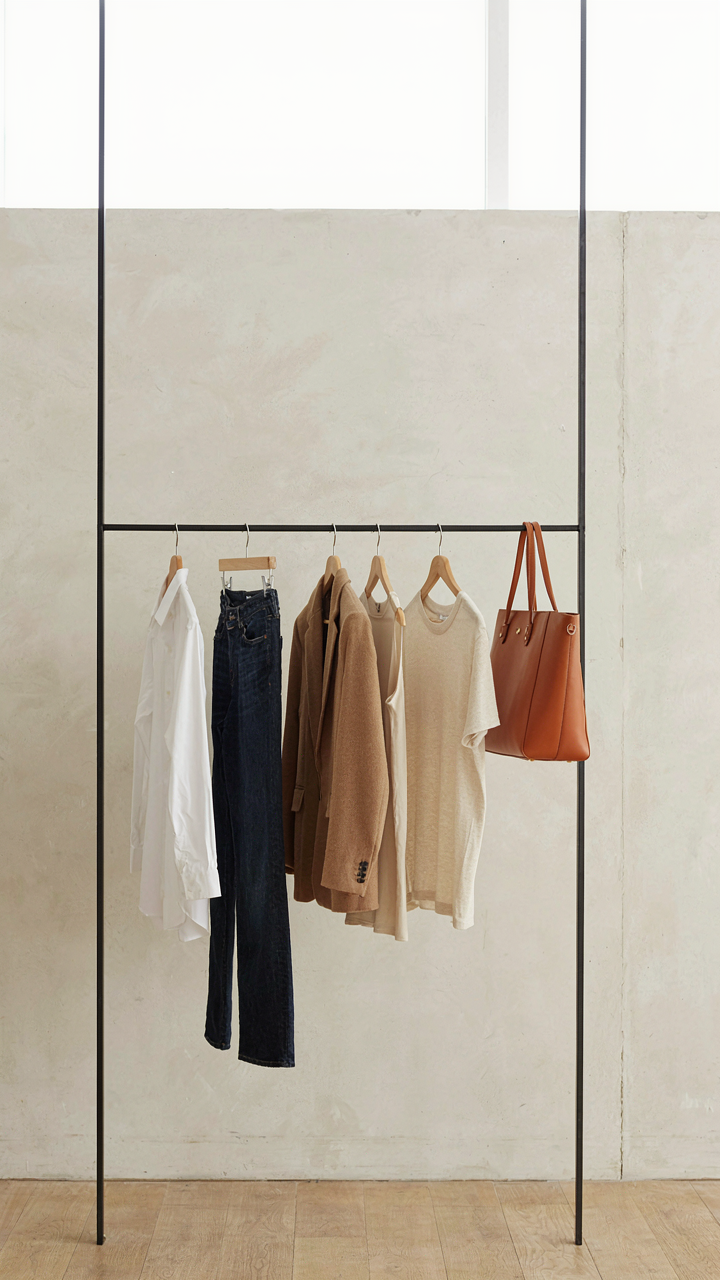
You’re hoping that owning more stuff will solve the problem of not knowing what to wear. It won’t. Economics calls this diminishing returns: you get maximum output from minimal input at the start, then effort increases while results plateau. In outfits, this means five core pieces—a white button-up, dark jeans, a neutral blazer, a quality tee, and one structured bag—generate more wearable combinations than twenty random items. These pieces work in rotation across seasons and anchor every outfit you’ll actually grab.
The reason most women over 40 fail here is they chase trends instead of building systems. A linen shirt in a trending color sits unworn while a cream button-up gets pulled from the closet weekly. Start by choosing fabrics that survive washing: cotton blends, wool, linen. Choose cuts that fit your actual body now, not the body you think you should have. One perfect cream blazer beats three mediocre ones. Your foundation pieces should be boring enough that you forget you own them but useful enough that you use them constantly.
Subtract Until Nothing Else Goes
The common advice says “add neutrals to what you have.” That’s incomplete. You need to audit what you own and remove items that don’t pair with at least three other pieces. If a sweater lives in your closet for six months untouched, it’s not a future outfit waiting to happen. It’s dead weight that makes everything else harder to see.
Quality over quantity isn’t a nice principle, it’s a working mechanism. One heavyweight cotton tee worn twice weekly outlasts four cheaper versions. One good pair of ankle boots handles more seasons and occasions than six pairs that sort of work for one thing each. Start removing before you buy anything new. Your closet should feel small enough to remember what’s in it.
The Confidence Algorithm: Stylish Outfits For Women Over 40 Casual
Stop Seeking Permission
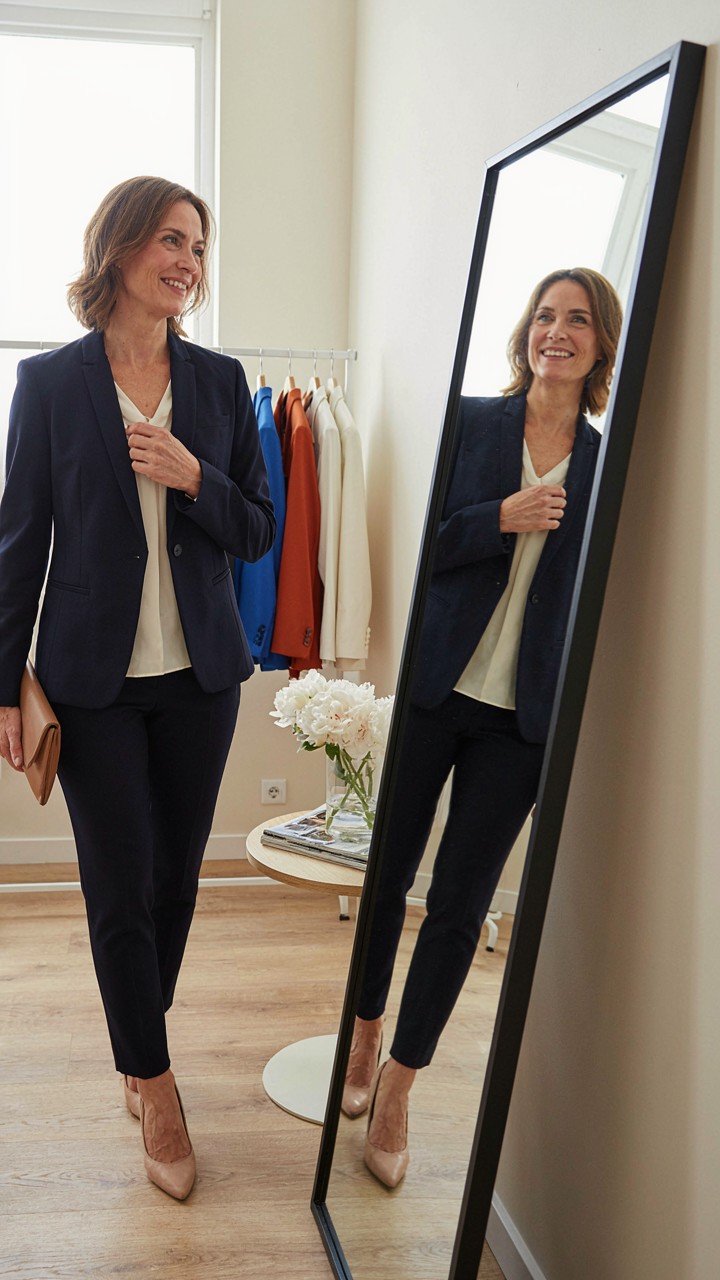
You’re reading this because you suspect other people’s approval matters more than it should, and you want the rules that let you skip that step. Here’s the mechanism: your outfit is a signal system. The moment you design it for external validation, you’ve already lost the internal compass that actually reads as confident. Most women over 40 treat their closet like a apology letter they rewrite daily. Stop.
Your personal aesthetic exists whether you defend it or not. The women who read as modern at 40, 50, 60 aren’t following trend cycles or age-appropriate checklists. They’ve identified three to five non-negotiable elements that reflect how they actually move through the world, then they build around those anchors. A structured blazer. White sneakers. Vintage denim. A silk camisole. Whatever. Once you name them, every other choice becomes easier because you’re not starting from zero each morning.
Dress For The Mirror, Not The Room
Psychology research on behavior change shows that external motivation produces compliance, but internal motivation produces conviction. Your outfit is the same. When you dress to avoid judgment, you’re running from a moving target that shifts with every person you encounter. When you dress for your own daily experience, you have one stable criterion.
The practical shift: before buying anything, ask whether you’d wear it if nobody would ever see the photo. This filters out 90 percent of trend-chasing noise. Your wardrobe becomes smaller, more intentional, and paradoxically more versatile. Outfits for women over 40 that read as modern typically share this quality: they were built for function and preference, not for debate. Wear what works for your life, not what works for the algorithm.
Curating Your Visual Brand: Outfit 40 Edit

Define Your Signature Elements And Palette
You want permission to stop guessing. That’s the real reason you’re here. The mechanism is this: constraint beats choice. Your brain has finite bandwidth. Spending it on daily outfit decisions drains the energy you need for actual work. Define three to four non-negotiable elements that appear in 80% of your outfits. These become your visual fingerprint. A neutral base color (charcoal, navy, cream). A fabric you return to (quality cotton, linen, wool). A silhouette that fits your body without apology. One accent color that signals intentionality, not accident.
Your palette should reflect how you actually live, not how magazines say you should. If you work from home, saturated colors feel performative. If you’re in client meetings, muted tones project stability. If you move between both, a neutral foundation with one bold element solves the code-switching problem in one outfit. The specificity matters. “Neutrals” is useless. “Ivory, charcoal, and camel with touches of forest green” is a working system you can build around for years without rethinking.
Eliminate What Dilutes Your Message
The advice to “curate your closet” misses the real work. Most women over 40 don’t have too many clothes. They have too many conflicting statements. That burgundy blouse from 2015. The trendy pieces from a moment of doubt. The aspirational items you bought for a version of yourself that never showed up. These pieces aren’t neutral. They’re noise. They compete with your actual uniform and create decision fatigue every morning.
Keep only pieces that align with your three to four signature elements. If something doesn’t reinforce your visual brand, it goes. This isn’t minimalism as aesthetic. It’s minimalism as strategy. Remove the pieces that make you second-guess yourself. Your closet should answer the question “what should I wear today” in under three minutes. That speed is worth more than a 200-piece wardrobe that leaves you paralyzed at 7 AM.
The Art Of Intentional Disregard: Dressing With Purpose

Trends Are Noise, Not Direction
You’re worried that ignoring trends means looking outdated. It doesn’t. Here’s the mechanism: trends exist to create artificial scarcity and urgency. Fashion cycles deliberately date clothing so you buy replacements. Once you see this, the power reverses. A woman over 40 who wears a well-fitted blazer in navy or camel every season looks intentional. A woman chasing micro-trends looks reactive. One reads as someone with judgment. The other reads as someone with anxiety.
The real superpower isn’t following trends slowly or following them fast. It’s understanding that your authority as an adult comes from consistency, not novelty. A capsule built on neutral silhouettes and quality basics stays current without looking like you’re desperately keeping up. You build this by asking one question before each purchase: Will I wear this in two years? If the answer relies on trends staying the same, skip it.
Simplicity Reads As Earned Authority
In design theory, the concept of “signal-to-noise ratio” matters: the clearer your message, the more attention it gets. Your outfit is a signal. Clutter drowns it out. Most advice tells women over 40 to add more accessories, more layers, more personality to feel complete. That’s backward. Authority comes from restraint, not accumulation. A woman in a fitted white shirt, dark jeans, and minimal jewelry commands attention because there’s nothing competing for it.
Simplicity also solves a mechanical problem: fewer pieces mean fewer mistakes. When you reduce variables, you increase consistency. Consistency builds trust. People perceive consistency as competence. This isn’t psychology. It’s pattern recognition. Wear the same silhouettes, colors, and quality level repeatedly. Let people recognize you by your clarity, not by your ability to execute a complicated look.
The Real Obstacle Isn’t Your Age; It’s Your Fear Of Dressing For Yourself

You’ve spent decades dressing for other people’s comfort. Your mother’s taste. Your boss’s expectations. Some phantom version of what forty should look like. Stop. Pick one piece you actually love today and wear it without permission. Not tomorrow. Today. The only thing standing between you and outfits for women over 40 that feel modern is you deciding you’re worth dressing for.