

The “Age Appropriate” Fallacy: Why It Cripples Your Style
Where The Myth Actually Started
You want permission to wear what you want without looking foolish. That’s the real reason you’re reading this. The “age appropriate” rule didn’t emerge from fashion logic or body science. It came from mid-20th century marketing departments who needed to segment consumers into profitable buckets. The fashion industry invented age brackets, assigned each one a uniform aesthetic, and then sold women the idea that crossing those lines meant social failure.
Before the 1950s, women simply dressed according to their resources and the occasion. The concept of a hard age cutoff for certain colors, silhouettes, or hemlines didn’t exist in the way we understand it today. Marketing created the anxiety. Once you stop seeing “age appropriate” as law and start seeing it as an old sales tactic, the restriction loses its grip. You’re competing against an invented standard, not a real one.
The Hidden Cost Of Playing It Safe

Economics calls this opportunity cost: what you give up by choosing one path over another. In style, playing it safe means sacrificing the one advantage you actually have at fifty: clarity about what works on your body and what doesn’t. Younger women waste years figuring this out. You already know your proportions, your skin tone, your lifestyle. That’s capital.
When you restrict yourself to “safe” choices, you’re trading real knowledge for imaginary social protection. The irony is brutal: the safe route makes you invisible. A woman of fifty wearing a bold color or a clean, modern silhouette gets noticed because she looks intentional. A woman wearing beige “appropriate” basics disappears into the background. Your refusal to color inside the invented lines is what makes you look stylish. Stop performing caution and start performing competence.

The Unspoken Rules Of Chic Over 50: And How To Break Them

What Fashion Actually Forbids You
You’re worried that looking good at fifty means becoming invisible. Here’s the mechanism: the fashion industry profits from scarcity and fear. It manufactures rules to shrink your options, then sells you solutions within those constraints. Tight silhouettes, exposed skin, bold color, statement jewelry, cropped proportions—these aren’t laws. They’re marketing boundaries designed to make you feel like you’re aging out of relevance instead of into power.
The real rule nobody states is this: fashion over fifty succeeds when you stop borrowing from younger aesthetics and start borrowing from architectural design. Load-bearing walls don’t apologize for their structure. Structure is what makes something stand. Your body has changed. That’s not a flaw to hide. It’s the foundation you build the outfit on.
Strategic Subversion Through Proportion
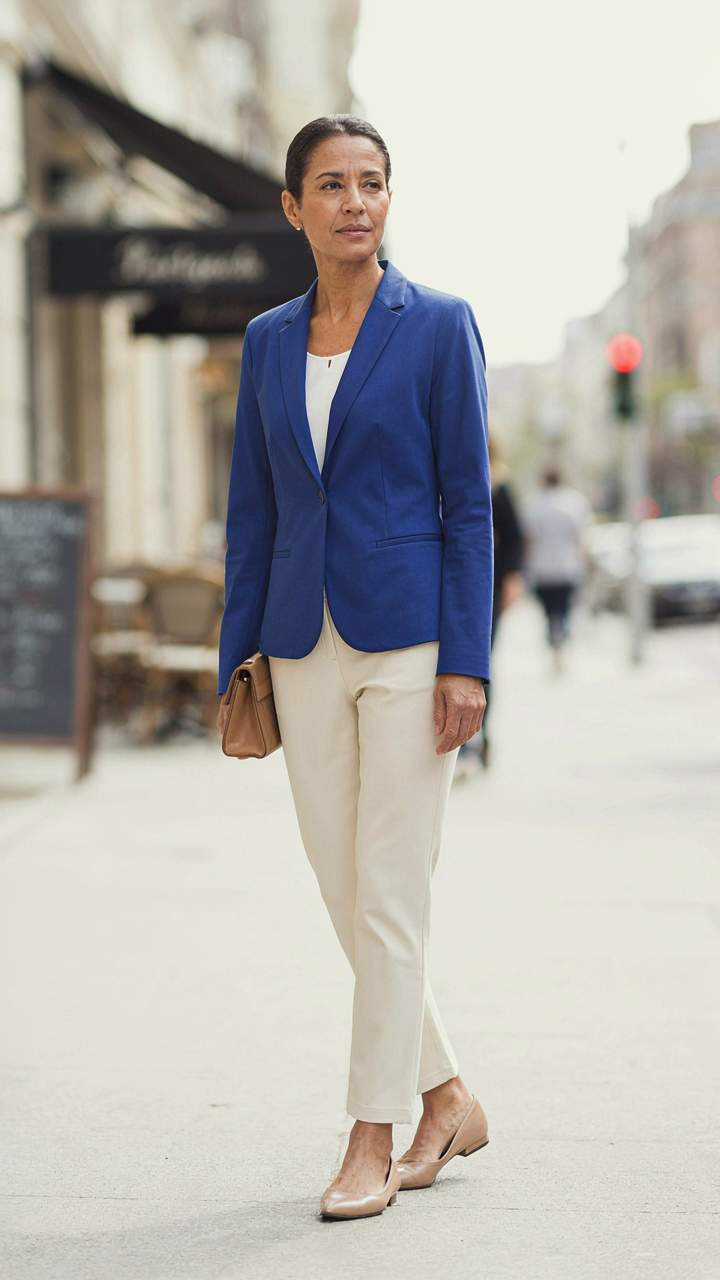
Breaking the rules doesn’t mean rejecting fit. It means changing where the fit lives. Instead of clinging to youth’s silhouettes, women over fifty often find power in what designers call “power suiting”—structured pieces that don’t hide the body but frame it. A well-cut blazer with proper shoulder seaming and a slightly relaxed waist reads as intentional authority, not desperate youth-chasing.
The tactical move is specificity over exposure. Shorter hemlines work if they’re paired with texture, fabric weight, or layering that signals control. A cropped pant with substantial boot or loafer. A sleeveless top layered under architecture, not floating alone. Bold color lands harder than pastels because it demands presence. You’re not following younger women’s logic anymore. You’re writing the syntax.
The Foundation Protocol: Building Your Ageless Wardrobe

Core Pieces That Actually Work
You’re afraid that if you don’t get this right, you’ll look like you’re trying too hard or, worse, invisible. The real mechanism is this: your brain reads outfits as a system, not a collection. One misaligned piece tanks the entire signal. You need anchors that work across contexts because repetition is how confidence reads, not variety.
Start with pieces that layer without bulk and transition across seasons. These aren’t trendy. They’re structural. A well-cut blazer in navy, camel, or charcoal becomes the backbone of twenty different outfits. Tailored trousers in neutral tones work with everything from silk shells to fitted sweaters. A crisp white button-up shirt is neutral technology, not fashion. Dark jeans that fit your actual proportions beat any trend. These pieces work because they solve problems instead of creating them.
- Tailored Blazer: Creates instant polish and structure. Wear it over dresses, with trousers, or layered over knits. The right fit at the shoulder matters more than price.
- Neutral Trousers: Invest in two pairs that fit your leg shape and rise preference. These anchor casual and professional looks without effort.
- White or Cream Button-Up: Works untucked, tucked, tied, or layered. This is your versatility workhorse across seasons and contexts.
- Quality Denim: One pair in a darker wash that fits your body now, not the body you had or want. Denim shows fit flaws faster than any other fabric.
- Fitted Sweater or Knit: Choose a neutral or one accent color you wear often. Fitted matters because oversized reads as hiding, not intentional.
These five pieces generate exponentially more outfits than ten random items. Build around them instead of treating your closet like a thrift store. The system compounds when pieces talk to each other.
The Investment Mindset That Actually Pays
The common advice here is garbage: “buy less, spend more.” That’s true but tells you nothing about the mechanism. Think like economics, not shopping. In economics, you calculate cost-per-use, not sticker price. A 200-dollar blazer worn twice weekly for two years costs you 77 cents per wear. A 40-dollar trendy piece worn four times costs you 10 dollars per wear. The math isn’t subtle.
Quality shows up in seams, weight, and how fabric behaves after five washes. Natural fibers age better than synthetics because the fiber structure stays intact longer. Cotton doesn’t pill. Linen doesn’t stretch out. Wool holds shape. Buy pieces you’ll actually reach for repeatedly, then stop buying. One excellent white cotton shirt beats five mediocre ones. The decision framework is simple: will you wear this sixty times in the next two years, or won’t you? If the answer is no, the price doesn’t matter. If yes, cheap costs more. Spend the money, then stop spending.
Color Theory For Over 50 Outfits: Beyond The Muted Palette

Find Your Undertone First
You’re worried muted colors are mandatory because you’ve absorbed the lie that brightness equals trying too hard. The mechanism is simpler: your skin undertone determines which colors actually make you look alive versus drained. Undertone is the underlying hue beneath your skin surface, separate from depth. It doesn’t change with age. Cool undertones have pink, red, or blue bases. Warm undertones have yellow, golden, or peachy bases. Neutral undertones blend both. Identify yours by checking vein color on your wrist in natural light, or how you react to metals—gold or silver.
Once you know your undertone, you stop guessing. A cool-toned woman in warm colors creates visual noise because the hues fight her skin. Warm-toned women in cool colors look sallow. The payoff is immediate: wear colors aligned to your undertone and you need less makeup, less styling effort, and fewer pieces to build outfits. The outfit does the work instead of fighting against you. Test this by wearing one color that matches your undertone for a full day, then one that opposes it the next day.
Saturation Over Brightness
The common advice says wear muted tones. That’s wrong. Saturation matters more than brightness. Saturation is how much pure pigment a color contains, independent of how light or dark it is. A deeply saturated burgundy reads as intentional and grounded. A pale, washed-out burgundy reads as faded. You can wear rich, dark jewel tones, warm earth tones, or even bold saturated hues—as long as they align with your undertone and you’re not pairing five high-saturation colors in one outfit.
The strategic move is this: lead with one saturated color close to your face, then anchor with neutrals. A woman over 50 in a saturated teal blouse with cream trousers and a camel blazer projects clarity. The same woman in pale blue, pale cream, and pale beige reads as unfinished. Saturation signals intention. It’s why a jewel-toned scarf tied at the neck—worn close to your face—changes the entire outfit’s impact without requiring a closet overhaul.
Texture And Fabric: The Underestimated Language Of Over 50 Womens Fashion

What Fabrics Actually Signal
You care about this because you’ve intuited that fabric choice determines whether an outfit reads as deliberate or default. Here’s the mechanism: texture operates like contrast in visual design. Your eye registers it before conscious thought kicks in. A matte fabric absorbs light and reads as grounded, authoritative, stable. A sheen reflects light and signals movement, vitality, intentionality. Women over 50 who default to one texture category—say, only matte knits—flatten their visual presence. The outfit becomes invisible because it lacks the signal that says “this was chosen.”
The real work happens in fabric weight and hand. Heavier natural fibers like wool, linen, and cotton hold structure without requiring tight fits. They drape over the body rather than clinging to it. Synthetic blends often compress against skin, which exposes rather than conceals. A 50-year-old in quality linen reads as someone with standards. The same woman in polyester reads as someone who ran out of time. The fabric does the talking, not your body.
Layering Depth Without Visual Chaos
The common advice says “mix textures for interest.” That’s lazy. The real principle comes from visual weight equilibrium. One heavy texture anchors the outfit. One medium texture adds dimension. One light texture provides breathing room. Too many competing textures create noise, not sophistication. Most women over 50 mistake texture mixing with throwing on whatever’s in the closet.
Here’s the protocol: start with a structured base like a wool blazer or linen shirt. Add one contrasting texture—a silk camisole under the blazer, or a fine knit over the linen. Close with a third element in a different weight: a leather belt, suede flats, a cotton scarf. This creates visual hierarchy. Your eye moves through the outfit with intention. The outfit reads as composed because it actually is. Texture becomes the system that prevents monotony without causing visual fatigue.
The Accessorization Lever: Applying Military Strategy To 50 Plus Outfits
One Statement Piece Changes Everything
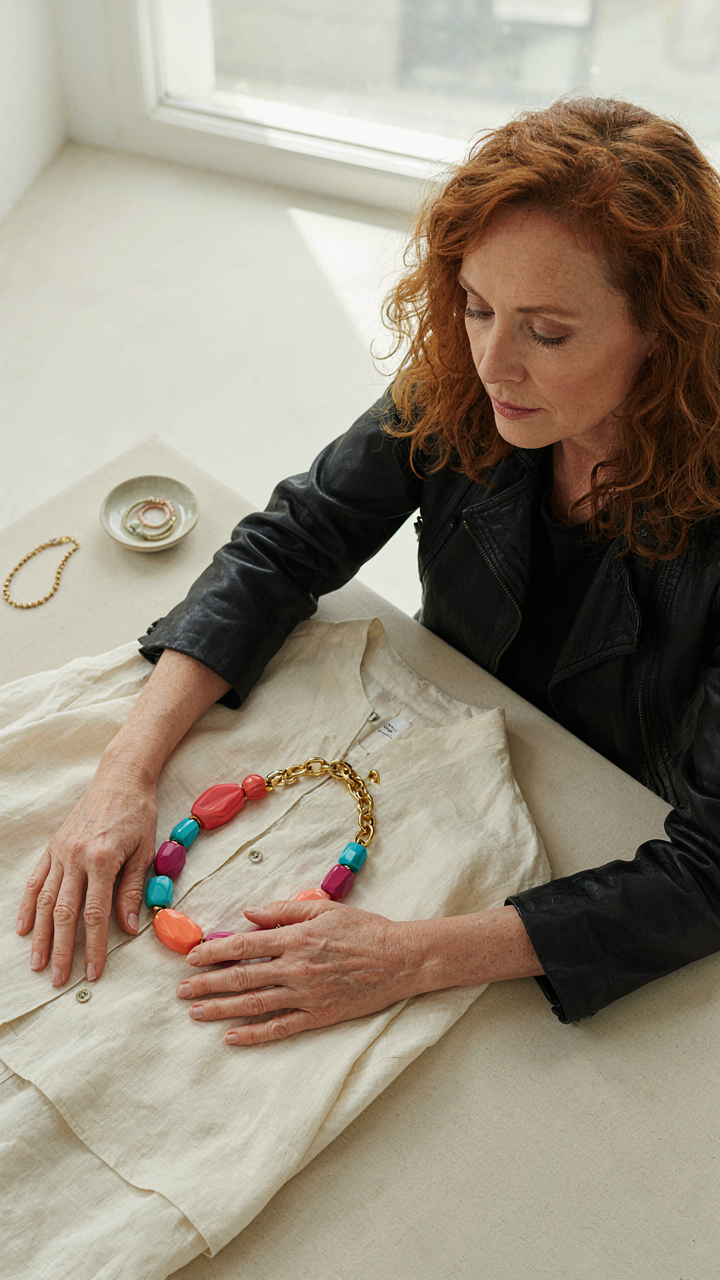
You’re worried that accessories won’t matter enough to justify the mental energy. They do, because accessories are your force multiplier. In military strategy, a force multiplier amplifies the effect of your existing resources without adding proportional cost. A single bold necklace, structured handbag, or pair of shoes doesn’t just complement an outfit—it rewrites how the entire look lands. The base outfit stays the same; the accessory shift changes perception entirely.
This works because your eye catches the accent first. A cream linen shirt and flat-front trousers become a completely different outfit depending on whether you pair them with gold jewelry or silver, a structured tote or a slouch. You’re not building an outfit from scratch each time. You’re anchoring a neutral base, then rotating one standout piece to create six different visual outcomes from three core garments. This is economy of effort masquerading as wardrobe expansion.
Reinforcement Through Complementary Elements
Every statement piece needs one supporting player, not five. The mistake most women make is adding too many secondary accessories, which dilutes the power of the main one. Military doctrine calls this concentration of force—putting your resources where they matter most. If your statement piece is a leather belt in cognac, your watch should be understated and your jewelry minimal. If your necklace commands attention, your bag recedes into neutral territory.
The reinforcement layer works through contrast and balance, not similarity. When you choose a structured handbag as your statement piece, lighter, more delicate jewelry actually strengthens the overall effect by creating visual contrast rather than competing for focus. Shoes operate the same way: if they’re bold, everything else tightens. If shoes are neutral, you have more flexibility elsewhere. The mechanism is simple: one focal point per outfit, one complementary element that supports without competing, everything else invisible.
Fit And Proportion: The Silent Power Of 50 Year Old Outfits

Tailoring As Strategic Advantage
You want tailoring to magically fix everything because admitting your body changed means admitting time moved. Stop. Tailoring isn’t magic. It’s geometry. Architecture uses proportion to create visual stability in structures. Your outfit works the same way. Tailoring removes excess fabric, shortens hems to match your actual leg length, and narrows shoulders when they’ve shifted. This isn’t vanity. It’s the difference between clothes that fight your frame and clothes that work with it.
Most women think tailoring means adding cost. Wrong. Tailoring prevents waste. A fifty dollar shirt that doesn’t fit costs more than a thirty dollar shirt that does because you’ll never wear it. A pair of well-fitted trousers with a hemmed inseam and tapered calves changes how you move through a room. You project less uncertainty. Tailoring isn’t decoration. It’s the structural adjustment that makes proportion read correctly at any age.
Body Architecture, Not Trends
Trends are designed for 25-year-old bodies in controlled lighting. Your body has a different shape now. That’s not a problem to solve. It’s information to use. Ignore what magazines say looks good on “women over 50” and map your actual proportions instead. Do you have a shorter torso or longer legs? Narrower shoulders or a wider midsection? High hip placement or low? These aren’t flaws. They’re your building constraints, and constraint is where real style happens.
Proportion means the relationship between pieces, not the size of pieces. Fitted works better than loose for most women over 50 because loose reads as coverage, which reads as doubt. Oversized cardigans, baggy jeans, and tent dresses don’t hide anything. They signal you’re hiding from something. Instead, choose structured fabrics that hold their shape, hemlines that hit at your narrowest point, and sleeve lengths that end at your wrist bone. The mechanism is this: when each piece has clear proportion to your body, your outfit looks intentional instead of default.
Developing Your Signature Old Woman Outfit: An Iterative Process

Test Before You Commit
You’re afraid of wasting money on clothes that won’t work. That fear is rational, but it stops you from actually building a wardrobe. The mechanism is simple: iteration beats prediction. You cannot think your way to a signature outfit. You have to wear it, move in it, see how it ages, and adjust.
Start with one calculated risk per month instead of overhauling everything at once. Buy a single piece in a neutral color or pattern you’ve never worn. Wear it eight times before deciding if it stays. Document what works—not feelings, but facts. Does it wrinkle? Does the neckline gap? Does it make you reach for it first?
- One neutral base piece: Trousers, a blazer, or a cardigan in black, camel, or grey. Wear it with existing items to see compatibility before expanding.
- One texture experiment: A linen shirt, a structured cotton blend, or a wool knit. Tests how different fabrics move on your body throughout the day.
- One proportion shift: If you wear fitted, try relaxed. If you wear loose, try tailored. One piece changes enough to show you what actually suits your frame.
- One color outside your default: Not a statement color. A shade darker or lighter than what you normally reach for. Tests your assumptions about what works with your skin tone.
- One silhouette variation: A different neckline, sleeve length, or hemline. Reveals which structural details actually make you feel confident versus which ones are habits.
The outfit you think you want isn’t the outfit you’ll actually wear. Real signature style emerges from evidence, not intention.
Build From What Survives
Stop treating your wardrobe like a museum collection. Most advice tells you to buy quality basics and layer forever. That’s incomplete. The real work is tracking which pieces you reach for after three months, which ones collect dust, and why.
Your signature outfit isn’t something you design upfront. It’s a pattern that surfaces after you’ve worn enough combinations to see what your body actually gravitates toward. Keep a simple note of what you wore each day for two weeks. Look for repeats. Those repeats are signals, not accidents. They reveal your actual aesthetic, not your aspiration aesthetic.
The items that survive rotation teach you something specific about your comfort zone, body proportions, and daily life constraints. Those survivors become the anchors. From there, you add complementary pieces with confidence because they’re building on evidence. Your signature outfit is the distilled version of what you’ve already proven works.
The Psychology Of Style: Owning Your Look

Confidence As The Ultimate Accessory
You care about this because you’re afraid that looking good at fifty means playing small, and you’re not willing to do that. Here’s what actually happens: confidence is a signal your nervous system sends through posture, eye contact, and decision-making speed. When you wear something you’ve actually chosen instead of something you think you should wear, your body language shifts. That shift is visible. People respond to it before they respond to the outfit itself.
The common advice says confidence comes first, then style follows. That’s backwards. Style choices that align with who you actually are create the conditions for confidence to emerge. You don’t build confidence by wearing beige and hoping. You build it by making deliberate choices about fit, color, and structure that make you feel anchored in your own body. This is why women over fifty often report feeling more self-assured in their fifties than their thirties: they’ve stopped performing for invisible judges and started dressing for themselves.
Projecting Authority Through Authentic Choices
Authority in clothing comes from consistency and intentionality, not from following a trend you don’t own. Women over fifty have something younger women are still acquiring: a clear sense of what works on their body and why. That clarity reads as authority. It’s not about rigid rules. It’s about eliminating the noise of indecision that shows up as hesitation in how you move through a room.
When you wear a well-fitted blazer in a neutral that complements your skin tone, paired with tailored pants and shoes that ground the outfit, you’re not trying to prove anything. You’re stating a fact: you know yourself. That certainty registers differently than any trend piece could. The mechanism is simple: pick three to five neutral base pieces that fit your frame perfectly, repeat them consistently, then let accessories and tops create variation. This removes daily decision fatigue and sends a constant signal that you’re intentional about how you show up.
The Real Obstacle Isn’t Your Age; It’s Your Adherence To Invisible Rules

You’ve internalized a rulebook nobody gave you. Wear this, avoid that, dress your age, don’t take up space. Outfits for women over 50 aren’t limited by your body or your years. They’re limited by the permission you won’t give yourself. Today, pick one piece that scares you slightly. Wear it. Notice how the world doesn’t collapse. Your age isn’t a style limitation. Your obedience to false rules is.