

The Vertical Axis Deception: Why Common Advice Fails Petite Women Outfits

What Vertical Lines Actually Do
You want to look taller because height signals authority and you’ve absorbed that as fact. Here’s what nobody says plainly: vertical lines don’t lengthen your body. They guide the eye upward, which is different. In visual hierarchy, borrowed from graphic design, a vertical element acts as a directional vector—it tells the viewer’s attention where to move, not how to measure your actual proportions. Stripes, seams, and open cardigans create visual movement that doesn’t add inches to your frame.
The real mechanism is perception displacement. When your eye tracks vertically, it spends less mental energy cataloging horizontal width. A long cardigan over a dress doesn’t make you taller—it reframes how your brain processes the silhouette by creating a continuous line that interrupts where people naturally scan for proportional breaks. This works because viewers assess height partly through segmentation, not measurement. Interrupt the segments, shift the perception.
The Status Trap Embedded In Height Obsession

Perceived height functions as social currency in ways fashion advice refuses to acknowledge. The entire lengthening premise rests on the unstated assumption that you should apologize for your actual proportions. That’s the real problem. Instead of building outfits around what your frame does well—proportion flexibility, dramatic impact with smaller pieces, the ability to wear statement items without visual overwhelm—petite styling gets reduced to a hack.
Stop treating your frame as a problem needing correction. Scale works for you when you recognize it. A petite woman in a fitted blazer and high-waisted trousers creates visual decisiveness that taller frames struggle to achieve with the same formula. Your job isn’t to fake height. Your job is to build outfits where every piece exists at a proportion scale that creates visual intention, not proportion anxiety.

The Architectural Method: Building Proportionality In Petite Outfits For Women

Vertical Lines Create The Illusion Of Height
You want to look taller because you’ve been told shorter bodies are worth less. The real mechanism is this: your eye follows a line, and the longer that line runs unbroken, the longer your frame appears. This is pure visual physics. A vertical seam, stripe, or button placement acts as a sightline. It tells the viewer’s eye where to travel, and traveling vertically makes proportions read differently than they actually are.
The common advice stops at “wear stripes.” That’s incomplete. The stripe width, placement, and contrast all matter. A thin vertical stripe down the center of a fitted shirt works. A thick horizontal stripe kills the effect immediately. The mechanism requires the line to be continuous and high contrast enough to register. A monochrome outfit with a subtle seam does nothing. You need visual friction between the line and the background.
Monochromatic Palettes Erase Visual Breaks
Wearing one color head to toe eliminates the segmentation that splits your frame into smaller pieces. When your top, bottom, and shoes read as one unit, your silhouette extends without interruption. This is not about being boring. This is about math. A petite body wearing black pants, a white top, and black shoes reads as three separate zones. The same person in all black reads as one vertical mass.
The depth of tone matters more than perfection. Charcoal and black technically differ, but the eye merges them into one visual field. Wear them together without hesitation. Navy and teal sit too far apart and create visible breaks. Test the combination in natural light before committing. The protocol is simple: pick your base color, then select everything else within two shades of that base. Shoes, top, bottom, and outerwear should land in the same value family. This removes the visual stops that make you look shorter.
The Illusionist’s Toolkit: Fabrics And Textures For Outfits For Petite

How Fabric Weight Reshapes Your Proportions
You want fabric to do the work so your body doesn’t have to. Borrow a term from physics: density. Heavy fabrics compress visual space. Light fabrics expand it. A petite frame wearing structured wool or denim reads as more grounded and solid. A petite frame in silk charmeuse or rayon reads as more elongated because the fabric moves with momentum rather than stopping at your edges. The trick isn’t buying expensive fabrics. It’s understanding that fabric weight functions as a proportion multiplier.
Lightweight fabrics work best when they drape downward without clinging. Clingy drape pools around your body and shortens your vertical line. Fluid drape creates movement that travels the eye from shoulder to hem in one motion. Choose rayon, linen blends, charmeuse, or cotton voile over jersey or thick knits. Vertical seams in these lighter materials also extend your silhouette faster than horizontal breaks. Test fabric by holding it at arm’s length. If it falls straight and moves, you have a working tool.
Texture As A Vertical Accelerant
Vertical texture patterns beat horizontal ones because human vision tracks repetition directionally. A pinstripe dress moves your eye up and down. A horizontal stripe does the opposite. The mechanism is simple: your eye follows the line orientation embedded in the fabric. Petite women benefit from vertical texture work because it literally guides perception along your longest axis instead of your shortest one.
Apply this to actual fabric choices. Corduroy with vertical wales elongates more than flat cotton twill. Ribbed knits stretch your frame taller than smooth knits. Jacquard with vertical geometric repeats outperforms solid fabrics. Keep texture subtle enough to read from five feet away. Build texture through fabric selection first, pattern second. Wear a ribbed turtleneck under a simple blazer instead of adding busy patterns that break your vertical line.
The Golden Ratio Protocol: Proportions And Scale For Petite Capsule Wardrobe Outfits

Applying The Rule Of Thirds To Outfit Breaks
You want the visual trick that makes you look taller without actually being taller. The mechanism is borrowed from composition in design: negative space. Your body needs visual interruption at specific intervals to create the illusion of length. Most petite women wear outfit breaks randomly, which fragments the frame instead of extending it.
The rule of thirds divides your silhouette into three zones: top, middle, and bottom. Place your visual break at two-thirds down your body, not at the middle. A cropped top with high-waisted bottoms creates break at 65 to 70 percent of your frame, not 50 percent. This trains the eye to move downward longer before stopping. Monochromatic dressing in the top two-thirds, with contrast only in the bottom third, reverses this and shortens you. The break point controls whether you appear elongated or compressed.
Scaling Accessories To Match Your Proportions
Accessories don’t work smaller just because you are. The mistake is thinking “petite” means “miniature everything.” A petite woman wearing a micro bag looks unbalanced because accessories require scale relative to your actual body width and height combined, not just height alone. Oversized jewelry and bags often work better than scaled-down versions because they anchor your proportions without disappearing.
Test accessory scale against your shoulder width, not your height. If your shoulders span 14 to 15 inches, a structured bag wider than 10 inches reads as intentional rather than overwhelming. Chain thickness, pendant drop length, and belt width all follow the same principle: proportion to torso width determines whether an accessory grounds your outfit or swallows it. Measure your actual shoulder width, then size accessories to 70 to 80 percent of that measurement. This gives you the anchor point all other decisions follow.
The Silhouette Strategy: Mastering Shapes For Petite Trendy Outfits

A Line Versus Straight: Body Type Considerations
You want to look taller. That’s the real reason you’re reading this, and you should stop feeling guilty about it. Here’s the mechanism: silhouette shapes create visual weight distribution, which either breaks your frame into sections or extends it. A-line skirts and dresses flare outward from the hip, adding volume at the bottom. Straight cuts maintain consistent width from shoulder to hem. For petite frames, the choice depends on torso-to-leg ratio, not generic body type labels.
A-line silhouettes work when you have a longer torso relative to leg length because the flare draws the eye horizontally across the widest point, then down to the hemline. Straight cuts work when you have proportionally longer legs or when worn with vertical elements like long cardigans that emphasize height. The trap most petite women fall into is choosing A-line because fashion media treats it as universally flattering. It’s not. Straight silhouettes lengthen your frame when paired correctly, which beats the visual shortening that happens when an A-line cuts you off at the wrong spot.
Tailoring For Precision, Not Just Fit
Everyone says “get things tailored.” That’s incomplete advice that wastes money. Tailoring serves one function for petite women: removing excess fabric that interrupts sight lines. Standard sizing creates breaks in your silhouette at the knee, hip, or shoulder that chop your frame into smaller pieces. A tailor doesn’t just take things in. A tailor repositions seams, adjusts hem heights to sit at your natural proportions, and ensures the garment hits your body at strategic points that extend, not truncate, your lines.
The precision work happens at three points: shoulder seams, hemlines, and waistband placement. Shoulder seams should sit directly on your shoulder bone, not slope down your arm. Hemlines should hit at your natural joints—the ankle, not the middle of your shin. Waistbands should land where your waist actually is, not two inches below it. These are not cosmetic fixes. They’re architectural corrections that determine whether a garment adds or subtracts from your perceived height. Without precision tailoring, even well-chosen silhouettes fail to do their job.
The Kinetic Energy Principle: Movement In Feminine Petite Outfits

How Fabric Flow Creates Vertical Lines
You want to look taller without constantly thinking about it. The mechanism is physics: fabric drape creates the illusion of length because your eye tracks the vertical path the material takes, not the body underneath. Heavy fabrics pool and anchor downward. Lightweight fabrics move with air currents and guide the eye upward through continuous lines. Weight distribution in fabric determines perceived proportion on petite frames.
Fluid materials like silk charmeuse, rayon, and linen blends generate vertical momentum naturally. These fabrics don’t cling to curves or bunch at the hip, which cuts the body in half. Instead, they flow from shoulder to hem in one uninterrupted channel. Your petite frame needs garments that don’t fight gravity. Structured fabrics create horizontal breaks. Drapey fabrics eliminate them.
Movement That Extends Your Perceived Height
Garments designed to move with your body create an optical extension that static clothing cannot match. Physics calls this momentum carryover. Applied to petite dressing, it means selecting pieces that continue motion beyond your actual frame. A long cardigan that swings with your stride, a slip dress that shifts slightly with each step, or trousers with excess length at the hem all create the visual effect of height through kinetic energy rather than stillness.
The amateur advice says just wear vertical stripes and call it a day. That’s incomplete. Movement works because it eliminates visual stopping points. A hem that grazes the ankle but flows slightly extends the line past where your body actually ends. Layered pieces that separate and move independently build vertical stacks instead of horizontal blocks. Test this: stand in a fitted dress, then move in a bias-cut slip dress. The second reads taller because the fabric itself lengthens the silhouette through motion.
The Unconventional Cut: Redefining Outfits For Short Petite Women

Hemlines That Break The Rule Book
You want permission to ignore what you’ve been told works. The real mechanism here is simple: most petite styling advice tells you to keep hemlines short because it “won’t overwhelm your frame.” That’s incomplete logic. Hemline length matters less than proportion to your actual leg length and where the cut lands on your body. A midi that hits mid-calf can elongate your frame if it creates visual continuity from hip to floor. A cropped pant at the ankle breaks your leg line and shortens you. The cut location trumps the category.
Standard petite fashion rules miss this entirely. They focus on avoiding long hemlines as a blanket rule instead of measuring where fabric lands relative to your proportions. Here are the hemlines that actually work when positioned correctly:
- Maxi skirts with a high waistband: Positioned at your natural waist, a maxi creates an unbroken line from torso to floor, extending your silhouette vertically. The high placement is non-negotiable.
- Cropped trousers at the true ankle: Not mid-shin, not above the ankle bone. The break should sit exactly where your ankle meets your foot to avoid chopping your leg.
- Midi dresses that graze mid-calf: Lands below the widest part of your calf, creating a clean vertical column. Pair with pointed-toe shoes to maintain the line.
- Full-length pants with minimal break: A slight kiss of fabric on your shoe creates length without bunching or pooling. Tailoring here is mandatory, not optional.
- Asymmetrical hems that hit one leg longer: Creates movement and visual interest while the longer side extends your line. Works best with fitted silhouettes above the hip.
The tactic is deliberate measurement, not category avoidance. Before buying, know your inseam and where each hem lands on your actual body. The outfit elongates you through exact placement, not through following a petite fashion script.
Asymmetrical Designs For Dynamic Elongation
Asymmetrical cuts work through the principle of visual disruption. In design theory, asymmetry forces the eye to follow a path rather than settle on a fixed point. Your frame length benefit comes from that eye movement traveling vertically instead of stopping at horizontal breaks. A one-shoulder top that drops longer on the right side creates a diagonal line. A wrap dress with an uneven hem guides the viewer’s gaze down the body. The mechanism is motion, not balance.
Most petite women skip asymmetrical pieces because they fear adding complexity to a small frame. Wrong. Asymmetry solves the compression problem that symmetrical cuts create. When both sides match, your proportions read as compact and closed. When one side extends differently than the other, it introduces length into the visual story. Pair asymmetrical tops with straight-leg or wide-leg bottoms to amplify the effect. Avoid pairing asymmetry with asymmetry, which fractures the line. One point of visual disruption elongates you. Two points confuse the eye and shorten your read.
The Accessory Apex: Elevating Your Small Frame With Outfit Petite Details
Heels And Footwear That Actually Work
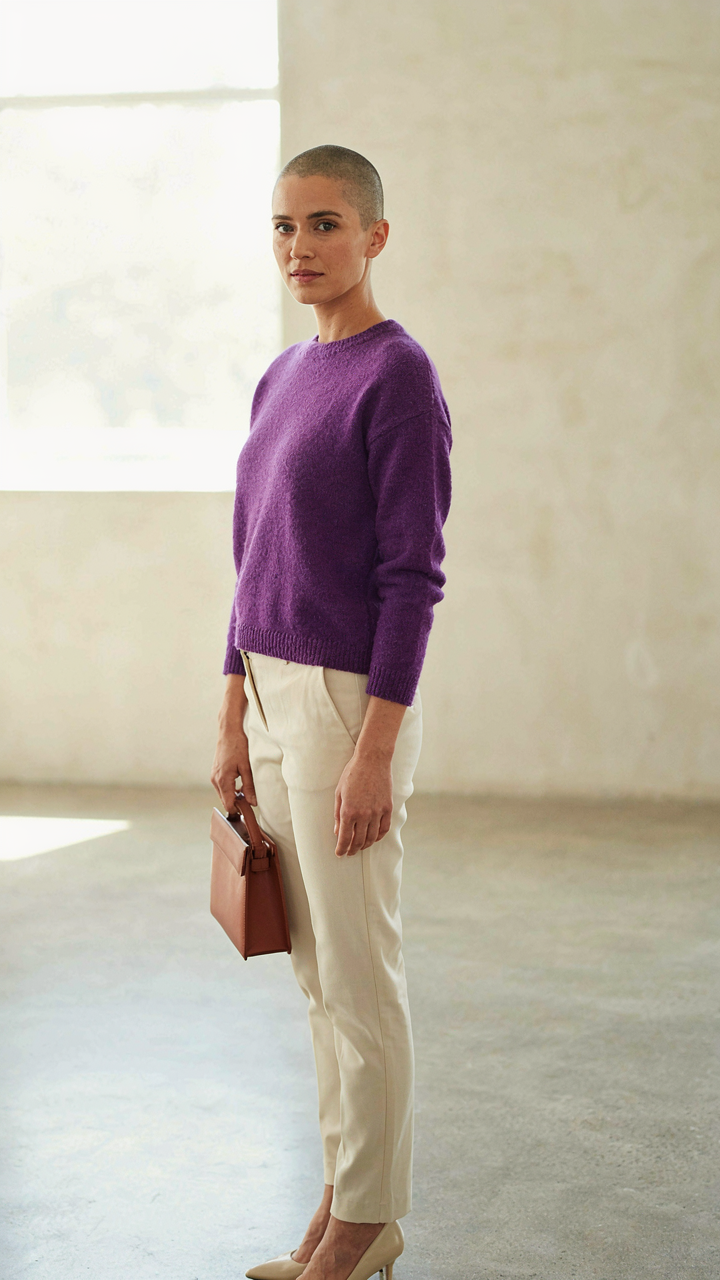
You want heels to make you taller. That’s the real reason you’re reading this. Here’s what actually happens: heels create optical illusion through angle and proportion, not magic. A pointed toe extends the line of your leg visually. A thin heel appears to lengthen the leg more than a chunky one because it creates less visual break between shoe and calf. The shoe color matching your skin tone or pants eliminates a horizontal line that cuts your leg in half.
Stilettos and kitten heels both work, but for different reasons. Stilettos create maximum leg extension through extreme angle. Kitten heels work because they’re lower visual mass while still tilting your frame upward. Block heels, despite trends, create a visual pause. They read as separate objects on your feet rather than continuations of your leg. Pointed-toe flats outperform round-toe versions by the same logic. The mechanism is proportion and visual continuity, not heel height alone.
Scale Your Metals And Bags To Match Your Frame
Jewelry doesn’t need to be tiny just because you are. The opposite rule applies: scale your jewelry to your bone structure, not your height. Oversized chunky jewelry on a petite frame creates visual weight that pulls you downward. A structured, proportional piece reads as intentional rather than overwhelming. Delicate jewelry vanishes against your smaller frame and reads as nervous rather than refined.
Bags follow identical logic. A tiny crossbody on a petite woman doesn’t elongate. It reinforces smallness. A structured, medium-sized bag creates visual balance and reads as confident. Keep bag length between waist and hip, never lower. Longer bags stretch proportions and ground you to the earth. A structured silhouette with clean lines creates vertical visual momentum. Match your metal tones to your undertone consistently to avoid visual fragmentation that shortens your perceived frame.
The Mindset Shift: Beyond The Garment For Outfit Petite
Confidence As The Ultimate Elongator
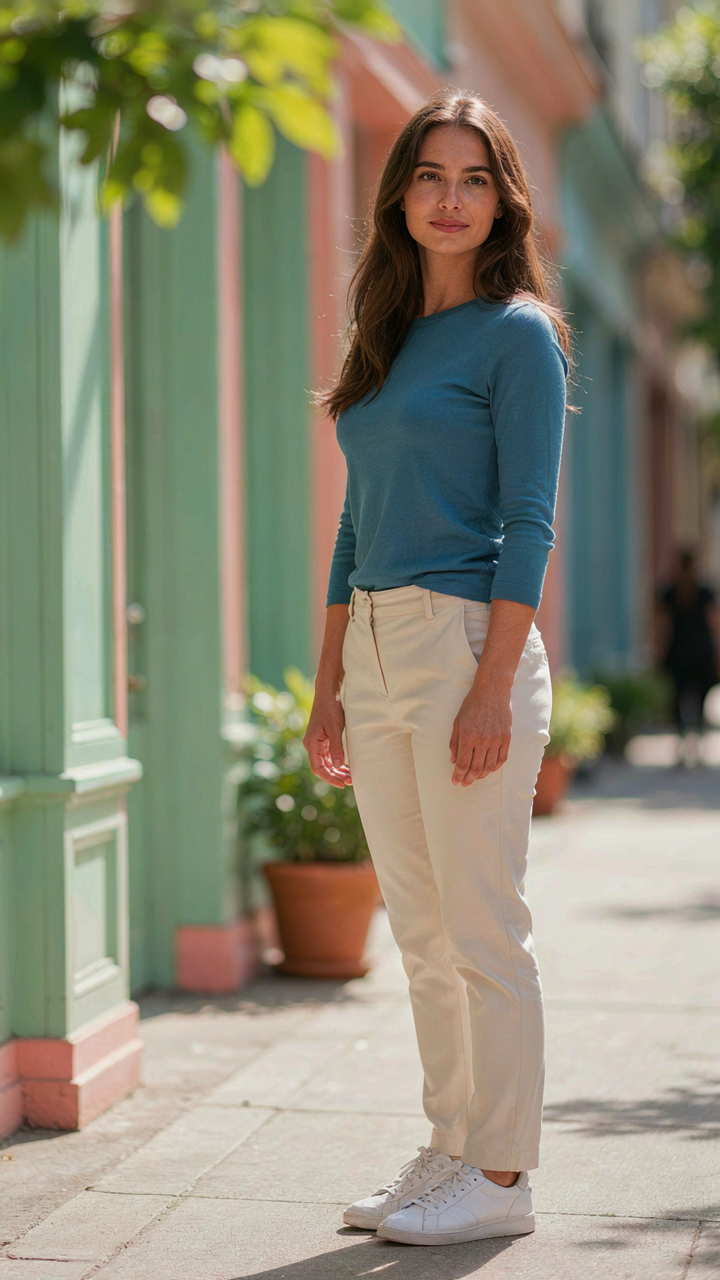
You’re reading this because you believe the right outfit can fix what you see as a problem. Here’s the mechanism: confidence operates like posture in physics. It changes your vertical axis. When you stand tall and move deliberately, observers perceive more height because you’re not collapsing inward. Doubt collapses you. Certainty extends you. The garment is secondary to how you inhabit it.
Most advice stops at “wear vertical lines” and calls it done. That’s incomplete. A petite woman in vertical stripes who walks hunched and avoids eye contact reads smaller than a petite woman in a simple crew neck who moves with purpose. The outfit amplifies what’s already there. If what’s there is apologetic energy, no fabric choice compensates. Wear what you choose without negotiation, and you’ve already won half the battle before the mirror.
Personal Style Philosophy Over Trend Chasing
Building a personal style philosophy means deciding what you stand for visually, not what fits the trend cycle. Petite women who chase trends often chase them in full-sized versions, which compounds the proportion problem. Instead, identify three non-negotiable elements that feel true to you: a silhouette category, a color story, a fit standard. These become your filter.
This filter eliminates decision paralysis and prevents the dopamine hit of a purchase from overriding what actually works on your frame. A personal philosophy forces you to ask: does this item reinforce my visual identity or distract from it? Does it fit my actual proportions or demand alterations I’ll never make? The answer determines whether it enters your closet or stays on the rack.
Your Perceived Shortness Isn’t A Flaw, It’s An Unoptimized Leverage Point

Most petite women spend energy fighting their frame instead of weaponizing it. You move faster through rooms. Your proportions compress drama into impact. Monochromatic fits, vertical lines, and fitted silhouettes don’t elongate you because longer exists—they work because they eliminate visual noise your frame doesn’t need. Stop dressing like you’re apologizing for your size. Pick one outfit formula that works and wear it until you forget you ever thought about this. Confidence reads taller than any hem ever will.