
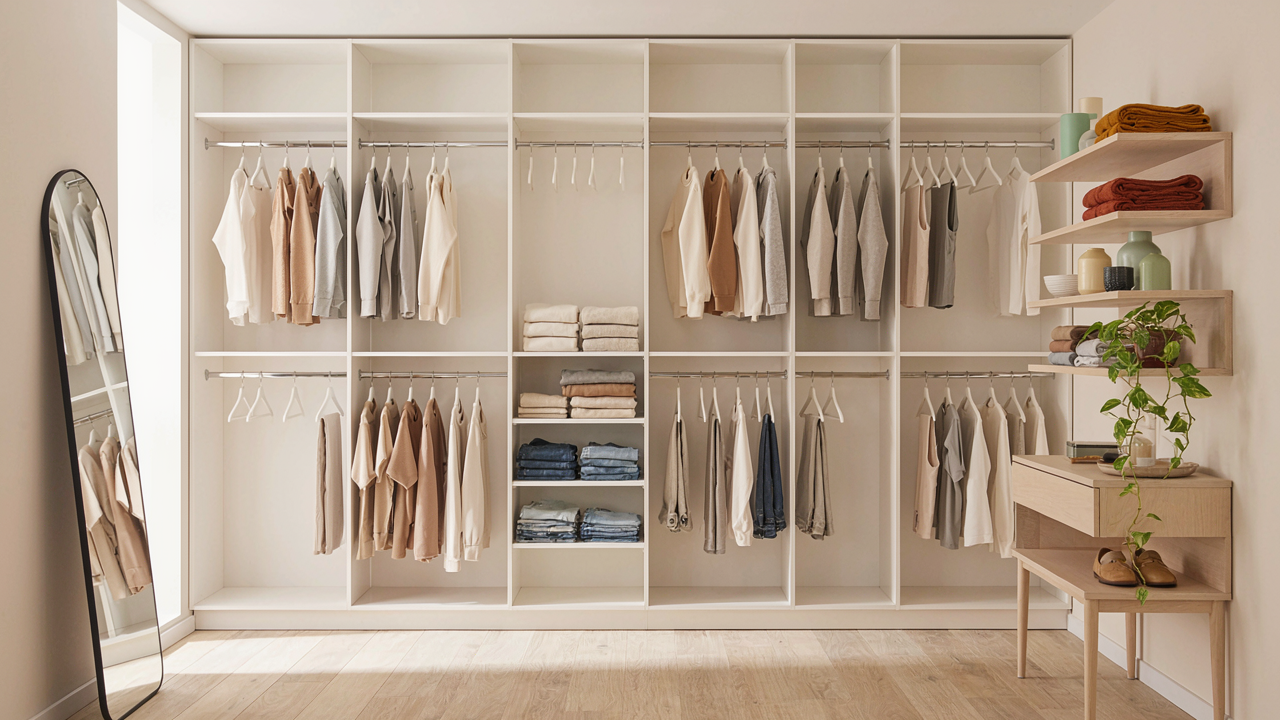
The Illusion Of Effortless Simple Outfits: Why Most Advice Fails

Why Generic Outfit Tips Miss The Target
You care about this because you think speed equals intelligence. It doesn’t. The real mechanism at work is constraint. Most outfit advice treats getting dressed like a math problem when it’s actually an inventory problem. Standard guidance tells you to buy neutral colors, stick to three items, or follow some arbitrary rule. None of that addresses why you actually struggle: you have too many options that don’t work together, and you haven’t built a system that eliminates decisions before you open your closet.
The gap between advice and results happens because people prescribe solutions without diagnosing the root failure. They say “buy basics” or “invest in quality pieces” without acknowledging that most people don’t know which basics actually coordinate with their body and lifestyle. You end up with a closet full of neutral pieces that still don’t form reliable combinations. The problem isn’t your taste. It’s the absence of a deliberate filtering mechanism that removes incompatible pieces before they take up space.
The Status Play Hidden In Speed

Speed isn’t actually the goal. Efficiency is the cover story. What you’re really after is the signal that comes with looking composed without appearing to try. This operates like signaling in economics: the outfit formula itself becomes proof of competence, not just a practical solution. When someone gets dressed in five minutes and looks intentional, observers don’t see speed. They see control. They see someone with standards and boundaries.
Most people chase outfit formulas to save time, but they stay with them because of what they communicate. A repeated formula proves you’ve made decisions once and stick to them. That reads as confidence. The real mechanism isn’t time saved. It’s the social proof embedded in consistency. When you wear the same formula repeatedly, you stop negotiating with yourself. That non-negotiation is the actual valuable part. Start by identifying which outfit combinations generate the response you want, not which ones take the least time to assemble.

The “Wardrobe Basics” Paradox: More Choices, Not Less

When Basics Become The Problem
You think accumulating basics solves the problem. It doesn’t. You’re actually terrified that one wrong outfit choice will expose you, so you keep buying the “safe” pieces everyone recommends. This creates the opposite effect: more items means more combinations, which means more decisions before 7 AM. Decision fatigue from basics is real cognitive load, not a feeling. Your brain burns through willpower matching a neutral sweater with neutral pants when the options feel infinite and interchangeable. The paradox is that “foundational” pieces marketed as simplifiers become complexity engines when you own too many of them without intentional constraint.
The mechanism is supply exceeding structure. Every basic tee, neutral trouser, and versatile jacket you add multiplies the decision tree exponentially. You need fewer basics with stricter rules about what counts as basic, not more basics with vague promises they “go with everything.” Most people own eight neutral tops when they need three. The excess creates the very friction it was meant to eliminate.
The Generic Recommendation Trap
Everyone tells you the same thing: buy quality basics, mix and match, build a capsule. This advice is incomplete and it makes you feel worse. The problem isn’t that basics don’t work. The problem is that nobody explains the actual filtering mechanism that separates a functional basic from a decorative one masquerading as practical. A basic isn’t basic because it’s neutral or expensive. A basic is basic only if it creates predictable visual outcomes when combined with other items in your actual wardrobe. Most people’s basics fail this test because they were chosen in isolation, not as a system.
Generic recommendations skip the hard part: defining what “goes with” actually means for your body, your lifestyle, and your actual color palette. Without those constraints, you end up with a pile of technically versatile pieces that create decision friction instead of removing it. Stop collecting basics. Start eliminating the pieces that don’t reliably pair with at least four other items you actually wear.
The Minimalist Wardrobe Protocol: Culling For Clarity

Strip Everything That Doesn’t Earn Its Place
You want permission to keep things. That’s the real question here. But permission from who? Yourself? You already gave it by not throwing them out. The mechanism is simple: every item in your closet is a decision tax. Each piece forces you to evaluate it every time you get dressed. Most people keep clothes out of guilt, not utility. The first step is brutal honesty. Go through everything. Touch each piece. Ask one question: does this serve my stated purpose? If the answer isn’t immediate yes, it goes.
The clothes that stay are the ones that function across multiple outfit combinations. This eliminates variance. You’re not keeping sentimental pieces or “aspirational” sizes. You’re not holding onto trends that peaked two years ago. You’re keeping the uniform components that actually get worn. This sounds harsh because it is. But the payoff is real: less cognitive load, faster decisions, zero buyer’s remorse echoing from your closet every morning. Everything remaining has to justify its existence by solving a specific problem in your formula.
The Economics Of One In One Out
Economics calls this equilibrium. In wardrobe management, it’s your friction point. When you buy something new, something old leaves immediately. No exceptions. This creates a natural governor on accumulation. Most advice says “one-in, one-out prevents excess.” That’s incomplete. The real mechanism is that it forces intentionality about every single purchase. You can’t add without subtracting. You can’t lie to yourself about needing more. The rule transforms shopping from impulse into triage.
This principle works because it removes the emotional buffer zone. You can’t buy the new jacket and “think about” what to remove later. You decide right now what gets displaced. Often, you realize the new item isn’t worth sacrificing the old one. That hesitation is the system working. The pieces that stay earn their position because you actively chose them over something else. You end up with fewer clothes, higher utility rate per garment, and outfit formulas that actually function instead of collapse under 47 unworn options.
Building Your Personal “Outfit Formula” Algorithm

Identify What Actually Stays The Same
You want this system to work because you’re tired of the mental tax. Here’s what nobody says: most of your closet is noise. You need to find the 20% that compounds. Start by naming your constants—the pieces that don’t change regardless of context. These are your anchors. A constant isn’t a trend. It’s a material, a silhouette, a color range, or a fit that aligns with your body and your actual life. Dark denim. Neutral base layers. A specific shoe profile. Write these down. They become your filter.
Your variables are everything else: the top, the jacket, the accessory that shifts the formula. Think of constants like operating system code—they run in the background and rarely need updating. Variables are the applications you swap based on the day’s demand. Most people reverse this. They fixate on variables (the flashy piece) and ignore constants (the foundation that makes the flashy piece work). Identify at least three constants before you build anything else. These form the skeleton. Everything hangs from them.
Map Your Decision Sequence For Speed
Decision trees come from computer science and logic, but your closet operates on the same principle: eliminate options at each branch until one path remains. You’re not choosing from thirty combinations. You’re answering a sequence of yes-or-no questions that narrows it down to two or three viable outfits. Start with context: where are you going? That question eliminates 60% of your options immediately. Formal event versus casual errands require different branches. Your formula branches there first.
The second branch narrows by season or weather. Then by the social stakes of the event. Then by what’s clean. Each decision point removes options, not adds them. Most people approach this backwards: they start with infinite possibilities and try to narrow down. You start with your constants and ask what variable works today. The sequence matters more than the pieces. Document your decision tree on paper or digital notes. Make it stupid simple: “If meeting clients, then tailored base plus neutral jacket, period.” Execute the sequence the same way every time. Speed comes from removing choice, not having better options.
The Capsule Wardrobe As A Strategic Asset, Not A Limitation

Build Redundancy Into Your System
You want the capsule wardrobe to feel like abundance, not constraint. That’s the real motive here. Military strategy calls this “redundancy”—the deliberate duplication of critical functions so a single failure doesn’t collapse the operation. Your outfit formula works the same way. You’re not building a wardrobe with one of everything. You’re building a wardrobe where multiple pieces solve the same problem from different angles.
A neutral base layer works with five different tops. A versatile pant works with eight outfits. This isn’t minimalism. It’s leverage. The repetition isn’t boring because you’re not wearing the same outfit—you’re wearing different combinations of the same reliable components. Each piece earns its spot by solving more than one equation.
Uniformity Compounds Over Time
Most advice on capsule wardrobes misses the actual mechanism. People think uniformity means wearing the same thing every day. Wrong. Uniformity means establishing constraints that force compatibility. Steve Jobs wore the same basic uniform not to seem profound, but to eliminate a decision bottleneck. Your capsule wardrobe does the same thing at scale.
When every piece works with every other piece, you stop evaluating fit, color theory, or trend alignment every morning. The formula is already set. You pick two to three items and you’re dressed. The time saved isn’t marginal. Over a year, you recover weeks. What matters is this: establish a color palette first, then build pieces that only work within it. This creates forced compatibility, not perceived limitation.
Optimizing For “What To Wear”: The Daily Decision Bypass

Pre Compute Your Outfits For Actual Scenarios
You want this section because you’re losing hours to decision fatigue while pretending you’re just being thoughtful. The real mechanism is simple: your brain treats each morning as a novel problem, burning willpower on a solved equation. Pre-computation means you’ve already decided before the moment arrives. You identify the three to five contexts you actually inhabit—office days, client meetings, casual Fridays, weekend errands—then build one outfit per context. No variations. No “what if.” This eliminates the decision loop entirely.
The math is straightforward. If you get dressed five days a week and spend fifteen minutes deciding, you’ve burned 1,200 minutes annually on choices you could have settled months ago. Pre-computed outfits don’t require genius or aesthetic risk. They require specificity about where you actually go and what those spaces demand. Write down your week. Count the repeating scenarios. Assign one tested outfit to each. The outfit doesn’t change until it stops working—not because you got bored, but because the context changed.
Your Visual Capsule Outfit Index
Intention without documentation fails. A visual index is your capsule outfits rendered in a format you can reference in thirty seconds, without thinking. Most people keep this in their head and rebuild the logic weekly. Store it differently: a photo gallery, a printed sheet taped inside your closet, or a note with links to each piece. The format matters less than consistency and speed.
- Office Standard: Photograph your complete outfit laid flat. Include shoes, layers, and accessories in exact combination. Tag it with the day it rotates (e.g., Monday, Thursday).
- Client Facing: Document one outfit that reads authoritative in your industry without requiring thought. Store the photo with notes on which client types trigger its use.
- Casual Weekend: Create one reliable outfit for running errands that fits your actual lifestyle, not an aspirational one. Include the shoe type that works for your local terrain.
- Seasonal Swap: Maintain separate indexes for summer and winter. Store them separately so you only reference the active season. Rotate them on the same calendar date each year.
- Emergency Option: Keep one outfit ready that works across multiple contexts when you haven’t done laundry or planned ahead. This is your fallback, not your default.
Referencing a visual index removes interpretation. You see the outfit, not a mental template you’ll alter based on mood. Print these photos or sync them to a folder you open on your phone before getting dressed. The decision transforms from “what should I wear” to “which scenario am I in today,” which takes five seconds instead of fifteen minutes. Build this index once, update it when pieces wear out, and stop rebuilding your outfit logic every seven days.
Beyond “Fashion 101”: Cultivating Intentional Style

Trends Are Noise For Your Closet
You follow trends because you’re afraid of being left behind, and that fear costs you money and time every season. Trends are signals of what the market is pushing, not signals of what works for your body, your life, or your goals. Most people mistake trend adoption for personal style. They’re opposites. A trend is consensus. Style is constraint.
The mechanism here is simple: trends force you to rebuild. Every cycle, new silhouettes, colors, and textures become “relevant,” which makes your existing pieces feel dated faster than they actually wear out. This rotation benefits retailers, not you. A real outfit formula doesn’t care what Pinterest decided this quarter. It works because it’s built on your body type, your actual schedule, and the impression you need to make. That consistency compounds over time. Trendless dressing is just another name for reliability.
Quality Compounds Like Capital
Buying fewer pieces that last longer is economics applied to fabric. Durability isn’t sentiment. It’s math. A shirt that costs three times more but survives fifty washes instead of fifteen cuts your per-wear cost by two-thirds. That’s not philosophy. That’s numbers.
Quality pieces anchor formulas because they don’t degrade visually or structurally. A well-made neutral in natural fiber (linen, wool, cotton, silk) looks better after a year than a cheap equivalent looks after two months. You wear better pieces more often because they hold their shape and color. This creates consistency in your formula without forcing you to think about it. Start identifying one high-quality piece per core category (neutral top, neutral bottom, layer) and build formulas around those anchors instead of rotating through disposable items.
The Feedback Loop: Refining Your Outfit Formulas

Audit Your Wardrobe For Performance
You want to know you’re not wasting money on pieces that sit in the dark. Here’s the mechanism: most people own clothes they never wear because they never tracked which pieces actually work. Treat your wardrobe like inventory. Every 30 days, note which items from your formulas you grabbed most. This data reveals the gap between what you think works and what actually does. Pieces that sit unused signal a formula problem, not a character flaw.
Real auditing means moving beyond “I like this” to “this solved a problem.” Track one variable: how often each piece appears in completed outfits over a month. Underperforming items either don’t fit your lifestyle, clash with your color story, or duplicate function better handled by another piece. Remove them or redesign the formula around them. This isn’t decluttering philosophy. It’s identifying which formulas work in practice and which exist only in theory.
Adapt Based On Real World Conditions
The common advice here is wrong: people think they need to feel inspired to change their formulas. That’s backward. Your formulas evolve when reality forces them to, not when you want them to. Feedback comes from friction. If you’re reaching for the same three shirts because the formula doesn’t include enough casual pieces, the formula failed, not your discipline. Update it immediately. If weather changes your life three months a year, your formulas need seasonal variants built in before those months arrive.
Adaptation means measuring outcomes, not intentions. Did the formula work this week? Did you get dressed faster? Did you feel equipped for the day? If no to any, identify which variable failed: wrong color combos, insufficient layering options, missing occasion coverage, or pieces that need better real estate in your closet. Make one surgical change per formula, use it for two weeks, then reassess. This is iteration, not reinvention. Each cycle refines what works until your outfit formula becomes automatic.
Your True Style Impediment Isn’t Your Closet; It’s Your Indecision

You already own enough clothes. The problem is you treat every morning like a blank canvas when you should treat it like a constraint. Outfit formulas work because they eliminate the noise between you and your closet. Pick three formulas today. Test them for a week. Your brain will stop spinning. You won’t suddenly have better clothes. You’ll just stop wasting the mental real estate that matters on decisions that don’t.