

The Deconstruction Imperative: Why Unraveling Precedes Reinvention

Surgical Seam Ripping, Not Hacking
You’re tempted to grab scissors because you want to skip ahead to the “creative” part. That impulse costs you material. Seam ripping is a surgical procedure borrowed from textile engineering, where precision determines yield. One stray cut through yarn destroys sections you could have salvaged. A seam ripper removes stitches without compromising fibers. Work parallel to the seam, not across it. Lift threads incrementally. The goal is clean edges and intact fabric panels.
Most guides gloss over this because it sounds boring. It’s not boring. It’s the difference between working with ten usable inches of fabric or six. A stretched sweater already lost structural integrity. Your job is to extract whatever hasn’t been compromised. Speed through this stage and you’re just creating smaller scraps of a failed project.
Extracting Usable Length And Fiber Stock

Stretched knits retain value in sections. The collar, cuffs, and ribbed edges hold elasticity longer than the body does. Identify where the damage is localized. Arms often stretch first. The torso body section might remain stable. Your inventory determines what refashion makes sense.
Document each usable section by length and condition. A 24-inch-long sleeve section works for a headband or a wrap. Ribbed edges become waistbands or new cuffs on reimagined pieces. Harvest systematically. Pile usable scraps separately from damaged ones. You’re building a component library, not a pile of yarn. This phase takes thirty minutes. Rushing it forces bad design decisions later.

Beyond The Patch: Upcycled Sweaters Ideas For Structural Transformation
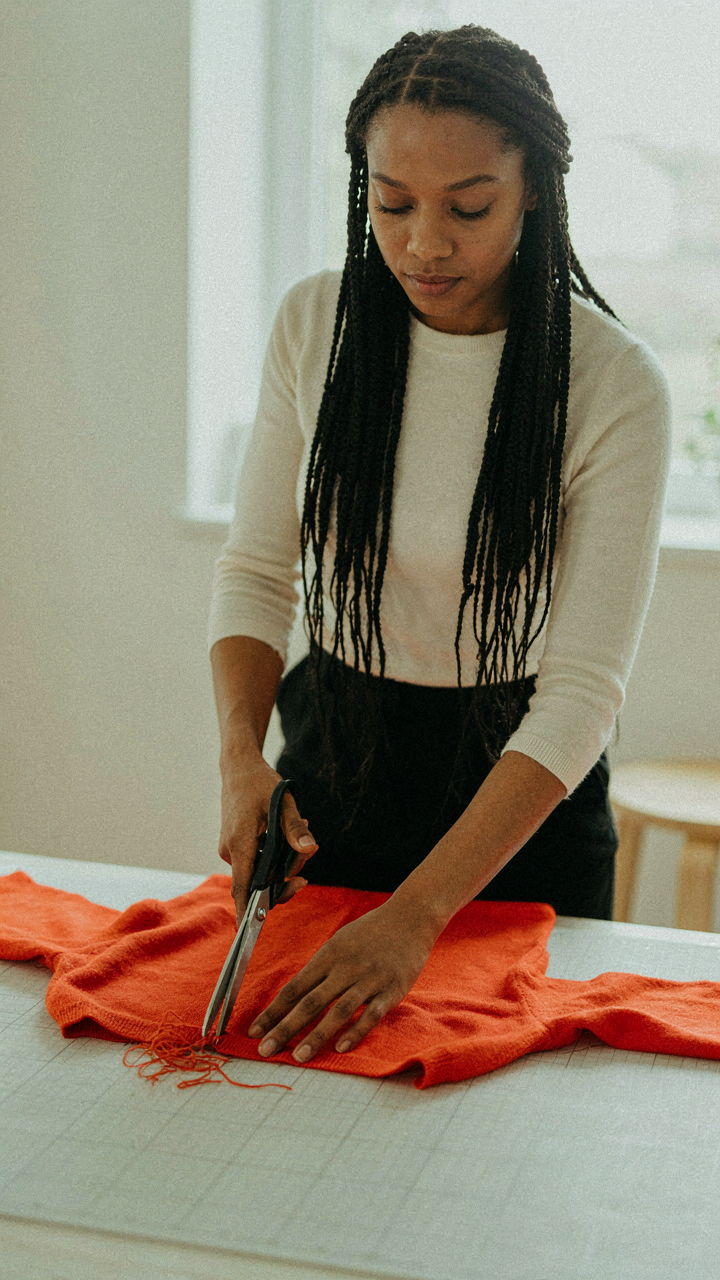
Transformative Cuts For New Garment Silhouettes
You’re looking at this section because you hate waste more than you hate the idea of actually breaking down a sweater you spent money on. Here’s the mechanism: stretched knits fail because the fibers lose elasticity, but the yarn itself remains intact. Cutting strategically lets you rebuild the garment around functional zones instead of fighting the damage across the entire piece. Think of it as triage in textile form—you’re isolating the compromised area and redistributing the healthy material to create something structurally sound.
The common advice says “just repurpose it into a blanket.” That’s incomplete. A sweater body has yardage worth preserving if you know how to read the grain. Most stretched sweaters fail at the torso or sleeves first. Cut those sections out entirely and use the intact side panels, back panel, or shoulders to construct a fitted sleeveless shell, a cropped top, or even the base of a vest. You’re not patching anymore—you’re redesigning the silhouette around the material that still performs.
Reimagining Sleeves, Collars, And Hemlines
The parts of a sweater that catch wear first are the edges—they’re where tension concentrates and where fiber breakdown accelerates. Instead of accepting stretched cuffs and necklines, you remove them entirely and rebuild. A loose or elongated neckline becomes the entry point for a new collar construction. You can cut away the damaged ribbing, fold the raw edge inward, and attach new ribbing, or transition to a flat collar that requires no elastic tension to function.
Sleeves teach you the most practical lesson about structural failure. A sleeve head that won’t sit right reveals that the armhole itself has deformed. Rather than fighting the loose fit, you can shorten the sleeve significantly and add new cuffs from quality ribbing, or convert long sleeves into fitted three-quarter length where the original stretch still holds. The hemline responds similarly—trim away the curled or loose edge and reattach fresh ribbing or a bound edge to stabilize it.
The Kintsugi Knit Method: Embracing Imperfection In Sweater Upcycle

When Mending Becomes The Design
You want permission to stop hiding damage. The real mechanism here comes from Japanese philosophy, not Western fashion trends: in kintsugi, the repair itself becomes the valuable object. You apply that principle to knitwear by treating visible mending as intentional craft instead of concealment. The stitching doesn’t disappear. It occupies the center of the visual hierarchy. This flips the psychology of a stretched sweater from ruined to rebuilt.
Visible mending works because it signals intentionality. A patched elbow reads differently than a hidden seam. Your eye lands on the repair as a deliberate line, not a flaw you’re supposed to overlook. Use contrasting thread colors, distinct stitch patterns, or textured yarn to telegraph that the work was chosen, not rushed. The sweater becomes evidence of a decision, which changes how both you and observers process its worn state.
Stitching And Appliqué Create Honest Character
Everyone tells you to match thread to yarn. That’s incomplete advice. Contrast stitching on a stretched sweater works because it transforms the garment into a statement about wear and choice rather than damage. A bright contrasting thread through a thin spot signals repair as art form. An appliqué patch in a complementary fabric covers functional issues while adding visual interest that wasn’t there before.
Appliqué solves multiple problems at once. It reinforces thin or pilled areas while creating a new focal point. Place geometric patches strategically across the sweater front or sleeves rather than just covering damage. Use natural fibers like linen, cotton, or even contrasting knit scraps. The patch becomes part of the garment’s story, not an asterisk on its history. Your execution changes how the sweater reads in the world.
Modular Sweater Upcycling: The Bio Mimicry Approach

How Segmentation Transforms Stretched Fibers Into Parts
You want permission to cut up your sweater without feeling like you’re destroying value. Here’s the real mechanism: a stretched sweater has already lost its structural integrity across the whole garment, so you’re not losing anything by separating it into segments that still have localized functionality. Knit segments work this way because yarn tension distributes unevenly. Borrowing from biology, a sweater isn’t a monolith—it’s an organism made of subsystems. The sleeves retain firmness while the body sags. The ribbed collar stays tight while the hem relaxes. These zones fail independently, which means they can be harvested independently.
Cut the sweater into functional zones: sleeves, body panels, front, back, collar, hem ribbing. Each segment carries different fiber density and elasticity. A sleeve that’s still elastic becomes a cuff. Ribbed edges that haven’t stretched become binding for a new edge. The loose body panels become fabric for patchwork or layering components. You’re not salvaging a ruined sweater. You’re mining it for working parts that were never actually ruined—they just existed inside a garment that failed as a whole.
Interlocking Components Into New Structures
Most upcycling advice stops at “cut it up and make a crop top.” That’s lazy. The real leverage is in how knit segments interlock mechanically, not aesthetically. When you join two knit pieces, the connection strength depends on stitch direction and yarn crimp, not on thread color or pattern matching. You can graft a horizontal-knit sleeve panel to a vertical-knit body panel because the fibers create friction at the joint. This isn’t sewing—it’s engineering a new garment structure where stress distributes across multiple anchor points instead of one stretched-out waistband.
Connect segments using mattress stitch or ladder stitch to hide the seam inside the knit structure itself. Layer three smaller segments to create intentional thickness where the original sweater was thin. Use the collar ribbing as a structural band that holds looser body segments in place. The mechanism here is load distribution: instead of weight pulling at one failing seam, you’ve created a network of load paths. Design the new garment so stress hits the strongest remaining segments—usually the original ribbed edges and cuff sections that retained their tension.
Old Sweater, New Identity: Accessory Alchemy
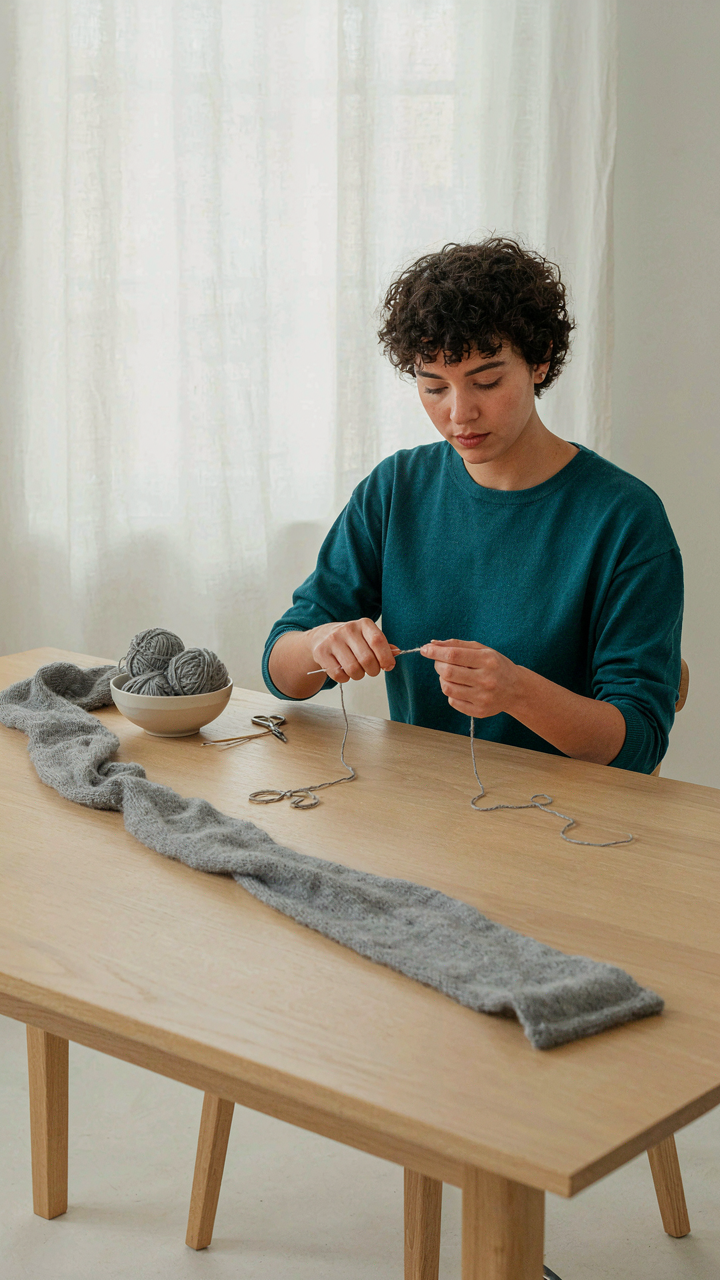
Turning Stretched Knits Into Wearables
You want proof the sweater wasn’t wasted, that your money didn’t vanish into the donation bin. That’s the real engine here. The mechanism is simple: stretched-out sweaters still contain usable fiber. You’re not salvaging sentiment. You’re extracting density from the densest parts of the garment and converting it into items that actually hold their shape because they’re smaller and don’t bear full-body weight.
- Beanies: Cut ribbed cuffs from sleeve hems or waistbands. These sections retain their elasticity because they were engineered to resist stretch. Stack two layers, seam them closed, and you have a structured crown without additional binding.
- Scarves: Unravel the body panels lengthwise and lay them flat. A single sweater body yields 4 to 6 feet of usable width. Seam multiple panels end-to-end, bind the raw edges with bias tape or a simple whip stitch.
- Gloves: Sleeves are pre-cylindrical. Remove the armhole seam, cut finger holes, and reinforce the openings with a ladder stitch. Thumb placement matters: measure against your hand before cutting.
- Leg warmers: Cut sleeves to calf length, preserve the cuff, and add ankle ribbing salvaged from the sweater’s waistband. They work because they sit on a stable joint, not a moving body.
- Mittens: Stack two layers of body fabric, trace a mitten template, and blanket stitch the perimeter. Use thumb sections from the underarm for authentic glove construction without cutting through the main panel.
The rule most people miss: prioritize components that already have structural integrity built in. Ribbed edges were knit tighter. Seams carry tension. New accessories succeed when you respect the original garment’s load-bearing zones and don’t ask them to do jobs they weren’t designed for.
Reclaimed Fibers Become Objects That Last
Jewelry and home goods require a different strategy than wearables because they don’t move against skin or weight. Take a sweater that’s beyond repair and unravel it completely. You now own hundreds of yards of yarn at zero cost. This shifts the economics of what’s worth making.
Wrap reclaimed yarn around wooden rings, brass cones, or river stones to create functional pendants and bracelets. The fiber holds dyes you already paid for. Coil the same yarn into trivets and place mats by stacking concentric circles and stitching them together at stress points. Wind it into drawer dividers by securing loops between two slats. The key is this: reclaimed fiber from a destroyed sweater works for static objects because tension and movement no longer degrade it. You’re no longer fighting against stretch fatigue. You’re leveraging the yarn’s remaining tensile strength in contexts where it doesn’t need to bounce back.
The Textile Rebirth Protocol For Upcycle Sweater Ideas

Dyeing And Color Blocking Strategy
You want to believe the sweater is salvageable because throwing it out feels like failure. Here’s the mechanism: dyeing works because it masks fiber damage while giving you control over the final statement. Strategic color application uses contrast to redirect attention from worn zones. Dark dyes hide stains and pilling better than light ones. Acid dyes bond permanently to protein fibers like wool and silk, making the color stable through washing.
The common mistake is treating dyeing as decoration instead of damage control. Pick dye colors that complement your existing wardrobe, not colors you think look interesting in the vat. Apply color blocking in horizontal bands or geometric shapes to create intentional visual breaks. This transforms an accidentally faded sweater into a designed piece. Measure the sweater before dyeing to account for potential shrinkage in hot water.
Felting To Restore Structure
Felting operates on the same principle as fabric consolidation in textile engineering: applying heat, moisture, and agitation causes fiber scales to interlock and compress. A stretched-out sweater recovers its original dimensions when those fibers lock back together. This is why felting works on animal fibers but not synthetics. Wool felts predictably. Cashmere felts too, but takes longer and requires gentler handling.
The process requires precision. Submerge the sweater in 140-160 degree Fahrenheit water mixed with mild detergent. Agitate gently for 10-15 minutes, checking every few minutes for tightness. Remove it when the weave tightens noticeably but before the piece becomes cardboard-stiff. Lay it flat to dry in the shape you want. Felting shrinks dimensions by 15-30 percent depending on fiber content and initial stretch level.
Uncommon Pairings: Integrating Sweater Repurpose With Other Materials

Knit Meets Structure: Leather, Denim, And Canvas
You want permission to make something that looks intentional instead of like you ran out of fabric. That’s the real calculation here. The mechanism is simple: knit stretches and moves. Rigid materials stop that movement at specific points. Pairing them isn’t decoration—it’s boundary definition. Leather panels on a sweater’s sides create a containment wall that arrests lateral stretch. Denim cuffs at the hem lock the bottom edge. Canvas yokes redistribute weight across the shoulder plane so the neckline doesn’t collapse downward over time.
The common advice is to “add contrast.” Wrong angle. You’re not making a statement. You’re installing structural guardrails. Leather works best on high-friction zones: underarms, side seams, shoulders. Denim handles cuffs and hems because it resists unraveling at raw edges. Canvas stabilizes loose-knit sweaters prone to sagging. Position these materials where the knit already shows stress—not for visual pop, but because that’s where the load concentrates. Sew them with thread that matches the denim or leather, not the knit. The seam disappears into function that way.
Weight Distribution For Draped Knits
Borrow from structural engineering: load path is the route force takes through a system. In a draped sweater, gravity pulls downward everywhere, but unevenly. Heavy knit bunches at the hemline. Lighter sections stretch thin around the bust. The fix is counter-intuitive weight addition, not removal. Add ballast to sections that already want to drop. A linen lining sewn into the hem channels fabric weight into a predictable vertical line instead of a saggy pool. Silk noil panels at the side seams distribute lateral pull evenly across the width.
The wrong move is removing fabric or cinching the garment tighter. That increases tension on the remaining knit and accelerates failure. Instead, insert reinforcing layers that accept the weight burden themselves. Fusible interfacing melted into the back panel of a stretched sweater redirects shoulder load before it reaches the neckline. Sew it to the wrong side only—never to the face of the garment. Apply gentle heat to activate the adhesive, then let it cool fully before wearing. This moves the stress load away from the knit fiber itself and into a separate structural system that can handle it.
The Art Of Intentional Disruption: Why Your Upcycle Sweaters Diy Ideas Matter

Opting Out Of The Disposal Cycle
You care about this because you sense the trap: buy, wear twice, discard, repeat. The mechanism fast fashion relies on is psychological obsolescence, not physical failure. A stretched sweater still functions. Brands need you to perceive it as dead so you purchase the replacement. Sweater refashion short-circuits this by proving the garment has utility beyond its original form. You reclaim the decision about when something ends.
The math is simple but ignored by most people. A quality wool or cotton blend sweater represents actual material value and embedded energy. Throwing it away transfers that value to landfill while you fund another production cycle. Refashioning forces you to engage with the object as a resource, not a status token with an expiration date. This is the opposite of how retail conditions you to think.
Building A Signal That Costs Differently
Anti-consumerism as aesthetic only works when it’s visibly intentional. A refashioned sweater signals something most people cannot fake: you made an active choice against replacement culture. This distinction matters because it’s rare. When others see a hand-altered garment, they recognize constraint transformed into style, not budget constraint disguised as style. The garment becomes documentation of a different value system.
The mechanics of status have inverted in certain circles. Where consumption once proved resources, restraint now proves taste and conviction. A sweater you’ve reconstructed, re-dyed, or cropped carries more cultural weight than a new purchase because it required knowledge and time instead of money. You’re not rejecting aesthetics—you’re rejecting the premise that aesthetics only come through acquisition. The refashioned piece becomes the garment people actually ask about.
The Real Obstacle Isn’t The Knit’s Condition, But Your Own Imagination’s Atrophy

You’ve been trained to discard. A stretched sweater feels broken because you’ve never seen it as raw material. But right now, pull out one dead knit from your closet. Crop it. Unravel it. Dye it. Cut it into panels for a tote. Your hands will remember what your mind forgot: you own the power to transform. Most people throw away money. You’re about to stop being most people.