

The Unseen Constraint: How Fabric Fails Your Pilates Flow

Where Most Fabrics Bottleneck Movement
You care about this because wearing the wrong material makes you look like you don’t know what you’re doing, and that kills focus. Here’s the mechanism: fabric behaves like a load-bearing structure during reformer work. When you’re pressing into the carriage or folding forward over the barrel, tension distributes across fibers. Cotton blends and loose weaves absorb energy instead of transferring it. The fabric fights you instead of moving with you. Compression fabrics work differently, but most people buy them wrong.
Most guidance says “just wear something stretchy.” That’s incomplete. Stretch alone isn’t enough. You need fabric that recovers immediately after deformation. Cotton holds its shape poorly after compression. Synthetic blends trap sweat, which adds weight and creates drag against the reformer’s frame. The fabric becomes a friction point. Nylon and spandex blends recover faster because their molecular structure snaps back. This matters because the reformer demands precision. Dead fabric steals that precision.
The Fibers That Actually Recover

Textile physics shows recovery rate as the key metric, not stretch percentage. A fabric stretches and either returns to shape or stays deformed. Nylon-spandex blends typically recover to 95 percent of original shape within seconds. Cotton-spandex blends recover at roughly 70 percent, leaving residual deformation that accumulates through a session. You feel this as restricted movement in later sets. Polyester-spandex hybrids sit between these ranges, which is why they’re generic. Your outfit fails gradually, not all at once.
Four-way stretch fabrics allow movement in all directions, which seems ideal until you factor in durability. The fibers break down faster from constant multi-directional stress. Two-way or three-way stretch holds up longer because fibers handle unidirectional tension better. For reformer work, you need primarily vertical and horizontal stretch with moderate diagonal give. This is why apparel designed specifically for pilates outperforms generic athletic wear. Pick nylon or polyester bases with 15 to 20 percent spandex content. Higher spandex percentages add recovery but compromise durability and lifespan.

Beyond The Instagram Flex: The Real Purpose Of Pilates Clothes

Tight Clothes Kill Your Range
You care about this because you want to look serious about pilates without admitting you’re mostly there to be seen. Here’s the mechanism: tight fabrics act like a limiter on your central nervous system’s ability to recruit full muscle engagement. Think of it in biomechanical terms—your nervous system reads compression as a boundary signal. Restrictive clothes don’t just feel limiting. They actually signal your body to stop recruiting deeper stabilizer muscles because the fabric itself provides false support. You end up doing partial reps of full-body movements, which means you leave results on the machine.
The reformer demands range of motion that your clothes either permit or prevent. Oversized gear creates slack that causes your body to compensate with momentum instead of control. Undersized gear restricts the eccentric lengthening phase where muscles build actual strength. Proper-fitting pilates clothes maintain contact with your skin without cutting off circulation or blocking joint movement. The fit matters because your nervous system needs accurate feedback about where your body exists in space. Wear clothes that move with your body, not against it.
The Hidden Cost Of Cheap Synthetic Blends
Most pilates advice skips this entirely: sweat management determines whether you maintain tension or slip out of position mid-rep. Cotton absorbs sweat and holds it against your skin, increasing friction that pulls you away from the reformer pad at critical moments. Performance synthetics like nylon and polyester blends pull sweat away from skin, but cheap blends do this poorly, creating a tacky residue that bunches fabric and breaks your form.
High-quality synthetic blends with moisture-wicking properties maintain contact pressure during the entire set. Your body stays locked in place. Your mind stays focused on the movement, not the discomfort. Cheap fabrics force micro-adjustments throughout each rep, fragmenting your attention and reducing the neurological adaptation your muscles need. Check fabric composition before buying. If the tag lists more than 20 percent cotton in a pilates-specific garment, the manufacturer chose cost over function. Your form depends on what you wear.
The Kinematic Fit Protocol: Maximizing Range Of Motion In Your Pilates Outfit

Seam Placement For Uninterrupted Movement
You want to feel like your clothes disappear during the workout, not because they’re magical, but because they won’t sabotage your form. Seam placement is biomechanics applied to fabric. Where seams run determines where fabric bunches, where it restricts, and where it supports. Most activewear brands ignore this—they chase aesthetics over function. Reformer work demands overhead reaches, spinal extension, hip flexion under load, and lateral rotation. Each demands specific seam architecture to stay invisible.
Seams should run along your body’s natural lines of elongation, not across them. The spine’s primary axis during reformer work moves vertically and in rotation, so side seams matter most. Front and back center seams need minimal tension load. Avoid seams that run horizontally across the chest, shoulders, or hips—they pinch and migrate during movement. Flat-lock stitching instead of traditional seams reduces friction against your skin and adds durability where tension peaks. Test this: do a chest-opening sequence on the reformer and notice if fabric pulls at the armpit or shoulder blade. That’s a seam placement failure.
Compression That Supports Without Caging
Compression sounds like marketing, but it’s physiology. Muscle compression improves proprioceptive feedback and reduces oscillation during dynamic movement—two things reformer pilates demands. The mistake most people make is confusing compression with tightness. Tight means restriction. Compression means graduated pressure that stabilizes without limiting range of motion. This is the difference between athletic support and suffocation.
Compression zones matter more than full-body compression. Target the mid-thigh, core, and shoulder stabilizers where reformer work generates instability. A reformer outfit needs compression through the hip flexors and glutes because those muscles fatigue fastest during footbar and carriage work. Your outfit should feel like an external cue, not a constraint. When you perform a long-box series, compression should remind your glutes to fire without preventing them from fully lengthening. Press your hand against your thigh in your outfit—if you can’t indent the fabric slightly, the compression is too aggressive and will impair circulation and range.
The Ergonomics Of Elegance: Why Less Is More In The Pilates Studio

Minimalist Fabric And Cut Beat Trend Chasing
You want to look put-together without looking like you’re trying. That’s the real game here, and it requires discipline. In industrial design, engineers strip away every component that doesn’t serve function. Your reformer pilates outfit needs the same treatment. One fitted tank, one pair of high-waisted leggings, one layer. Each piece performs a job: moisture management, unrestricted movement, visible form correction. Loose fabric hides bad alignment. Tight fabric shows it. Most people choose baggy clothing to hide insecurity, not comfort.
The mechanism is simple. Minimal design forces intentionality in every purchase. You stop buying pieces that “could work” and start buying pieces that do work. Neutral colors, clean lines, and second-skin fits eliminate decision fatigue in the studio. You show up, you move, you leave. No wardrobe maintenance spiraling into closet clutter. This is how athletes think about gear. Function first. Aesthetics follow naturally when nothing wastes energy.
Distraction Removal Through Strategic Simplicity
Nothing kills focus like a reformer carriage pinching fabric or a neckline collapsing mid-bridge work. The biomechanics of Pilates demand proprioceptive awareness, and your outfit either supports or sabotages that. Loose sleeves catch on the equipment. Waistbands roll. Straps slip off shoulders during chest expansion work. Each micro-adjustment pulls cognitive resources away from breath, alignment, and muscle engagement. You can’t fix your scapular positioning when you’re fixing your top.
Clothing should become invisible once you put it on. Choose pieces with no excess fabric at joints, secure necklines that won’t shift, and waistbands engineered to stay put through dynamic spine extension and rotation. Test movement before committing to a purchase. Perform a squat, reach overhead, and lie on your back for sixty seconds. If anything moves, it goes back. Your outfit disappears only when it’s built for the exact demands of the work.
The Feedback Loop Principle: Your Outfit As A Sensor
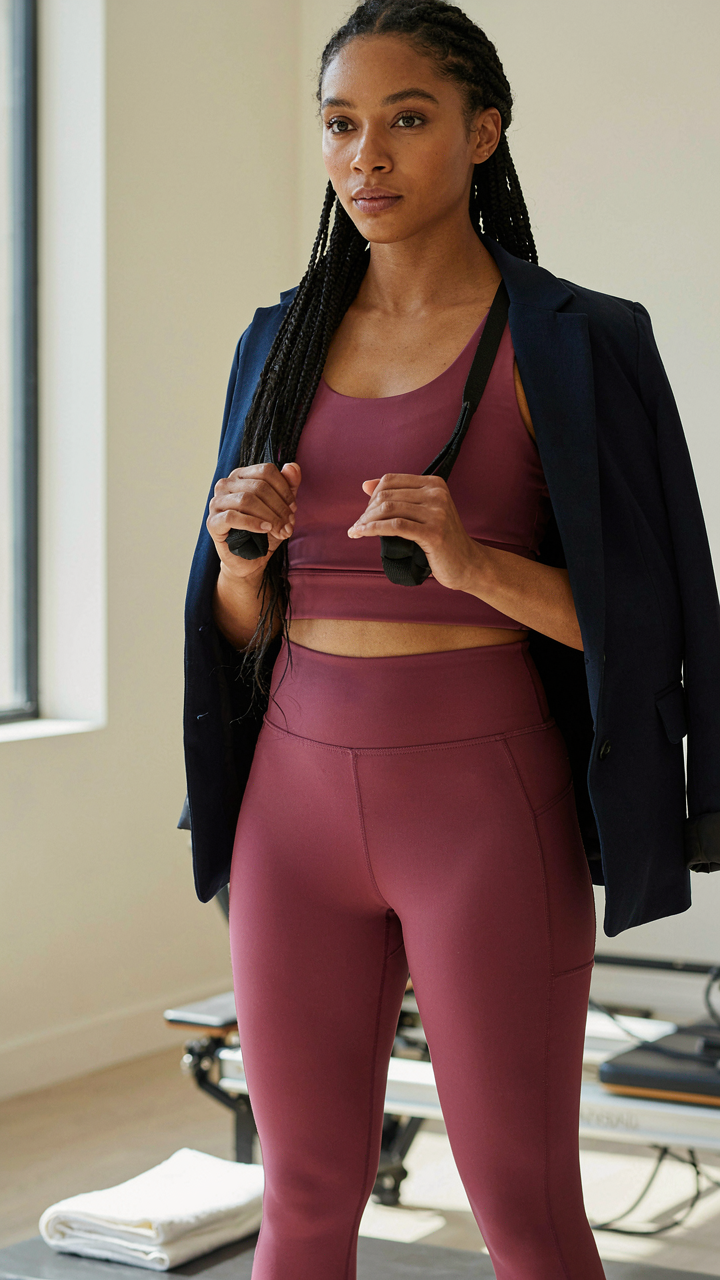
Clothing As Proprioceptive Input
You want to believe your reformer pilates outfit is just decoration, but it’s not. Cybernetics—the study of feedback systems in machines and organisms—teaches us that every sensor in a loop changes behavior. Your outfit is a sensor. The fabric, fit, and tension against your skin feed information to your nervous system in real time, which your brain uses to calibrate movement precision. Strip that away and you lose data.
Most people ignore this entirely. They wear loose, shapeless gear and wonder why their form stays sloppy. The mechanism is simple: tight, responsive fabric creates continuous tactile input about body position and muscle engagement. A reformer pilates outfit that fits close enough to signal without restricting sends micro-corrections to your nervous system during every rep. Your body knows where it is because it can feel itself.
Sensation Refinement During Execution
Tactile cues override vague intention. When you wear a reformer pilates outfit designed with feedback in mind, specific fabrics press against specific muscles—your core, glutes, shoulders—and that pressure becomes a signal you can’t ignore. You stop guessing whether you’re engaged and start knowing. The outfit becomes part of your technique system.
This is why high-performance reformer pilates athletes wear fitted, four-way stretch fabrics with strategic compression zones. Not for looks. The fabric’s resistance during movement teaches your muscles how they should fire. When you feel tension increase at your obliques during a twist, that’s your outfit enforcing proper form. Stop tolerating gear that lets you hide. Wear something that talks back to you.
The Durability Dividend: Investing In Pilates Clothes That Last

Fabrics That Resist Degradation
You’re afraid cheap gear will embarrass you after three months. That’s not the real problem. The real problem is fiber structure. Borrowing from materials engineering, durability in textiles depends on tensile strength—the force required to break a fiber under stress. A reformer pilates outfit endures because its fibers resist both mechanical stress from movement and chemical stress from sweat and washing.
Nylon and polyester dominate reformer wear because they’re engineered to hold shape under repeated tension. Nylon has superior elasticity recovery—it snaps back to form after stretching. Polyester resists moisture absorption, which means less fabric degradation from sweat sitting in fibers. Spandex (elastane) adds the critical flex, but quality matters: high-grade spandex maintains recovery through 300-500 wash cycles. Cheap blends fail faster because the fibers separate under stress rather than move as one system.
Care Protocols That Compound Over Time
Cold water washing preserves fiber integrity because heat accelerates polymer breakdown. Most people ignore this and wonder why their leggings pill or lose shape after six washes.
- Wash inside-out in cold water: Reduces friction on the outer surface where pilling starts. Protects color and fiber structure simultaneously.
- Skip the dryer entirely: Heat degrades elastane faster than any other factor. Air dry flat or hang to preserve fiber alignment and stretch capacity.
- Use sport-specific detergent: Standard detergent leaves residue that traps moisture in fibers. Sport detergent is formulated to rinse clean and prevent bacterial buildup.
- Never use fabric softener: It coats fibers with silicone, reducing breathability and accelerating pilling by creating slick surfaces that snag.
- Wash with similar colors only: Prevents dye transfer that weakens fiber bonds and creates visible wear patterns that compound over time.
These aren’t suggestions. They’re the difference between a reformer pilates outfit that functions for two years versus six months. The mechanism is simple: fibers survive longer when they’re not chemically stressed, thermally degraded, or mechanically damaged by friction. Your washing routine determines how many times your clothes can actually perform before they fail.
The Sweat Equity System: Managing Moisture For Peak Performance

Fiber Science Beats Marketing Claims
You want to stay dry during reformer work because wet fabric kills your grip on the equipment and ruins your mental focus. Here’s what actually matters: use polyester blends with nylon, not cotton or cotton-dominant blends. Polyester moves moisture away from skin faster than natural fibers because water doesn’t bond to synthetic polymers the way it does to cellulose. That’s basic material science. Most brands slap “moisture-wicking” on anything stretchy and call it a day.
The real mechanism is capillary action. Tight weaves in synthetic blends create channels that pull sweat outward faster than loose weaves absorb it inward. A 88% polyester, 12% spandex blend outperforms a 50/50 cotton-poly mix every time because the polyester dominates the fiber structure. Check the tag. If you see more than 30% cotton, you’re buying a sweat trap marketed as performance wear.
Breath Movement Over Bulk Coverage
Temperature regulation in reformer work isn’t about wearing less—it’s about fabric construction that doesn’t trap heat against your body. The physics term is convective cooling: moving air pulls heat away more efficiently than still air. Your outfit needs strategic ventilation, not just thin material.
Look for fabrics with visible grid patterns or mesh panels. These create air channels. Seamless or minimal-seam construction matters because stitched areas hold heat and moisture. Your torso stays warmer than your limbs during reformer work, so place breathable panels on your back and sides. Buy pieces with laser-cut or bonded edges instead of traditional hems—they reduce the dead zone where sweat sits instead of evaporating.
Beyond Black: Strategic Color Choices For The Pilates Reformer

Color As A Cognitive Tool
You want to know if wearing blue instead of black makes you look smarter or more intentional. The real mechanism is simpler: color shapes your nervous system state before you even touch the reformer. Psychology calls this priming. In movement practice, color functions like a loaded question your body answers automatically. Warm tones elevate heart rate and mental activation. Cool tones lower cortisol and sharpen focus. Black neutralizes all of this, which is why it dominates reformer studios. But neutral isn’t strategic.
The common advice says wear whatever makes you feel confident. That misses the point. Confidence is downstream from physiology. Muted jewel tones like deep teal, burgundy, or olive trigger the parasympathetic nervous system without demanding attention. These colors work because they contain enough saturation to signal intentionality without the cognitive load of bright hues. Wear them during sessions where control and precision matter most. Your body will cooperate faster than it does in black.
Contrast Works Better Than Tonal Matching
High contrast between your top and bottom creates a visual anchor point your brain locks onto during movement. This isn’t aesthetic preference. It’s proprioceptive feedback. When your reformer outfit separates at the midline, your core engagement sharpens because your visual system has a clearer reference for alignment. A cream-colored tank over charcoal leggings does this work automatically.
Low contrast outfits blur your body’s boundaries during flow sequences. Your nervous system works harder to track where you are in space. Tonal matching feels clean but costs you performance. Choose one piece with presence and one piece that recedes. This simple split keeps your visual cortex efficient and frees neural resources for the actual movement work.
The Unseen Edge: How Your Pilates Outfit Translates To Real World Strength

Precision Transfers Into Movement Quality
You want to believe your reformer pilates outfit doesn’t matter because admitting it does means you’ve ignored a cheap leverage point for months. Here’s the mechanism: your nervous system reads fabric feedback and joint constraint as permission to move with specificity. Tight sleeves and strategic compression signal stability to your proprioceptors. Loose or shifting fabric creates micro-corrections that degrade the exact positioning reformer work demands. This isn’t psychology. This is neurology.
When your outfit stays where it belongs during leg springs or carriage work, your body stops wasting attention on adjustment. That freed cognitive bandwidth goes directly into the precise muscle engagement reformer pilates requires. A fitted tank top that moves with you versus one that rides up forces your central nervous system to choose between managing fabric and managing form. You’ll move sloppier every time you pick the distraction. The precision you build on the reformer only compounds in daily life when your clothes never interrupt the signal.
Compounding Returns Stack Across Months
Everyone talks about consistency with workouts as if showing up is the hard part. It’s not. Staying sharp across dozens of sessions while maintaining movement quality is what separates results from repetition. This operates on an economics principle called diminishing marginal utility. Each reformer pilates outfit that fits poorly costs you incremental precision that multiplies across your training block.
Wear a reformer pilates outfit built for the work and your body adapts to the actual demand pattern. You practice the movement correctly. That correct pattern becomes your nervous system’s default. Five months in, that default shows up when you’re carrying groceries, sitting at your desk, or standing during a meeting. The person wearing shifting, poorly fitted gear five months ago is still moving from their baseline. Your outfit choice compounds into postural advantage that becomes invisible to everyone except the person living in your body.
The Only Wasted Movement Is The One Spent Worrying About Your Workout Fit

Stop treating your reformer pilates outfit like it’s separate from your performance. Your clothes either remove friction from your session or they create it. Pick pieces that move with your body, not against it, then stop thinking about it. The best outfit is the one you forget you’re wearing because you’re too focused on the work. Your fit matters exactly as much as your form, and both demand the same thing: zero compromises.