

The Illusion Of “Comfort”: Why Most Maternity Activewear Fails You
Stretch Alone Isn’t A Strategy
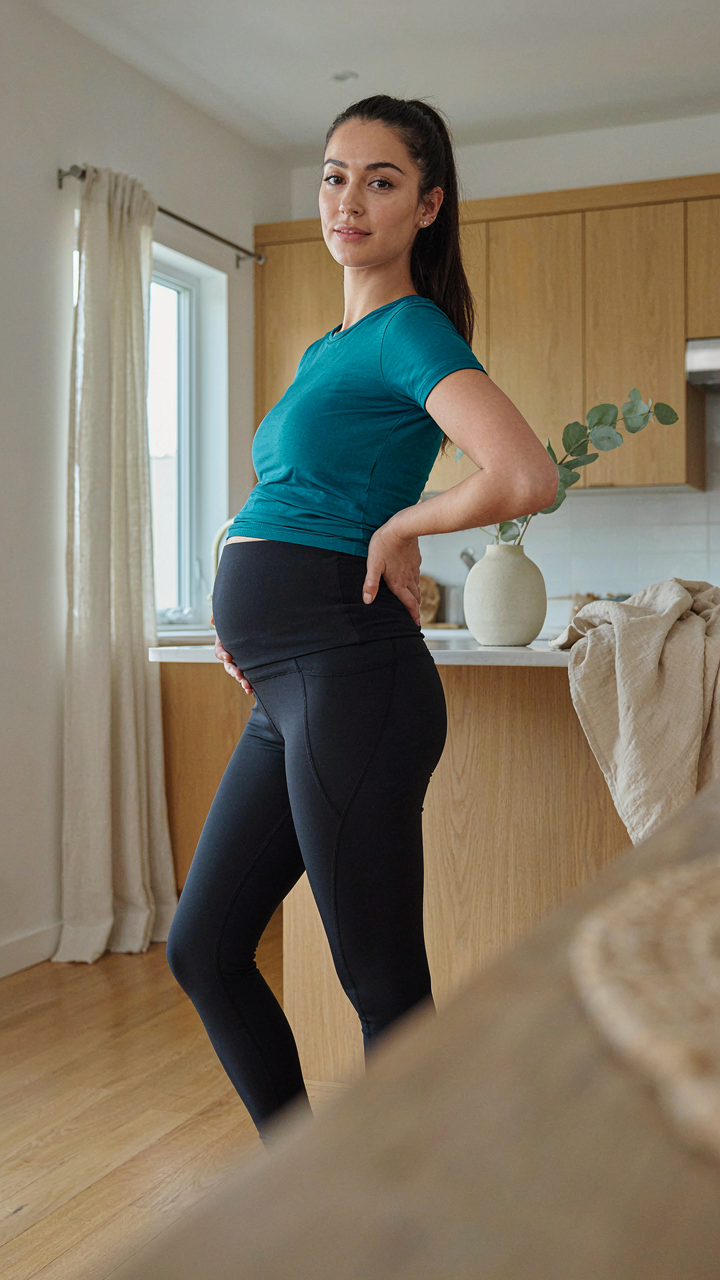
You want to believe that more stretch means more comfort because it sounds scientific and requires no real thinking on your part. The mechanism is simpler: most maternity activewear treats stretch as a catch-all solution when it’s actually just one variable in a failing equation. Generic four-way stretch fabric moves with your body but doesn’t anticipate where your body actually needs support during pregnancy. Your growing belly shifts your center of gravity forward by up to four inches. Fabric that simply stretches equally in all directions creates drag in the wrong places and leaves your lower back unsupported exactly when it matters most.
Targeted support means different panel construction in different zones. The panel across your lower abdomen needs compression that prevents that forward drag on your spine. The side panels need to stabilize your ribcage as it expands upward. The back panel must counterbalance the forward weight shift. A brand using this architecture costs more upfront but eliminates the constant micro-adjustments you make while moving, which drains energy faster than the actual workout. Most maternity activewear defaults to uniform stretch because it’s cheaper to manufacture and easier to market.
How Pregnancy Rewires Your Mechanics

Biomechanics is the field studying how forces move through bodies, and pregnancy introduces a load distribution problem that generic activewear ignores completely. Your pelvic floor muscles weaken progressively through pregnancy, not because you’re weak but because hormonal changes literally soften the connective tissue holding everything in place. This changes how your glutes fire, how your core stabilizes, and which muscles compensate during movement. Standard activewear assumes a non-pregnant biomechanics model. It supports the anterior chain and ignores the posterior chain collapse that happens in the second and third trimester.
The real issue is that maternity activewear designers often don’t account for this cascade. Your glutes stop firing as efficiently because your pelvis tilts forward under the weight of the belly. Your lower back muscles overwork to compensate. Your breathing becomes shallower because the baby takes up space your diaphragm used to own. Activewear built around this reality includes structured side seams that reinforce the obliques, a higher waistband that doesn’t dig into your ribs as they flare, and a back panel that extends lower to support your sacrum. Check the seam placement first, before fabric content, because seams determine whether the garment works with your changing body or against it.

The Pregnancy Workflow: A Strategic Approach To Your Active Wardrobe

Phased Adaptation For Each Trimester
You want to feel in control during a time when your body isn’t. The mechanism that makes this work is treating pregnancy like a project with distinct phases, each with different physical demands and fit requirements. First trimester feels normal until it doesn’t. Your regular activewear still works, but bloating hits different than normal bloating. By second trimester, your center of gravity shifts. Underband pressure becomes intolerable. Third trimester requires pieces engineered for load distribution, not just stretched versions of regular gear.
The common advice here is generic: “just size up.” Wrong. Sizing up doesn’t address the specific pressure points that change each trimester. First trimester needs only minimal accommodation in the underband and bust. Second trimester demands mid-rise support that doesn’t dig. Third trimester requires long-length bottoms that stay put as your body pitches forward and high-waist designs that support the round without restriction. Each trimester needs different pieces, not bigger versions of the same piece.
Daily Wear Integration, Not Workout Isolation
Maternity activewear functions best when you stop treating it as category separation and start treating it as infrastructure for all movement. This is systems thinking applied to clothing: one garment class serving multiple contexts instead of outfit fragmentation. Most pregnant people buy “workout clothes” then never wear them because they don’t move through normal days in them. The friction is too high. Real adoption happens when you wear the same pieces to the grocery store, for a walk, to a doctor appointment, and to the gym.
The design elements that make this work are compression in the right zones, non-restrictive waistbands that don’t require adjustment, and fabric that doesn’t telegraph sweat or look “athletic” in inappropriate contexts. A high-waist legging with side pockets, underband support, and neutral colorways works everywhere because it solves the actual problem: keeping your belly supported while you move, whether you’re exercising or existing. Build your rotation around these multipurpose pieces first, then add sport-specific items second.
Maternity Leggings: The Core Operating System Of Your Pregnancy Wardrobe

How Compression Actually Works On Your Body
You want to feel controlled, not trapped. That’s the real tension nobody admits when they talk about maternity leggings. Compression operates on a load-distribution principle borrowed from structural engineering: instead of gravity pulling your belly and shifting your center of mass forward, graduated compression spreads that force across a wider surface area of fabric and your torso, reducing localized pressure on any single point.
Most advice treats compression as a luxury feature. It’s not. Compression in maternity leggings directly counters the biomechanical shift pregnancy forces on your skeleton. Your pelvis tilts forward between weeks 12 and 28. Compression that sits at 20-30mmHg (medium grade) provides enough support to stabilize your abdomen without restricting breathing or circulation. The mechanism is simple: less compensatory muscle engagement means less lower back fatigue by day’s end.
Fabric Behavior Under Heat And Movement
The standard narrative about maternity activewear fabrics is incomplete. Most sources mention “breathability” as if it’s one property. It isn’t. Breathability requires three separate mechanisms working in sequence: moisture wicking (fiber pulls sweat away from skin), moisture transport (fabric moves that sweat laterally), and vapor evaporation (air circulation dries the surface). Most maternity leggings nail the first two and fail at the third.
Nylon-spandex blends (75/25 ratio) became the pregnancy activewear standard because nylon dries faster than cotton and holds compression shape better than polyester alone. Spandex recovery—the fabric’s ability to return to original shape after stretching—directly determines how long compression functions. A quality maternity legging recovers to 95% of its original dimensions after 100 wash cycles. Below that threshold, the compression fails gradually, and you’re paying for dead weight. Check fiber composition before purchase; if it doesn’t list the ratio, the manufacturer is hiding something.
The “Adaptive Load” Principle: From Engineering To Maternity Movement

How Weight Distributes Through Fabric
You want to believe that buying the right activewear solves the problem of moving safely while pregnant. It doesn’t. The real mechanism is how load transfers through the garment to your body. Engineering calls this stress distribution. In maternity activewear, this means the fabric and structure redirect the weight of your belly away from your lower back and instead disperse it across your core, hips, and shoulders. A mediocre sports bra with poor load distribution concentrates force on shoulder seams. A designed one spreads it. The difference is measurable in how your body feels after thirty minutes of movement.
Most maternity activewear brands ignore this entirely and just add fabric to the front. That’s lazy. Real adaptive load happens through strategic panel placement and fabric weight variation. High-stretch blends in the belly panel absorb the majority of load while stiffer side panels act as anchors, transferring force laterally instead of downward. This isn’t about comfort as a feeling. It’s about mechanics. When load distributes correctly, your muscles work less, your joints move through safer planes, and fatigue drops measurably.
Leverage Changes Your Movement Pattern
Pregnancy shifts your center of gravity forward. Biomechanics is the study of how bodies move under load, and it shows that forward displacement requires different muscular engagement to stay stable. Standard activewear assumes your weight stays centered. Maternity activewear that works accounts for leverage redistribution. Your pelvis tilts. Your posture compensates. The garment must counteract this without fighting your body’s natural adaptation. When the front panel provides targeted compression without restriction, it allows your glutes and core to engage at their actual mechanical advantage instead of overcompensating in your lower back.
The mechanism is straightforward: support the load, don’t carry it. A well-designed maternity sports bra or legging doesn’t just hold things in place. It repositions how your body recruits muscle groups during movement. Your lats can activate more efficiently. Your hip stabilizers don’t work in constant overtime. The garment becomes a temporary correction to a temporary problem. You move more efficiently because the physics change, not because you feel more confident. When choosing maternity activewear, look for high-rise waistbands paired with reinforced side seaming. That combination manages leverage better than anything else.
Beyond Yoga Pants: Curating Your Maternity Workout Outfits Collection

Impact Classification Changes Everything
You want permission to skip the expensive stuff and still look like you have it together. Here’s what actually matters: the mechanical difference between high-impact and low-impact exercise determines what your abdominal wall and pelvic floor can handle during pregnancy, which is the only thing that should drive your clothing choice. Low-impact work like walking, swimming, or stationary cycling keeps vertical force minimal. High-impact activities like running or jumping create ground reaction forces that spike dramatically with each landing.
Your outfit must accommodate these forces differently. Low-impact activities need support without compression that restricts breathing or fetal movement. High-impact work demands structured waistbands, reinforced side panels, and shorts or leggings that prevent chafing during repetitive motion. Most maternity activewear brands blur this distinction to sell one-size-fits-most collections. You need to match the garment’s construction to your actual activity, not your pre-pregnancy workout preferences.
Strategic Layering For Control And Comfort
Thermal regulation during pregnancy isn’t about feeling warm or cold, it’s about managing your body’s baseline metabolic shift upward by 15 to 20 percent during the second and third trimesters. This is biology, not preference. You need a system that sheds or adds layers without removing the entire garment mid-workout. The mechanism is simple: base layer against skin handles moisture, middle layer provides structure, outer layer controls temperature swings.
Build your layering protocol this way: start with a breathable racerback or cross-back tank designed for pregnancy, add an open-front hoodie or zip-up as your temperature moderator, then choose fitted leggings with a high-waisted panel that stays in place. This stacking system lets you strip to the tank, tie the zip-up around your waist, and adjust without exposing your midsection in public spaces. Modesty during pregnancy isn’t about shame, it’s about avoiding unwanted commentary and maintaining mental focus during your workout.
The “Second Skin” Fallacy: Why True Stretch Fabric Is Non Negotiable
Elasticity Vs. Simple Stretch
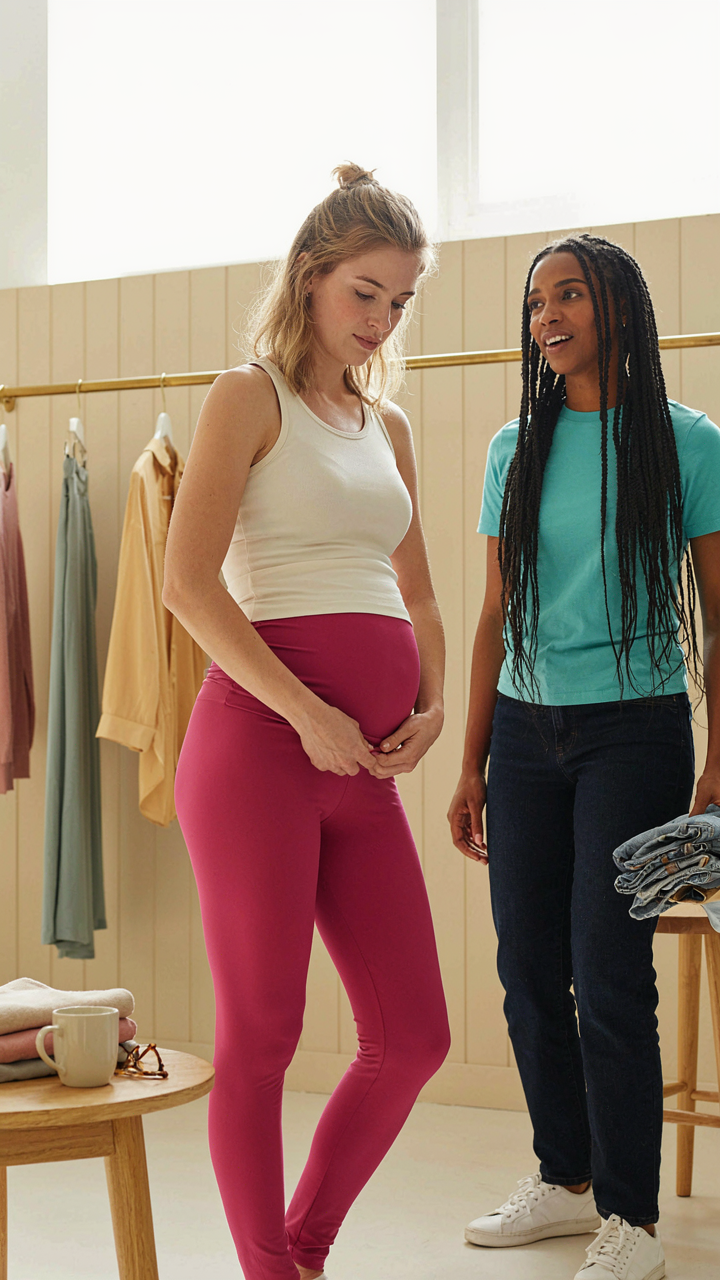
You want to believe that any fabric labeled “stretch” will work for nine months of expansion and contraction. It won’t. The mechanism here comes straight from materials science: elasticity measures how a fiber recovers after deformation, while simple stretch just means the weave has give. Most maternity activewear uses the latter and fails catastrophically by month six because the fabric never returns to its original shape.
Real elasticity requires fibers like spandex woven throughout the base material, not just loosely woven cotton or polyester. When spandex comprises 15 to 20 percent of the blend, the fabric snaps back. Below that threshold, you get sagging panels and bunching at the seams. The distinction determines whether your leggings fit in week eight the way they fit in week twelve. Test this yourself: pull a seam on any maternity activewear piece and hold for ten seconds. If it doesn’t return flat within two seconds, the spandex ratio is too low.
Recovery And Durability Over Time
Stretch retention is not magic or marketing. It’s chemistry. Every wash cycle breaks down spandex fibers slightly, which is why maternity activewear loses its snap faster than regular athletic wear if the engineering is weak. The common advice says to buy multiple pieces and rotate them. That’s correct but incomplete. What matters is that you start with genuinely high-elasticity fabric, because degradation compounds fast during pregnancy when you’re wearing pieces five or six days per week.
A maternity activewear piece with proper spandex integration maintains 80 to 90 percent of its elasticity after 30 to 40 washes. Below that standard, you’re watching your investment flatten by mid-pregnancy. Choose brands that publish their fiber content explicitly and aim for spandex ratios above 18 percent in any piece you’ll wear during peak expansion. Wash in cold water, air dry, and check the fit monthly to catch degradation early so you can replace pieces before they become unwearable.
Pregnancy Yoga And Beyond: Specialized Gear For Specialized Movement

Where Your Feet Actually Connect
You want the yoga instructor to see you as someone who has her body under control, not someone white-knuckling through downward dog. Grip matters because pregnancy shifts your center of gravity forward by up to two inches, which changes where your hands and feet need to activate to stay stable. Most maternity activewear ignores footwear entirely, but non-slip soles with enhanced traction become load-bearing infrastructure during poses that demand proprioceptive feedback.
Yoga socks with rubber grips work better than bare feet or standard socks during pregnancy because they create friction without the joint stress of full shoes. The rubber coating prevents sliding on mats while allowing natural foot spreading, which pregnancy hormones already demand. Hand grip matters equally—some maternity-specific leggings include textured waistbands or integrated grip panels at pressure points where your hands need contact during supported poses. The mechanism is simple: friction plus stability reduces compensatory tension in your lower back, which is already loaded.
Supporting Posture Where It Actually Fails
Postural alignment aids sound generic until you understand that pregnancy doesn’t distribute weight evenly. Your anterior core weakens while your posterior chain tightens, creating a mechanical problem that standard “good posture” cues don’t fix.
- Structured waistbands with strategic compression: Support the lower abdomen without restricting breathing, anchoring your center of gravity closer to your midline during forward folds and lunges.
- Built-in shelf bras with firm underband support: Prevent shoulder rounding caused by breast weight gain, which can reach five to seven pounds per side during later pregnancy.
- Seamed panels along the spine: Create gentle feedback that prevents excessive lumbar extension during back bends, redirecting stretch toward hamstrings instead of compromised discs.
- High-rise waistbands that don’t dig: Distribute pressure across a wider surface area rather than concentrating it at a single point, reducing nerve compression.
- Graduated compression in the outer thigh: Stabilizes the hip external rotators during warrior poses and lunges, preventing the valgus knee collapse that pregnancy laxity enables.
Real postural support requires engineering, not just fabric. The pieces that work use compression gradients and seam placement to create structural boundaries your ligaments can’t maintain alone. When you move through sequences, your proprioceptive system reads these cues and auto-corrects positioning without conscious thought. That’s the payoff: your body learns alignment through the gear itself.
The Postpartum Reintegration Protocol: Your Maternity Activewear As A Bridge

Compression For Recovery And Core Support
You want your body back, and you’re afraid it won’t happen. Here’s the mechanism: compression garments use mechanical pressure to reduce swelling and stabilize abdominal tissue during the healing phase. Think of it as load-bearing in structural engineering—the fabric carries stress your recovering muscles can’t yet handle alone, which accelerates return to function rather than forcing it.
Postpartum compression in maternity activewear isn’t recovery magic. It’s a temporary load-transfer system. High-waisted leggings with reinforced panels apply graduated pressure to the abdomen, reducing fluid accumulation that typically peaks between days three and five. This pressure also cues your nervous system to activate deeper core muscles without demanding maximum effort from tissue still knitting itself back together.
Transitioning Back To Non Maternity Items
Most advice here is useless: “listen to your body” tells you nothing. The real question is whether your body’s actual dimensions match your pre-pregnancy baseline. Maternity pieces stretch deliberately to accommodate shift, so they’ll feel loose once swelling drops and diastasis recti begins closing, which happens gradually over six to twelve weeks for most people.
Don’t swap everything at once. Replace one piece per week based on fit, not timeline. If your torso still needs accommodation but your waist has tightened, you’re in the hybrid phase where you mix maternity bottoms with regular tops. Once your ribcage settles and your waist returns to its natural position, your pre-pregnancy activewear will fit correctly again—this is when you fully transition out.
Beyond Fashion: The Strategic Investment In Your Maternity Activewear

The Real Math Behind Piece Selection
You’re worried you’ll waste money on clothes you’ll wear for nine months. Here’s the mechanism: cost-per-wear collapses when a piece functions across trimesters and beyond postpartum. Economics teaches us about diminishing returns, but maternity activewear inverts that curve. A quality sports bra worn 200 times over eighteen months costs less per wear than a cheap one failing after two months of stretched elastic.
High-quality pieces use stronger fabrics and construction methods that handle repeated stretching without losing shape. Cotton-blend and performance synthetic blends maintain integrity longer than budget alternatives. Buy three versatile pieces that layer and transition rather than ten single-use items. The math is simple: fewer garments rotating more frequently beats quantity chasing.
Building Layers That Work Across Your Timeline
Most advice says “buy maternity clothes as you grow.” That’s incomplete. You need a system that functions across all three trimesters plus the postpartum period when your body isn’t immediately pre-pregnancy. Think of your collection as a wardrobe operating system, not a seasonal closet. Each piece must serve multiple functions: support, coverage, temperature control, and adaptability.
Core pieces anchor the system. Supportive leggings with adjustable waistbands work early pregnancy through nursing phase. Long-line sports bras with stretch panels accommodate growth without replacement. Layering tops in neutral colors repeat across outfits. This reduces decision fatigue and cost. The protocol: identify five to seven foundational pieces, verify they function across your specific timeline, then add category-specific items only as needed.
The Real Obstacle Isn’t Your Changing Body; It’s Your Willingness To Adapt Your Toolkit, Not Your Ambition

Most women quit their fitness routines because they treat maternity activewear as a temporary compromise instead of a strategic upgrade. Your body didn’t betray you. Your old gear did. Find one quality maternity sports bra today that actually supports your changing frame, then build your rotation around it. Everything else follows. You don’t need motivation to keep moving when your clothes finally work with you instead of against you.