

The Sweat Tax: Why Most Hot Yoga Outfit Choices Fail Immediately

Performance Fabrics Don’t Perform In Heat
You’re buying the brand promise instead of testing the fabric behavior. The problem isn’t that performance materials don’t work—it’s that most people choose them for the wrong reason in hot yoga environments. Cotton fails because it absorbs sweat and holds it. Polyester blends marketed as “moisture-wicking” often trap heat instead of dissipating it. The difference matters when you’re holding Warrior II in a 105-degree room.
What actually happens: synthetic fabrics pull moisture away from skin, but dense blends slow evaporation. Looser weaves in nylon or newer polyester variants let air move through the fabric itself, cooling by exposure rather than just wicking. This is basic thermodynamics applied to textile structure. Read the weave density and fiber composition before the marketing copy. Most brands bury these details because they don’t sell as well as the word “advanced.”
The Weight Of Wet Fabric On Practice

Moisture retention operates like added resistance in your workout. As your fabric absorbs sweat beyond its wicking capacity, it gains weight and clings to your skin. That’s not metaphorical drag—it’s literal drag on your range of motion and breath capacity. A shirt that weighs two ounces dry can weigh four ounces saturated, pulling down on your shoulders and restricting chest expansion during pranayama.
The mechanism is simple: heavier fabric requires more muscular effort to move, raising your core temperature further. Your nervous system detects this extra load and interprets it as genuine effort, spiking cortisol when you should be parasympathetic. Choose ultra-lightweight fabrics under three ounces per garment and test them by soaking a sample in warm water, then squeezing it out. If it retains visible moisture after wringing, it’s too dense for hot yoga. Your practice quality depends on fabric weight as much as on your breathing technique.

The “Less Is More” Fallacy: Strategic Exposure For Optimal Hot Yoga
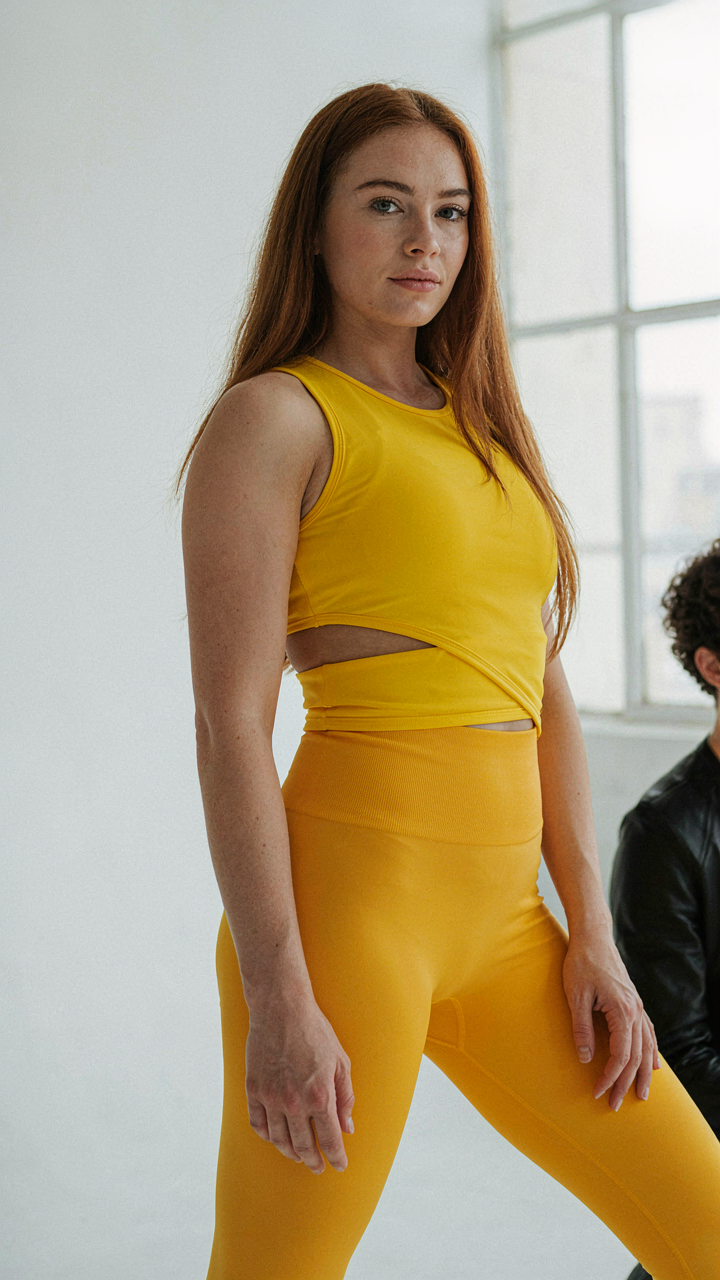
Where Heat Actually Escapes Your Body
You want permission to wear less because it looks better. That’s the real reason this section matters. But here’s the mechanism nobody states: thermoregulation isn’t about total skin exposure—it’s about airflow interruption. Borrow a term from fluid dynamics: boundary layer. Your body creates a thin thermal blanket of warm air around your skin. Tight, occlusive fabric traps this layer and magnifies heat stress. Strategic cutouts disrupt the boundary layer at high-heat zones, letting convection work instead of fighting it.
Most advice tells you to “just wear less.” Wrong. Wearing less everywhere creates uneven heat distribution and forces your core to compensate. A crop top with high-waisted leggings leaves your lower back and kidneys exposed to direct heat without protecting your midsection. The placement of exposure matters more than the total amount. Asymmetrical tank tops and side-cutout designs work because they break the thermal blanket where sweat accumulation peaks, not because showing skin is inherently cooling.
Fabric Weight And Fiber Structure
The common pitch: wear lightweight, breathable fabric. Accurate but incomplete—it ignores fiber geometry. Not all breathability works the same. Nylon and polyester move sweat differently than cotton blends or performance synthetics, and the distinction comes down to fiber cross-section and weave density. A loosely woven fabric lets air pass through but traps moisture. A tightly woven synthetic with moisture-wicking properties creates capillary action that pulls sweat away from skin, allowing faster evaporation. That’s the actual cooling mechanism. The fabric must have low permeability to liquid water but high permeability to water vapor. Choose materials with microfiber construction or intentional moisture-wicking treatments. Look for nylon-spandex blends or polyester with DriWick-type technologies that pull sweat outward rather than absorbing it. Fabric weight under 150 grams per square meter keeps the garment light without sacrificing structural integrity. Test this: spray a fabric sample with water. Quality hot yoga materials shed water instead of absorbing it.
The “Second Skin” Protocol: Engineered Fit For Unrestricted Movement

Compression Dynamics: Enhancing Blood Flow, Not Restricting It
You want compression because you think it makes you look better in the studio. What actually matters is that graduated compression in hot yoga fabrics moves blood toward your heart during intense poses, preventing the pooling that causes cramping and fatigue. Borrow from sports physiology here: compression garments work on pressure gradients, not uniform squeezing. The mechanism is directional. Fabric tension increases from ankle to hip or wrist to shoulder, forcing venous return upward. This keeps oxygen delivery steady when you’re holding a deep backbend at 105 degrees.
Most yoga brands sell compression as a static tightness stat. Wrong. Real compression fabric uses knit construction with elastane blends that maintain graduated tension through movement and sweat saturation. Four-way stretch with proper elastane content preserves that gradient even as fibers absorb moisture and you shift through transitions. The difference between adequate compression and useless tightness comes down to fiber composition and knit density, not marketing language. Test it: hold a pose for sixty seconds and notice whether your legs feel fresher or more fatigued at the sixty-second mark.
Seamless Design: Eliminating Friction And Irritation Points
Seams aren’t just uncomfortable—they’re friction traps that accelerate sweat pooling and bacteria growth. Hot yoga happens in 104-to-110-degree rooms with your skin exposed and moving across surfaces. Every seam becomes a pressure point. Seamless construction uses knitting technology that builds the garment as one continuous piece rather than cutting and stitching separate panels. There’s no interrupted thread creating a dam for moisture. Seamless design prevents the chafing that stops people from committing to longer holds.
Flat-lock stitching is the compromise option when seams are unavoidable, but it’s still inferior to true seamless because it still creates a texture discontinuity. The best hot yoga fabrics use linked construction at the shoulders and sides, places where movement is highest. Your skin needs uninterrupted contact with consistent fabric texture. When you sweat heavily, friction spikes at seam locations and irritation follows within three to four sessions. Choose seamless panels across the torso and thighs, then accept minimal seams only at internal side panels if necessary for fit.
The Hot Yoga Aesthetic Deception: Function Over Fashion Studio Fantasies

Looking Good Versus Actually Working
You want the outfit to signal you belong in that heated room. That’s the real trade you’re making—and most people optimize for the wrong variable. In thermodynamics, we call it the transfer of heat energy, but in hot yoga outfits, it’s the transfer of sweat away from your skin before it pools and breaks your grip. The gap between what looks intentional on Instagram and what keeps you stable at 105 degrees determines whether you slip off your mat or nail your hold.
Most hot yoga wear prioritizes visual coherence over vapor management. Brands layer marketing onto fabric specs because aesthetics sell faster than performance data. Your outfit needs to shed moisture faster than your body produces it, reduce friction between skin and mat, and hold its structure when soaked. The studios with the best retention rates aren’t filled with people in designer pieces. They’re filled with people who stopped caring what they looked like and started measuring what actually works.
The Trend Resistance Protocol
Ignoring trends in yoga wear isn’t about being contrarian for status. It’s about measuring your own variables instead of borrowing someone else’s framework. A fitted high-waist legging is fashionable right now. It’s also prone to bunching during forward folds in extreme heat, creating dead zones where sweat pools instead of evaporating. Your personal comfort metric matters infinitely more than the current consensus about what a hot yoga outfit should communicate.
Build a personal performance baseline by testing one variable at a time across five sessions minimum. Track which shorts, bra tops, or tank styles keep you grounded when your palms sweat. Note which fabrics recover their shape after wringing them out. Write down what actually happens to your body during holds, not what the outfit looked like walking in. This data beats any trend cycle because it’s built on your specific heat tolerance, grip strength, and movement patterns. You own this framework after three weeks of honest observation.
The Biometric Wardrobe: Hacking Your Thermoregulation In Hot Yoga

Where Heat Actually Leaves Your Body
You want to look like you belong in that 105-degree room without melting into a puddle of regret. Here’s what nobody tells you: thermoregulation is physics, and your outfit is an engine. Physics calls this “heat transfer.” In a hot yoga outfit, you’re not just choosing fabric—you’re engineering a thermal system that either accelerates evaporation or traps moisture against your skin.
The room temperature alone won’t kill you. Your body kills itself when sweat sits on your skin instead of evaporating. Evaporative cooling works through one mechanism: liquid water requires energy to become vapor, and that energy comes directly from your body heat. The faster sweat evaporates, the more heat you shed. Fabric choice determines evaporation speed. Tight cotton holds moisture. Loose, synthetic blends let air circulate underneath. Your outfit becomes the difference between thermoregulation and heat stress.
Moisture Management Below The Surface
The common advice is “wear moisture-wicking fabric.” That’s incomplete. Wicking alone doesn’t cool you—it just moves sweat around. The real mechanism happens in the fiber structure itself. Synthetic fabrics like polyester and nylon have hydrophobic properties, meaning water doesn’t bond to them. That’s deliberate engineering, not magic. The sweat moves through the fabric’s capillary channels, spreads across a larger surface area, and evaporates faster than it would on your skin.
Micro-level moisture management requires two conditions: the fabric must repel water molecules, and it must create pathways for air to reach the wet surface. Flatlock seams eliminate chafing points where moisture pools. Mesh panels strategically placed at high-sweat zones like your lower back and underarms accelerate evaporation exactly where you need it. Your hot yoga outfit functions like a breathable membrane—the mechanism is surface area multiplication and air velocity through engineered voids.
Fabric Intelligence: Beyond Cotton For Hot Yoga Outfit Superiority

When Synthetics Beat Natural Fibers
You care about this because you want to look like you know what you’re doing in a hot room. Here’s the mechanism: synthetics use capillary action from physics to move sweat away from skin faster than natural fibers absorb it. Cotton holds moisture and cools you through evaporation only, which is slow. Engineered blends don’t wait for evaporation.
Most people default to cotton because it feels “natural,” which is lazy reasoning. Performance fabrics like polyester and nylon blends move moisture at the fiber level, not the surface. They dry in minutes instead of hours. Your outfit stays light against your body instead of heavy and clingy. This matters in 105-degree heat because added weight increases core temperature.
- Polyester blends (85/15 poly-spandex): Move sweat outward through fiber structure, dry in 30-45 minutes, maintain shape under tension and repeated washing without degradation.
- Nylon composites: Higher tensile strength than polyester, resist pilling during friction zones like underarms, handle repeated hot water cycles without stretching out.
- Polypropylene microfiber: Thinner diameter than standard synthetics, creates more surface area for moisture dispersion, dries fastest but lower durability than nylon or polyester.
- Spandex blends (4-8 percent content): Add recovery and compression without bulk, regulate fit across sweat cycles, maintain seam integrity during dynamic movement.
- Moisture-wicking treatments (proprietary coatings): Applied during manufacturing, enhance capillary action chemically, separate from the base fiber performance itself.
The outfit that stays comfortable doesn’t feel premium because it performs—it feels premium because it doesn’t demand your attention during practice. Pick blends with 80+ percent synthetic content and spandex under 8 percent to avoid excessive stretch that creates baggy areas mid-session.
Bamboo Against The Rest
Bamboo marketing claims natural softness and breathability, but this oversells what bamboo actually does in a hot yoga environment. Bamboo viscose (the processed form used in apparel) absorbs moisture better than cotton but still relies on evaporative cooling. It doesn’t have the capillary structure of engineered synthetics. You’re trading performance for a feel-good narrative.
Specialized synthetics—engineered nylon or polyester with moisture-wicking treatments—outperform bamboo in rooms above 95 degrees because they work through transport, not absorption. Bamboo blends work fine for warm yoga or general wear because the heat load is lower. The trade-off is recovery time between washes and longevity under repeated hot water exposure. Choose bamboo if you prioritize sustainable sourcing over pure performance metrics. Choose synthetics if you practice hot yoga more than twice weekly and need your outfit functional for back-to-back sessions.
The “Don’t Get Choked” Rule: Necklines And Waistbands For Pose Yoga

Necklines That Won’t Strangle Your Throat
You care about this because a bad neckline will either expose you or restrict your breathing, and both kill your confidence mid-class. Think of neckline design through fluid dynamics: airflow follows the path of least resistance, and your neck is the bottleneck. A crew neck or mock neck creates a seal that traps heat and sweat exactly where you don’t want it. Racer backs and scoop necks work because they sit low enough to let air move through while keeping you covered during forward folds and inversions where gravity works against you.
High necklines sound protective until you raise your arms overhead in Mountain Pose. That’s when the fabric pulls tight across your collarbone, cutting off shoulder mobility and making you feel strangled. The real move is a scoop or V that starts at least two fingers below your collarbone. Racerback straps stay in place during movement without pinching. Test the neckline by doing three arm circles in the dressing room. If it tugs or rides up, it will sabotage every flow sequence.
Waistbands That Stay Put Without Cutting
A waistband’s job is singular: stay where you put it without moving up, rolling down, or digging into your ribs when you fold forward. High-waisted designs dominate hot yoga for a reason, not because of trends. The band distributes pressure across a wider surface area instead of concentrating force on one line, which is basic load distribution. A two-inch or wider waistband won’t dig in during extended holds or deep twists.
The mechanism that actually keeps pants up is friction combined with a gentle grip. Elastic that’s too tight creates pressure that numbs your core after thirty minutes. Elastic that’s too loose slides south during Downward Dog. You need a band that secures without compression. Test it by wearing the pants for ten minutes before class and doing a forward fold. If you feel a pressure line or the band slips, find another cut. The right waistband disappears from your awareness entirely.
Footwear & Headwear: Unsung Heroes Of Hot Yoga Outfit Comfort

Barefoot Versus Grip Socks: What Actually Matters
You want grip socks because you’re afraid of slipping and looking incompetent in front of strangers. That’s the real reason. But here’s the mechanism: hot yoga creates a friction problem. Your feet sweat. The mat becomes a hydroplaning surface. Barefoot yogis rely on mat texture and foot positioning. Grip socks use rubber pads on the sole to create traction through moisture. Studios market grip socks as premium accessories, but the actual choice depends on your mat quality and foot sweat rate, not brand messaging.
Barefoot practice builds proprioceptive feedback from the mat surface directly to your sole. You feel micro-adjustments. Grip socks reduce that sensory input but eliminate slip risk. Choose barefoot if your studio uses premium mats with high friction. Choose grip socks if you sweat heavily or the mat feels slick. Hygiene is secondary to function here. The studio cleans the mat between classes. Your personal mat at home doesn’t encounter other people’s bacteria. Test both approaches in your first three sessions, then commit to whichever prevents you from correcting balance mid-pose.
Headbands And Hair Ties: Sweat Management As Focus Tool
Sweat in your eyes kills focus faster than a weak intention ever could. Headbands and hair ties aren’t accessories; they’re cognitive engineering. Physiology shows that thermal discomfort and visual distraction trigger the amygdala’s threat response. A headband channels sweat away from your face. A secure hair tie prevents strands from moving, which creates micro-distractions your brain processes as instability. Both tools reduce noise in your nervous system during heat exposure. The right setup means your prefrontal cortex stays online instead of hijacked by sensory irritation.
Wear a moisture-wicking headband on your forehead and hairline, not a decorative band. Position it before you sweat, not after. Hair ties should be tight enough that they don’t shift during downward dog. Loose bands will slip as your scalp heats up. Quality matters: synthetic or merino blend headbands wick faster than cotton. Replace them every six months. Once you eliminate sweat and hair distraction, you notice your breath control improves within one session.
Post Practice Rituals: Extending Your Hot Yoga Outfit Lifespan

Immediate Care: The Real Cost Of Waiting
You want your gear to last because replacing it constantly signals poor planning. Here’s the mechanism: sweat doesn’t damage fabric. Bacteria colonizing dried sweat does. The moment you leave the studio, you’ve started a microbial clock. Nylon and spandex blends trap moisture in their weave structure. That trapped environment becomes a breeding ground within hours if you don’t interrupt it.
Rinse your outfit in cold water before sweat fully dries. This physically removes salt and mineral deposits that accelerate fiber breakdown. Don’t throw it in a gym bag. Air drying matters more than you think because moisture trapped against your skin transfers bacteria back into the fabric. Hang it immediately after rinsing, away from direct heat or sunlight, which degrades elastane faster than sweat ever will.
Washing Protocols: Material Science Meets Maintenance
Think of your hot yoga outfit as a high performance material system, not casual clothing. In materials engineering, fatigue failure happens when stress cycles accumulate. Each wash cycle is a stress cycle on spandex fibers. Machine washing accelerates this degradation through agitation and heat. Most people wash wrong and blame the brand.
Hand wash in cold water with mild detergent designed for technical fabrics. Use a delicate cycle if you must use a machine, but avoid the dryer entirely. Heat destroys elastane’s molecular structure permanently. Lay flat to dry or hang from a clip. The stretch returns when you follow this protocol. Skip fabric softener and bleach completely. They coat the fibers and reduce the fabric’s ability to wick moisture during your next session.
Beautiful Yoga Poses Photography: Capturing Authentic Performance

Real Movement Over Posed Stillness
You want these photos to make you look effortless. That’s the real motive here. The mechanism is simple: stillness reads as strain in hot yoga because sweat, heat, and muscle engagement all demand continuous micro-adjustments. A frozen pose looks unnatural. Motion photography captures what actually happens in your body during practice, which is movement through space under load and temperature stress.
Most yoga photography advice says “get the peak moment.” That’s incomplete. The peak moment is often the moment right before total commitment, when muscles brace and tension shows. Instead, capture mid-flow transitions where your outfit moves with you, where fabric has already shifted to its working position, where the body reads as integrated rather than flexed. This shows how your hot yoga outfit performs under real conditions, not studio conditions.
Fabric Behavior Under Load
Biomechanics has a term called “compliance”—the ability of a material to deform under stress then return to form. Your hot yoga outfit’s compliance determines whether photography shows control or chaos. Nylon blends with spandex demonstrate high compliance. They compress during deep forward folds, then snap back when you move into standing sequences. Cotton blends fail here. They absorb sweat, stay deformed, and read visually as limp in photos.
Photograph the moments where your outfit resists and recovers. High-waisted designs show this clearly during hip-opening poses because the waistband stays planted while your torso rotates. Racerback tops demonstrate compliance during arm transitions because the straps track shoulder movement without bunching. The outfit that stays functional in motion is the outfit that photographs as intentional rather than accidental. Choose materials and cuts that film their own competence.
The Real Obstacle Isn’t The Heat, It’s Your Attachment To Looking Like Everyone Else

You don’t need the Instagram-perfect hot yoga outfit. You need the one that makes you move without thinking about your body. Stop buying what the algorithm shows you. Tomorrow, wear whatever you already own that lets you breathe and stretch. Notice what actually works. Your real competition isn’t the person next to you in matching sets. It’s the voice telling you to care what they think.