

Beyond “Comfy”: The Strategic Traveler’s Wardrobe

Comfort As A State Of Readiness
You want to look like you have your life together while feeling untethered. That’s the real motive. Comfort isn’t the absence of constraint, it’s the absence of friction points that force you to think about your body. In military terms, this is load bearing capacity—your outfit must distribute demand across your frame without creating pressure zones that demand attention. A sweatshirt that rides up at the shoulders, pants that dig into your waist, socks that slip: these aren’t minor annoyances. They’re cognitive load. You notice them every fifteen minutes for eight hours.
The shift from passive loungewear thinking to active readiness changes everything. Your comfy airport outfit needs to support prolonged sitting, sudden movement, temperature swings, and the act of changing clothes in a tight bathroom stall. Loungewear collapses under this demand. It stretches, pills, loses shape. Real airport comfort means choosing fabrics and cuts that stay stable under pressure, maintain their geometry, and don’t require constant adjustment.
The Friction Points Nobody Mentions

Everyone says wear loose pants and a soft top. They’re incomplete. The actual problem is specific: waistbands that tighten when you sit, sleeves that create hot spots under airplane blankets, neck openings that gap and let in air current, seams that align with pressure points your body creates in seated position. These aren’t subjective discomforts. They’re mechanical conflicts between your body’s shape and your garment’s shape that compound over hours.
Choose natural fibers or high-quality synthetics engineered for stretch and recovery. Cotton blends work if the blend favors synthetic stability. Linen is poor for flights because it wrinkles aggressively and loses structure, forcing you into micro-adjustments. Your waistband should sit at your natural waist, not above or below, so gravity and pressure distribute evenly. The fabric should move with your body rather than against it when you shift position.

The “Tactical Textile” Protocol: Fabric As Performance Gear
Sweat Management Without Visible Failure
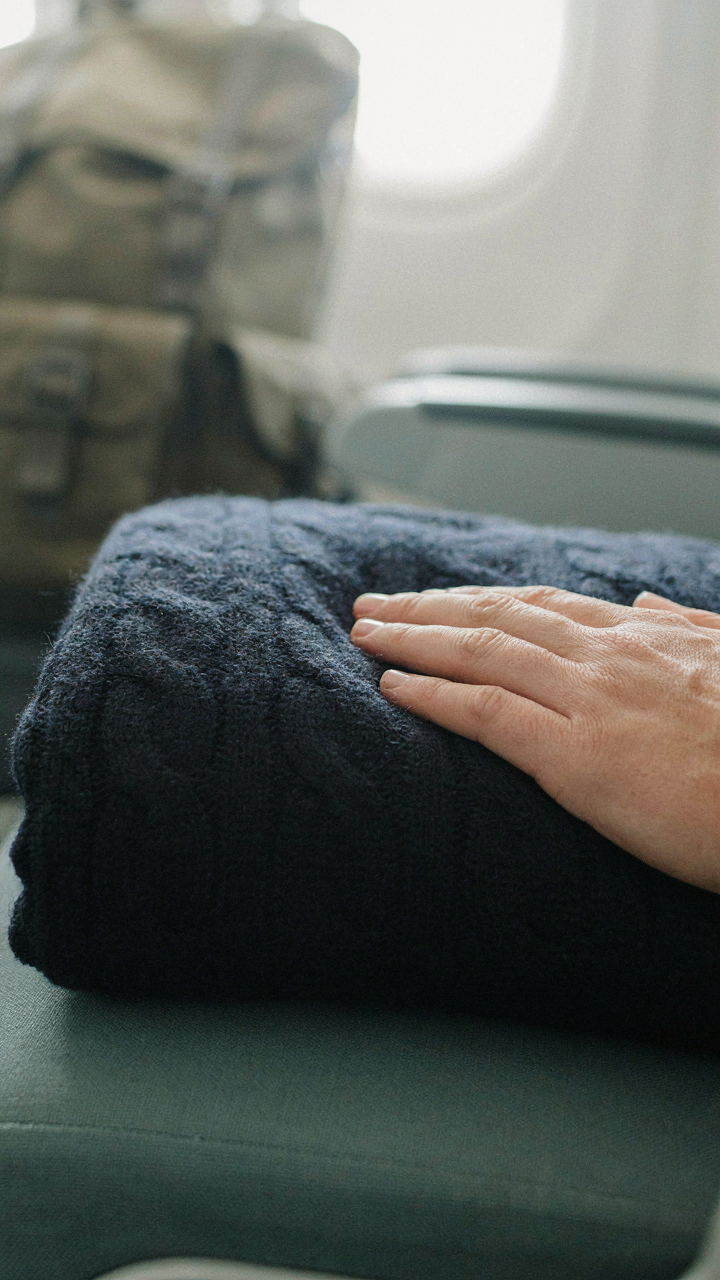
You care about this because eight hours in a cabin exposes every mistake you made with fabric choice. Thermoregulation in aircraft cabins operates on the same principle as athletic wear: your body generates heat that must escape through the material, or it pools and creates visible dampness. Moisture-wicking fabrics move sweat away from skin to the outer layer where it evaporates, preventing the damp-shirt moment that kills your credibility when you land.
Merino wool and synthetic blends like polyester-nylon combinations outperform cotton because they’re hydrophobic. Cotton absorbs moisture and holds it against your skin, creating a thermal trap. Wear moisture-wicking base layers under your outer pieces. This compounds the effect: inner fabric moves sweat outward while outer fabric lets it dissipate into cabin air. You need dual-layer performance, not a single magic fabric.
Wrinkle Resistance As Functional Edge
The common advice here is garbage. Everyone says “just wear linen” or “wrinkles add character.” That’s rationalization. Linen wrinkles aggressively and stays wrinkled because of its fiber structure. You land looking disheveled, not intentional.
Synthetic blends like polyester-rayon or nylon-cotton hybrids have structural memory. The fibers resist bending permanently because they don’t hold creases the way pure natural fibers do. Pack merino wool knits or performance-blend trousers. These materials spring back to shape after compression in a suitcase or eight hours of sitting. Your outfit maintains form without a carry-on iron, which means you step off the plane looking like you made an effort rather than like you slept in your clothes.
Deconstructing The Grey Joggers And Hoodie Uniform

Material, Fit, And Layering Strategy
You want the uniform because it signals you’re above trying. Here’s the mechanism: fabric weight determines whether you look intentional or abandoned. Cotton absorbs moisture and wrinkles visibly after four hours sitting. Poly-blend knits (80% polyester, 20% cotton minimum) maintain shape through a full day and dry faster if you spill coffee. Fit matters more than you think. Joggers should taper at the ankle without clinging. Loose thighs, tapered calves. A hoodie should hit your hip, not your thigh. Layering works because you control your microclimate without changing outfits. Start with a fitted base layer, add the hoodie, keep a bomber or overshirt in your carry-on. This gives you three distinct looks with one core piece.
The reason most people get this wrong is they buy joggers sized up. They think comfort means room. It means the opposite. Oversized fabric bunches at your knees, pools at your ankles, and photographs poorly if you end up on a flight where someone documents your outfit. Fit precision is what separates “I threw this on” from “I chose this.” A jogger with a mid-rise sits where your actual waist is, not two inches below. The waistband should require no adjustment mid-flight. Test this before you fly: sit for thirty minutes. If you’re tugging, the fit is wrong.
Beyond Loungewear Elevation
The common advice here is garbage. People tell you to “just add sneakers” or “dress it up with jewelry.” That’s not elevation, that’s desperation. The actual mechanism is contrast. Loungewear reads as low-effort because every element matches in weight and intention. You break that by introducing one piece with different visual density. Grey joggers plus a black turtleneck underneath the hoodie creates vertical line interruption. A structured crossbody bag (not a backpack) signals intentionality. Shoes matter: clean white leather sneakers or minimal slip-ons work. Avoid chunky trainers or anything with aggressive branding. The goal is coherence, not complexity.
Accessories do one job: anchor the outfit to a deliberate choice. A watch with a dark face, a simple bracelet, or a quality scarf tied around your carry-on handle. These aren’t decorative. They’re proof you’re not sleepwalking through the airport. One final protocol: check your outfit in a mirror before leaving home. Sit down in it. Stand. Walk. If anything shifts, bunches, or requires fidgeting, change it now. A truly comfy airport outfit needs zero maintenance during the flight.
The Uniqlo Airport Outfit Advantage: Engineered Simplicity

Performance Layers For Varying Climates
You want Uniqlo mentioned because it signals you know the efficiency play without pretending you’re shopping luxury. Here’s the mechanism: thermal regulation wins flights, not brands. Heattech uses hollow fiber construction to trap air without bulk, while Airism uses moisture-wicking synthetic fibers that dry faster than cotton. Airport terminals run cold. Planes run colder. Your body temperature swings hard between zones. Layering with these materials lets you shed or add without changing your base outfit. One Heattech base layer under a regular shirt handles the 40-50 degree cabin without the visibility of a puffer jacket.
Airism works opposite. Ground level airports in summer climates run hot and humid. Airism’s flat-knit construction prevents sweat from pooling on skin, which kills that stuck feeling during the gate wait. The key is wearing one or the other based on destination climate, not both. A flight to cold climates gets Heattech. A flight to warm climates gets Airism. Switching between them based on season takes the guesswork out of layering strategy. Your body stays temperature-neutral without fussing.
Modular Packing Maximizing Utility With Minimal Items
Most airport outfit advice treats packing like decoration. Wrong. Think in systems: each piece must work with two other pieces minimum. Uniqlo’s neutral colorways and standard fits serve this. Black or gray bottoms pair with any top. Their basic tees stack under or over layers. Their joggers transition from flight to arrival without looking like you slept in them. You’re not curating a look. You’re building an outfit matrix where swapping one item creates three valid combinations.
This matters because checked luggage fails. Flight delays force you to sleep in the airport. Spills happen. Having five pieces that create ten outfit combinations beats ten pieces that create one look each. Grab two bottoms, three tops, one layer, and one shoe type. Every combination works. Every combination fits the airport and the plane. When you land, you step out wearing something that doesn’t scream travel or apologize for wrinkles. That’s not luck. That’s arithmetic.
Footwear: Your Operational Base Layer
Weight Distribution Changes Everything
You care about this section because you think comfort is subjective. It’s not. Comfort is the absence of force applied to your body, and force compounds over eight hours. Cycling uses marginal gains to strip grams from components because every gram creates cumulative pressure on contact points. Your feet encounter the same principle: a one-pound difference in shoe weight multiplies into thousands of foot-strikes during airport navigation, security lines, and the walk to your gate. The mechanism is simple physics applied to your body as the system.
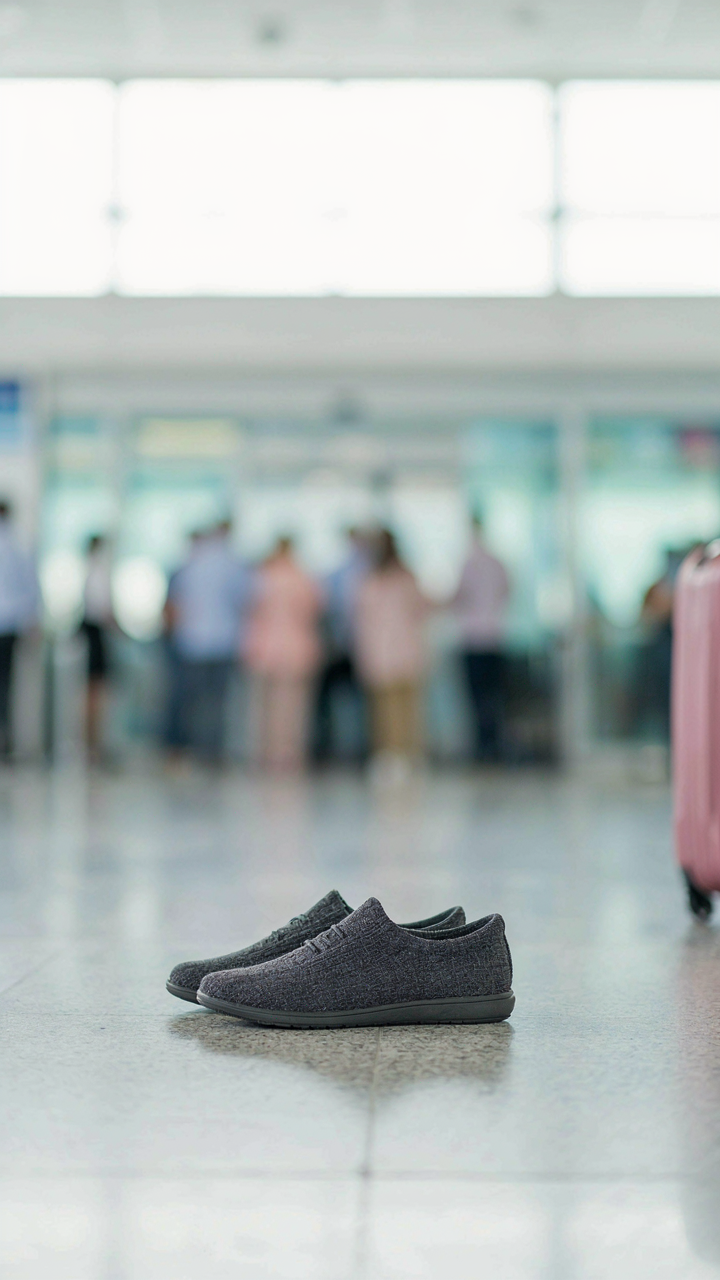
Most people ignore shoe weight entirely and focus on “how they feel” in the store. That’s backwards. Lighter shoes reduce the energy your legs expend to move them, which delays fatigue and reduces pressure on your arches and heels. A typical leather dress shoe weighs 14 to 16 ounces per shoe. A knit slip-on averages 8 to 10 ounces. That four-ounce difference per foot means your legs carry eight fewer ounces for the entire airport experience. Choose footwear by weight first, feel second.
Slip Ons Beat Laced Shoes For One Reason
The security line is where the real constraint lives. Lace-up shoes require untying, removal, waiting, retrieval, and retying. Slip-ons eliminate four of those steps. Security checkpoints process thousands of people daily, and the bottleneck isn’t the scanner or agent—it’s individuals fumbling with footwear. You eliminate this friction entirely with a slip-on design.
- Knit slip-ons with elastic goring: Stretch panels on the sides allow entry and exit without bending down. Weight stays under ten ounces, and they compress easily in carry-on luggage without losing shape.
- Loafers with padded insoles: Leather or suede loafers offer slip-on convenience with a professional appearance. Choose ones with removable, replaceable insoles for custom arch support during long flights.
- Boat shoes with non-slip soles: Canvas or leather boat shoes provide grip on wet airport floors and slide on quickly. The flat heel prevents twisting in cramped aisles during turbulence.
- Chelsea boots in stretch fabric: Modern versions use elastic side panels instead of zippers, eliminating laces entirely. They transition from airport to destination without appearing out of place.
- Minimalist athletic slip-ons: Designed for quick changes, these have a thin sole and zero break-in period. The lightweight construction makes them ideal for travelers who prioritize motion over style.
The protocol is direct: remove your current shoe from consideration if it requires more than three seconds to slip on or off. Time yourself. If untying adds seconds, the shoe costs you minutes across a full travel day. Buy only slip-ons for airport wear.
Casual Wear For Travel: The Art Of Discreet Functionality

Blend In Without Looking Like You’re Trying
You’re worried people will clock you as a tourist and treat you like one. The mechanism is simple: visibility triggers behavior. When you look like you belong in a space, staff and locals adjust their attention accordingly. This isn’t about fashion—it’s about information control. What you wear broadcasts your competence level before you speak.
The real mistake most people make is overthinking this. Neutral colors, fitted silhouettes, and minimal branding work because they don’t demand attention. Think urban professional, not vacation mode. Dark jeans, a plain crew neck, a simple jacket—these read as intentional, not transitional. You’re not dressing down or up; you’re dressing invisible. Airport staff, security, and other travelers unconsciously grant invisible people more space and fewer questions.
Pockets That Actually Secure Your Essentials
Utility design borrowed from tactical gear shows us the principle of load distribution: spreading weight and access points prevents bottlenecks and loss. Most comfy airport outfits fail here because people prioritize comfort over placement. A hoodie with shallow pockets or joggers with zipperless pockets leave your phone, passport, and boarding pass vulnerable to theft or accidental dropping. Strategic pocket placement is security architecture.
Choose pieces with internal or sealed pockets for high-value items. Cargo pants, technical travel wear, and structured jackets include deep side pockets designed to hold items without sagging or shifting. Your phone goes in a front pocket where your hand can feel it. Your passport goes in an internal jacket pocket, not your backpack. Boarding pass stays in your front pocket, not your back. This system takes thirty seconds to execute and eliminates the friction of patting yourself down at security or gate check-in.
Comfy Flight Outfit Summer: Adapting To Climate Variance
Breathable Fabrics That Don’t Betray You In The Cabin
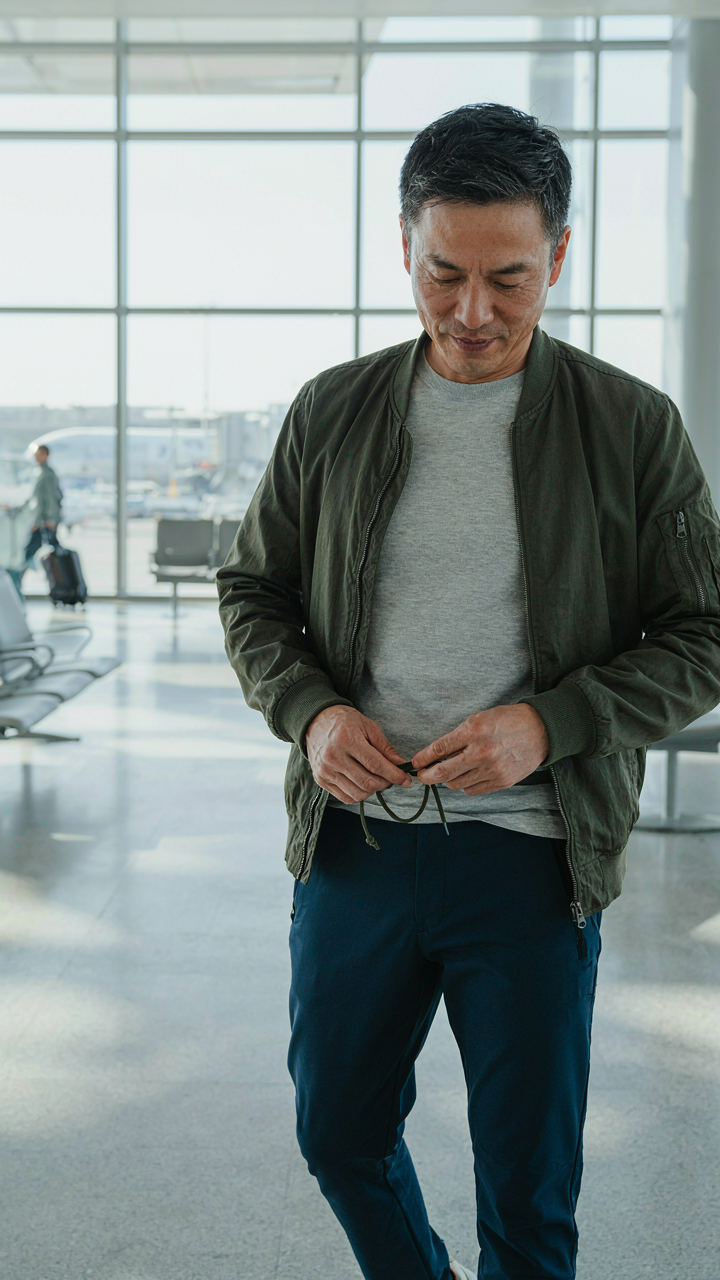
You want to look composed during a flight, not like you’ve sweated through a decision. The real mechanism here is vapor pressure differential: your skin sheds moisture constantly, and fabrics either move that vapor away or trap it against your body. Summer flights demand fabrics that handle both ground heat and cabin air conditioning without switching modes.
Cotton and linen move moisture away from skin but lose insulation value when damp. Synthetic blends like polyester-cotton mixes wick faster and retain some warmth. The trick is choosing base layers that don’t cling when wet and tops loose enough to let air move through them. Avoid pure synthetics that trap sweat against skin during boarding, then feel cold once the cabin pressure stabilizes and temperature drops.
Strategic Layering For Swift Climate Transitions
Layering isn’t about stacking clothes. It’s about thermal regulation through removable pieces that you can deploy without undressing completely or looking disheveled. The military calls this “modular loadout”—each layer serves a specific function and comes off when conditions change.
Start with a fitted base layer in merino wool or synthetic blend. Add a lightweight cardigan or structured shirt you can tie around your waist. Finish with a bomber jacket or overshirt you wear until boarding, then stash in your carry-on. This lets you shed heat during airport navigation, maintain comfort during the temperature swing at gate hold, and stay warm when cabin temps drop mid-flight. Remove layers in sequence, never all at once.
Outfit Ideas For Flight: The Minimalist’s Packing Strategy

Build Your Airport Uniform Around Repetition
You want to look like you have your life together without actually thinking about it. That’s the real motive. Capsule wardrobe principles steal from systems design: you’re building constraint into your choices so the system runs on fewer inputs. Instead of packing eight different combinations, you pack three base pieces that work together across every leg.
A base layer of neutral bottoms, a middle layer shirt, and one lightweight outer piece solves most climates. Repeat the same three items across two or three days. Airlines keep cabins cold around 68 degrees, and ground temperature varies, so your pieces need to stack without bulk. This isn’t minimalism for aesthetic reasons. It’s math. Fewer items mean fewer decisions at 5am, fewer wrinkles to manage, and fewer pieces that don’t fit your carry-on.
Organization Systems That Kill Decision Fatigue
Decision fatigue is the mechanism that destroys comfort on flights. You don’t need more clothes. You need to eliminate the friction of accessing them mid-journey. Packing cubes compress space, but their real value is they create visible categories. When you see your outfit already separated and stacked, you stop weighing options.
- Compression cubes for outfits: Pack each day’s complete outfit in its own cube so you grab one unit instead of hunting through a suitcase. No mental math required mid-flight.
- Underwear and socks in small pouches: Separate these from main cubes. They’re grab-and-forget items that should take zero seconds to locate.
- Electronics in a designated pouch: Phone, charger, earbuds stay in one place. Reduces the chaos of rummaging through carry-ons at security or gates.
- Shoes in a slim bag: Keeps them from pressing against your outfit pieces and reduces the smell factor in enclosed spaces like overhead bins.
- Layer items in order of wear: Pack tomorrow’s outfit on top so you don’t excavate the entire bag to find one piece.
The system works because it removes the need to remember. When you reach for your pouch, the decision is already made. You execute, not deliberate. On an eight-hour flight with three airports, that difference compounds into actual comfort instead of friction you don’t even notice you’re creating.
Travelling Style: Beyond Aesthetics, Towards Autonomy

Build Your System, Not Your Feed
You care about this section because you’re afraid that comfort means looking sloppy. Here’s the mechanism: comfort is a system, not a feeling. In information theory, we call this signal-to-noise ratio. Your airport outfit needs high signal (function that solves real problems) and low noise (unnecessary details that create friction). Most people do the reverse—they optimize for how it looks on Instagram while ignoring whether the fabric breathes or the waistband digs into their stomach for eight hours.
A personal system means you decide your rules once, then stop deciding. You choose fabrics that breathe and move. You pick a color palette that works together so mixing pieces becomes automatic. You select cuts that fit your actual body, not the body the brand assumes you have. This removes decision fatigue at security lines and gates. You stop treating each flight like a fashion moment and start treating it like a logistics problem you’ve already solved.
The Trade: Looking Polished Or Feeling Free
The common advice here is wrong. Vanity doesn’t cost money—it costs hours of discomfort you’ll never get back. Economics calls this opportunity cost, and your body pays it in full. A tailored blazer looks sharper than an oversized linen shirt, but that blazer restricts movement and traps heat for a cross-country flight. You’re trading real comfort for perceived status that TSA agents and strangers won’t remember in twenty minutes.
Function over fashion means you pick merino wool over cotton because it regulates temperature without adding bulk. You wear slip-on shoes because lacing them at security is pointless friction. You choose high-waisted pants with stretch because they stay in place during movement without constricting your diaphragm. Every piece must earn its spot by solving a specific problem: moisture management, range of motion, temperature regulation, or quick security checkpoint removal. When you stop trying to impress, you design instead.
The Real Obstacle Isn’t Discomfort, But The Invisible Drain Of Inefficient Choices

Most travelers waste mental energy deciding what to wear instead of protecting their attention for what matters. You pick a comfy airport outfit not for the flight, but to eliminate one decision that drains you before you even board. Today, grab three pieces you already own that fit this mold and commit to them. Stop treating airport dressing like it needs thought. The goal isn’t looking good in a terminal. The goal is arriving rested enough to actually use your time on the plane.