

The Microclimate Control Protocol: Your Personal Weather System

Gap Strategy Over Coverage
You want to look put-together without sweating through your clothes by noon. Here’s what nobody says plainly: the thermodynamics principle of convection applies directly to your outfit. Heat moves from your skin to the air through moving air currents. Gaps in your clothing aren’t failures of design—they’re deliberate channels that pull warm air away from your body.
The standard advice says “wear light colors and breathable fabric.” That’s incomplete. You can wear the most breathable fabric made and still overheat if your outfit traps air against your skin. A sleeveless top with fitted shorts creates dead zones where sweat sits. Intentional gaps between pieces—exposed collarbone, space between a cropped shirt and high-waisted bottoms, open sides—move air across your body and prevent that stagnant heat pocket.
Fiber Selection As Heat Dissipation

Natural fibers absorb and release moisture at different rates, and your outfit’s performance hinges entirely on which ones you choose. Cotton absorbs up to 27 percent of its weight in water before feeling damp. Linen absorbs moisture but releases it faster, so you feel drier longer. Synthetic blends like nylon and polyester wick moisture away from skin but trap heat at the surface.
For summer, pure linen or linen-blend fabrics outperform cotton in actual heat management. Linen’s hollow fiber structure allows air circulation within the weave itself, not just on the surface. Cotton stays wet against your skin after sweating. Choose linen for items that touch your torso directly—tanks, shirts, lightweight pants—and save cotton for pieces that sit loose or don’t touch skin. The fiber you pick determines whether you cool down or stay damp.

Beyond “Light Colors”: The Albedo Effect For Summer Style

Why White Actually Works Better Than You Think
You want the easy answer: wear light colors and you’ll stay cool. But that’s incomplete, and it costs you outfit options. Physics calls it albedo—the measure of how much solar radiation a surface reflects instead of absorbing. Apply this directly to fabric: a white cotton shirt reflects roughly 70 percent of incoming sunlight, while a navy one absorbs most of it and converts that energy to heat against your skin. The difference isn’t marginal. It’s measurable and it compounds over hours in direct sun.
White dominates summer styling for one mechanical reason: reflectivity. But the color spectrum matters more than you’re told. Cream, off-white, and pale yellow perform nearly as well as pure white while avoiding the visual flatness that makes white look cheap or institutional. Pale gray reflects adequately without the brightness some find harsh. Navy, black, and charcoal fail the albedo test entirely. The mechanism is straightforward: lighter hues have longer wavelengths that bounce back instead of converting to thermal energy. Choose your summer base layer by reflectivity first, aesthetics second.
Surface Texture Changes Heat Absorption More Than Fabric Type
Everyone fixates on cotton versus linen, but they’re missing the real lever. Texture—the physical surface structure of the weave—determines how much heat the fabric can shed through air circulation. A smooth, tight weave traps air molecules against your skin and holds heat. A loose, textured weave creates gaps that allow moving air to pull moisture and warmth away. Linen wins in summer not because of the fiber itself, but because traditional linen construction is inherently loose and textured. It’s a material property that directly affects convection.
Cotton performs just as well when woven loose enough to match linen’s structure. The problem is most summer cotton is woven tight to feel refined. Tactile roughness is your indicator: run your hand across the fabric. If it feels smooth and dense, heat stays trapped. If it feels open and slightly irregular, air moves through it efficiently. That’s the mechanism you actually need to evaluate. When selecting casual summer outfits, prioritize loose weaves in any fiber over specific fabric names. Check the thread count if available—lower counts mean looser construction. Apply this rule before color, and you outpace 90 percent of summer dressing advice.
The “Breathable Gap” Theory: Airflow Is Your AC

Fit Creates The Ventilation Zones
You want to stay cool without looking sloppy, and that tension is real. The mechanism is simple: tight fabric traps heat against your skin. Loose fabric lets air move across it. The gap between your body and the garment is where cooling happens. A fitted tank top that sits half an inch from your torso moves air through that space. A baggy tee suffocates itself against your chest because fabric bunches and blocks circulation.
Strategic fit means placing loose zones exactly where your body generates the most heat: armpits, inner thighs, the small of your back. Fitted sleeves with loose side seams work. A snug waistband with an open back works. Tight everywhere fails. The goal isn’t loose or fitted in absolute terms. The goal is engineered gaps where sweat can evaporate instead of pooling under fabric.
Convection Does The Real Work Here
Physics calls it convection: fluid (air or sweat) moves from hot zones to cool zones, transferring heat. In garment design, this means the shape and placement of openings determine how effectively air cycles through your outfit. A shirt with side slits moves air vertically up your torso. A dress with a high back cutout creates a stack effect: hot air rises and exits through the opening.
Most summer advice tells you to wear “breathable fabrics” and calls it done. That’s incomplete. Fabric matters less than airflow pattern. Linen traps heat if it’s tailored tight. Cotton lets air circulate if it’s cut with vents. A sleeveless cut with underarm gussets beats a short-sleeved shirt with sealed seams every time. The fabric is secondary to the geometry. Design the gaps first, then choose your material.
Smart Fabric Selection: Your Defense Against Humidity (Women’s Fashion Summer)

Natural Fibers Versus Performance Synthetics
You want to believe cotton is always the answer because it feels premium and natural. It isn’t. Cotton absorbs moisture and holds it against your skin, making you feel heavier as humidity climbs. The mechanism is absorption capacity: cotton fibers swell when wet, trapping sweat and slowing evaporation. In physics terms, this is thermal mass working against you. Heavy fabric equals heat retention.
Performance synthetics like nylon and polyester function differently. They repel moisture rather than absorb it, allowing sweat to move across the surface faster. Linen occupies the middle ground, offering breathability without the moisture-trapping liability of pure cotton. For summer, the rule is simple: prioritize fiber behavior over fiber origin. What the material does matters more than what it is.
Weave Types For Maximum Air Permeability
Loose weaves win. Tight weaves trap air; loose weaves let it move through. Gauze, voile, and open-weave linen create channels for airflow that dense fabrics block. The textile industry measures this as thread count inversely related to breathability. Lower thread count typically means larger gaps between fibers, which means faster air circulation against your skin.
Seek fabrics with visible texture or intentional spacing. Seersucker, chambray, and mesh weaves all use structure to create airflow paths. Jersey knit moves with your body without clinging. Avoid anything that reads as uniform and smooth in hand; that density signals trapped heat. Test breathability by holding fabric up to light. If you see light pass through easily, air passes through the same way.
The Minimalist Wardrobe: Casual Classy Outfits For Any Summer
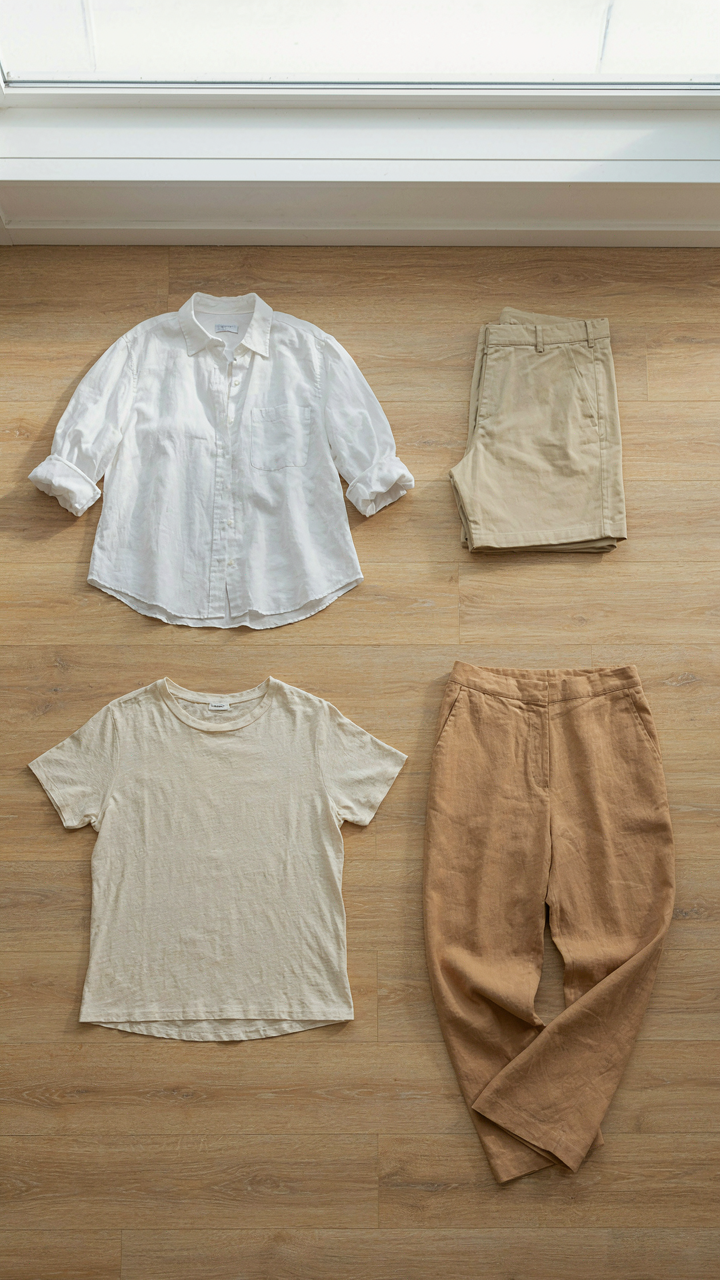
Core Pieces That Actually Work
You want to look put-together without thinking about it, which means you’re afraid that looking effortless requires effort. Here’s the mechanism: a capsule wardrobe removes decision friction by creating automatic combinations. You buy pieces that layer with each other, not pieces that sit alone.
- White linen shirt: Breathes in heat, pairs with shorts or lightweight pants, works untucked or tied at the waist. Linen wrinkles are intentional, not a flaw.
- Neutral flat-front shorts: Khaki, cream, or soft gray. Mid-thigh length works across body types. Skip cargo pockets and excess hardware.
- Lightweight cotton tees: Fitted, not oversized. Cream, navy, and gray form the foundation. Quality cotton resists pilling and holds shape after washing.
- Linen blend pants: Moves between casual and semi-dressy. Natural fiber blend reduces wrinkles without sacrificing breathability.
- Simple cotton sundress: Unstructured cut, neutral tone. Acts as both outfit and base layer for styling flexibility.
These five pieces combine into dozens of outfits because they share a color family and similar weight. You’re not collecting styles, you’re collecting compatible tools. The entire system collapses if you buy one colorful statement piece that matches nothing else.
Building Real Durability Into Fabric Choice
The common advice says buy quality. That’s not wrong, but it’s incomplete. Economics teaches you that durability is a function of material density, not brand name or price. In summer clothes, this means fabric weight measured in grams per square meter.
Linen at 200+ GSM and cotton at 150+ GSM resist pilling, hold their shape through multiple washes, and keep their drape. Cheaper versions use thinner fibers that break down faster in heat and humidity. A $40 heavy cotton tee outlasts three $20 synthetic blends. You’re not paying for prestige, you’re paying for fiber strength that survives the washer. Check the tag. If the fabric weight isn’t listed, that’s a red flag that the manufacturer is hiding thinness. When you find pieces that work, buy a backup in the same size and color before the retailer discontinues it.
Strategic Accessorizing: Shade And Style

The Hat That Actually Works
You want people to notice you stayed put together in ninety-degree heat. Here’s the mechanism: a wide-brim hat doesn’t just block UV rays—it creates an air gap between your scalp and the sun’s direct radiation. Physics calls this the albedo effect, where light-colored surfaces reflect rather than absorb energy. Apply that principle to summer outfits: a seven to eight-inch brim deflects heat before it reaches your head, lowering core temperature measurably. Most women skip this because it feels like protection gear, not fashion. Wrong framing. The hat is the outfit’s thermal engine.
Straw and linen hats beat cotton because their weave structure allows faster evaporation while maintaining that gap. Cream, white, or natural tan colors outperform darker options by a significant margin—not because of fashion rules, but because they bounce more wavelengths back into the atmosphere. Pair the hat with a simple linen shirt or sleeveless tank, and you’ve eliminated the cognitive load of “does this match.” The hat does the work. Your outfit stays coherent while your body stays cooler than it would in full sun, brimless.
Bags And Shoes That Don’t Trap Heat
Forgetting about footwear and bag weight is lazy advice that solves half the problem. A heavy canvas tote or structured leather shoulder bag forces your body to work harder in heat, raising sweat production and core temperature. Switch to a crossbody bag made from mesh, linen, or breathable nylon—something under two pounds. Your shoulder doesn’t stay compressed, airflow reaches your torso, and you move without fighting your own gear.
Shoes matter the same way. Closed-toe leather traps moisture and heat against your foot, which signals your nervous system to sweat more broadly. Flat sandals, woven slides, or minimal canvas sneakers let air circulate. Match bag and shoe materials—both breathable, both light in color and weight. That combination keeps your outfit functional in heat, not just visually coherent. The outfit stops fighting your body and starts working with it.
The “Florida Outfits” Fallacy: Why Less Isn’t Always More

Loose Fabric Does The Work You Don’t
You think maximum skin exposure keeps you cool because you’re afraid of looking covered up in summer. Wrong mechanism. Thermal dynamics matter more than visibility. Loose, lightweight fabric creates airflow against your skin that tight or bare skin cannot replicate. A linen shirt worn open over a tank moves air. Bare shoulders stagnate heat against your body. The gap between fabric and skin is the cooling system, not the absence of fabric itself.
Most summer advice stops at “wear less.” That’s incomplete and backwards. Loose cotton and linen garments trap moving air in a thin layer that acts as insulation against external heat while allowing sweat to evaporate. Fitted clothes cling to your body and prevent this convection. A loose oversized tee outperforms a crop top in actual temperature regulation because it creates space for air circulation. The mechanism isn’t exposure. It’s airflow management.
Protection Beats Exposure Every Time
Sun exposure raises core body temperature faster than ambient heat does. This is physics, not preference. A woman in a lightweight long-sleeve shirt with UPF protection stays cooler than one in a sports bra because the sun radiates direct thermal energy onto exposed skin. Your body then works harder to cool itself, depleting hydration and energy. You feel hotter even if the air temperature is identical.
The real move is strategic coverage with breathable materials. A gauze shirt, linen overshirt, or lightweight kimono blocks UV while maintaining airflow. Sunscreen requires reapplication and doesn’t cool your body the way fabric does. If you’re chasing actual temperature comfort rather than looking a certain way, cover the high-sun areas: shoulders, chest, back of neck. Wear your coverage loose enough to breathe. That’s the protocol.
The Europe Summer Traveler’s Kit: Efficient Packing, Effortless Style

Build A Rotation, Not A Wardrobe
You want to look put-together without overthinking it, which means you’re afraid of looking like you tried too hard or, worse, that you don’t know what you’re doing. Here’s the mechanism: clothing systems work like portfolio construction in finance. You select a small number of assets that correlate low with each other, then rotate them. This cuts decision fatigue and eliminates the need to pack everything. Four to five core pieces that mix across color and cut will cover thirty outfit combinations without redundancy.
Cotton linen blends and lightweight cotton serve as your base because they dry fast and wrinkle acceptably after rolling in a bag. A neutral tee, one patterned button-up, tailored shorts, one pair of lightweight trousers, and a single linen layer cover city exploration, casual dinners, and daylong walking tours. The key is choosing cuts that fit your frame now, not aspirational frames. Oversized pieces look sloppy when packed; fitted pieces look intentional and compress smaller.
Pack By Constraint, Not By Activity
The common advice says pack an outfit for each activity you plan, which guarantees you’ll overpack and abandon half your clothes. What actually works is reverse logic: you pack for the harshest constraint first, then everything else fits into those parameters. In summer Europe, the constraint is heat and mobility. Heavy fabrics, structured pieces, and anything requiring ironing become liabilities, not options.
Lay out every item you think you need, then remove anything that takes more than three minutes to dry or anything you can’t move freely in for six hours. Roll instead of fold. Rolling cuts volume by thirty percent and prevents creases better than flat folding. Pack shoes in the center of your bag, surrounded by soft items like socks and undergarments. Wear your heaviest shoe on the plane to save space.
Shorts And Skirts: The “Unrestricted Movement” Advantage Summer Shorts Outfits For Women

Length And Fit For Heat Dissipation
You want shorts that make you look intentional, not like you’re hiding something. That’s the real motive here. Thermodynamically, shorter inseams create what engineers call “boundary layer disruption”—air moves across your skin instead of getting trapped. Mid-thigh shorts (roughly 3 to 5 inches above the knee) hit the practical sweet spot. They expose enough leg surface to let convection work without reading as overly exposed in casual settings. Knee-length or longer traps heat around your legs and thighs, defeating the purpose entirely.
Fit matters more than length. Tight shorts don’t move with you and compress warm air against your skin. Loose or relaxed fits let air flow underneath as you walk. The mechanism is simple: loose fabric acts as a channel for air circulation. Cargo shorts, bermudas, or straight-leg cuts outperform skinny cuts in summer heat because they allow space between fabric and skin. Test this by moving—if fabric stays pinned to your body, it’s working against you.
Natural Fibers That Breathe
Most advice tells you to pick “breathable” fabrics without explaining what that means. Breathability is just moisture wicking plus air permeability combined. Linen is the standard because it has low fiber density—threads space out naturally, creating channels for water vapor to escape and air to pass through. Cotton blends work too, but pure linen outperforms them by design. Synthetics like polyester trap sweat against your skin and slow evaporative cooling.
Linen does wrinkle. Accept this or don’t wear it. The wrinkles are the cost of the mechanism that keeps you cool. Ramie and hemp work similarly to linen but see less retail availability. Check the tag: 100 percent linen or linen-dominant blends (70 percent linen minimum) matter. Wear untucked to maximize air exposure around your midsection, and pair with lightweight undergarments that don’t compress against your body.
The “Effortless Chic” Illusion: True Comfort Is The New Trendy

What “Chic” Actually Means In Summer
You want people to think you didn’t try. That’s the real anxiety here. The mechanism is simple: fashion borrowed from economics the concept of “signaling.” You signal status through restraint, not excess. Summer chic signals you’re comfortable enough to ignore trends entirely. But most women interpret this backward and add more stuff, thinking minimalism means expensive basics. It doesn’t. It means removing anything that doesn’t solve a heat or movement problem.
Real summer chic emerges from editing, not curation. A linen shirt worn loose with flat sandals works because both pieces handle sweat and airflow, not because they coordinate with some mood board. The pieces communicate function first. When function is obvious, the outfit reads as intentional. That’s where chic lives.
When You Stop Dressing For Approval
Prioritizing what your body needs forces brutal honesty about fit, fabric, and silhouette. Most advice says “wear what makes you feel confident,” which is useless. Instead, wear what performs. A cotton blend tank that doesn’t cling during heat defeats the purpose. High-rise shorts that don’t ride up during movement are non-negotiable. Loose linen pants that don’t wrinkle into a mess after sitting matter more than trend cycles. Function leads to authentic style because authenticity is just the absence of pretense.
The shift happens when you stop asking “does this look good” and start asking “does this work.” Breathable fabrics manage sweat before it becomes visible. Loose cuts allow air circulation without looking sloppy. Neutral tones hide the reality of daily wear better than colors. Stop buying pieces that require maintenance during the day. Your outfit should fade into the background so you don’t think about it. That’s when style actually emerges.
The Real Obstacle Isn’t The Heat; It’s Your Resistance To Strategic Simplicity

You already own the pieces. You’re not missing some secret formula or obscure brand. The friction comes from overthinking, from treating every outfit like a puzzle instead of a system. Most women waste energy choosing when they should waste fabric. Pick three neutral bases, rotate them with two color palettes, and you’re done. Stop negotiating with yourself. Build your system today, then never think about summer dressing again. You’ll look effortlessly put together because you finally stopped trying to be clever.