

The Visual Dominance Principle: Belts For Women Outfits

Where Your Eye Lands First
You want to know this because a belt that works is the difference between looking intentional and looking like you grabbed whatever was in your drawer. A belt functions as a visual anchor in outfit composition, borrowing from graphic design the principle of contrast and focal point placement. Your eye moves to the belt before it scans the rest of the outfit because it interrupts the vertical line of the body with horizontal mass and usually color difference. This is not subtle. The belt either grounds the entire composition or it derails it.
Most women treat belts as optional accessories. They’re not. A belt is a decision point that either confirms or contradicts everything else you’re wearing. Placement matters more than the belt itself. Worn at the natural waist, it creates proportion and definition. Worn lower, it shifts your visual center and changes how the entire silhouette reads. The belt’s width, material, and buckle design amplify or diminish this effect. Choose consciously or don’t wear one.
Outfit Decomposition Before You Fasten

Strip your outfit into components and identify what the belt actually needs to solve. Most styling advice skips this step entirely, which is why people end up with belts that clash with their intentions. Decompose the outfit into three layers: base color and tone, fabric texture and weight, and silhouette structure. The belt must align with at least two of these three. If your outfit is monochromatic and relies on texture variation, the belt should echo one of those textures or sit neutral. If your outfit is structured and graphic, the belt can be a tonal anchor or a deliberate contrast point. A belt that works does one job cleanly, not three jobs poorly.
The buckle is where most people fail. A oversized buckle on a minimal outfit reads as costume. A delicate buckle on structured pieces looks underdressed. Match the visual weight of the buckle to the visual weight of the outfit itself. If you’re wearing a fitted blazer and tailored trousers, a substantial belt with presence works. If you’re in a flowing dress, a thin belt or a barely-there buckle disappears into the composition instead of fighting it. This is not taste. This is proportion and visual load. Test the outfit with the belt fastened, then remove it and compare what changes in how the eye moves through the silhouette.

Beyond The Waist: Redefining “Ways To Wear A Belt”

Stop Treating Belts Like Waistband Guards
You want permission to break the rules without looking like you’re trying. That’s the real motive here. The mechanism is simple: a belt’s primary function is load-bearing, but its secondary function is visual interruption. You can weaponize that second function anywhere on your body where you want to create a horizontal line that divides or anchors a proportion. The waist isn’t special. It’s just the default because it’s practical for holding pants up.
Most people never experiment beyond the waist because they assume that’s the belt’s only job. It isn’t. Fashion history shows belts worn over coats, dresses, and even layered across the torso—not as mistakes, but as deliberate proportional tools. Once you see a belt as a line-drawing device instead of a functional necessity, placements multiply.
The Geometry Of Placement
Every placement creates a different silhouette math. Think of proportion like a musical scale: the belt divides your body into intervals, and different divisions create different visual weight. Placing a belt high on the hip elongates legs. Placing it low shortens the torso. Placing it over an open jacket creates a contained column. Each placement answers a specific visual problem you’re trying to solve.
- Hip level (1-2 inches below natural waist): Extends leg line and creates visual space between torso and lower body. Works best with high-rise pants or when you want to appear taller.
- Natural waist: The traditional placement. Provides the most balanced proportional division. Best for standard body frames and neutral styling.
- Over an open layer (shirt, jacket, cardigan): Anchors an outer garment to your frame and prevents shapelessness. Creates definition without tightening the actual waist.
- Across the hips (sitting on hip bones): Tilts emphasis toward the lower half. Useful for de-emphasizing a wider upper body or adding width to narrower frames.
- Over a dress or tunic (mid-torso): Defines shape in formless silhouettes. Changes the garment’s visual length and creates an hourglass effect.
Every placement is a calculation. Test each one on your frame. The one that makes your proportions feel balanced is the one that works. That balance is your protocol.
The Proportionality Protocol: How To Style Belts Outfit

Where Your Belt Sits Changes Your Shape
You want people to see you as taller or thinner without admitting that’s why you care about belt placement. The mechanism is simple: a belt divides your body into two visual sections, and where that division lands determines whether each section reads as larger or smaller to the eye. This is the golden ratio applied to fashion, borrowed from architecture and design. In those fields, the ratio sits at approximately 1.618:1 between two segments. Place your belt too high and you compress your torso while elongating your legs. Place it too low and you do the opposite. Most people ignore this entirely and just buckle wherever the loops naturally rest.
The practical protocol: for a balanced silhouette, position your belt so the buckle lands at your natural waist, roughly one to two inches above your hip bone. This creates the smallest visual break in your body’s vertical line, which makes you appear taller overall. For someone with a longer torso, dropping the belt one inch lower shifts the visual proportion downward and adds length to the leg line. For someone with shorter legs, raising it creates the inverse effect. Test this by standing in front of a mirror in fitted clothing and moving a belt up and down one inch at a time. You’ll see the silhouette shift with each adjustment.
Breaking The Line To Redefine Shape
Most belt advice talks about “drawing the eye” or “creating balance,” which is vague enough to be worthless. The real tactic is exploiting visual breaks to compress or expand specific zones of your body. A belt creates a horizontal break in your outfit’s visual flow. If your goal is to minimize your midsection, place the belt at your narrowest point and wear a fitted top that ends at or slightly below the belt. The fitted fabric above the belt acts as a container, while the break itself creates a visual reset that makes the lower half read independently. If your goal is to add definition to a shapeless silhouette, the belt actually creates the definition through contrast, not through any magical pulling effect.
The placement rule shifts based on what you’re wearing. Over a loose shirt or dress, a belt creates a pinch point that defines your waist by compressing fabric outward, which emphasizes curves. Under an open layer like a cardigan or oversized shirt, the belt disappears functionally but still creates a visual waistline through the buckle and the separation it creates between layers. In structured clothing, the belt reinforces existing lines. In unstructured clothing, the belt creates the lines from scratch. Experiment by tightening your belt gradually while watching how each zone above and below it shifts visually. Stop when the silhouette matches your intention, not when it feels tight.
Material & Texture As Signal: Clothing Hacks

Leather Versus Fabric: What Your Belt Says
You want people to read you correctly on sight. Material choice is the mechanism that controls how your belt registers in someone’s visual hierarchy before they think about it. Leather signals formality, intentionality, and investment. Fabric signals approachability, flexibility, and often casualness. Neither is better. The gap between them matters.
Leather belts hold structure and age visibly. They darken, crease, and develop character over time. Fabric belts (canvas, cotton blends, synthetics) absorb color and movement differently. They feel less permanent, which is why they work in casual contexts. The real move: match material density to outfit formality. Thick leather with a suit. Woven cotton with shorts. Mismatch them deliberately only if you’re steering the entire outfit toward contrast, not confusion.
Hardware Choices As Subtle Status Indicators
Buckle design operates like semiotics in fashion. The hardware either whispers or shouts. A simple, thin metal loop reads minimal and considered. An oversized, ornate buckle reads either playful or trying. Gold-toned hardware signals warmth and informality. Brushed silver or matte finishes signal precision and restraint. Cheap plating that oxidizes fast reads as careless.
The mechanism here is material longevity. Hardware that degrades visibly signals low investment or low standards. Solid brass, stainless steel, and authentic silver age deliberately and stay legible. Plated zinc falls apart within months. When someone notices your buckle, they’re also subconsciously registering whether it looks maintained or neglected. Choose hardware that matches the lifespan of your belt material. A cheap buckle on a quality leather belt creates cognitive friction that people feel without naming it.
The Capsule Wardrobe Outfits Integration Strategy
Strategic Belt Additions Amplify Outfit Rotation
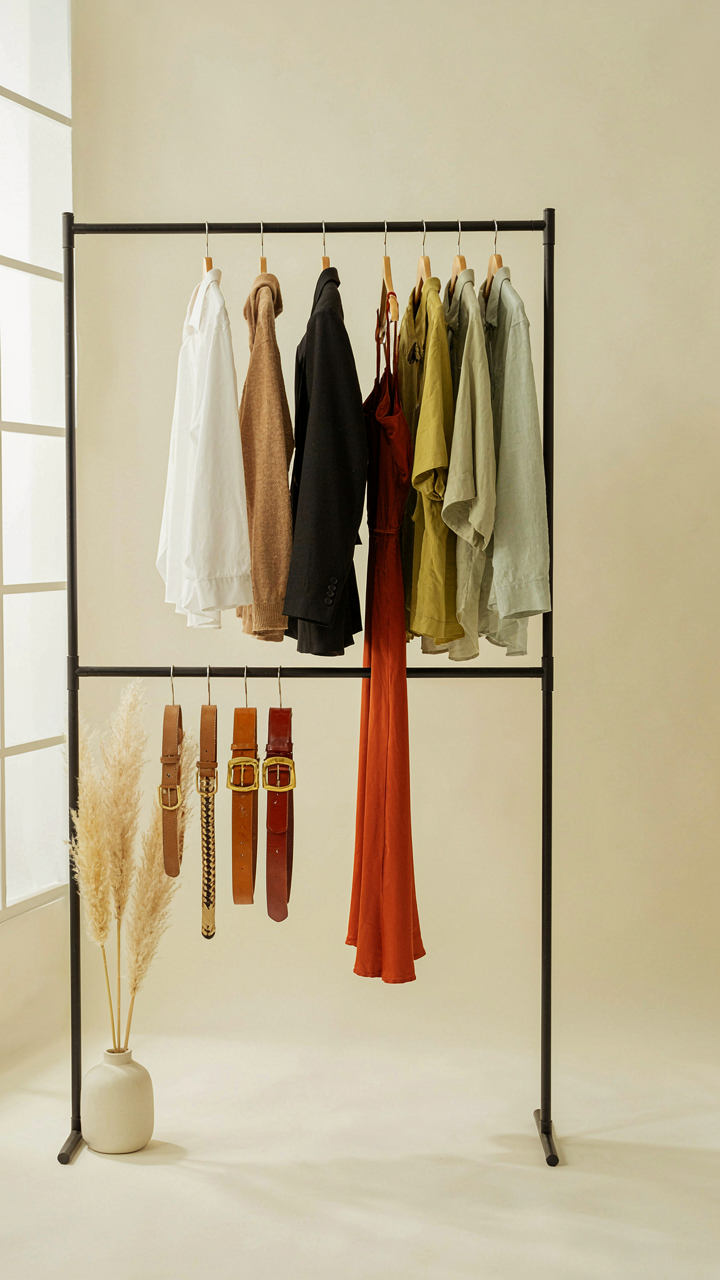
You want to buy fewer clothes while looking like you own more. That’s the real math here. Borrowing from inventory management, a belt functions as a stock rotation tool: the same piece multiplies perceived variety without physical multiplication. One belt repositions an existing outfit into a new visual category.
A capsule wardrobe lives or dies on recombination. A neutral leather belt worn at the natural waist reads formal with tailored trousers. The same belt worn low on the hip over a loose shirt creates casual visual weight distribution. The mechanism is simple: belt placement and width alter silhouette perception, making identical base pieces function as different outfits. You’re not buying new clothes. You’re changing how existing clothes read.
Eliminate Redundancy Before Adding Anything
Most people own five belts that do the same job. Stop. A functional capsule needs exactly three belts: one neutral leather for structured pieces, one braided or textile option for casual layers, and one statement piece if your wardrobe supports it. Anything beyond this is waste disguised as options.
The rule is ruthless specificity. If two belts serve the same width, material, and color range, one of them leaves. Keep the one that actually gets worn. A capsule wardrobe fails when you treat belts as interchangeable. Each belt should solve a different styling problem. When you eliminate redundant options, you stop second-guessing. You wear what you own.
The Contrast & Harmony Dialectic: Fashion Hacks Clothes
Color Contrast Theory For Belt Impact
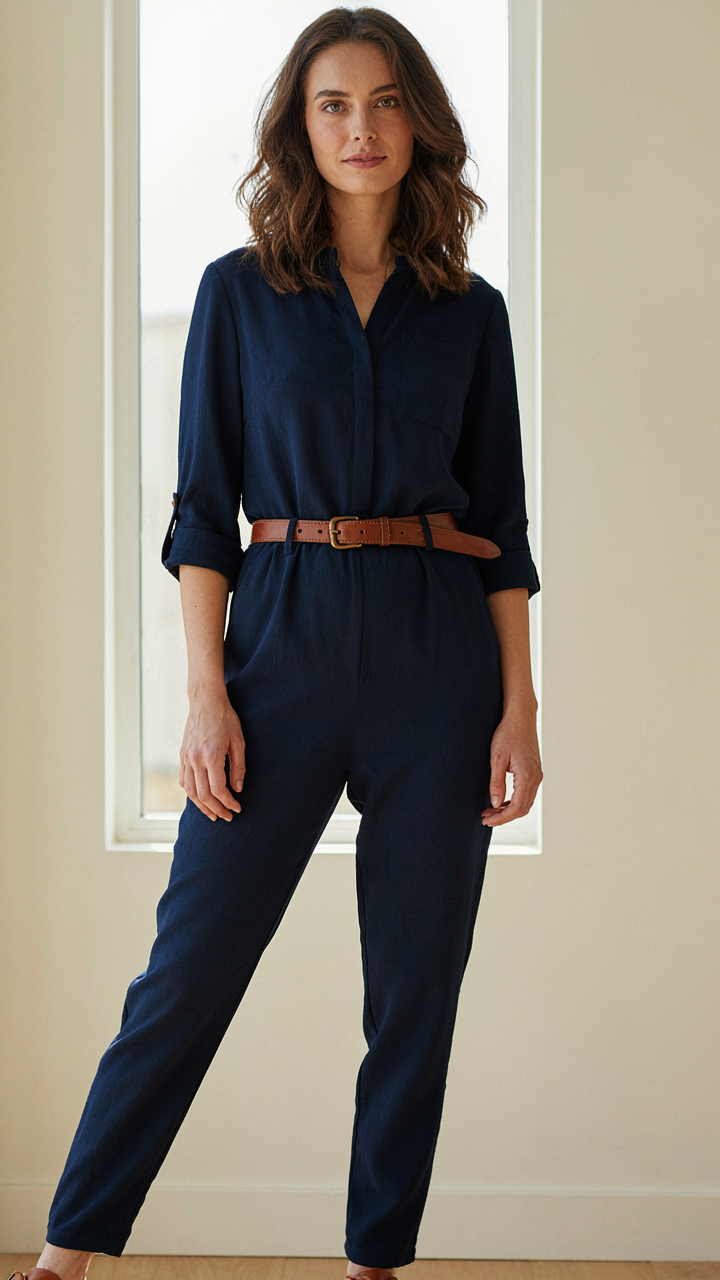
You want the belt to be noticed without looking like you’re trying. The mechanism is contrast theory from visual design: your belt only registers when it breaks the dominant color field of your outfit. A navy suit with a navy belt vanishes. A navy suit with a cognac belt becomes intentional.
The mistake most people make is confusing “contrast” with “bright.” A belt doesn’t need to be loud to work. It needs to differ enough from both your torso and pants that your eye lands on it as a separate object. Warm against cool, dark against light, matte against shine—all create the same effect. The belt tightens the outfit by creating a horizontal anchor point that disrupts the vertical line of your clothing.
Texture Harmony Or Deliberate Discord
Matching texture between belt and shoes is conventional advice, and it’s incomplete. Texture matching creates unity, but unity often reads as boring because you’re not asking your belt to do any work. Deliberate texture discord forces the belt into visibility by making it materially different from its surroundings.
A smooth leather belt on a wool knit creates friction visually. A woven canvas belt on silk creates surprise. The rule: if your outfit leans uniform in texture, introduce a belt texture that breaks that uniformity. If your outfit already has mixed textures, the belt can either resolve the chaos with matching texture or amplify the intentionality with something completely different. Choose one strategy per outfit, never both.
The Feedback Loop Method: How To Wear A Belt
Outfits As Self Regulating Systems
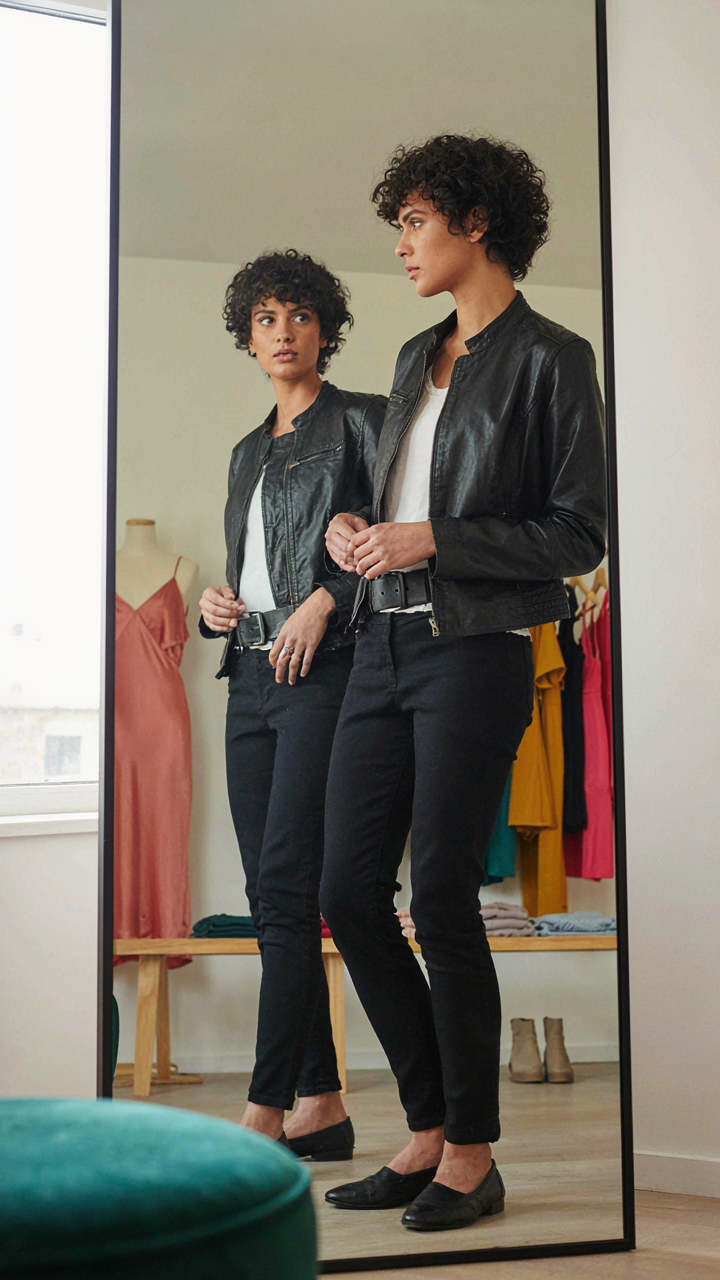
You want permission to stop overthinking this. Cybernetics teaches us that systems self-regulate through feedback loops: input, output, measurement, adjustment, repeat. Your outfit works the same way. The belt isn’t a fixed element you choose once and forget. It’s a control mechanism that responds to visual data and corrects drift in real time.
Most people treat belt selection like a static rule: “brown with brown, black with black.” That’s backwards. The belt’s job is to measure how your silhouette reads and adjust the proportion until the eye stops searching. Wear the belt, look in the mirror, notice what the eye lands on, then move or tighten it. That’s the loop.
Adjust By What You See Not What You Know
The common advice here is incomplete: “wear your belt at your natural waist.” That works for one body type in one outfit category. Ignore it. Instead, position your belt where visual tension collapses. If your torso reads too long, bring the belt up slightly to break the line. If your frame looks split, drop it fractionally to unify the mass. You’re not following a chart. You’re reading feedback.
The mechanism is contrast and line interruption. Your eye needs a horizontal break point to process proportion correctly. Position the belt where that break feels intentional, not accidental. Then stop adjusting. One micro-shift per outfit, not ten. That’s the discipline: measure once, adjust once, move forward.
Belt Idea: Beyond Utility To Identity
Your Belt Signals What You Won’t Compromise On
You want people to know you’re not following the herd. The real mechanism here is semiotics—the study of signs and meaning. Your belt functions as a sign that communicates group membership and values. The generic leather belt from a mall retailer broadcasts nothing. A deliberate belt choice broadcasts that you’ve made an intentional decision about how you present yourself. This is why belt selection matters beyond keeping pants up.
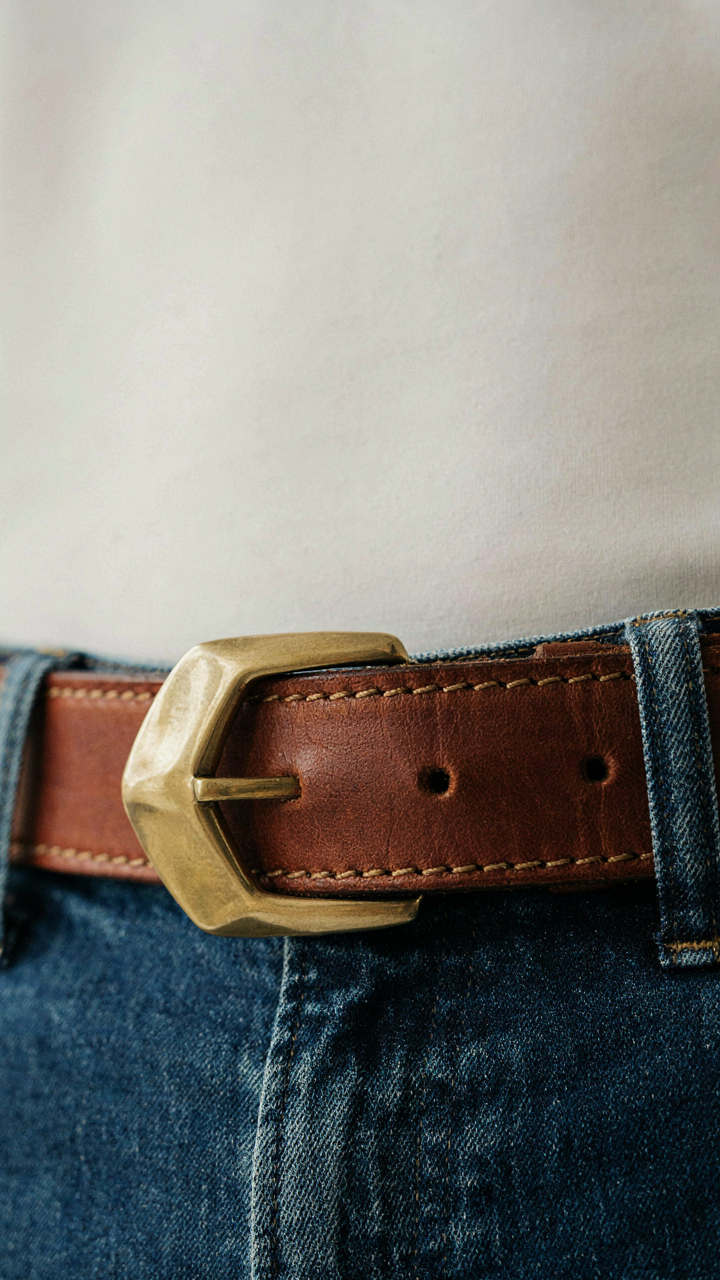
The signal works because belts occupy liminal space in an outfit. They’re visible enough to notice but not so dominant they overwhelm. This constraint forces precision. You can’t hide behind volume or complexity. A distinctive belt—tooled leather, an unusual buckle, a non-standard width—proves you care about the details others miss. This specificity builds recognition and trust. People remember the person with the quality harness belt, not the person in generic khakis.
Skip The Trend Cycle Altogether
The common advice says to match your belt to your mood or season. That’s wrong. Trend-driven belt choices age fast and signal the opposite of intentionality—they signal reactivity. A woven canvas belt in this year’s neutral tone will look dated in eighteen months. A solid brass buckle with quality leather remains functionally identical in ten years. The mechanism at work is durability signaling. Objects that last and resist trend cycles communicate that you value substance over noise.
Authenticity in belts comes from choosing based on your actual lifestyle and aesthetic, then sticking with that choice long enough to own it. Buy a belt that solves a real problem in your wardrobe. Wear it until it shapes itself to your body. Build the patina. This is how a belt stops being an accessory and becomes a tool that reflects who you actually are. The buckle you wear daily becomes more honest than the one you rotate seasonally.
Womens Belts For Jeans: The Underrated Power Play

Elevating Denim With Intentional Choices
You want denim to read as deliberate instead of default. Most people grab whatever belt fits without understanding that belt placement, width, and material create visual hierarchy on your body. This is basic optics: a belt at the natural waist creates a horizontal line that resets proportions. Too low and it flattens. Too high and it chops. The mechanism is simple—the belt anchors where your torso meets your legs.
Width matters more than most admit. A thin belt disappears against a fitted jean, making the waist look wider by contrast. A medium belt (1.25 to 1.5 inches) sits in the sweet spot—visible enough to create definition without overwhelming the hip. Material signals intentionality. Leather, woven, or metal chain each communicate different restraint. A structured leather belt says maintenance and control. A woven belt says texture awareness. Pick one that mirrors your shoe or jacket to create a closed loop in your outfit’s visual story.
Belts Beyond The Expected
The common advice treats jeans belts as functional only. Wrong. A belt is a reset button that changes how an outfit reads. Think of a belt as a “contrast agent” from visual design—it introduces opposition to draw the eye. A metallic chain over matte denim creates that contrast instantly. A wide fabric belt in a solid color breaks up patterns in printed jeans. A sculptural buckle becomes a focal point that justifies wearing no other accessories.
Unexpected textures work because they’re perceived as intentional rather than accidental. Braided leather, suede, or chain belts force the eye to pause on your midsection instead of letting it drift. The action: pair a textured belt with simple jeans in a neutral wash, keep the rest of your top plain, and the belt becomes the statement. This concentrates attention and reads as control rather than clutter.
The Real Obstacle Isn’t Your Wardrobe; It’s Your Inability To See Clothing As A Non-verbal Language

Most people treat belts like afterthoughts. They grab one, loop it through, and move on. But a belt signals intention. It says whether you understand proportion, hierarchy, and visual storytelling. Start treating your belt as punctuation, not filler. Pick one outfit you wear this week and deliberately choose a belt that contradicts or enhances it rather than matching it. You’ll stop seeing fashion as rules and start seeing it as communication. When you control the narrative, people listen without you saying a word.