

The Thermal Regulation Protocol

How Your Body Actually Cools Itself
You care about this section because staying cool at work signals competence. Sweat stains signal the opposite. Here’s the mechanism: your body regulates temperature through four pathways—radiation, convection, conduction, and evaporation. Radiation dumps heat directly into the air around you. Convection moves heat away via air movement. Conduction transfers heat to whatever touches your skin. Evaporation—sweat turning to vapor—handles the heavy lifting on hot days. Most people ignore evaporation entirely, then wonder why they fail.
Your office outfit either accelerates or blocks these four pathways. The goal isn’t to look cool. The goal is to engineer a microclimate that lets your body shed heat before sweat becomes visible. Tight fabrics trap heat against your skin and slow evaporation. Loose fabrics allow air to move across your skin, speeding up convective cooling. Color matters too. Dark colors absorb radiation from sunlight and indoor lights. Light colors reflect it. This isn’t philosophy. This is physics applied to fabric.
Fabric As A Microclimate Engine

The common advice says “wear cotton and you’re done.” Wrong. Cotton absorbs moisture but holds it. Your shirt stays damp against your skin, which slows evaporation and kills cooling efficiency. Moisture-wicking synthetics like polyester and nylon pull sweat away from your skin and move it outward, where air can evaporate it faster. Linen performs differently—it absorbs up to 20 percent of its weight in moisture before feeling damp, which gives you a buffer. Silk wicks moisture effectively but costs money and wrinkles on contact.
The real protocol: layer lightweight pieces with open weaves to maximize air exposure. A thin linen shirt over a moisture-wicking tank creates two thermal barriers that work together. The outer layer shields you from direct sun radiation. The inner layer pulls sweat away from skin. Weave matters as much as fiber. Loose weaves let air flow through the fabric itself, not just around it. Dense weaves trap air inside the material, which insulates you—the opposite of what you need. Check your fabric by holding it to light. If light passes through easily, the weave supports evaporation.

Deconstructing The Dress Code Myth

What Your Handbook Actually Says
You’re worried people will judge you for breaking invisible rules that don’t exist in writing. Most offices have a stated dress code that is far more flexible than the one you’ve internalized. Read the actual policy. Most corporate environments permit sleeveless tops, open-toed shoes, and lightweight fabrics in summer. The restriction isn’t the rule itself, it’s the gap between what’s written and what you believe is safe. That gap lives in your head, not in HR’s handbook.
The mechanism is simple: fear of social consequence beats comfort every time. You’ll sweat through a blazer rather than risk a sideways glance. But the blazer isn’t required. The permission slip is already there. You’ve confused “conservative” with “mandatory” because you watched others do it first and assumed they knew something you didn’t. They didn’t. They were also guessing.
Strategic Layers Over Compliance
The real move is borrowing from military logistics: optimal function under constraint. You don’t eliminate the dress code, you distribute compliance across multiple pieces rather than concentrating it in one heavy garment. A linen short-sleeve shirt over a fitted tank removes formality through texture and layering, not by breaking rules. A cotton blend knee-length skirt moves air around your legs while staying professional. An unstructured blazer in cotton or a cotton blend hangs loose enough for circulation.
This approach works because it separates aesthetics from restrictions. You look intentional and put-together while solving the actual problem, which is heat. The blazer isn’t the enemy. The sealed, non-breathable fabrication is. Replace it with something that breathes and keep the silhouette. Most offices won’t notice the difference because the outline still reads as professional. What they will notice is that you’re not visibly uncomfortable, which signals confidence and control.
The Material Science Of Chill: Beyond Cotton
Natural Fibers Vs. Synthetics: The Airflow Trade
You want to believe cotton is the answer because it’s natural, traditional, and sounds right. It isn’t. Thermodynamics doesn’t care about your preference. Cotton absorbs moisture but traps it against your skin, turning damp fabric into an insulator that works against you. Linen moves moisture faster and allows air to pass through the weave structure itself. Synthetics like polyester and nylon wick moisture away from skin to the fabric surface where evaporation actually happens. The mechanism: fiber hygroscopicity determines how much water the material holds before it stops breathing.
The real play is mixing fibers strategically. A 55 percent linen, 45 percent cotton blend gives you linen’s airflow advantage with cotton’s comfort and wrinkle tolerance. Avoid 100 percent synthetics in office settings because they create a vapor barrier that traps heat buildup. High-performance synthetics designed for athletic wear work better, but they broadcast “gym clothes” in a professional context. Choose blends that prioritize linen content if your office runs warm, or pure linen for extreme heat exposure.
Fabric Weight And Weave: Density Determines Everything
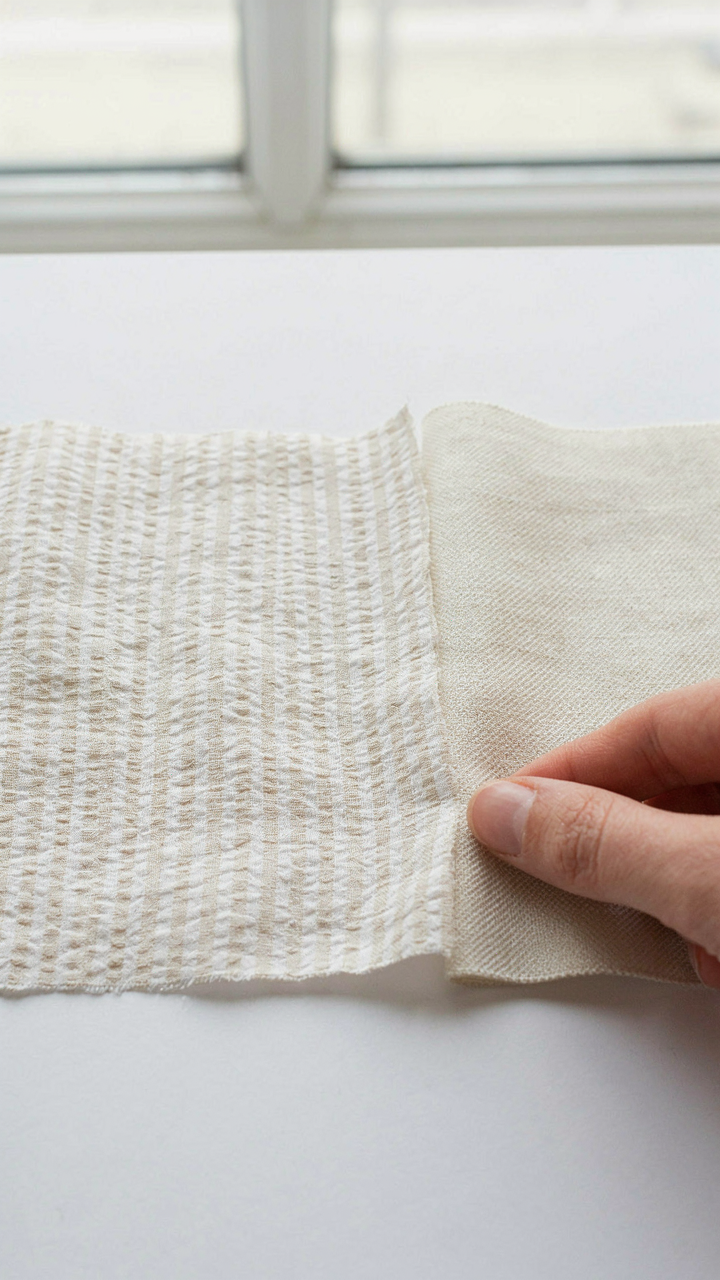
Fabric physics teaches us that density is resistance. Apply this to textiles: tight weaves trap air pockets, which retain heat. Loose weaves let air move through. A summer work shirt at 140 gsm (grams per square meter) breathes differently than one at 200 gsm. Most office fabrics sit between 160 and 180 gsm. Lower doesn’t mean better quality. It means less insulation, which is what you need in July.
Weave type matters more than most people admit. Oxford cloth feels crisp but the tight weave holds warmth. Poplin is similarly dense. Twill traps heat. For summer, seek open weaves: linen plain weave, cotton voile, or seersucker. Seersucker’s puckered surface creates air gaps between fabric and skin, breaking contact that causes heat retention. Check fabric specifications before buying. Weight and weave together determine your actual cooling performance. Ignore one and you’ll pay the temperature cost in your office chair.
Business Comfortable Outfits: The Strategic Silhouette

Loose Fits Vs. Tailored: Maximizing Air Circulation
You want to look intentional at work without sweating through your shirt by 11 AM. That tension is real, and loose clothing seems like the obvious answer until you realize it reads as sloppy. Physics governs this: airflow moves fastest over surfaces, slowest in dead zones. Loose fabric creates those dead zones. Sweat pools inside baggy sleeves and pant legs because air has nowhere to push it. The garment traps heat instead of releasing it.
Tailored cuts with strategic looseness work better. Fitted shoulders and chest let air move across your body. Tapered sleeves narrow at the wrist instead of billowing. Trousers sit close to your leg without clinging. This moves moisture away from skin and lets it evaporate. Skip the oversized aesthetic entirely in summer. Your body temperature drops faster when cloth stays near enough to pull sweat away, then loose enough for air to reach it.
Structure Without Constriction: Modern Cuts For Comfort
The standard advice about structured office wear ignores what modern fabrics actually do. Cotton blends and performance materials exist now. You don’t need stiff, heavy suiting to look professional. Cheap tailoring recommendations come from people selling you traditional fabric thickness as a status marker.
Modern cuts use structure in placement, not volume. Darts at the back shoulder create shape without bulk. Seams positioned correctly follow your body without hugging it. Look for garments cut with slight A-line or drop-waist silhouettes. These create visual definition while leaving space for airflow. Rayon blends and linen-cotton combos hold their shape under AC and humidity. Buy based on seam placement and fabric composition, not how stiff the cloth feels in the store.
The Coastal Business Casual Color And Pattern Playbook

Why Light Colors Actually Work
You want to look expensive without sweating through your shirt by noon. Here’s the physics: light colors reflect solar radiation instead of absorbing it. Darker fabrics trap that energy as heat. White, cream, and pale gray bounce sunlight away from your body before it converts to warmth on your skin. This isn’t fashion advice. It’s thermodynamics applied to fabric.
The mechanism matters because most people think light colors just “look cooler.” They do look cooler. But they function cooler because of wavelength reflection. Wear cream or pale khaki instead of navy or charcoal, and your core temperature stays measurably lower in the same office environment. The difference compounds over eight hours.
Patterns That Reduce Visual Fatigue Without Adding Layers
Everyone says patterns add interest. That’s weak reasoning. Patterns work because they break up monotony in your visual field, which reduces the cognitive load your brain assigns to monitoring a blank surface. Small geometric prints, thin stripes, and subtle checks demand less mental processing than solid colors while keeping you cooler than layered textures would.
Pick patterns with high contrast ratios between colors but stick to the light palette. A pale blue with white pinstripes works. Cream with soft gray tonal squares works. The pattern itself doesn’t generate heat. What matters is you’re wearing one lightweight piece instead of stacking a base layer under a solid overshirt. One garment beats two every time for temperature regulation.
Women’s Business Casual Outfits Summer: Accessorizing For Ambience

Minimal Jewelry Keeps You Cooler
You want accessories because they signal competence, but metal and fabric touching your skin in summer heat is dead weight. Thermodynamics calls these contact points “thermal sinks”—they absorb and hold body heat instead of letting it dissipate. Every bracelet, necklace, and layered ring becomes a barrier between your skin and the air that’s supposed to cool you.
Strip down to one piece maximum. A thin gold or silver band works. Skip the layered necklaces, the chunky bracelets, and anything that sits against your collarbone or wrists for hours. Your neck and wrists are major heat-release zones. Covering them with metal defeats the point of dressing light. The rule is brutal: if it touches skin for more than five minutes, it heats you up.
Hair And Makeup Reduce Your Thermal Load
The common advice says “just wear your hair up” but misses the real mechanism. Hair holds moisture and traps heat against your scalp. Makeup seals your pores slightly, reducing evaporative cooling on your face. You’re not being vain by thinking about this. You’re managing biological function.
Keep makeup minimal and focus on products that breathe. Skip foundation on your forehead and cheeks when possible. Use a tinted moisturizer instead. Wear your hair off your neck completely, not in a loose bun that still touches your shoulders. The goal is maximum air exposure on your face, neck, and scalp. Start by removing makeup from areas that sweat first. Your face stays cooler, your concentration stays higher, and you avoid that mid-afternoon collapse.
The Footwear Freedom Framework

Open Versus Closed Trade Offs
You want people to see your feet look intentional, not like you gave up. That’s the real tension here. Thermodynamics governs what happens: closed shoes trap heat because they restrict air circulation around your foot’s surface. Open designs expose more skin to moving air, which accelerates evaporative cooling. The office environment doesn’t care which you choose, so pick based on sweat volume, not aesthetics.
- Loafers without socks: Closed uppers but slip-on design allows some heel exposure. Works if your office doesn’t demand formal dress codes and foot sweat stays moderate.
- Sandals with structured straps: Open design maximizes airflow. Requires a professional cut, not beach flip-flops. Leather or suede versions read as intentional in casual to business casual settings.
- Perforated leather oxfords: Closed shoe silhouette with punched ventilation holes. Maintains formality while allowing measurable airflow compared to solid leather versions.
- Mules or backless slip-ons: Heel exposure without full sandal openness. Middle ground for moderate temperature days. Choose structured versions to avoid looking like you’re in recovery mode.
- Canvas sneakers or minimalist designs: Open mesh panels with breathable uppers. Casual enough for tech or creative offices. Ventilation rivals sandals while reading less extreme than bare-foot designs.
Most offices still enforce some version of “closed toe at minimum,” so you’re not choosing between sandals and everything else. You’re choosing between strategies within that constraint. Pick open designs on high-sweat days, closed on presentation days. The mechanism is simple: skin exposure plus ambient air movement equals lower foot temperature.
Breathable Materials That Last Eight Hours
Everyone says “natural fibers breathe better,” then picks cotton and wonders why their feet stayed damp. Cotton absorbs moisture and holds it. That’s the opposite of what you need. True breathability requires materials that either repel moisture or channel it away from skin without absorbing it. Canvas, mesh panels, and perforated leather accomplish this through structure, not fiber magic.
Suede and nubuck perform better than smooth leather in humidity because their raised surface texture creates air pockets. Leather itself breathes fine if it’s perforated or tanned with treatment that increases porosity. For all-day wear in an office, choose materials rated for real foot environments, not theoretical ones. Test any shoe by wearing it through a full workday before making it your rotation piece. If your feet feel clammy after eight hours, the material isn’t working regardless of what the label claims.
Soft Corporate Outfits: The Layering Deception
The Blazer Myth
You want the blazer because it signals competence and rank. The mechanism is different: a blazer indoors during summer defeats itself. Air conditioning chills faster through fabric weight, so you’ll either remove it within an hour or sweat under it. The office dress code that demands blazers year-round isn’t protecting your credibility—it’s burning your focus on temperature regulation instead of work.
Modern offices run cold by design. Most corporate buildings maintain 68-72 degrees, which means the blazer creates a thermal mismatch the moment you sit still. Lightweight structured shirts and tailored vests deliver the visual authority without the bulk. If your workplace genuinely requires a jacket, wear it during entry and exit, then store it at your desk. The people judging you are not counting how many hours you wore it.
Strategic Outer Layers For Transition
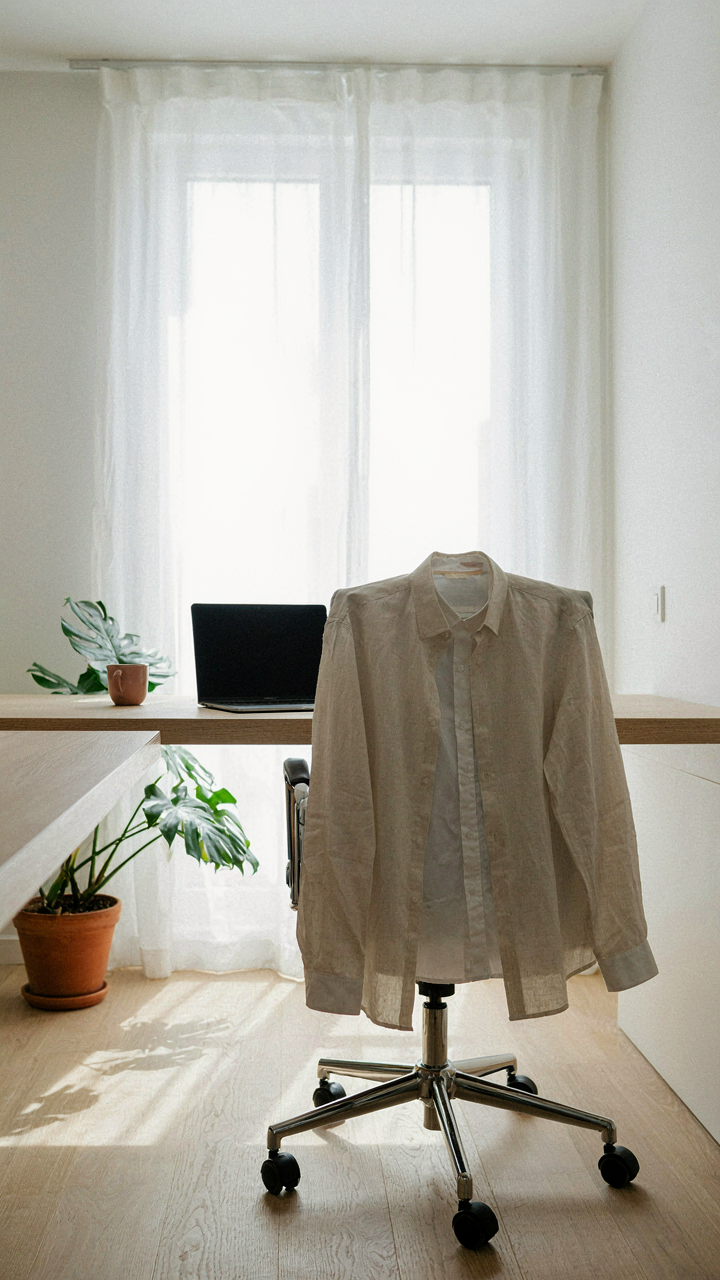
Transitional layers work like military logistics: move only what you need, when you need it. A linen overshirt or unstructured jacket serves a specific tactical window—the commute, the meeting room with aggressive AC, the client call where formality matters. The mistake is wearing it all day as insurance against social judgment.
Your real move is treating the layer as a removable asset, not a permanent fixture. Drape it over your chair during focus work. Grab it before stepping into conference rooms or heading to the lobby. This approach keeps your core temperature stable while maintaining the appearance of polish when it matters. The protocol is simple: layer for the transition, not the entire shift.
The Real Warmth You Generate Isn’t From Your Clothes; It’s From Your Inability To Adapt

You sweat in summer work outfits because you refuse to shift your mindset about what “professional” means. The fabric doesn’t matter if you’re clinging to winter thinking. Open your closet today and remove one item you wear out of obligation, not comfort. Your body knows the difference between actual professionalism and theater, and so does everyone else watching you suffer.