
The Myth Of Infinite Recycling: Beyond The Bottle

Energy Cost Of PET Versus Virgin Production
You want recycled polyester to be the guilt-free option, but the energy math doesn’t actually support that narrative. Thermodynamics doesn’t care about your intentions. Producing recycled polyester from post-consumer bottles requires melting, purifying, and re-polymerizing plastic that’s already degraded—a process that burns 30 to 40 percent of the energy needed to make virgin polyester from crude oil. That gap closes further when you factor in collection, sorting, and transportation logistics. The real win comes only at scale and only if recycled material replaces virgin production entirely, which it doesn’t.
The industry frames recycled polyester as inherently superior because it sounds better. It isn’t. Virgin polyester production consumes crude oil, yes, but it operates at industrial efficiency levels refined over decades. Recycled polyester production splits focus between virgin and recycled capacity, meaning manufacturers run both plants partially full. This kills per-unit efficiency on both sides. The break-even point where recycled becomes genuinely cheaper occurs only when recycled material hits 50 percent of total polyester supply—a threshold the industry won’t reach for years, if ever.
Material Degradation Cycle Explained

Every time polyester gets recycled, its polymer chains shorten. Biology calls this chain scission—the breaking of molecular bonds—and it applies directly to synthetic fibers. You can’t recycle the same polyester bottle indefinitely because the material becomes brittle and loses tensile strength. Most recycled polyester comes from virgin material blended with five to fifteen percent recycled content, not from previous garments. The industry doesn’t have a working system to recycle finished clothing back into new clothing at scale because sorting mixed fibers, dyes, and finishes costs more than buying new material.
After two to three recycling cycles, polyester degrades enough that it can’t be used in apparel anymore—it gets downgraded to carpet, insulation, or non-woven applications. At that point, landfill or incineration becomes inevitable. Brands marketing their recycled polyester collections as circular are leaving out this timeline. The fiber doesn’t vanish; it just moves to lower-value applications until disposal becomes the only option. Understanding this degradation curve forces a harder question: is recycled polyester solving the problem or just delaying it?

Microplastic Fallout: The Silent Contamination

How Washing Releases Fibers
You care about this section because you want to believe recycled polyester is the ethical choice, and admitting it sheds plastic into water systems threatens that narrative. Here’s the mechanism: synthetic fibers are held together by friction and chemical bonding, not natural cohesion. Washing applies mechanical stress—agitation, tumbling, temperature variance—that breaks those bonds. Fibers release as loose strands, not by design flaw but by material structure.
Recycled polyester sheds at rates comparable to virgin polyester because the recycling process doesn’t strengthen fiber adhesion. The fibers are already compromised from their first lifecycle. A single synthetic garment releases hundreds of thousands of microfibers per wash cycle. Water carries these particles directly into municipal systems and eventually oceans. The shedding isn’t preventable through consumer behavior alone—it’s built into how synthetic textiles function.
Where Microfibers Go After Washing
Synthetic microfibers don’t degrade or settle into stable forms. They persist in aquatic ecosystems and accumulate in organisms that mistake them for food. Here’s what happens to the particles your washing machine sends downstream:
- Wastewater treatment plants: Most facilities lack filtration fine enough to catch microfibers below 20 microns, allowing 95 percent of shed fibers to pass through into rivers and coastal waters.
- Freshwater bioaccumulation: Microfibers settle into sediment where benthic organisms ingest them, transferring plastic particles up the food chain into fish populations and eventually human consumption.
- Ocean water column: Fibers remain suspended and circulate for years, distributing across ocean currents and concentrating in gyres where microplastic density far exceeds natural organic matter.
- Drinking water contamination: Recent studies confirm microplastics in tap water and bottled water globally, with synthetic fibers comprising a measurable portion of detected particles.
- Soil persistence: Irrigation with contaminated water or sludge application deposits microfibers into agricultural soil, where they remain indefinitely and may impair soil microbial function.
The environmental burden of recycled polyester isn’t hypothetical or long-term. Microfiber release begins in the first wash and continues for the garment’s entire lifespan. The plastic persists after your clothing ends up in a landfill or incinerator, but the contamination cycle starts the moment water touches the fabric.
The “Eco Friendly Fabric” Paradox: Greenwashing’s Favorite

What The Label Doesn’t Tell You
You want recycled polyester to be the answer because buying it makes you feel like you’re solving something without changing your consumption habits. Here’s the mechanism: brands market recycled polyester as environmentally responsible, but the environmental benefit depends entirely on what it replaces and how the recycling process actually runs. A recycled polyester shirt isn’t inherently better than virgin polyester if both require chemical-intensive processing and global shipping to reach you.
The marketing works because it transfers moral responsibility from the consumer to the material. You see “made from recycled plastic bottles” and assume you’re part of the solution. But recycled polyester still requires high heat, solvents, and energy to break down and reconstruct polymer chains. The environmental math only works if the recycled version prevents a virgin polyester shirt from being made instead, not if it simply adds another product to your closet.
The Chemical Debt Behind Every Piece
Industrial economics governs recycled polyester production the same way it governs virgin polyester, except recyclers face an additional cost burden that most brands don’t disclose. Converting used bottles and fabric scraps into wearable fiber requires either mechanical recycling, which degrades the polymer quality with each cycle, or chemical recycling, which uses aggressive solvents like dimethylformamide (DMF) to dissolve and reconstruct polyester chains.
Chemical recycling produces higher-quality fiber but generates toxic wastewater that facilities must treat or discharge. Mechanical recycling avoids this chemical step but produces lower-grade polyester that companies blend with virgin polyester anyway to meet durability standards. Neither process eliminates the core issue: you’re still producing polyester, a synthetic polymer that requires petroleum derivatives and extensive processing regardless of its origin point.
Beyond Lucy And Yak: The True Cost Of Circular Fashion

The Sorting Problem Nobody Mentions
You want to believe recycled polyester works because it sounds responsible. The mechanism everyone skips: textile recycling requires sorting polyester from cotton, nylon, elastane, and dyes before machines can process it. Most facilities sort by hand or use basic optical scanners. Contamination kills the entire batch. A single silk thread in recycled polyester ruins the molecular structure for future use.
Infrastructure doesn’t exist at scale. The US has roughly 1,500 textile recycling facilities, but most are downcycling operations that shred fabrics into insulation or rags. True fiber-to-fiber recycling happens in only a handful of plants globally. Transportation costs alone make it cheaper to use virgin polyester in most regions. The recycling loop breaks before it starts because the first step, separation, remains manual and economically unviable.
The Math That Doesn’t Add Up
Economics calls this the rebound effect: efficiency gains get consumed by scale, negating the original benefit. Recycled polyester costs less to produce than virgin, so brands make more of it, and total polyester consumption climbs. A garment labeled recycled still requires energy for collection, sorting, chemical processing, and transportation. One lifecycle assessment study found recycled polyester saves roughly 30 to 40 percent of carbon versus virgin polyester, but that margin shrinks when you factor in reverse logistics.
The business model punishes true circularity. Brands profit from selling new clothes, not maintaining old ones. Extended producer responsibility laws exist in Europe and parts of Asia, but they impose fees, not accountability. A brand pays a recycling fee and calls the transaction complete. Nobody tracks whether that garment actually gets recycled or ends up in a landfill in Southeast Asia. The cost of genuine accountability exceeds the cost of the clothing itself.
The Recycled Polyester Fabric Uses Deception: Not All Applications Are Equal

Where Recycled Polyester Actually Works
You want recycled polyester to be a solution because it feels like progress, but the truth is simpler: it only works in specific applications where durability demands are low and wash cycles are predictable. Think of recycled polyester like a material with a defined fatigue threshold—borrow a term from materials engineering—meaning it degrades under specific stress conditions that matter more than fiber source.
Recycled polyester performs best in athletic wear, casual activewear, and lightweight outerwear where garments see 50 to 100 washes before replacement. The fiber retains strength in these contexts because the end-user tolerates—even expects—a 12 to 24 month lifespan. Performance underwear, gym shirts, and windbreakers don’t require the structural integrity that formal wear or workwear demands. The recycled fiber’s slightly lower tensile strength becomes irrelevant when the design expectation already includes eventual replacement.
Where Recycled Polyester Fails Without Admission
The common advice skips this: recycled polyester deteriorates faster than virgin polyester under repeated mechanical stress and high heat. Brands market recycled poly as ethical then hide it inside jeans, work pants, and outerwear designed to last three to five years. Fiber breaks down during washing, drying cycles, and storage. The polymer chains shorten. Color fades asymmetrically. Seams weaken before the fabric itself fails, creating a product that looks acceptable but performs worse than its virgin counterpart after year two.
Recycled polyester also absorbs moisture and odor more readily than virgin polyester because the recycling process creates micro-fractures in the polymer structure. This matters zero in a shirt you wash weekly. It matters entirely in performance outerwear or compression garments where moisture management is the primary function. Check the technical specs of “eco” hiking jackets—most use recycled polyester in the shell layer where water resistance depends on polymer integrity. The marketing pitch hides a mechanical downgrade.
The Closed Loop Fantasy: Unpacking Textile Recycling Limits
What Actually Happens To The Polymer Chain
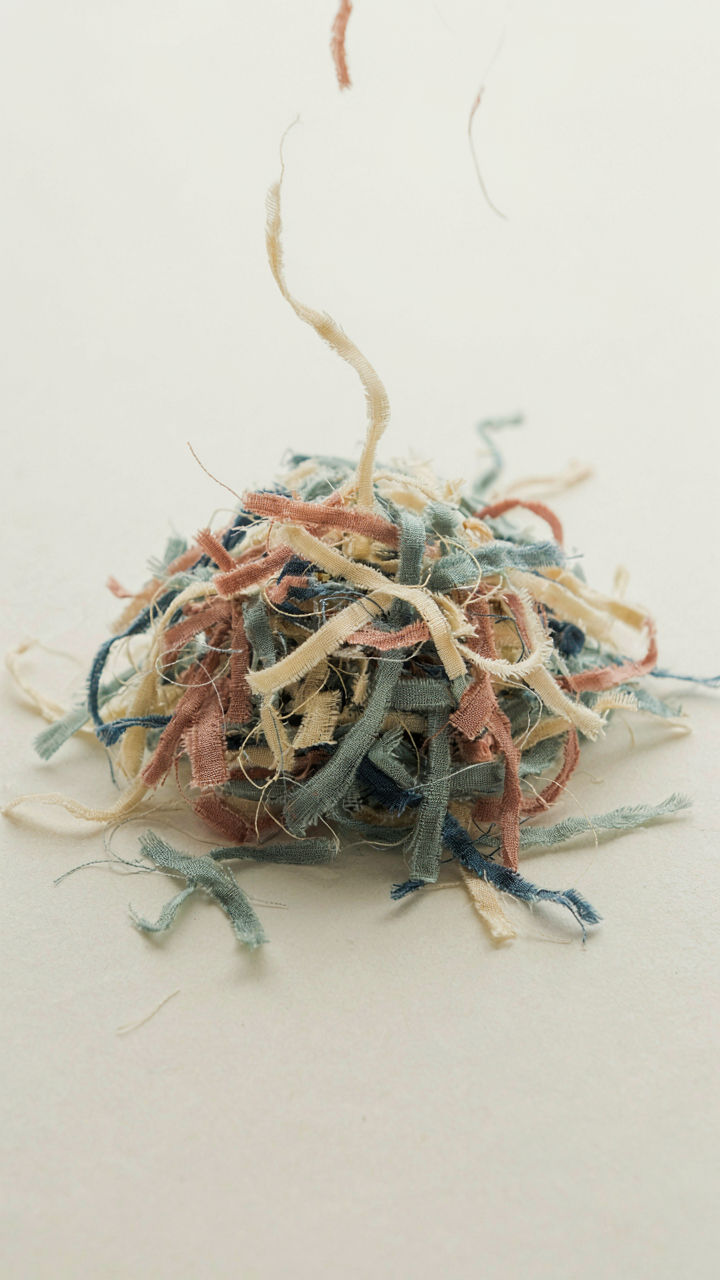
You want to believe recycled polyester is a solution because it feels like you’re solving something without changing your behavior. Here’s what nobody tells you: polyester is a polymer, and polymers degrade at the molecular level every time you recycle them. Each heating and reprocessing cycle breaks the long-chain molecules into shorter segments. Shorter chains mean weaker fabric. The material loses tensile strength, elasticity, and durability with each pass through the recycling loop.
The industry calls this “downcycling” but avoids saying it plainly. A polyester bottle becomes fiber, which becomes lower-grade fiber, which becomes non-textile waste. The polymer doesn’t regenerate. It fragments. After two to three recycling cycles, the material quality drops too far for apparel use. This isn’t a limitation we’re solving. It’s a hard constraint built into how polymer chemistry works.
The Entropy Tax On Material Value
Thermodynamics teaches us that disorder in a system always increases. Recycled polyester pays an entropy tax with every cycle: the material becomes more disordered, loses performance properties, and requires more processing energy to make it usable again. The virgin polyester you buy today will never be as good after recycling as it was before.
The real cost sits hidden in the energy required to sort, shred, wash, and reprocess the material. New polyester from crude oil requires less processing energy per pound of usable output than recycled polyester does. The gap narrows only when virgin resin prices spike, which happens intermittently. Most recycled polyester programs depend on this price arbitrage to exist at all. When virgin polyester is cheap, recycled polyester becomes economically dead weight.
Sustainable Fashion Poster: A Reality Check Protocol

What Brands Actually Hide In Their Claims
You want to believe the brand cares so you don’t have to feel complicit. That’s the real driver here. But the mechanism is simpler: brands use vague language because specificity kills the sale. Recycled polyester requires less energy to produce than virgin polyester, but brands almost never quantify this or disclose the chemical processing involved. They show you the recycled symbol and let your brain fill in “good.” Most won’t tell you the garment still sheds microplastics or that the recycling process itself generates waste they don’t measure.
The gap between “made from recycled materials” and “made responsibly” is where brands operate. A shirt labeled recycled might contain only 30% recycled content mixed with virgin polyester, but marketing frames it as if the entire piece came from old bottles. Ask three questions before trusting any claim: What percentage is actually recycled? Where did it come from? What testing proves the environmental benefit? Brands with real answers provide them upfront. Silence is the tell.
Check Before You Buy
Start with third-party certification, not brand promises. Look for Global Recycled Standard (GRS) or similar independent verification that audits actual recycled content percentages and supply chains. Many certified recycled polyester still comes from questionable sources or mixed-quality inputs that undermine the environmental argument. Check if the brand discloses their recycling partner and allows public scrutiny of that process.
- Global Recycled Standard (GRS) certification: Verifies recycled content percentage and tracks material from source through production, eliminating ambiguity about what percentage is actually recycled versus marketing spin.
- Recycled Claim Standard (RCS): Confirms recycled content but with less rigorous supply chain oversight than GRS, so it’s a weaker indicator but still better than unverified claims.
- Brand transparency reports: Request or find sustainability reports that specify recycled content percentages, chemical processes used, and where recycled materials source from to catch inconsistencies.
- Material sourcing breakdown: Demand itemized composition showing recycled versus virgin polyester percentages rather than accepting vague “recycled content” language without numbers.
- End-of-life recycling claim: Verify whether the brand actually takes back garments for recycling or just sells them with the assumption someone else will handle disposal.
The most honest brands publish this data without being asked. If you’re digging through PDFs and contacting customer service to get basic facts, the brand is hiding something. Move to competitors who lead with specifics instead of aesthetics.
The Uncomfortable Truth About “Sustainable Fabrics”

Recycled Polyester Versus The Energy Math
You want to feel like you’re making a real choice instead of participating in manufactured consent. Here’s the mechanism nobody states: recycled polyester uses a thermodynamic loan system. The fabric requires 30-40% less energy to produce than virgin polyester because the polymer chains already exist. You’re not creating new molecular structures from crude oil—you’re melting and respinning what’s already there.
But the lifecycle comparison reveals the trap. Recycled polyester still sheds microfibers in the wash. It still requires chemical treatment to achieve durability and color fastness. The energy saved in production gets partially recaptured through washing and degradation cycles that virgin polyester also experiences. You traded one cost for another, not eliminated the cost. The garment still ends up in a landfill in five to seven years, degrading at the same rate as virgin polyester because both are chemically identical once worn.
What Actually Replaces Polyester
Nobody’s building the infrastructure yet. That’s the honest answer. The common advice says natural fibers like linen or cotton are the answer. They’re not. Cotton consumes massive water volumes and requires pesticides. Linen demands land and processing chemicals. Both degrade in landfills faster than polyester, which sounds good until you realize the speed of decomposition doesn’t reduce environmental impact—it just makes the problem invisible sooner.
The real candidates emerging are cellulose-based synthetics derived from wood pulp with closed-loop solvents, and lab-grown protein fibers. Both exist in pilot production. Neither scales at cost parity with polyester today. The mechanism that matters: polyester won’t be replaced by finding a better fabric. It’ll be replaced when the economics of production change—either through carbon taxes that price crude oil higher or through manufacturing processes that make alternative polymers cheaper than current methods. Until one of those conditions shifts, recycled polyester remains the marginal improvement while the system stays structurally the same.
The Real Obstacle Isn’t Finding Sustainable Fabrics; It’s Your Desire For Easy Answers In A Complex World

Stop waiting for recycled polyester clothing to become perfectly ethical. It won’t. You’re searching for moral simplicity in an industry built on compromise. The real move is buying less total, choosing recycled polyester over virgin when you do shop, then wearing pieces until they fall apart. That’s not sexy. That’s actually sustainable. Pick one brand using recycled poly and commit to it this week. Your comfort with “good enough” beats your paralysis over “perfect” every single time.