

The Petite Capsule Wardrobe Lie: Fit Is A Feeling, Not A Measurement

Standard Sizing Was Never Built For Your Body
You’re hoping a magic number exists somewhere that will finally make clothes feel like they were made for you. It doesn’t. The mechanism at work here is simple: standard sizing exists to maximize production efficiency, not to fit the actual diversity of human proportions. Petite women get treated as a scaled-down version of average heights, but your body isn’t a proportional shrink. Your shoulders don’t scale down at the same rate as your inseam. Your torso length differs from the ratio brands assume. Conventional sizing ignores this because individualized production costs money.
Brands size on a bell curve. Most of their revenue comes from the middle. Petite sizing exists, but it typically shortens everything equally, which creates new problems. A petite small doesn’t account for the fact that your arm holes might need repositioning, your shoulder seams need narrowing, or your rise needs adjustment. You’re chasing a measurement that was never designed with your proportions in mind. The fit you’re searching for won’t come from finding the “right size.” It comes from understanding which specific measurements matter for your actual shape.
Silhouette Trumps The Number On The Tag

Fit is determined by silhouette, not by whether something is labeled XS or small. Think of silhouette as architecture: the relationship between the garment’s structure and your body’s contours. A well-proportioned oversized shirt can fit better than a properly-sized one if the sleeve length, shoulder seam, and torso length align with your frame. The tag is noise.
Start by identifying which silhouette proportions work on your body. Does a cropped length land at your natural waist or create bulk? Do standard arm holes sit too low, creating excess fabric under your arms? Does a typical rise pull down because the crotch depth was designed for someone taller? Map these answers for each garment category in your capsule. Then shop by those silhouette parameters first, size second. This shifts your entire approach from chasing measurements to building a wardrobe that actually moves with you.

The “Proportion Play” Protocol For Petite Women
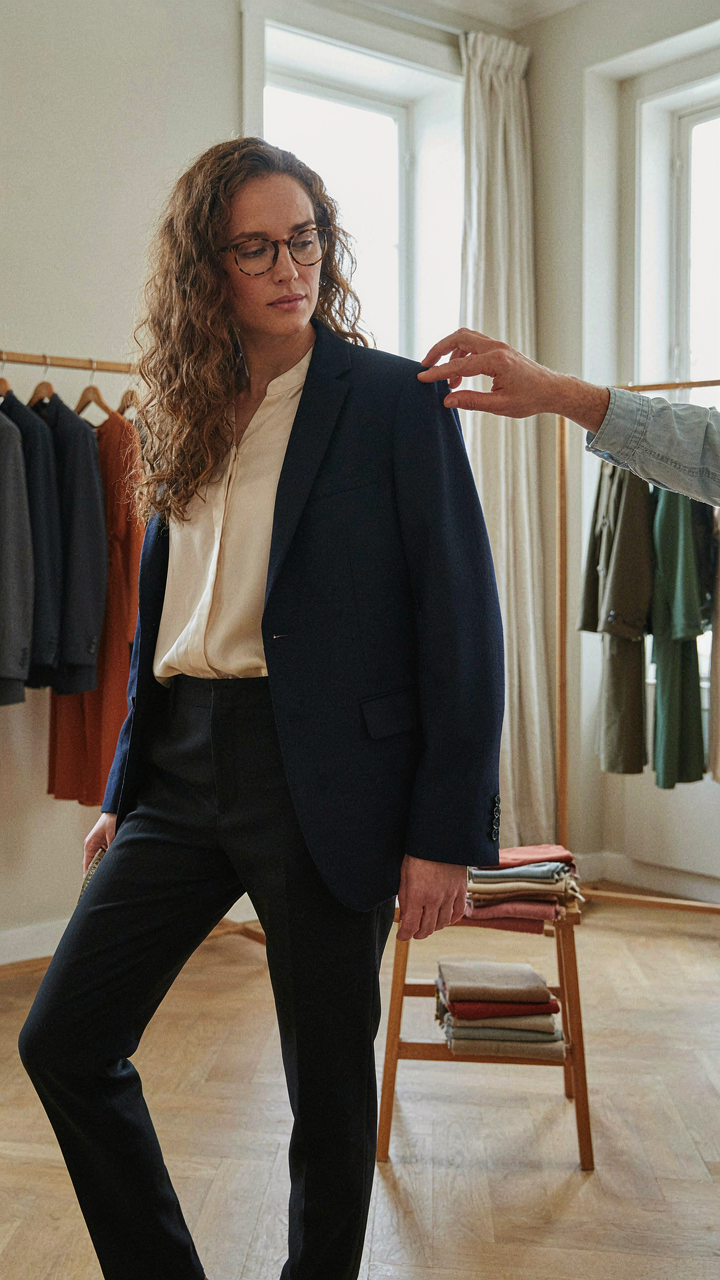
Where Seams Actually Land On Your Frame
You want to look taller without announcing it. That’s the real motive here. Most capsule advice ignores this entirely and treats petite dressing like a scaling problem. It’s not. It’s an optics problem. Tailoring works through visual interruption. A seam placed at your natural waist creates a horizontal break. That break divides your vertical space. Tailors call this “proportion mapping.” Lower the seam, you shorten your leg line. Raise it, you extend it. Petite women need seams positioned to serve elongation, not fit.
Standard off-the-rack proportions assume a 5’10” frame. Armholes sit lower on you. Waistbands land below your natural waist. Hem lengths create a visual anchor point too far down your leg. You can’t fix this by buying “petite” versions alone. Those adjust length but rarely seam placement. Strategic tailoring repositions three seams: shoulder, waist, and hem. The shoulder seam should sit right at your shoulder point, not drift toward your neck. The waist seam belongs at your actual waist, not two inches below. The hem creates your leg-to-shoe ratio. Work with a tailor who understands this mechanism, not just someone who takes things in.
Density And Drape Work Together, Not Alone
Fashion designers borrow from physics when they balance weight distribution. Petite frames require density to anchor visual weight and drape to avoid drowning the silhouette. Most advice says “wear fitted pieces” or “add structure.” Both miss the real principle: density needs strategic placement. A structured blazer with a rigid shoulder works if it’s proportioned to your frame. But a standard blazer compresses your upper half and makes your legs look shorter by contrast. The mechanism is ratio. Drape alone fails too. Flowing fabric without weight makes petite women look swallowed. The fix combines both: use structured pieces in your upper half, drape strategically in the lower half to create visual balance without adding visual bulk where it shortens you.
Build a hierarchy. Fitted, structured pieces (blazers, tailored trousers, structured skirts) belong in your core items. They anchor your silhouette and create intentional line breaks. Drape works best in layers that fall from structured pieces. A draped blouse under a fitted blazer maintains proportion. A draped skirt over fitted leggings works. The pattern is identical: structure first, drape second. This prevents you from disappearing into fabric while avoiding the “too tight” trap that creates visual stubby proportions.
Capsule Wardrobe For Petite Women: Fabric As Your Secret Weapon

Weight And Drape Control Your Silhouette
You’re hoping fabric choice will magically fix proportions you think are wrong. The mechanism is simpler: physics governs how cloth falls on a frame. Heavier fabrics create vertical line and mass. Lighter fabrics cling and shorten. For petite frames, weight becomes your primary tool. Structured cotton blends, ponte knit, and wool hold shape without pooling. They land at the right hip point and ankle length without excess fabric bunching at hems or cuffs.
Drape is the secondary control. Fluid fabrics demand precision in construction, or they overwhelm small frames. A flowing linen shirt designed for average heights hits mid-thigh on you and reads as a dress. The same linen in a cropped cut with darts sits at the hip and elongates the leg. Stiff fabrics give you room for error. Choose structured materials for basics, reserve fluidity for intentional pieces where length and cut are already petite-specific.
Contrast Creates Perceived Dimension
Generic advice tells you to use texture for “interest.” That’s lazy thinking. Contrast operates like visual weight distribution in design. Matte against sheen, smooth against napped surface, dense against open knit breaks up the vertical line and draws the eye horizontally. A petite frame benefits from strategic texture mixing that redirects gaze without adding volume.
Pair a smooth merino shell with a textured knit cardigan. The contrast stops the eye mid-torso, creating a proportion point. Matte trousers with a subtle sheen blouse create definition between pieces rather than reading as one flat form. The goal is articulation, not decoration. Texture contrast makes seams, breaks, and intentional layering visible. This visibility creates the illusion of intentional segmentation, which reads as deliberate proportion rather than ill-fitting standard sizes.
The “Visual Flow” Method For Petite Fashion
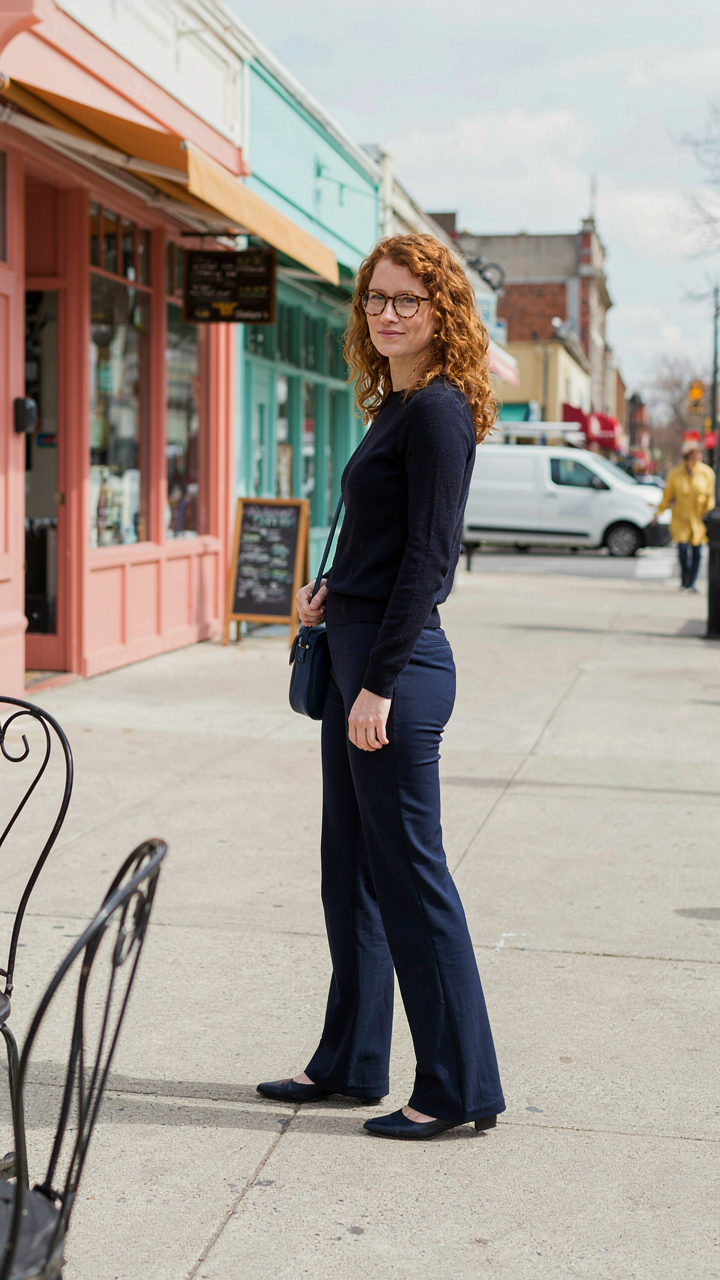
Unbroken Color From Neck To Ankle
You want people to see you as taller without admitting that’s what you’re optimizing for. The real mechanism is borrowed from graphic design: continuity. When your eye doesn’t stop, your brain doesn’t measure. A monochromatic scheme creates an uninterrupted vertical line that the viewer’s gaze travels without friction. Your body reads as one shape instead of segmented sections that invite height comparison.
The common advice says wear all black. That’s lazy. The strategy is matching the top, bottom, and shoes within the same color family or value range. Camel to tan to beige works. Navy to slate to charcoal works. The tonal shift matters less than the absence of a hard stop at the waist or ankle. Your capsule needs pieces that pair within color families, not just pieces that happen to exist.
Pattern Scale Relative To Frame Size
Large prints overwhelm a petite frame because proportion is relative to body mass, not absolute. A bold botanical or oversized geometric tile that looks balanced on a 5’10” frame reads as chaotic on someone 5’2″. The scale swallows the wearer instead of complementing the silhouette. Your capsule should feature small to medium prints only, and use them sparingly as accent pieces, not base layers.
Build your capsule with solid colors as the foundation, then add precisely one or two patterned pieces in tight scales: mini checks, fine stripes, small florals. A petite capsule without solid color pieces is already failing because you’ve eliminated your easiest route to visual continuity. Use pattern to add dimension and interest, never as filler or to add perceived volume where petite frames need the opposite.
Beyond Trends: Building Your Essential Petite Wardrobe Capsule

The Pieces That Survive Every Season
You’re worried about wasting money on clothes that won’t fit next year. Here’s the mechanism: seasonless pieces aren’t neutral by accident—they work because they solve a proportion problem, not a trend problem. Petite bodies need consistent anchor pieces that don’t shift with fashion cycles because the fit disruption itself is the real cost. A well-fitted white button-up in cotton doesn’t age out because button placement and shoulder seam position remain constants in petite construction.
The standard advice tells you to buy “basics.” That’s lazy. What you actually need are pieces engineered for petite proportions that don’t depend on styling tricks to work. A petite-cut blazer with a shortened torso, tapered sleeves, and proper shoulder pitch functions the same way in 2020 and 2028. Dark wash jeans with a 26-inch inseam, mid-rise positioning, and a cropped leg length solve the same visual problem regardless of decade. The anchor pieces carry their own logic—they prove themselves through repetition and fit, not through fashion authority.
Investment Pieces Versus Disposable Solutions
Most capsule advice conflates “quality” with “expensive,” which breaks the model for petite wardrobes. The real distinction sits in economics: an investment piece outlasts the garment itself through either fit precision or fabric integrity. A petite-specific tailored pant in Italian gabardine with a proper inseam costs more upfront because the pattern grading alone reflects your actual proportions. A mass-market pant that you hem to fit costs less now but requires tailoring twice, fits less consistently, and deteriorates faster at seams under adjustment stress.
Disposable fashion for petite frames is the petite knockoff—brands that mark down proportions without adjusting construction. You pay less but wear it fewer times because the proportions create fatigue. A petite investment piece gets worn 150 times before it shows wear. A disposable petite compromise gets worn 40 times before the fit frustrates you out of rotation. Build your capsule by tracking cost-per-wear, and only buy investment pieces where petite-specific construction exists for that garment category.
Accessories: The Leverage Points In Your Petite Capsule Wardrobe

Where Your Eye Lands First
You want accessories to do the heavy lifting so you don’t have to buy more clothes. The real mechanism is simple: accessories break up your vertical line. A petite frame reads as one continuous mass when dressed in a single color or uninterrupted fabric. A belt, a necklace, or a scarf creates a visual break point. Your proportions don’t change, but the observer’s eye divides your frame into sections, which makes each section read as shorter and better balanced against the whole.
Placement beats quantity every time. A necklace at your collarbone shortens your neck visually. A belt at your natural waist divides your torso from your legs. A bag held at hip level anchors your lower half. None of these work by accident. Each one is positioned to interrupt the vertical line at a specific point where petite frames need division most. Test this: stand in front of a mirror without accessories, then add a single item. Watch where your eye goes first. That’s your leverage point.
Proportion Math In Wearable Form
Accessories follow the same proportion rules as clothing, except the margin for error is smaller. Think of it like leverage in physics: a small object at distance creates the same force as a large object up close. A delicate bracelet on a petite wrist reads differently than the same bracelet on a larger wrist. A large pendant overwhelms a petite chest. A small crossbody bag looks intentional on you. The same bag worn by someone five inches taller reads as an afterthought.
The common advice here is worthless: “just size down.” That’s not how it works. You’re not just making things smaller. You’re matching the proportional weight of each item to your frame’s actual dimensions. A watch face that sits comfortably on a petite wrist has a specific case diameter, not just “a small watch.” Earrings that balance your face have a length and weight determined by your bone structure, not by some vague idea of “delicate.” Measure your wrist circumference, your face width, and your shoulder span. Use those as your scaling reference, not guesswork.
Color Theory For The Petite Wardrobe

How Contrast Works Against You
You want color to make you look taller, not chop you into pieces. High-contrast combinations—white top with black bottom, for example—create a visual line that breaks your frame into horizontal segments. In optical design, this principle mirrors how the human eye tracks edges and boundaries. For petite frames, this edge-tracking works against you because each segment reads as shorter when visually divided. Low-contrast dressing keeps the eye moving vertically without interruption, which extends perceived height.
The mechanism is simple: your eye doesn’t stop at a boundary it can’t clearly see. Monochromatic palettes, tonal layering, and analogous color combinations all suppress horizontal breaks. This isn’t opinion. It’s how contrast functions in visual perception. Wear a camel sweater with cream pants instead of navy pants, and you’ve already extended your vertical line without changing fit or cut. The petite capsule works with this, not against it.
Strategic Color Blocking For Proportion
Color blocking—using solid blocks of color adjacent to each other—is how most people try to create shape and interest. The common advice says to “use color blocking to emphasize your best features.” That’s incomplete. Real color blocking in a petite capsule works by controlling where the eye stops and starts. If you block color vertically, you reinforce height. If you block horizontally, you shorten yourself. Vertical color blocking means a darker side panel on a lighter center, or a long color-blocked cardigan over monochromatic pieces underneath.
Placement matters more than the colors themselves. A petite woman wearing a horizontal color-blocked stripe at chest height has created a visual equator that anchors the eye to the middle of her frame. The same stripe placed as a vertical accent on a cardigan’s button placket moves the eye upward. Build your petite capsule with color-blocked pieces that run lengthwise: cardigans with vertical panels, column dresses with side blocking, jackets with contrasting vertical seams. This turns the color block into a tool for elongation, not decoration.
The Capsule Wardrobe Women Need: Function Over Fads

Stop Pretending Your Lifestyle Is Someone Else’s
You’re afraid you’ll build a wardrobe that doesn’t match reality, then blame the system instead of yourself. That’s the real cost of generic capsule advice. The mechanism is simple: most capsule frameworks assume an average body and an average life. Neither exists. A petite woman who works from home has zero use for office blazers. A petite woman in finance needs them but not weekend wear. Start by naming what you actually do, not what you think you should do or what influencers do.
- Work environment: Office, hybrid, fully remote, or client-facing. This determines whether tailored pieces matter and how many.
- Social calendar: Regular events, occasional outings, or minimal socializing. Shapes the ratio of casual to polished pieces needed.
- Physical activity: Gym, sports, outdoor work, or sedentary. Dictates how many athletic or durable pieces belong in rotation.
- Climate and season: Year-round heat, distinct seasons, or layering climate. Changes the weight and type of fabrics you’ll actually wear.
- Commute and errands: Car, public transit, walking, or mixed. Petite women in cold climates need different outerwear solutions than others.
Once you list these, you stop buying for an imagined life and start buying for the one you live. Your capsule becomes a tool instead of a status symbol. That distinction changes everything about fit, quantity, and durability.
The Math Of What Petite Bodies Actually Need
The real problem with capsule wardrobes for petite women isn’t the concept, it’s the proportion math that nobody teaches. Most capsules assume a standard height range and recommend piece counts that don’t account for how petite proportions require different layering and stacking strategies. A petite woman needs fewer total pieces because her surface area is smaller, but she needs higher precision in each piece because poor fit is more visible on a compact frame. This is basic geometry applied to clothing. Oversizing doesn’t hide shortness on petite bodies, it swallows them. Undersizing creates the opposite problem. You need pieces that work specifically at your scale, not downsized versions of standard sizes.
Audit your actual daily rotation for the next two weeks. Track what you wear, how often, and why you skipped other pieces. The reason matters: did you skip something because it didn’t fit right, or because it didn’t suit your day? Petite women often confuse a poor fit with poor design. Once you separate these, you build a wardrobe where every piece earns its place through actual use, not theoretical versatility.
The Fall Capsule Wardrobe Fallacy: Adapt, Don’t Overhaul

Layering Without Adding Bulk
You want the fall refresh to feel intentional so you don’t waste money on pieces that won’t work. Here’s the mechanism: layering on a petite frame operates like load-bearing in architecture—distribute weight across multiple thin surfaces rather than stack it vertically. A petite body has less surface area to work with, so each added layer compresses the torso and shortens the visual line. Most advice says “just layer smaller pieces,” which is incomplete.
The real move is strategic proportioning through fit, not quantity. A fitted long-sleeve tee under a cropped sweater works because negative space breaks the bulk. An oversized linen shirt over a tank creates depth without drowning your frame. The key: each layer must end at a different point on the body. If your base layer, mid-layer, and outer layer all hit at the same length, you’ve created a visual column that reads heavy. Offset the hems by 2 to 4 inches minimum so the eye travels between distinct points rather than seeing one thick mass.
Transition Pieces That Actually Shift Seasons
The standard advice pushes you toward “versatile basics in neutral tones.” Wrong framing. Transitional pieces don’t bridge seasons because they’re beige—they work because they shift the weight distribution of your outfit without requiring a full rebuild. Think of transition pieces as the connector elements that make your existing spring and winter items function in new contexts.
A petite-cut blazer in a medium weight fabric works as a layering anchor in September when days are warm. By November, the same blazer anchors heavier knits underneath. A fitted cardigan buttons over dresses in fall and over tees in late spring. The piece doesn’t change; the pairing does. This approach lets you keep your core investment intact while extending utility. You’re not overhaul-building a new wardrobe—you’re rotating anchors that recontextualize what you already own.
Mastering The Mirror: Your True Style Authority

Stop Waiting For Permission
You want someone to tell you what looks good so you can stop feeling like you’re getting it wrong. Here’s the mechanism: your eye already knows. The problem isn’t your taste—it’s that you’ve outsourced judgment to rules designed for average bodies. Petite proportions demand real-time feedback, not a checklist. When you try on a piece, you see instantly whether the sleeve lands right, whether the hem hits at your best point, whether the volume reads as intentional or drowning. That visual data is your only reliable input.
Most capsule wardrobe advice ignores this. It tells you to buy specific colors or follow a formula, as if fit questions resolve through color theory. They don’t. A petite woman can wear oversized pieces perfectly—if the break point lands correctly. She can wear cropped proportions that would overwhelm someone taller. The rule isn’t the garment type or cut. The rule is: does your body’s actual dimensions make this work, yes or no. Start noticing which pieces you reach for without thinking. Those aren’t random. They’re the ones your eye already approved.
The Fit Test Never Lies
Every outfit you own passes one test or fails it: does it make your actual frame look intentional. Photography, trends, and influencer styling don’t matter in your closet. Intention does. When a hem hits your natural waist, or a sleeve ends at your wrist bone, or a neckline sits where your proportions need it, you feel the difference immediately. Your mirror tells you before your brain finishes a sentence. The petite body’s proportions change how silhouettes read—a regular ankle crop becomes a wide-leg on your frame, a standard midi becomes a maxi. Your eye catches this mismatch faster than any measurement guide.
Build your capsule by wearing pieces three times before deciding. First wear: novelty masks bad fit. Second wear: the real picture emerges. Third wear: you know whether it stays. Remove anything that requires styling tricks to work. Remove anything where you’re fighting the proportions. Keep only what your eye approves without negotiation. This eliminates 80 percent of the decision-making noise. Your mirror becomes the authority because it shows your actual reality, not a brand’s sample size assumption.
Your True Limitation Isn’t Your Height, But Your Reliance On External Rules For Style

You’ve been waiting for permission to dress like yourself. The petite capsule wardrobe isn’t about following another rulebook. It’s about building a system that stops you from second-guessing every choice. Pick three colors that make you look alive. Buy only pieces that fit your frame without alteration. Wear them. Stop consulting fashion rules written by people who don’t share your body. Your style doesn’t need justification, just intention.