

The Minimalist Wardrobe Deception: Why More Choices Means Less Style

Cut Excess, Define Your Core
You want permission to stop trying. That’s the real reason this matters. Here’s the mechanism: decision fatigue is real, and your brain burns cycles on every garment you own. In economics, we call this the paradox of choice. Apply it to your closet and you get the same result: more options create paralysis, not freedom. A lazy girl outfit isn’t lazy because she owns less. It’s lazy because she’s eliminated the decision.
Most people misunderstand this. They think minimalism means owning five white t-shirts in slightly different weights. Wrong. Ruthless curation means owning pieces that work because you’ve already answered the hard question: what is your actual uniform? Strip everything else. Your core wardrobe should answer one specific problem—how you actually move and work and exist—not every hypothetical version of yourself. Once you know this core, building an outfit takes seconds instead of twenty minutes of mental archaeology.
Pieces That Stack Without Thinking

Versatility isn’t about buying items that “go with everything.” That’s marketing language for shapeless. It’s about understanding which specific combinations your life actually requires. Think of it like systems design in engineering: each piece must serve multiple functions within defined constraints, not infinite ones. A black oversized button-up isn’t versatile because it’s black. It’s versatile because you’ve already tested it under three different pants, two shoe types, and one layering scenario that covers 80 percent of your week.
The mistake everyone makes is buying “statement pieces” that need specific contexts. Those don’t build lazy outfits. They add complexity. What actually works: neutral base colors that repeat, silhouettes that don’t compete with each other, and textures you can layer without creating visual noise. Test every combination before committing. If a piece doesn’t slot into at least three existing outfits without friction, it doesn’t belong in your core. The goal is that getting dressed becomes muscle memory, not an art project.

The “Strategic Slouch” Protocol: Mastering Elevated Loungewear Style
Quality Fabric Does The Heavy Lifting
You want permission to look put-together without trying. That’s the real ask here. The mechanism is simple: expensive-looking fabric signals effort regardless of how the garment actually fits or what you do in it. Borrowed from materials science, think of fabric as the load-bearing wall of your outfit. Everything else is decoration.
Cotton-linen blends, quality knits, and structured cottons carry visual weight that cheap synthetics can’t match. A $15 polyester sweatshirt looks like what it cost. A $60 cotton-modal blend looks like intention. The difference isn’t visible thread count or thread count claims. It’s how light hits the surface and how the material holds its shape through movement. Fiber quality determines whether slouching reads as “got it together” or “gave up.”
Clean Lines Beat Fussy Details
The common advice here is wrong. Lazy girl outfits don’t work because they’re simple. They work because simplicity forces the fabric and fit to do all the talking, with nowhere for mediocrity to hide. Borrowed from graphic design, negative space is your friend. Every pocket, seam, and embellishment competes for attention and makes the outfit feel busier than it is.
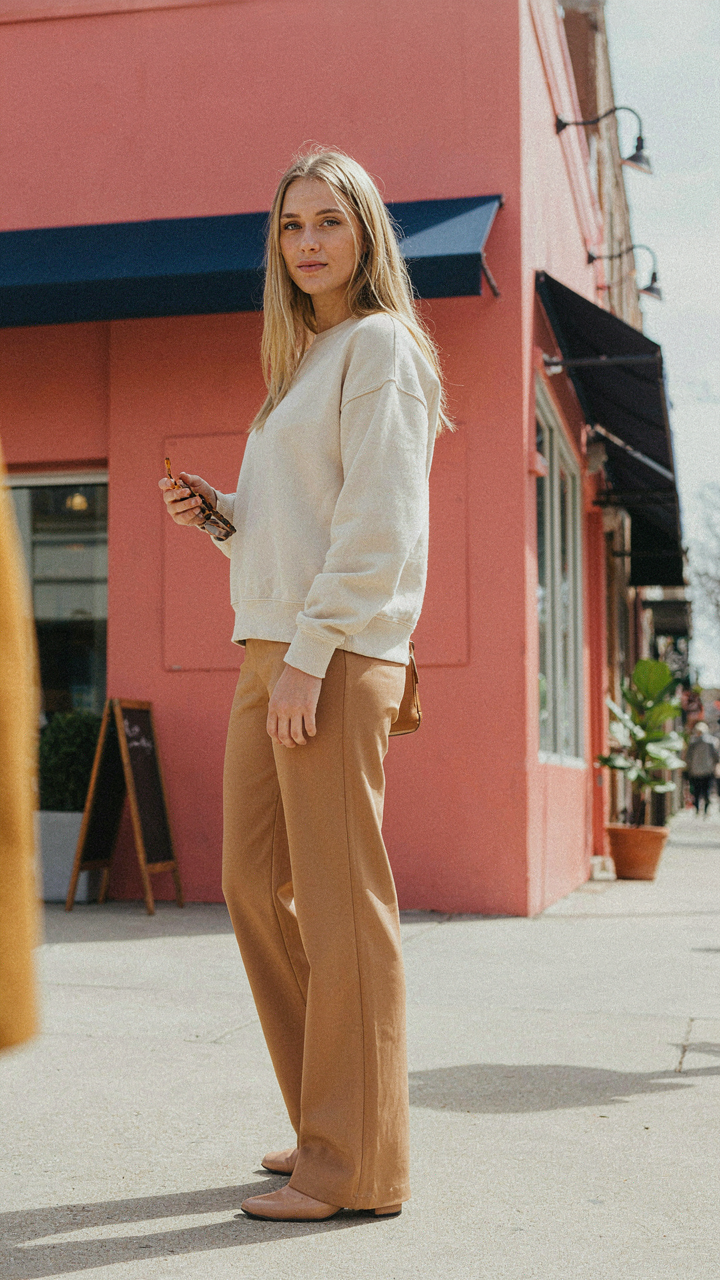
Straight-leg pants over cuffed hems. Oversized tees with minimal branding. Unbuttoned cardigans in solid colors. These pieces work because the eye settles on the garment itself, not on competing visual elements fighting for focus. The fit should feel intentional but not tight. Structured enough that the fabric drapes instead of clings. This is the protocol: choose one statement piece per outfit, let it breathe, fill the rest with neutrals that support it.
Accessory Alchemy: The 80/20 Rule For Lazy Girl Outfits

Where Minimal Adds Maximum Value
You want to look put-together without the effort, which means you’re trying to compress polish into the smallest possible time investment. Here’s the mechanism: accessories aren’t decoration. They’re the conversion points where a base outfit becomes intentional. Economics calls this leverage—you deploy a small resource to move a large outcome. In lazy girl outfits, one accessory swap shifts the entire perception from sloppy to considered.
The reason most people fail here is they add too many things. A watch, a bag, a belt, a scarf, rings, a hat. That’s not minimalism. That’s sabotage disguised as effort. The actual play is choosing one or two pieces that do disproportionate work. A structured bag elevates basics instantly. A quality watch telegraphs discipline. A belt changes proportions without changing clothes. Pick your leverage points, then stop.
Invest In The Pieces That Never Betray You
Don’t chase trends in accessories. Trends date faster in small pieces because they’re visible constantly. A leather belt in cognac brown works identically in 2024 and 2034. A canvas tote in cream still reads clean in every season. Timeless doesn’t mean boring—it means the piece doesn’t require justification or apology when you wear it six months later.
This sounds obvious but people still buy fast fashion accessories expecting them to perform like investment pieces. Cheap metal oxidizes. Synthetic leather cracks. Canvas frays at edges. Spend on materials that age well: genuine leather, solid metals, natural fabrics. A $120 leather belt costs roughly $0.30 per wear across three years. A $15 synthetic belt costs $1.50 per wear before it splits. The math runs the other direction than most people think. Your accessories should require zero thought about whether they still work.
The “Comfy Girl Outfits” Myth: When Comfort Becomes Complacency

The Comfort Competence Tension
You want comfort without looking like you stopped trying, and that fear drives most lazy girl outfit failures. Here’s the mechanism: comfort and polish operate on a continuum like a physics system balancing opposing forces. Move too far toward ease, and you lose visual hierarchy. Move too far toward polish, and you sabotage the entire premise. The sweet spot isn’t compromise—it’s strategic material and fit selection that performs both functions simultaneously without negotiation.
Most lazy girl advice tells you to “just wear what feels good.” That’s incomplete. Comfort without structure reads as neglect, not intentionality. The real play is choosing fabrics and cuts that drape well enough to signal effort while eliminating the physical friction that makes getting dressed feel like work. A well-fitted linen shirt worn untucked moves different than a shapeless oversized tee, even if both feel equally soft against skin. One registers as deliberate. One registers as default.
Small Changes That Shift Everything
Fabric upgrades matter more than people admit because they’re the mechanism between comfort and perception. A cotton blend that holds shape outperforms cheap jersey that bags at the waist within weeks. You don’t need to spend heavily, but you need material that has actual structure built into its weave. Switching from fast fashion basics to mid-weight cotton or linen blends changes how an outfit photographs, how it moves, and critically, how long it stays polished through the day.
Add one tactical element per outfit: a leather belt over a dress, a fitted blazer over sweats, or a structured bag that forces better posture. These aren’t decoration—they’re anchors that create visual balance and stop your brain from perceiving the outfit as lazy. The fit of your trousers matters more than the price point. A properly tailored pant in any fabric outlasts and outperforms three pairs of ill-fitting designer ones. Tailoring costs less than most people think and reverses the entire trajectory of basic pieces.
The House Outfit Ideas Fallacy: Ditching Sloppiness At Home

Your Clothes Signal To Your Brain Before They Signal To Anyone Else
You want permission to dress down at home because you think nobody’s watching. That’s the real motive here. But the mechanism is neurological, not social. Neuroscience calls this “enclothed cognition”: what you wear alters how your brain processes tasks and decisions. Wear shapeless sweats all day and your executive function follows suit. Wear structured pieces even at home and your mind defaults to focus mode.
The mistake everyone makes is treating home clothes as a separate category from “real” clothes. They’re not. Your brain doesn’t distinguish between an outfit worn for an audience and one worn alone. It responds to the signal your clothing sends about what mode you’re in. A fitted crewneck and tailored trousers at home isn’t performative. It’s a physiological tool that keeps your work output and decision-making sharp during the hours you’re most likely to waste them.
Structure Works Because Constraint Sharpens Output
Lazy girl aesthetics get this backwards. The “house outfit” trend treats home as a place to abandon standards. Real productivity demands the opposite. You introduce constraints at home the same way a director frames a shot: limits force creativity and focus. A defined home uniform removes the daily decision about what to wear, which sounds trivial until you realize decision fatigue is what kills your afternoon work sessions.
Pick three to four pieces that work together: a neutral base layer, one structured piece like a blazer or tailored cardigan, straight-leg or wide-leg trousers, and one accessory like a belt or scarf. Wear this combination on repeat at home. Your brain registers the consistency as a signal that you’re in production mode, not drift mode. This isn’t about looking polished for Instagram. It’s about engineering your own cognitive state through what touches your skin.
The Uniform Blueprint: Unlocking Simple Outfits For School & Beyond

Why The Uniform Actually Works
You want permission to stop deciding what to wear. Military strategy calls this standardization: soldiers wear uniforms to eliminate decision fatigue and ensure readiness. Your personal uniform operates on the same principle. You’re not being lazy. You’re removing friction so the effort you do spend lands visibly. The mechanism is constraint. Every piece you own must function within a narrow system, which means each item pulls weight.
Most people treat their closet like a buffet. They buy what looks good in isolation, then fail to combine it into anything coherent. A uniform system forces the inverse. You choose the foundation first, then build variations inside it. This is why “lazy girl outfits” work when random outfit stacking doesn’t. You’ve eliminated the actual work: the cognitive load of compatibility.
Your Core Components And How To Stack Them
Start with a color palette of three to four colors that appear in at least 60 percent of your wardrobe. This isn’t trendy advice. It’s optical engineering. Neutrals like black, white, beige, or gray become your base layer. Add one secondary color you genuinely wear, not one you think you should wear. Then decide: fitted or loose as your silhouette default.
- Foundational Bottom: One cut that fits your body without alteration. Dark jeans, black trousers, or a neutral skirt. Wear it four days a week minimum. Repetition is the point.
- Neutral Top Layer: A white or cream long sleeve or short sleeve that fits at the shoulders. This becomes your constant. It pairs with everything without thought.
- Texture Break: One material that differs from your usual—linen, corduroy, or structured cotton. This single piece signals intentionality without requiring complexity.
- Layering Piece: A cardigan, blazer, or overshirt in your secondary color. This transforms any base outfit from incomplete to polished in seconds.
- Variation Anchor: One statement item per season—a patterned shirt or colored sweater. Rotate it with your core three pieces to create perceived variety without closet expansion.
Once you’ve identified these five components, every outfit you build uses at least three of them. School outfit Tuesday looks identical to Thursday because it is. The polish comes from fit and fabric quality, not from inventing new combinations. Your brain stops working on clothes. That’s the entire goal. When you get dressed in under five minutes and still look intentional, the system worked.
Beyond “Comfy School Outfits”: The Psychology Of Effortless Presentation

How Status Reads Without Effort
You want people to assume you have your life together without actually having to try. That’s the real game here. Competence signals work the same way a airline pilot’s uniform does: borrowed authority. You’re deploying constraint as status. A structured blazer over basics tells people you understand proportion and hierarchy, even if you grabbed it in thirty seconds. The mechanism is simple: restriction signals intentionality. Loose, unstructured clothing reads as apathy. Fitted pieces read as deliberate choice.
Lazy girl outfits weaponize this asymmetry. You select items that enforce structure through cut alone, not through styling effort. A well-fitted white shirt needs nothing else because the garment itself carries the weight. The neckline, seam placement, and fabric weight do the communication for you. Dark denim with a clean break at the ankle works the same way. These pieces don’t require accessories, layering, or makeup to broadcast competence. They work in a boardroom or a coffee shop because the silhouette carries the signal independently.
The Absence That Reads As Confidence
Most advice about understatement misses the actual mechanism: removal creates mystery, and mystery reads as power. A minimalist outfit isn’t boring because it lacks information. It’s compelling because the person wearing it didn’t feel the need to explain themselves. This operates on the psychology of authority, not decoration. Someone with status doesn’t over-explain their presence.
Intentional understatement in lazy girl outfits means refusing to fill dead space. No overstyled hair. No excessive jewelry. No layering just to add visual interest. The outfit becomes a baseline, not a statement piece. This frees your presence to do the work instead of your wardrobe. People read restraint as confidence because confident people don’t need validation from outfit complexity. The protocol is straightforward: pick neutral colors, fitted silhouettes, and stop adding before you feel satisfied.
The “Lazy Outfits” Trap: Avoiding The Slide Into Apathy

Know When Your Closet Stops Working
You’re afraid that lazy girl outfits are just permission to stop trying. They’re not. The real mechanism here borrows from inventory management: turnover rate. Your wardrobe’s turnover rate is how often you actually wear pieces versus how many sit unused. When turnover drops, you stop seeing what you own. You start buying duplicates of the same thing. You mistake comfort for style. A brutal wardrobe audit forces you to see what actually moves through your life versus what you’ve been pretending to wear.
Start by pulling everything out. Not metaphorically. Actually remove every piece from your closet. Try on the pieces you wore in the last three months. The ones you reach for without thinking. Keep only those. Everything else either gets sold, donated, or stored separately. The pieces that didn’t make the cut reveal a gap between who you think you are and who you actually are. That gap is where laziness hides.
Repair, Don’t Replace
Good fabrics last longer than most people think. Cotton, linen, wool, and quality synthetics handle wear. The problem isn’t the fabric. The problem is you ignore small damage before it becomes irreversible. A loose seam becomes a rip. A missing button becomes a stain from sweat and friction. Pilling gets ignored until the whole garment looks tired. Prevention costs almost nothing. Repair costs time, but extends life by seasons.
- Button replacement: Keep a basic sewing kit with thread matching your most-worn colors. Replace buttons immediately after they loosen, not after they fall off.
- Seam reinforcement: Tack loose seams at stress points like armholes and side seams before they split. Five minutes now saves a piece.
- Fabric pilling: Use a fabric shaver or lint roller on sweaters and knits after washing. Do this before pilling becomes embedded.
- Wash frequency reduction: Washing breaks down fibers faster than wearing does. Spot clean instead of full washes when possible. Air out between wears.
- Hem adjustment: Hems wear faster than fabric. Get them reinforced or re-hemmed before they fray or drag on the ground.
The pieces that last longest aren’t the ones you baby. They’re the ones you maintain systematically. Set a monthly maintenance date. Check seams, buttons, hems, and pilling on your five most-worn pieces. Fix what you find before it compounds into replacement territory.
The Real Obstacle To Your Polished Ease Isn’t Your Wardrobe; It’s Your Addiction To Performative Effort

You don’t need better clothes. You need permission to stop trying so hard. The polished lazy girl outfit works because she stopped seeking validation through visible labor. She wears what feels good and moves on. Start today by picking one outfit that requires zero thought and wearing it without apologizing for it mentally. Stop treating ease like a luxury you haven’t earned yet. Effort disguised as effortlessness is just effort with extra steps.