
The “Perfect Tee” Delusion: Why Most Advice Misses The Point

You’re Chasing A Status Signal, Not Clothing
You want permission to believe a $120 tee will fix your wardrobe because buying the right thing feels like progress without the work. The mechanism is consumption as substitution: we mistake acquisition for decision-making. The fashion industry profits on this exact loop. People bounce between cheap basics that fall apart and expensive basics that promise permanence, never stopping to ask what a tee actually needs to do.
Most advice treats basic tees like a solved problem with a simple answer. It’s not. The real question isn’t which brand wins. It’s whether you understand the economics of cheap labor and fast production embedded in the garment itself. Until you see that cost structure, you’ll keep making the same mistake regardless of price point.
The Time Tax Of Constant Replacement

Economics teaches opportunity cost: the real price of something is what you give up to get it. A cheap tee costs you replacement cycles. You buy it for ten dollars, wear it sixty times, then the collar stretches, the fabric pills, the color fades unevenly. You replace it. Repeat this every eight months and you’ve spent eighty dollars annually plus the mental load of shopping again.
A tee at fifty to eighty dollars from a maker using better cotton and tighter construction lasts two to three years with proper care. The math seems worse initially. But you’re not factoring in the hours spent researching, shopping, and reorganizing when cheap basics fail. You’re not counting the friction of never having a reliable foundation. The protocol: calculate your total tee spending over three years, then divide by actual hours spent acquiring and replacing. Compare that to buying three or four quality pieces upfront.

Beyond “Basic”: Deconstructing The Essential T Shirt Types

Your Actual Life Dictates The Fit, Not Pinterest
You want permission to stop thinking about this. That’s the real motive. Most advice about basic tees treats them as interchangeable units, which is how you end up with a drawer full of shirts you don’t wear. The mechanism is simple: a tee only functions as a uniform when it aligns with your actual body, climate, and daily friction points—not some generic ideal. Your lifestyle enforces constraints that matter more than brand names.
Start by mapping your real usage: How many hours per day do you spend in this shirt? Are you sitting at a desk, moving between temperature zones, or outdoors? What does your body do to standard cuts? A shirt that works for someone with a narrow chest and long arms fails for someone built differently. Document three weeks of what you actually reach for, then reverse-engineer the pattern. That pattern becomes your specification.
Fiber Architecture And The Durability Trade Off
Textile engineering teaches us about tensile strength—the ability of material to resist breaking under stress. A basic tee’s fiber composition determines how many wash cycles it survives before collar degradation, pilling, or shape loss. Most basic tee advice stops at “cotton is breathable,” which misses the entire mechanism of durability.
A 100% cotton tee breathes efficiently but degrades faster than blends. A cotton-polyester blend (typically 50/50 to 65/35) resists pilling and maintains shape through more washes, though it breathes slightly less. Pima or supima cotton costs more upfront but has longer fibers that create tighter yarn construction, meaning fewer pills and sustained softness across thirty-plus washes. Thread count matters less than fiber length. Buy one tee in your intended fabric, wear it hard for six weeks, wash it ten times, then assess whether the collar holds, the body retains shape, and shrinkage stabilizes within acceptable range before committing to multiples.
The 80/20 Tee Protocol: Maximizing Versatility With Minimal Investment

The Economics Of Tee Ownership
You want permission to buy fewer things and feel smarter about it. Here’s the mechanism: Pareto’s principle from economics states that 20 percent of inputs generate 80 percent of outputs. Applied to tees, this means five to six tees in your rotation produce the vast majority of your actual outfits. Most people own fifteen to twenty basic tees and wear six. The rest sit dormant, creating decision fatigue and closet waste.
The constraint forces precision. When you own only the tees that work, you stop buying based on what feels new and start buying based on what actually layers, coordinates, and survives repeated washing. This isn’t minimalism as aesthetic choice. It’s operational efficiency. You reduce decision time, eliminate dead inventory, and guarantee every piece earns its space through measurable outfit combinations.
Core Neutrals For Maximum Pairing
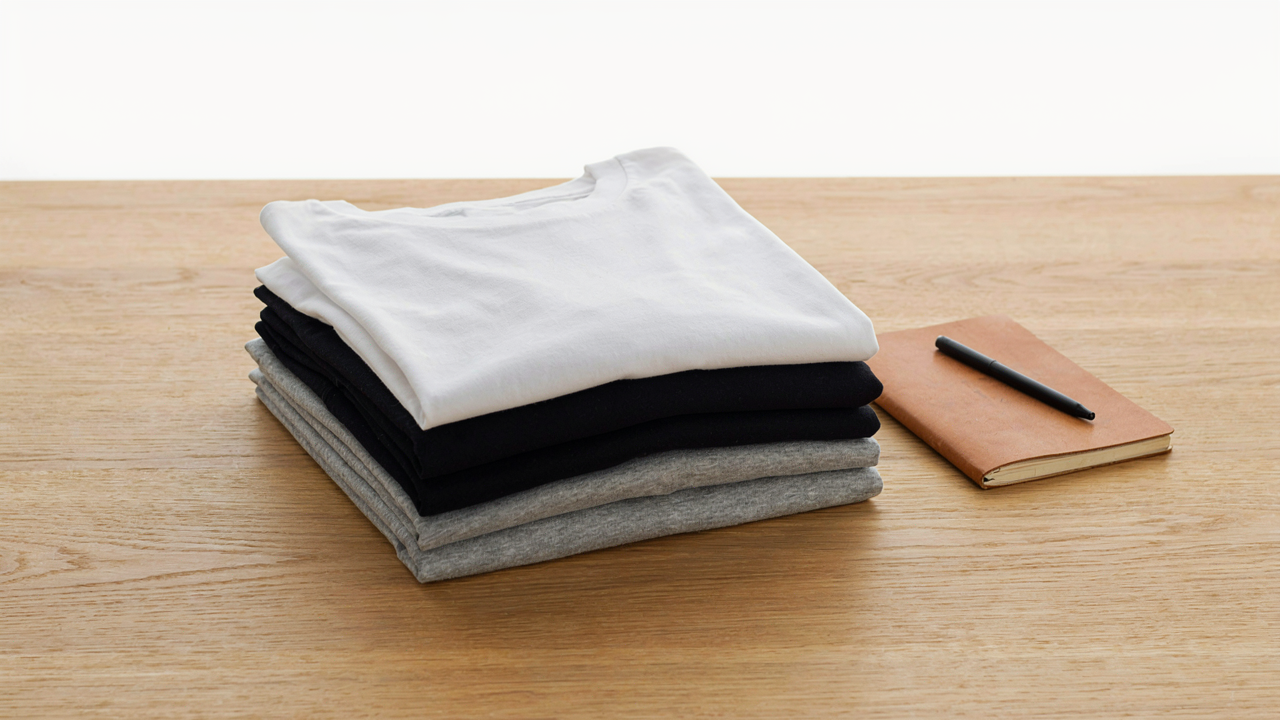
Start with white, black, and gray. These three colors form the foundational anchors for every outfit category because they neutralize rather than compete with other pieces.
- White: Works as a base layer under everything and as a standalone piece. Pairs with every bottom color without visual conflict. Wear it under open shirts, blazers, or oversized outerwear.
- Black: Functions as visual weight and contrast. Grounds lighter bottoms and works under structured layers. Never reads as casual when paired intentionally with tailored pieces.
- Charcoal Gray: Bridges white and black without the starkness of either. Works with cool and warm tones alike. Versatile enough for business casual contexts.
- Navy: Delivers depth without the formality of black. Pairs with earth tones, denim, and khaki. A strategic fourth if your lifestyle includes casual professional settings.
- Cream or Off White: Softens the visual intensity of pure white while maintaining neutrality. Better for warmer months and warmer skin tones.
These five colors represent deliberate choices, not abundance. Each solves a specific pairing problem. You’re not collecting neutral tees. You’re stocking the exact neutrals that expand outfit combinations without redundancy. Test each color against your existing bottoms before buying. A tee that doesn’t coordinate with at least four different bottoms doesn’t belong in the rotation.
The Fitted Tee Fallacy: Why “Perfect Fit” Is Overrated

Movement Over Static Measurements
You want the fit to look good in the mirror because you think that’s where people evaluate you. It’s not. The real test happens when you move. Borrow a concept from biomechanics: load path. In structural engineering, load path describes how force travels through a system. A tee’s fit matters the same way. Fabric needs room to redirect stress at shoulder joints, armpits, and chest when you lift, reach, or sit.
A tee cut too tight at the armhole creates tension the moment you raise your arms. The seam pulls inward, sleeve cap rides up, and you unconsciously adjust your posture to compensate. This isn’t discomfort you notice. It’s constraint you feel as restriction. A properly fitted tee distributes this load across a wider area so movement stays natural and repeatable throughout the day.
Utility Dictates Comfort, Not Preference
The common advice is to find what “feels good.” That’s backward. Fit serves function first, then comfort follows. A tee worn under a blazer needs different proportions than a standalone piece. Layering tees demand slimmer cuts to avoid bulk under jackets. Standalone tees worn in warm weather should sit looser to allow air circulation and reduce sweat concentration.
Your job determines the fit you actually need. If you sit at a desk eight hours, chest and shoulder tightness becomes a problem fast. A fractionally roomier cut prevents the slow compression that kills posture. If you move constantly, a snug tee reduces fabric movement that creates unnecessary friction. Stop choosing fit based on how it photographs and start choosing based on how it performs during your actual day.
The White T Shirt Imperative: A Non Negotiable Foundation

Why White Dominates Over Everything Else
You want white because you’re afraid of making the wrong choice, and white eliminates that fear entirely. This is pure signal theory from economics: white communicates neutrality, which paradoxically makes it the most powerful baseline. A white tee absorbs no judgment. It pairs with everything. It doesn’t age into irrelevance like trend colors do. The mechanism is elimination through universality, not addition through personality.
White performs this function because it sits at the intersection of fabric visibility and psychological safety. You see the quality of construction, fit, and material without distraction. Worn fabric shows wear uniformly. Seams, hems, and weight become obvious. This transparency is why minimalists default to white first, then black, then neutrals. Everything else introduces noise into a system built to reduce variables.
Keeping White Actually White Without Constant Replacement
The common advice here is garbage: bleach destroys fibers, hot water weakens cotton, and frequent washing degrades the garment faster than wear. The real mechanism is preventing oxidation and particle embedding. White yellows when UV light breaks down cellulose or when body oils and detergent residue accumulate in the weave. Stop both and your white stays white.
Wash in cold water with minimal detergent, inside out to shield the surface from abrasion. Dry flat or hang in shade, never direct sunlight initially. When storage happens, use acid-free tissue or a dark cotton bag to block ambient light. Store in a cool, dry space away from heat sources. This isn’t complicated. You’re managing three variables: light exposure, chemical residue, and fiber stress. Control those and a quality white tee lasts years before looking tired.
Curating, Not Collecting: A Systems Thinking Approach To Wardrobe

Where Your Closet Actually Breaks
You want permission to buy more tees without feeling guilty. Here’s the real mechanism: most people don’t have a wardrobe problem, they have a visibility problem. Military logistics borrows from queuing theory, which identifies bottlenecks as points where throughput collapses. Your tee bottleneck isn’t scarcity, it’s decision friction. You own tees you can’t see, can’t reach, or can’t pair with anything. The tee itself becomes worthless not because it’s low quality but because accessing it costs mental energy.
The common advice says “get rid of what you don’t wear.” Wrong. That’s backward. You don’t wear tees because you can’t find them or you’ve psychologically forgotten they exist. Most people solve this by adding organizational tools, which just creates a second closet. The real bottleneck is quantity relative to visibility. You need to cut inventory until every tee you own occupies a mental slot. Military units don’t optimize by adding storage, they optimize by reducing what moves through the system.
Rotation Velocity Determines Everything
Don’t think about “wearing all your tees equally.” Think about rotation velocity. A tee worn twice weekly moves faster through your wardrobe than one worn monthly. The faster a garment rotates, the more utility it extracts per calendar year. Basic tees in heavy rotation accumulate wear patterns that reveal fit and fabric reliability. This matters because you’re gathering data for future purchases, not just getting dressed.
Inventory management works backward from usage. Identify which three to five tees you reach for without thinking. Those are your baseline rotation tees. Everything else benchmarks against them. If a tee sits untouched for six weeks, it’s not “saving you money for later,” it’s dead inventory occupying physical space and mental bandwidth. Create a simple protocol: wear from one pile, launder back to another, and watch which tees return to the wearing pile fastest. That velocity tells you what actually fits your life.
Beyond “Cute Basic Tees”: Investing In Your Personal Brand
Quality As The Unmissable Signal
You want people to assume you have your life together without saying a word. That’s the real driver here, and it’s not shallow. In economics, signaling theory explains how one actor communicates hidden traits to another through observable choices. A basic tee signals competence the same way. Cheap fabric and sloppy seams broadcast neglect. Structured cotton and precise stitching broadcast standards.
The mechanism is simple: people cannot see your discipline, your taste, or your income directly, so they read your tee. A worn-out shirt from a discount bin signals you either don’t care or can’t afford better. A well-constructed tee in quality fabric signals you understand what matters and have the resources to act on it. This isn’t vanity. It’s the tax you pay for being taken seriously.
The Language Built Into Fibers And Seams
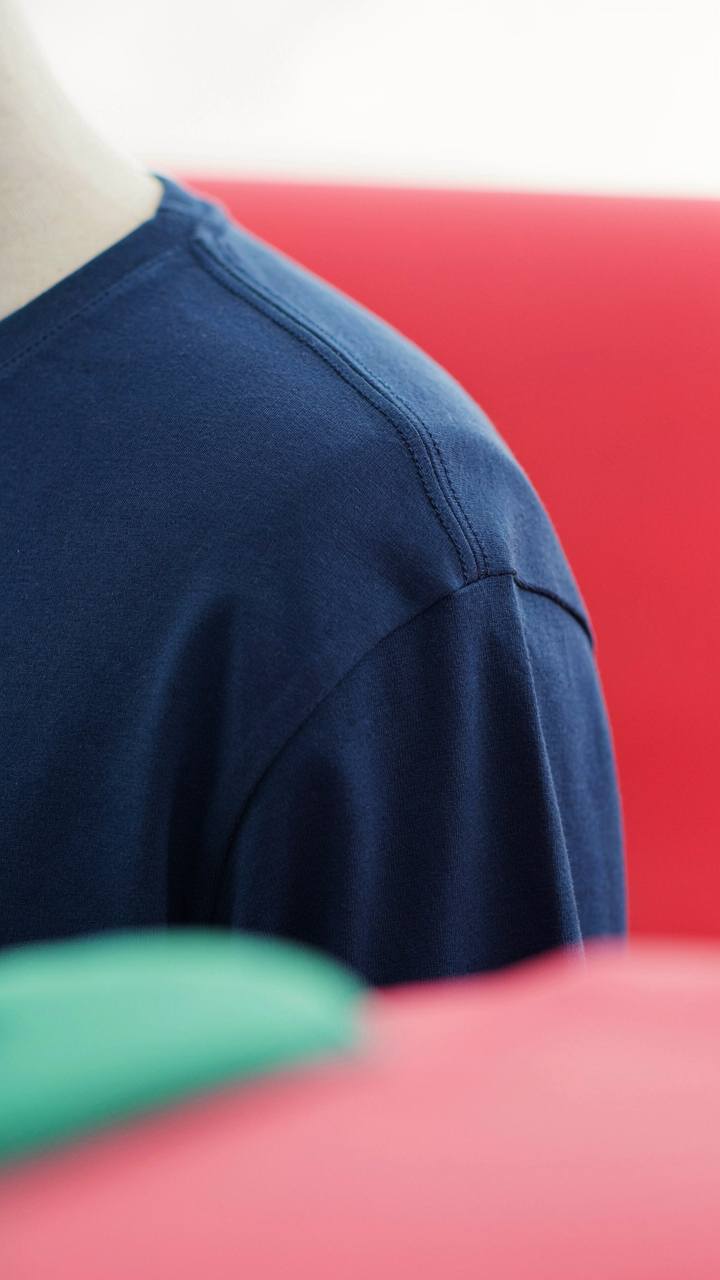
Most advice stops at “buy good cotton” and calls it done. That’s incomplete. Fabric weight, weave structure, and how the garment was finished communicate different things. A 180-gram single-jersey tee feels insubstantial. A 200-250 gram weight holds its shape through dozens of washes and communicates durability through touch.
Cut precision matters more than most realize. The armhole depth, sleeve length, and torso proportions determine whether the tee looks intentional or borrowed. Seam construction, neckline binding, and hem technique separate basics that last two years from basics that last a decade. When you understand these variables, you stop seeing basic tees as interchangeable commodities and start seeing them as the foundation of a coherent personal brand. Choose brands where the seams are flat-locked, the neckline doesn’t curl, and the fabric retains its color after 50 washes.
The “Basic T Shirt” Upgrade: Your Signature, Not A Trend

Deciding What Actually Represents You
You want people to perceive you as intentional. That’s the real reason you’re reading this. Basic tees work because they’re a uniform—they remove the noise so your choices become visible. In economics, this is called the substitution effect: when one variable stays constant, the others gain weight. Your basic tee is the constant. Everything else you layer, pair, or do with it becomes the signal.
The mistake most people make is treating basics as invisible. They’re not. A basic tee is foundation architecture. It sets the baseline for how intentional your entire appearance reads. The fit, fabric weight, neckline, and sleeve length communicate before you open your mouth. Choose it deliberately or choose it by accident—either way, it’s communicating.
- Crew Neck Over V-Neck: A crew neck reads neutral and approachable. A V-neck reads intentional about body proportion. Pick one and commit to it across your basics.
- Weight and Drape: Heavier fabrics (6-7 oz cotton) hold shape better and age visibly. Lighter fabrics (4-5 oz) feel modern but show wear faster and require replacement sooner.
- Sleeve Length: Standard sleeves hit mid-bicep. Oversized sleeves read contemporary. Fitted sleeves read classic. Your choice locks in an era, so know which one you’re signaling.
- Color Palette Constraint: Black, white, navy, gray, and cream. Adding more colors defeats the purpose of basics. Scarcity in the basics forces intentionality in everything else.
- Visible Seam Quality: Flat-lock seams last longer than standard stitching. French seams on side panels resist unraveling. These details cost 15-30% more upfront but double the effective lifespan.
Once you identify your baseline tee, buy three to five in that exact specification. Stop auditioning. Stop comparing. You’re building a uniform, not a collection.
The Wardrobe Equation: Less Choice, More Clarity
A uniform collapses decision fatigue into a single choice made once. You wear the same basic tee in rotation while everything else stays variable. This isn’t laziness—it’s how cognitive load works. Your brain has a finite budget for decisions. Steve Jobs, Mark Zuckerberg, and most operating executives wear the same thing for this exact reason: preserve mental energy for decisions that matter.
The mechanism is simple: eliminate low-stakes variables to protect high-stakes decisions. Your basic tee is the eliminated variable. You’re not thinking about whether the fit is right or the color works. That decision happened once. Now you think about what you do with it—how you layer it, what you pair it with, what context you wear it in. That’s where intentionality lives. Stop rotating through twelve different basics. Own two or three in your color, rotate them, and rebuild your decision-making bandwidth where it counts.
The Real Obstacle Isn’t Finding The Right Tee, It’s Your Addiction To External Validation

You don’t need another basic tee. You need permission to stop performing for an audience that doesn’t pay rent. Most people buy basics hoping the right shirt fixes something broken inside. It doesn’t. A minimalist wardrobe works because it forces you to become interesting without props. Pick one quality tee today, wear it until the seams know your shape, and watch how quickly you stop caring what strangers think. The tee isn’t the transformation. You are.