

The Unseen Audience: Why You Really Take Mirror Selfies

The Validation Loop
You care about this because you suspect you’re chasing something that won’t stick. The psychology field calls this “external locus of evaluation” – the belief that your worth exists outside you, waiting for confirmation. Mirror selfie outfit poses operate on the same mechanism. You’re not documenting an outfit. You’re submitting it for judgment and hoping the judgment comes back favorable.
The feedback arrives fast: likes, comments, reposts. Your brain registers this as proof of value. The outfit wasn’t the goal. The response was. This loop trains you to pose differently the next time, not for yourself, but for the invisible audience you’ve internalized. Each angle, each pose adjustment, is calculated to maximize this external validation before you even press share.
The Actual Currency You’re Trading

Skip the generic advice about “authenticity” – that’s what people say when they don’t want to admit what’s really happening. Mirror selfie outfit poses signal social rank because clothing and body presentation have always been status markers. Economics calls this “signaling theory.” You’re not just showing clothes. You’re communicating that you have access to certain items, live a certain lifestyle, move through certain spaces.
The pose itself does the heavy lifting here. A carefully angled mirror selfie suggests control, intentionality, and confidence in how you’re perceived. The outfit is the content, but the pose is the subtext: I curated this. I knew how to present it. I belong in the frame I’m creating. This is why casual, unposed mirror selfies rarely go viral. They don’t signal anything. Posed ones signal mastery of self-presentation, which reads as competence, which reads as status.

The Context Is King Protocol For Mirror Outfit Selfie
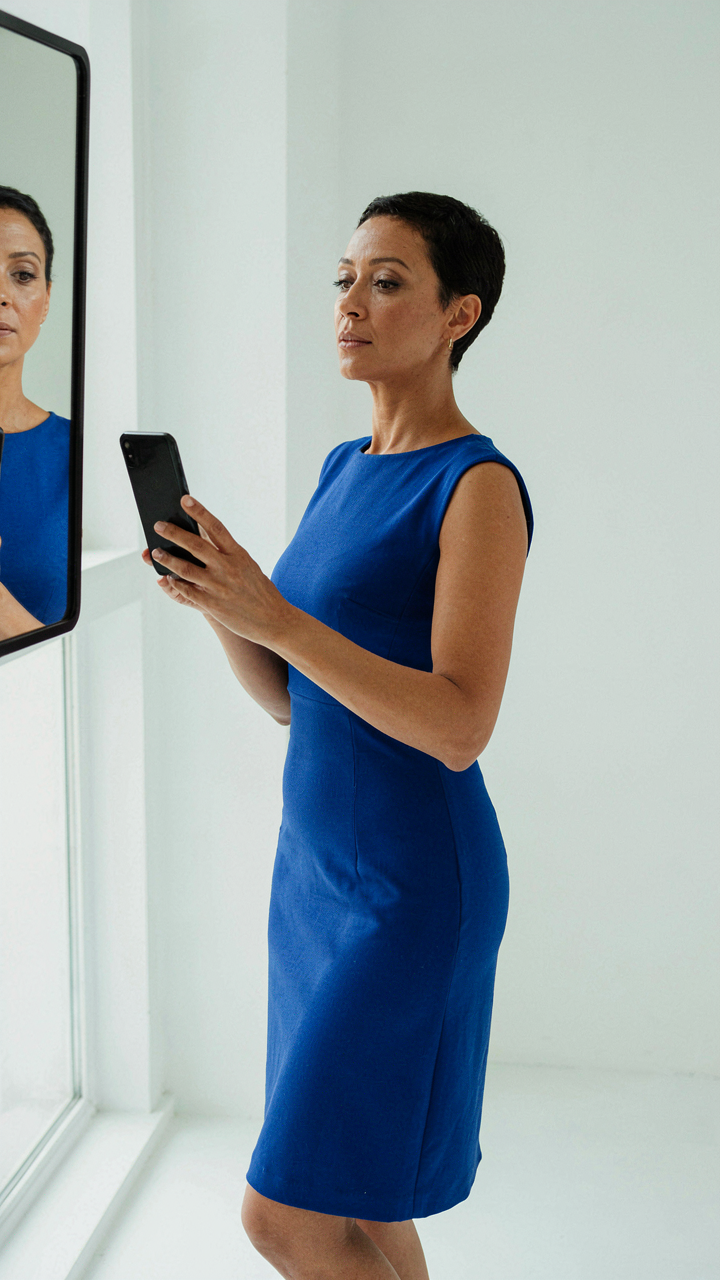
Your Outfit Lives Or Dies In Its Background
You want people to notice your outfit, not question why you took the photo in a cluttered room. The mechanism here borrows from figure-ground theory in visual perception: your brain separates foreground from background, but only when the background doesn’t compete. A cohesive environment—whether minimal wall, textured brick, or intentional backdrop—anchors the outfit as the subject. A chaotic room fragments attention and dilutes the message you’re sending.
Your outfit and environment must form a unified narrative, not exist in opposition. This means matching the energy level of both. A high-fashion structured blazer demands a clean, intentional background. Casual loungewear works in lived-in spaces. The disconnect between polished outfit and messy surroundings reads as inauthentic and damages credibility. Scout your mirror location before you pose. If it doesn’t frame your outfit, move.
Eliminate Everything That Isn’t The Outfit
The standard advice here is “keep it simple,” which is lazy and vague. What actually matters is visual hierarchy: nothing in the frame should compete for eye movement with your outfit’s details, silhouette, or color. A busy mirror frame, clutter on shelves behind you, or conflicting patterns all pull the viewer’s eye away from the garment. This is a hard rule, not a preference.
Clean the space behind you with the same intention you’d apply to editing a photograph. Remove items that don’t support the outfit’s story. If your mirror has a frame, ensure it doesn’t introduce visual noise. The background should enhance contrast between you and everything else, forcing the viewer’s gaze directly onto fabric, fit, and form. This is the only acceptable outcome.
Gravity & Leverage: A Physics Approach To Mirror Selfie Poses
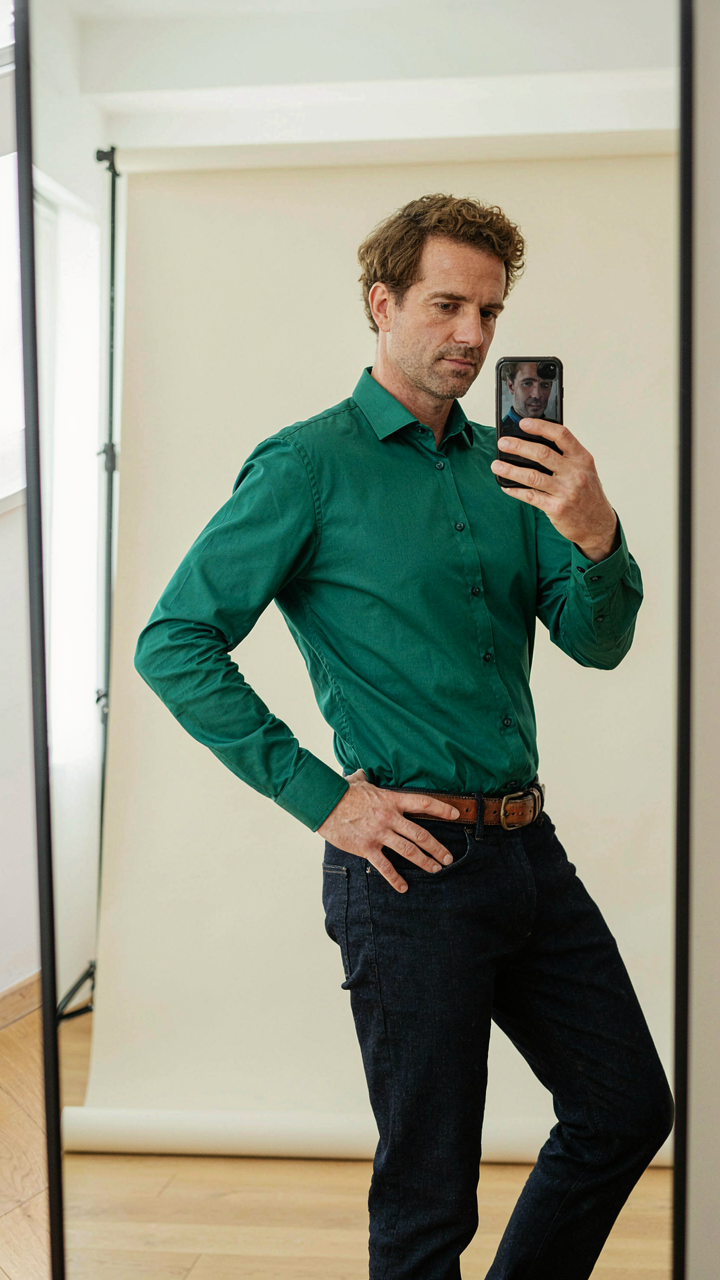
How Your Body Distributes Weight
You want to look effortless in photos because effort reads as desperation. Here’s what actually happens: physics demands that your body shift mass to create visual tension that reads as confidence. Weight distribution isn’t about standing still. It’s about controlled imbalance.
When you load weight onto your back leg, your front side naturally opens toward the camera. Your shoulders drop away from your ears. Your torso elongates. This isn’t a pose trick—it’s leverage. The camera captures the line of your body as extended rather than compressed. Most people stand symmetrically in mirrors and wonder why they look flat. They’ve eliminated the mechanical advantage that creates dimension.
Arm Placement Creates Visual Angles
In engineering, a cantilever is a beam fixed at one end, free at the other—it creates structural drama through asymmetry. Your arms work the same way in mirror selfies. Arms hanging at your sides make you a rectangle. Arms extended, bent, or placed against your body become force multipliers that reshape how the camera reads your frame.
When your arm bends away from your torso, you create negative space that makes your waist appear narrower and your shoulders broader. When your arm crosses your body, it anchors a diagonal line that pulls the eye down and across. When your hand rests on your hip or chest, you establish a pivot point the viewer’s attention actually lands on. Position your arms with purpose, not comfort.
The “Effortless Power” Method For Mirror Poses Aesthetic

Weight Distribution Wins The Frame
You want people to believe you didn’t try. That’s the real fear underneath this whole section. The mechanism is borrowed from sculpture and portraiture: weight distribution creates visual tension. In a mirror selfie, where you stand carries more visual weight than what you wear. Shift your weight to one leg, angle your shoulders back slightly, and the outfit gains dimension automatically. Your body becomes the frame that makes the clothes work, not the other way around.
Most people plant their feet dead center and wonder why they look flat. Weight on your back leg creates a natural S-curve in your posture without you having to contort. Your shoulders drop naturally. Your neck lengthens. The outfit drapes differently on a weighted body than on a symmetrical one. Lean into your front hip, keep your chest open, and let gravity do the work. The pose reads as casual because your body genuinely is in a relaxed state, not performing one.
What Actually Reads As Unforced
The staged perfection advice is wrong. Perfect symmetry screams effort. Real people move, shift, and exist in asymmetry. An unforced mirror selfie outfit pose relies on one tactical element: your eyes. Look slightly off-camera or downward for one beat, then adjust. This micro-moment of genuine distraction breaks the “I’m posing” vibe. Your facial muscles relax. Your shoulders settle. The outfit becomes incidental to how you actually inhabit your body in that second.
Authenticity reads because it removes the performer’s tension. When you stop thinking about how your legs look and start thinking about the texture of your shirt or the angle of light on your jacket, your body stops compensating. Your arms fall naturally. Your jaw unclenches. This isn’t about being fake casual, it’s about actually being casual for the split second you take the shot. Genuineness is the specific texture that makes an outfit look worth wearing instead of worth posting.
Mastering The Frame: Compositional Hacks For Mirror Pic Aesthetic

Divide Your Mirror Into Strategic Zones
You want people to know you thought about this. The real mechanism is that your brain processes images faster when elements sit on intersecting lines rather than dead center. In photography, the Rule of Thirds splits the frame into nine equal sections using two horizontal and two vertical lines. Position your outfit’s focal point—the fit, the accessories, the silhouette break—where those lines cross, not in the middle of the mirror. Your eye lands there first. That’s not accident.
The mirror selfie advantage is that you control both the background and the subject within a single rectangular boundary. Angle your body so the strongest visual element of your outfit aligns with one of those intersection points. If you’re showcasing a statement jacket, let it sit on the left vertical line. If boots are the outfit’s anchor, position your legs along the lower horizontal line. The composition doesn’t make the outfit better. It makes the outfit readable.
Use Angles To Guide The Viewer’s Eye
Architecture uses vanishing points to pull the viewer into depth. Your mirror selfie uses the same principle through body positioning and line direction. When you angle your body against the mirror rather than stand flat, your limbs create diagonal lines that move through the frame. These diagonals guide attention the way a road guides a driver—the eye follows the path you build.
Point your shoulders away from the camera while keeping your torso visible in the mirror. Angle one leg forward or back. Extend an arm naturally. These aren’t random pose choices. Each line directs the viewer’s gaze through the outfit in sequence: sleeve, fit, waist, leg, shoes. The composition becomes a visual route. Without deliberate angling, the mirror selfie reads as static. With it, the outfit narrative moves.
Casual Outfits, Intentional Poses: The Paradox Of Power
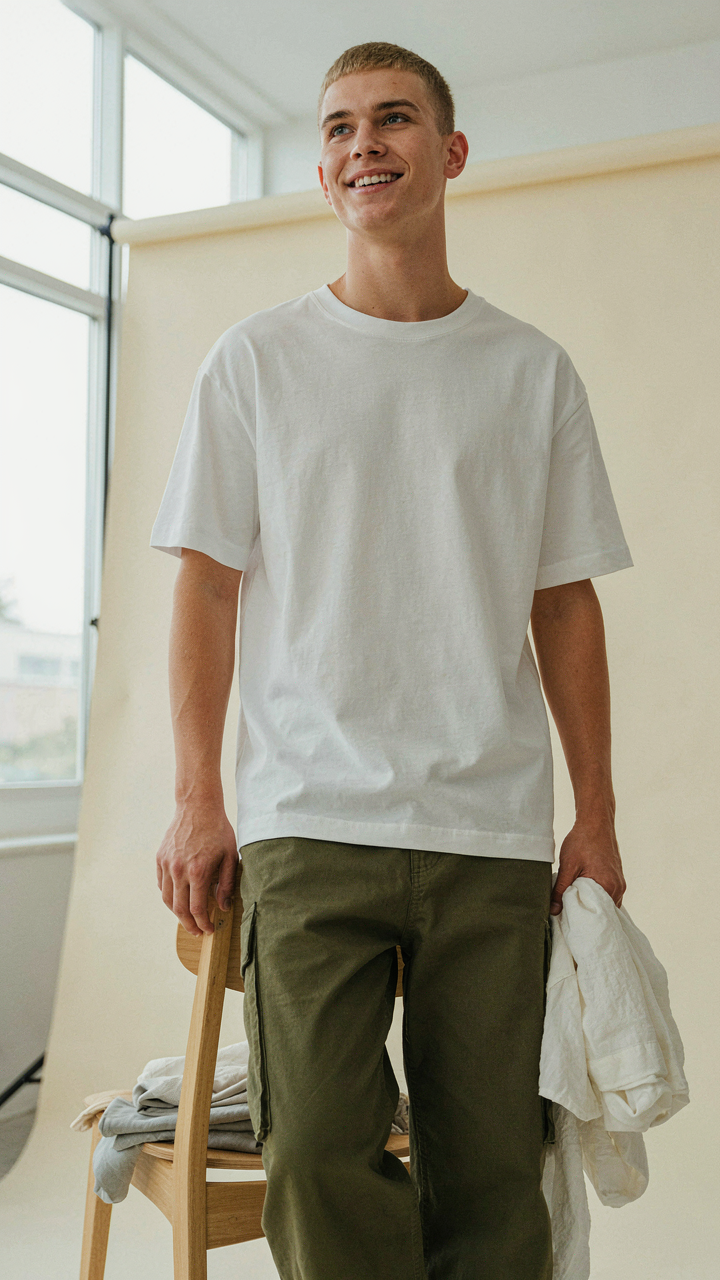
Intentional Angles Trump Relaxed Clothing
You want people to think you didn’t try, which means you’re terrified they’ll see effort. The real mechanism here borrows from physics: tension. A casual outfit without deliberate pose composition reads as unfinished. You need opposing forces. Wear relaxed fit jeans and an oversized shirt, then counter that softness with a sharp shoulder angle or a defined jawline tilt. The contrast is what stops the scroll.
Most advice tells you to “just be natural,” which guarantees a forgettable image. Natural without structure collapses into blurry background noise. Position your body so one side catches light while the other recedes. Tilt your head fifteen degrees away from your front shoulder. This creates visual tension that casual clothing alone cannot deliver. The outfit does the talking only when your frame amplifies it.
Comfort Requires Calculated Stillness
Holding a pose looks stiff only when you shift your weight mid-shot. Relaxed doesn’t mean unanchored. Plant your feet on a specific spot and don’t move them during shooting. Lock your core just enough to eliminate micro-movements. This paradox solves itself: the more still you stand, the more relaxed your face and shoulders appear in the final image.
Slouching to look comfortable backfires because your body collapses into itself. Instead, stand with weight balanced on your back leg, front leg slightly bent, shoulders rolled back naturally. Take twenty shots from that single position. One will have the right micro-expression and light convergence. Comfort in a mirror selfie comes from knowing exactly where your body sits in the frame, not from moving around searching for it.
The Uni Outfits Advantage: Utility And Style In Mirror Poses Outfit
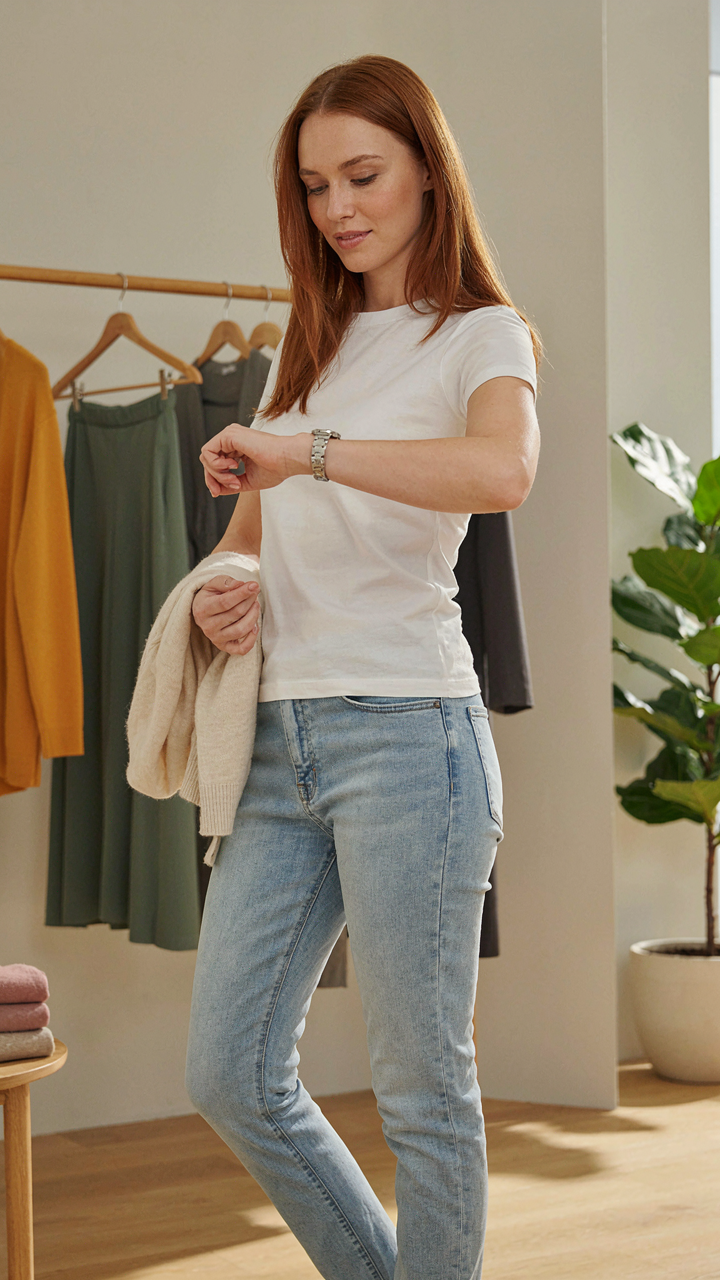
Consistency Through Repetition
You want people to remember you, not your clothes. That’s why uniform elements work in mirror selfies: repetition builds recognition faster than variety ever will. Think of it like branding in graphic design, where a logo stays the same across every touchpoint. Your mirror pose outfit follows the same principle. When you repeat the same core pieces—same wash of jeans, same neutral base layer, same jacket—the variable becomes your pose and angle, not your outfit. This forces your brain to focus on how you’re positioned, not what you’re wearing.
The mechanism is simple: constraint breeds clarity. Wearing the same foundational pieces in multiple mirror selfies means each photo reads as part of a series, not a one-off. Your audience recognizes the consistency and perceives it as intentional. A neutral base repeated across five mirror selfies reads as a deliberate aesthetic. The same outfit worn once reads as random. Repetition in mirror pose outfits separates people who look styled from people who look like they got dressed.
Accessories As Pose Anchors
Accessories aren’t decoration you add after choosing your outfit. They’re spatial markers that guide where your body goes in frame. A bag worn crossbody determines shoulder angle. A hat forces head tilt. Rings and bracelets create hand placement options that look natural instead of awkward. This is how you solve the hardest part of mirror selfies: what do you do with your hands and arms.
Strategic accessory placement turns a generic mirror selfie into a structured pose. A watch visible on your wrist gives your arm a reason to exist in frame at a specific angle. Layered necklaces or chains draw the eye downward and justify a slight chest-forward position. Sunglasses pushed up on your head create a reason to tilt slightly backward. The accessories become the skeleton of the pose. Without them, you’re fighting to look natural. With them, your body has a clear spatial reason for every placement.
The 3 Second Rule: Capturing The Unstaged Shot For Poses For Pictures Mirror Selfie

Mental Rehearsal Before The Camera Raises
You want this to look effortless because effortless means you weren’t trying, which means you’re naturally this put-together. That’s the fear driving this section. The mechanism is simple: your brain needs a pre-loaded sequence before your hands execute it. You cannot improvise a good pose in real-time while managing lighting, angle, and outfit visibility simultaneously. Pre-visualization collapses decision-making into muscle memory.
Think of this like stage blocking in theater, not meditation. You’re mapping three distinct positions your body moves through in rapid succession. The first position catches the outfit’s full geometry. The second introduces a micro-shift, usually a shoulder roll or slight weight transfer, that breaks the rigid look. The third returns to a near-baseline but with one deliberate detail exposed, like a hand placement or collar adjustment. Run this sequence mentally five times before raising the phone.
- Outfit geometry capture: Stand square to mirror, arms at sides or one on hip. This establishes the silhouette and how fabric drapes across your torso and legs without distortion.
- Shoulder rotation with hip counter-weight: Rotate one shoulder back 15 degrees while shifting hips forward slightly. This creates dimensionality and prevents the flat, head-on appearance that kills outfit posts.
- Hand-to-detail anchor: Move one hand to a pocket, collar, or fabric detail. This creates a visual focus point and signals intentionality rather than randomness.
- Head angle variation: Tilt head 10-15 degrees toward the raised shoulder. This tightens the jawline and prevents the bloated look cameras create at certain angles.
- Weight distribution: Keep 60 percent of your weight on your back leg. This naturally straightens the front leg and elongates the line from hip to ankle.
The 3-second constraint forces you to execute without overthinking. You press record, cycle through your three positions in smooth succession, then stop. No second-guessing, no seventeen takes of the same angle. The urgency kills self-consciousness.
The Authenticity Of Motion Over Stillness
Everyone thinks a good mirror selfie outfit pose is a static hold. It’s not. The real advantage comes from capturing transition, which reads as intention, not insecurity. A frozen position looks chosen and therefore examined. Motion through three positions in three seconds looks like you’re just checking yourself before you leave, which is the exact social narrative that sells the outfit.
Bodies in genuine motion hit angles and proportions that stationary poses miss entirely. When you shift weight or rotate your shoulders, muscles catch light differently, fabric moves into more flattering configurations, and the overall image reads as alive rather than performed. Film the movement, then extract a single frame mid-sequence where the outfit reads best. This creates the illusion of a candid capture when in reality you engineered it completely. The mechanism is simple: motion generates more viable frames than any single static pose.
The Only Pose That Truly Matters Is The One You Strike In Real Life, Consistently

You can master every mirror selfie outfit pose in existence and still look like a stranger in your own clothes the moment you leave your apartment. The real skill isn’t contorting yourself for the camera. It’s dressing so intentionally that your body language shifts automatically. Your posture changes. Your confidence shows up without trying. Take one outfit you actually own today and wear it for a full day without checking yourself in mirrors. That’s the pose that counts.