

The Authenticity Illusion: Why Staged “Natural” Fails

Spotting The Forced Moment
You want to look effortless because effortless reads as credible, and credible instructors book more clients. But here’s the trap: the camera catches strain. When you manufacture a candid pose—the laugh that isn’t landing, the hair flip timed to the shutter—the viewer’s brain registers the performance, not the person. Photography trades in micro-expressions. A genuine moment holds texture. A posed “natural” moment flattens into obvious staging. The distinction isn’t philosophical. It’s neurological. Your nervous system knows the difference between felt experience and rehearsed action, and so does everyone scrolling past your feed.
The common advice tells you to “just be yourself” in front of the lens. Useless. You can’t think your way into authenticity mid-shoot. Instead, identify one real physical sensation from your actual teaching and anchor the photograph to that. Not the feeling of being watched. Not the goal of looking a certain way. The specific thing your body knows: the slight shoulder drop after a long exhale, the grip adjustment on the mat edge, the weight shift into your standing leg. Photograph that thing, and the authenticity writes itself.
Real Vulnerability Without The Performance

Vulnerability isn’t a mood you perform. It’s a permission you grant the camera to catch you in transition, in the 0.3 seconds before you reset. Most yoga photoshoots fail because instructors stay locked in their “instructor mode” the entire time—jaw tight, posture maxed out, everything held. That’s the opposite of what draws people in. Vulnerability in this context means allowing the photograph to see you tired, thinking, adjusting, learning. These moments feel risky because they expose the work behind the pose, not just the pose itself.
The mechanic is simple: shoot between moments, not during them. After you’ve held a pose, before you’ve moved to the next one. In that neutral space, your face relaxes, your body settles, and the camera captures something true. Your students see this state constantly in class—the human instructor, not the perfect asana demonstration. That recognition is what builds authority and connection, not the highlight reel version of yourself. Build this into your shot list. Schedule 30 percent of your shoot time for these between-state captures, and instruct your photographer to shoot continuously during transitions, not just on your cue.

The “Less Is More” Protocol: Stripping Down For Impact
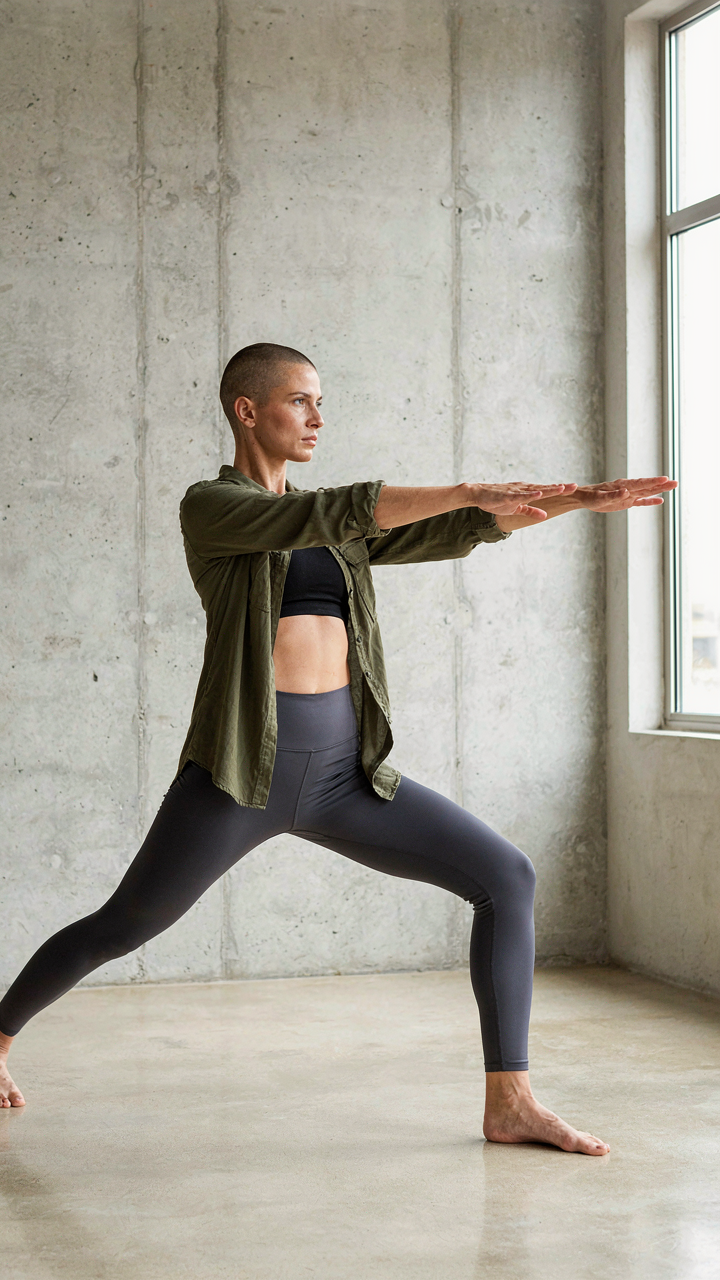
Empty Space Wins The Frame
You want your photos to look expensive without spending money on props and backdrops. That’s the real reason you’re reading this. The mechanism is simple: clutter competes with your body for attention. In visual design, we call this the signal-to-noise ratio from information theory. Your yoga form is the signal. Everything else is noise. Remove the noise, and viewers process your alignment, positioning, and presence instantly. That speed of processing creates the illusion of sophistication.
Most yoga shoots fail because instructors treat the background like it needs to earn its place. It doesn’t. A plain wall, a single window, concrete, wood flooring, or open sky does the job. The background exists to frame you, not to distract from you. Negative space is not empty space. It’s the stage your body performs on. Choose locations where what you remove matters more than what you add.
The Uniform Approach To Visibility
Don’t overthink outfit variety for a photoshoot. Wear one fitted, neutral-toned set and shoot multiple poses, angles, and lighting conditions within the same session. This is how professional athletes and models work. Consistency in the frame means the eye tracks your form, not your wardrobe changes. Black, charcoal, navy, or white leggings paired with a matching sports bra or tank creates visual continuity that forces focus onto your posture and precision.
Instructors often swap outfits thinking it adds production value. It adds friction instead. Each clothing change resets the viewer’s visual processing. They’re registering the new outfit, not your teaching ability. One outfit, shot thoroughly and from multiple angles, generates more usable content than five outfits shot hastily. You control the narrative through repetition and depth, not through variety.
Beyond Asana: Capturing The Unseen Energy Of Yoga Aesthetic Photography

The Breath Frame
You want the photos to prove you’re advanced without actually demonstrating advanced practice. That’s the real pull here. The mechanism is simple: breath work creates micro-muscular engagement that reads as control and presence in still frames. Borrowing from physiology, breath is the variable that produces observable tension without visible strain. The diaphragm expands the ribcage, shoulders settle, the face softens. A photographer trained to catch these moments captures what a static pose alone never shows.
Most yoga photoshoots chase dramatic backbends and arm balances. Wrong approach. A transitional breath frame between poses often carries more authority than the pose itself. Direct your photographer to shoot during the exhale, not the hold. The body compresses slightly, the core engages visibly, and the expression becomes grounded. This is what separates instructor content from fitness influencer content.
Vulnerability Over Technical Precision
The standard advice says perfect alignment sells credibility. It doesn’t. Imperfect form paired with genuine emotional presence builds trust. Subscribers don’t follow flawless poses, they follow teachers they believe actually live what they teach. A slightly collapsed shoulder in a forward fold photographed with real breath and closed eyes reads as authentic instruction. A geometrically perfect pose with an empty stare reads as ego.
Direct your photographer to capture your actual teaching moment, not your best asana. This means shooting during class sequences where you’re correcting alignment or demonstrating modification, not isolated perfect poses. The vulnerability of showing modification variations, the slight fatigue in transition frames, the concentration face during balance work—these create recognition. Subscribers think, “She’s real. I can actually learn from her,” not “She’s impossibly strong.” Start requesting contact sheets where the out-takes and in-between frames get reviewed before the polished options.
The Narrative Arc: Crafting Your Yoga Photoshoot Story

Build Sequence Before You Shoot
You want people to see you as intentional, not scattered. The real mechanism is this: your brain processes images in order, and order creates meaning. Borrowing from film editing, the cut between shots determines whether viewers see progression or chaos. Most yoga instructors shoot random poses in random locations, then panic during editing. You need the opposite. Decide your opening image, your climax, your resolution before the camera starts rolling.
The sequence should mirror how students experience a class. Start grounded, move through intensity, land in calm. This isn’t poetic—it’s neurological. Your viewer’s nervous system follows the visual journey you create. A shoot that opens with aggressive backbends then shifts to seated poses feels disjointed because it violates expectation. Plan three to five distinct phases. Shoot them in order or mark each file clearly so editing becomes assembly, not reconstruction.
The Visual Arc From Tension To Release
This is where most advice fails. People say shoot “before and after” or “journey through the practice.” Both are vague and miss the actual lever. Tension and release is borrowed from composition theory in photography and design. The opening images need subtle visual weight, then progressive lightness. Darker fabrics, tighter framing, grounded poses first. Then progressively open the frame, lighten the palette, elevate the body position.
Your photoshoot story works when the viewer feels something shift without naming it. Start with close-ups or compressed angles. Move to wider frames and open spaces. The final images should breathe more than the first. This isn’t about emotion—it’s about visual grammar. When you export the sequence, flip through them at speed. If you feel calm moving forward and restless moving backward, you’ve built the right arc. If not, reshoot or reorder until the progression feels inevitable.
The Anti Trend Uniform: Outfits For Lasting Impression, Not Fleeting Fashion

Neutral Palettes That Actually Work
You want to look current without dating yourself in six months. That’s the real fear here. The mechanism is simple: neutral colors—black, white, cream, gray, earth tones—work across lighting conditions, seasons, and years of social feeds. They don’t distract from your body or the pose. Neutrals are the inverse of fashion trends; they’re anti-trends. They stay.
Solid colors photograph cleaner than patterns. A black sports bra with high-waisted cream leggings reads the same in 2020 as it does in 2027. Avoid neon, pastels tied to specific seasons, or color combinations that trend on Instagram. The goal isn’t to disappear—it’s to stay relevant through the pose itself, not the outfit. Shoot in neutrals, and your content won’t feel stale within a year.
Fabric That Lets You Move
Comfort isn’t motivation. Comfort is mechanics. When your shirt pulls or rides up, you lose focus on alignment and your nervous system tightens. Tight muscles photograph as stiff. The fabric has to move with you, not against you.
Cotton blends and performance synthetics (polyester, nylon mixes) are the standard for yoga photoshoots because they stretch, dry fast, and hold their shape through multiple takes. Avoid pure cotton—it bags after washing and shows sweat stains in photos. Test every piece in the actual poses you’ll shoot before you book the photographer. If you’re thinking about the fabric during a headstand, the shoot is already compromised.
Environmental Alchemy: Using Location For Potent Wellness Photography

Your Location Is Your Visual Argument
You want the location to do the heavy lifting so you don’t have to. That’s the real reason location matters in yoga photography. In branding terms, borrowed from architecture, your location functions as the “context layer”—it either reinforces your teaching philosophy or contradicts it. A studio instructor shot in a sterile gym looks confused. A vinyasa teacher photographed on a rooftop at sunrise tells a story that matches her positioning. Your location must align with the results you claim to deliver.
Most yoga photographers treat location as scenery. Wrong. Location is qualification. It tells prospective students what kind of practice they’re buying. An instructor shot in a raw warehouse space signals intensity and authenticity. The same instructor shot in a manicured garden signals accessibility and calm. You need consistency between your actual teaching environment and your photography. If you teach in a studio, shoot in a studio. If you teach outdoor classes, the photos must reflect that reality. Misalignment kills credibility before the prospect reads a single word about you.
Raw Materials Demand Raw Settings
Nature doesn’t need filters because it has depth. This isn’t poetry—it’s optical fact. Natural environments contain shadows, texture, and light variation that studio lighting rigs struggle to replicate. Concrete, weathered wood, and stone surfaces absorb and reflect light in ways that create dimension. A yoga pose shot against a blank wall reads flat. The same pose against a textured hillside or brick wall gains presence because your eye has reference points to track.
The mechanism is visual contrast. Yoga is about creating internal space. Your photography needs external space that mirrors that idea. Open horizons, negative space between trees, or stretched sky behind a backbend all support your core message. The location doesn’t enhance the yoga—it translates the internal experience into something the camera can actually capture. Scout locations with one question: Does this background have visual separation, or does it collapse the subject into clutter? If your instructor disappears into the location, it’s the wrong spot. You need background that holds its own without competing.
The Unposed Yoga Pose Photoshoot: Engineering Serendipity

Movement Demands Specific Camera Setup
You want candid shots because you think they look more authentic. That’s not the real reason. You want them because posed stills make you look frozen, which kills the instructor brand you’re building. Physics governs this: velocity changes how muscle definition reads on camera, and momentum creates visual tension that stillness erases. A 24mm or 35mm lens captures the arc of movement without distortion, while wider angles flatten the body’s actual geometry. Shutter speed matters more than composition here. Shoot at 1/500th or faster to lock movement without motion blur, unless you’re deliberately using that blur to show trajectory.
The camera position itself becomes a tool. Place it at the height of the pose’s midpoint, not eye level. If you’re shooting Warrior Two, shoot from torso height, not face height. This angle catches the shoulder and hip alignment that proves form, which is what people actually hire you for. Your photographer needs to move with the flow, not stay static. The unposed look only emerges when the camera tracks the movement rather than waiting for it. This is the mechanism: the photographer becomes a moving target, not a fixed one.
Capturing The Moment Between Poses
Everyone says shoot holds. That’s the lazy advice, and it costs you credibility. The transition is where form breaks down or holds solid. That five-frame window between Downward Dog and Warrior One reveals whether you’ve got control or just flexibility. Your nervous system’s actual skill shows in that moment, not in a static hold where you can muscle through bad alignment. Film sequences instead of single frames. Shoot bursts at three to five frames per second when moving between poses, then drop to single shots during holds. The burst captures the micro-corrections your body makes mid-transition, which is what students actually need to see.
Transitions also mask the awkwardness of repositioning. Moving footage feels purposeful, while pauses between poses look like resetting. You’re not documenting yoga. You’re documenting competence in action. Select three to four key transitions per shoot: entry into a standing pose, a balance shift, a forward fold recovery, and an exit. These are the moments where poor instruction shows, so they’re where good instruction shines. Review footage immediately after shooting to confirm you caught the transition cleanly. If the movement blurred or the camera lost focus, you reshoot that sequence before moving on.
The Feedback Loop System: Iterating For Optimal Yoga Shoot Results

Looking At Your Work Without Ego
You think you need outside validation to know if your yoga photoshoot worked. You don’t. What you actually need is a ruthless ability to spot what failed before your audience does. The mechanism is simple: distance plus criteria equals objectivity. Pull the images 48 hours after the shoot when you stop defending your choices. Open them in a grid view, not one at a time. Ask three specific questions: Does the pose read from ten feet away? Is the fabric doing what you intended? Does the lighting eliminate or create shadow detail on the model’s form?
Most yoga instructors skip this step entirely, which is why they end up with mediocre content they keep posting anyway. Critique precedes iteration. You need a system before you need feedback from others. Look for patterns in what you’d retake, not isolated failures. If three out of eight shots have blown-out faces during sun exposure, that’s your setup problem, not the model’s problem. Document what you’d change in a simple note, numbered by shot. This becomes your protocol for the next shoot.
Signals That Actually Matter
Your audience tells you what works through specific actions, not feelings. In fitness content, the mechanism is engagement architecture: people click, comment, or share only on posts that activate one of three responses—clarity, aspiration, or recognition. A yoga photoshoot succeeds when viewers can either see themselves doing the pose, understand exactly how to load their weight, or feel the instructor’s credibility in their body position.
Track three metrics ruthlessly:
- Save rate over like rate: Saves indicate people plan to reference this image later. This means the pose, outfit, or alignment detail was useful enough to bookmark. It’s a stronger signal than vanity metrics.
- Comment specificity: Comments asking “what pose is this” or “how do I modify this” mean your photography communicated the pose clearly. Generic compliments mean the image was pretty but forgettable.
- Share to stories: When followers repost your yoga shoot to their stories, they’re claiming the aesthetic or instruction as their own. This signals the image feels ownable, not just aspirational.
- Click-through rate to your services: If people viewing the yoga photoshoot convert to booking a class or consultation, your positioning worked. Everything else is secondary.
- Repeat audience: The same 20-30 accounts engaging multiple times means you built actual followers, not temporary traffic. They’re your feedback loop partners.
Adjust your next shoot based on what actually moved people, not what you think should move them. If your audience engages more with close-up detail shots than full-body poses, that’s your signal to frame tighter. If saves spike on images showing modification options, build more variations into your next shoot day. Run this protocol every three shoots minimum so you compress the gap between what you create and what works.
Monetizing Your Aesthetic Yoga Photos: Beyond The Pretty Picture

Strategic Placement Across Revenue Channels
You want these photos to feel like they’re working for you while you sleep, which is fine, but the real mechanism is distribution specificity. In marketing, this is called channel-market fit: the right asset in the right place triggers a specific buyer action. Your yoga photoshoot isn’t one product. It’s raw material that needs repurposing for each revenue stream. A single image performs differently on Instagram Stories than it does in an email funnel or on your website homepage. Each platform has different compression, audience expectations, and conversion psychology.
The work isn’t taking the photos. It’s building the system that deploys them strategically. Your studio photo becomes a lead magnet when used in a landing page header. The same shot becomes social proof when placed in testimonial sections. It becomes urgency when paired with limited-time offer copy. You’re not selling the photo. You’re selling the framework it sits inside. Assign each image a specific job before you post it anywhere.
Converting Engagement Into Paying Students
Most advice says “post consistently and engagement will follow,” which skips the actual mechanism. Engagement without conversion is an ego metric. You need a response architecture: a documented path from view to payment. When someone saves or comments on your yoga photoshoot, that’s not the goal. That’s data telling you they’re interested in a specific offer. Your next move must be predetermined.
Build this system in three steps. First, identify which photo types generate saves versus comments versus shares. Second, create a corresponding offer for each engagement type. A save suggests research mode, so follow with educational content and a free workshop link. A comment suggests community desire, so respond with a group class invitation. Third, track which conversions stick. After three months, you’ll know which photos convert browsers into paying members. Double down on those photo concepts and retire the ones that only harvest vanity metrics.
The Digital Footprint: Mastering Distribution For Maximum Reach

Where Your Photos Actually Live
You care about this because you think posting is distribution. It isn’t. Posting is submission. The real mechanism is algorithmic fit: each platform has a conversion funnel, and your yoga photoshoot content either matches the platform’s profit model or it doesn’t. Instagram rewards engagement loops. YouTube rewards watch time. TikTok rewards completion rate and shares. Post the same image everywhere and you’ll watch it die on three platforms while thriving on one. The platform chooses the content, not you.
Instagram and Reels favor vertical video and carousel format for yoga shoots because those formats keep users scrolling and clicking. YouTube Shorts demand fast cuts and pattern interrupts within the first second. TikTok’s algorithm cares less about follower count and more about whether strangers watch to completion. LinkedIn performers often see better reach with behind-the-scenes yoga content than polished final shots. Pinterest drives actual traffic because users save intentionally and return weeks later. Each requires different framing, aspect ratios, and hooks. Treat each platform as a separate distribution channel, not a repost terminal.
Signal Over Noise: What Actually Moves The Needle
Analytics without a framework is just counting. The real leverage point comes from signal detection: identifying which metrics predict business outcomes. Think of metrics in information theory terms, where signal is what converts and noise is what inflates your ego without converting. Engagement rate means nothing if those engaged people never book a class. Reach is vanity if your yoga photoshoot attracts followers who ignore your calls to action. Save rate on Pinterest converts better than likes on Instagram because saving indicates purchase intent.
Track three metrics only: click-through rate to your website or booking link, conversion rate from viewer to email signup or class booking, and cost per conversion if you’re running ads. Ignore follower count, total impressions, and vanity metrics entirely. Most yoga instructors obsess over which photos got the most likes instead of which ones drove actual bookings. The post with 50 likes that generates three class bookings outperforms the post with 500 likes that generates zero. Pull your analytics weekly and identify the single variable that moved: was it the time posted, the caption hook, the workout type featured, or the outfit choice. Adjust only one variable per post and measure again.
The Real Obstacle Isn’t Your Outfit, It’s Your Inability To Articulate Value Beyond Superficial Aesthetics

You can nail every pose in perfect lighting wearing the trendiest gear, and still fail if you haven’t solved the actual problem: why someone should hire you. Your yoga photoshoot matters only when it communicates transformation, not just aesthetics. Stop obsessing over which angles flatten your stomach and start showing what your students actually get. The outfit is the container. Your unique teaching philosophy is the product. Film yourself teaching today, not just posing, and watch how fast your inquiry emails change.