
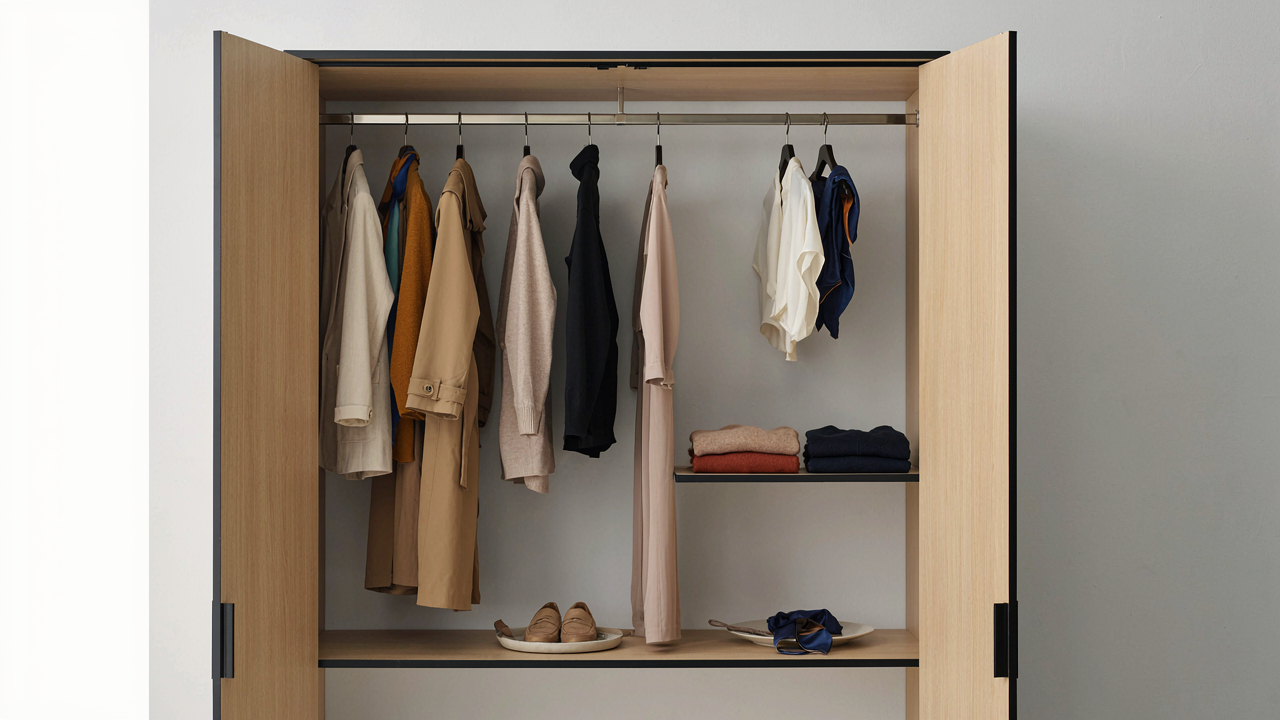
The Illusion Of Choice: Why More Clothes Mean Less Power

Decision Fatigue Drains Your Executive Function
You want a capsule wardrobe because you’re afraid you’ll look repetitive. But the real cost of a bloated closet isn’t vanity. It’s cognitive load. Neuroscience borrowed a term from economics: decision fatigue. Each choice your brain makes depletes the same finite resource. A full closet demands more micro-decisions before 9 AM than a curated one. You’re spending willpower on fabric selection instead of saving it for work that matters.
The morning routine exposes this instantly. A closet with forty pieces demands you eliminate thirty-five first. Each rejection requires a decision. You’re running calculations on color coordination, recent wear patterns, and contextual appropriateness before your brain hits full capacity. A twelve-piece capsule removes the filtering step entirely. You open the door. Three options exist. You choose one. That’s it. The mechanism is ruthless: fewer inputs, fewer decisions, more cognitive resources for actual performance.
The Paradox Of Abundance In Office Wardrobe

More options don’t increase satisfaction. They decrease it. This is documented, not theoretical. When faced with infinite choice, people experience decision paralysis followed by buyer’s remorse. Your office wardrobe operates under the same principle. A woman with thirty blazers experiences more anxiety about fit and appropriateness than one with three. She’s constantly second-guessing her selection. She wonders if the fabric choice signals the wrong thing to leadership. She questions whether she should have worn the other one.
Abundance creates a comparison trap. Every piece you own becomes a metric against every other piece you own. You notice the blazer that fits better. You see the pants with superior drape. Suddenly the acceptable outfit feels mediocre by internal reference. A capsule eliminates this benchmark. When you own five white shirts, they’re each evaluated against the role they serve, not against each other. You wear the one appropriate to today’s context. No secondary ranking happens. You move forward. The protocol: audit your closet, identify what you actually reach for, remove everything else, and commit to zero replacement decisions for thirty days.

The 5 Piece Protocol: Deconstructing Your Work Capsule Wardrobe

Start With What Actually Works
You want a capsule because you’re tired of deciding what to wear. That’s fear disguised as efficiency. The real mechanism is constraint: fewer options force intentional combinations instead of random grabbing. A five-piece protocol works because it sits between paralysis and boredom. Two pieces create one outfit. Five pieces create ten outfit combinations without redundancy. This is combinatorics, not fashion theory. You’re applying mathematical efficiency to your closet.
Start by identifying what you’ve actually worn in the past three months at work. Not what you think you should wear. What you reached for. Most people own thirty items and rotate five. Strip away the dead weight and build forward from what already functions in your life. The foundation must be honest, not aspirational.
Layering Creates The Illusion Of Variety
Layering isn’t about warmth. It’s about transformation. One base piece becomes three different outfits when you add different layers on top. This is how military uniforms maintain consistency across climates and seasons. A neutral blazer over the same shirt reads completely different from the same shirt alone. The mechanism is visual reframing through structured addition, not multiplication of base items.
Your five pieces should include at least two items designed for layering. A fitted blazer and a lightweight cardigan work differently over identical bases. The blazer signals authority and formality. The cardigan reads casual and approachable. Same bottom, same shirt, two distinct social signals. Stack these strategically and five pieces suddenly feel like fifteen without buying more.
Beyond Trends: Curating A Timeless Work Clothes Capsule Wardrobe

The Fabric Question Nobody Answers Honestly
You’re worried cheap clothes will expose you as someone who doesn’t have it together. That’s not actually the problem. The mechanism is degradation: synthetic blends and thin weaves break down visibly within months, forcing you to replace them constantly. You end up spending more and looking worse. Natural fibers and high-quality blends—wool, cotton, linen, and their structured combinations—hold shape, resist pilling, and age predictably. A wool blazer from five years ago still reads as intentional. A polyester one from last season reads as disposable.
Durability isn’t about luxury; it’s about economics. When fabric maintains its structure through dozens of washes and wears, each garment costs less per wear. The upfront investment disappears across time. Buy pieces where the fabric weight matters: dress pants in gabardine or wool blend instead of thin cotton, blazers with substantial suiting, knits with density. Check fiber content on the tag. If it’s mostly synthetics, skip it. Your capsule needs pieces that survive, not ones that fade into thin transparency after three months of actual use.
Colors And Cuts That Actually Persist
This advice gets mangled into “neutrals only” or “wear black forever,” which misses the real pattern. In design history, certain color relationships and proportions recur because they map to human perception, not fashion cycles. Navy, charcoal, cream, and olive have appeared across decades not because designers colluded but because these colors work with most skin tones and don’t clash with other work pieces. Cuts matter the same way: straight-leg trousers, structured blazers, and fitted but not tapered shirts don’t vanish because they’re proportionally stable—they fit most bodies and adapt to minor style shifts without looking costume-like.
The concrete move is this: choose your five core colors first (navy, gray, cream, one earth tone, one secondary neutral), then test every piece against the existing palette. A garment that only works with one other item isn’t capsule material. Buy cuts that hit standard landmarks—waistband at the natural waist, blazer ending mid-hip, sleeve length to the wrist bone—because these proportions don’t require alterations across body types and they won’t read as dated in two years. Stick to this constraint for six months before adding anything new.
The Uniformity Advantage: Why CEOs Embrace The Work Capsule

Cognitive Load And The Decision Tax
You want permission to stop thinking about clothes because you sense that caring about them signals weakness. The real mechanism is neuroscience: every decision your brain makes depletes a finite resource called cognitive bandwidth. Steve Jobs wore the same black turtleneck and jeans daily. Not for mystique. He eliminated a recurring decision to preserve mental energy for product design. A work capsule operates on the same principle. Each morning, you’re not choosing between 47 shirt options. You’re executing a predetermined protocol. That freed attention flows toward work that compounds.
The decision tax hits hardest when options multiply without meaningful variation. Most people own clothes that occupy the same visual and functional space, forcing the brain to distinguish between near-identical items. A capsule removes this friction by design. You select pieces once during setup, then stop selecting. The cognitive load doesn’t disappear. It transfers to a single deliberate session, then vanishes from daily rotation. This is why uniformity works for high-output people. It’s not discipline. It’s resource allocation.
Authority Reads Through Repetition, Not Variety
The common advice says to mix and match for “flexibility.” That’s backward. Authority in professional environments builds through signal consistency, not variety. Neurobiology explains this: the human brain recognizes patterns and assigns credibility to predictability. When colleagues see you in the same style combination repeatedly, that consistency registers as intentionality. Intentionality reads as competence. A person who knows exactly what they’re wearing appears to know exactly what they’re doing.
Repetition also eliminates the friction that undermines perception. A wrinkled shirt chosen at random signals chaos. A clean, consistent outfit chosen once and executed daily signals control. The work capsule makes you visible through reliability, not novelty. Your appearance stops demanding attention, which allows your work to demand it instead. The mechanism is direct: wear the same structured blazer and neutral trousers combination for three weeks, and people stop noticing your clothes and start noticing your output. That’s the trade. That’s the entire point.
The “Scarcity Multiplier” For Work Capsule Wardrobe Women

How The Military Allocates Finite Resources
You want permission to buy fewer clothes without feeling like you’re settling. That’s the real fear underneath this. Military logistics solves this through constraint optimization: given limited resources, ruthlessly eliminate waste to maximize operational output. Your wardrobe works the same way. Scarcity forces intentional pairing instead of mindless grabbing. When you own eight pieces instead of eighty, each one earns its place through actual utility, not potential use.
The mechanism is psychological friction working for you, not against you. Fewer options eliminate decision fatigue in the morning. Fewer items force you to buy higher quality because you’re replacing them through use, not volume. Fewer pieces mean everything coordinates because you designed it to. This isn’t deprivation. It’s rational allocation. You’re not working with less. You’re working with what actually functions.
Stacking Utility Across Every Item
The common advice is to buy “versatile basics.” Wrong. Versatile means nothing specific, and specificity is what makes pieces actually stack. Each item should solve at least two problems simultaneously: a neutral blazer that fits your frame and works for both client meetings and casual Fridays. A sweater that layers under jackets and works alone in spring. Pants in a weight and color that transition from season to season without looking seasonal.
Start with your high-friction moments: the outfit situations that make you hesitate or buy something new. Build pieces that solve those moments first. Then verify that each solution also works in a second or third context. A white buttondown shirt worn alone, under a sweater, under a blazer, or tied at the waist isn’t versatile because it’s boring. It’s versatile because you mapped three distinct scenarios before buying it. Stack utility intentionally before checkout, not after.
Accessorizing As An Algorithm: Elevating Your Work Capsule

Jewelry, Scarves, And Bags As Stackable Layers
You want accessories to do the work so you don’t have to think about it. That’s the real reason you’re reading this. The mechanism is simple: accessories function like variables in an equation. Change one, the entire outfit recalibrates. A neutral blazer plus gray trousers becomes three different outfits when you swap the bag, add a scarf, or change your jewelry metal. You’re not buying more clothes. You’re buying outfit permutations. This is leverage.
- Gold Metal Jewelry: Warm metal reads as approachable and creative. Works across neutrals without clashing. One quality chain or pair of earrings covers multiple outfits across your week.
- Structured Leather Bag In Cognac Or Caramel: Neutral enough to pair with any color in your capsule. Lasts years with minimal maintenance. Carries professional weight without looking corporate-sterile.
- Silk Scarf In A Solid Or Subtle Pattern: Drapes over shoulders, ties as neckwear, or loops through bag handles. One scarf creates three distinct silhouettes. Cognac, cream, or navy work across your palette.
- Second Bag In Black Or Charcoal: Provides tonal contrast to your cognac bag rotation. Creates visual separation between outfit combinations. Extends bag life through rotation.
- Silver Or Stainless Steel Minimalist Watch: Reads as intentional, not decorative. Pairs with both warm and cool metals. Anchors an outfit with understated professionalism.
The swap takes seconds. Jewelry changes outfit chemistry faster than anything else in your capsule. A single necklace or earring set transforms how people perceive an outfit you’ve worn before, making repetition invisible.
Footwear For Varied Business Casual Settings
Most advice here is wrong. People tell you to own five shoe styles. You don’t. Business casual footwear works on a spectrum, not categories. The real decision is: how much formality does your specific workplace demand on any given day? A creative agency operates differently than a financial services office. Your shoe strategy follows that reality, not generic rules.
The baseline is two quality pairs that cover 80 percent of your week. A structured leather loafer or oxford in black or brown handles Monday through Thursday in most environments. A pointed-toe flat or minimal pump adds slight visual height and formality when needed. Both should be leather or quality leather alternative that won’t crack after three months. Skip trendy heel heights. Comfort compounds over a full workweek. If your office code shifts between casual Fridays and client-facing days, add one additional pair only after you’ve proven the first two get actual wear.
Building Your 2026 Work Capsule: Future Proofing Your Style

Office Norms Are Shifting Faster Than You Think
You’re worried your capsule will look dated in two years. That fear is rational. Office dress codes haven’t stabilized yet. They’re still moving between remote flexibility, hybrid compromise, and competitive formality depending on industry and geography. The mechanism is simple: companies chase talent, and talent demands flexibility. What passes as professional in 2026 won’t be uniform. Your capsule needs to account for drift, not assume a fixed standard.
Build pieces that work across three scenarios simultaneously: stricter than today, looser than today, and exactly where we are now. This means choosing neutral colors and silhouettes that scale up or down in formality without replacement. A structured blazer works in rigid environments and hybrid spaces. A relaxed Oxford shirt functions in both conservative and casual settings. You’re not predicting the future. You’re building tolerance for multiple futures at once.
Pieces That Compound In Value Over Time
The common advice says buy versatile. That’s lazy. You need to buy pieces that gain utility as your wardrobe grows. In economics, this is called compounding returns. A navy trouser compounds because it pairs with twenty other pieces you own or will own. A white button-up compounds because it layers, tucks, knots, and coordinates across seasons. A camel blazer compounds because it bridges warm and cool tones without fighting textures you already own.
Reverse-engineer your purchases. Before buying, list ten specific outfits that piece enables. If you can’t hit ten, skip it. This eliminates dead inventory that looked versatile in the dressing room. Focus on base layers and neutral outer layers first. These compound fastest. Then add strategic accent pieces once your base reaches critical mass. Each new piece should integrate with at least five existing items before you buy it.
Beyond Business Casual Must Haves: The Strategic Power Of Less

Owning Fewer Things Actually Costs Less
You want to believe a capsule wardrobe makes you look intentional. That’s the story that sells. But the real mechanism is economic: you stop the bleeding of money into clothes that sit unworn. Most people maintain a sprawling closet because it feels safe, like optionality. It’s not. It’s leakage. Economics calls this the “sunk cost fallacy” applied to inventory—you keep buying to justify what you already own. A capsule wardrobe inverts this: fewer pieces force higher utilization rates, which means each dollar spent works harder before it becomes waste.
The math is straightforward. If you own 30 work pieces and wear 7 regularly, you’ve funded 23 pieces that generate zero return. Shrinking to 12 pieces you actually wear means your budget per piece can increase without your total spend rising. Buy better quality. Wear it longer. Replace on a schedule, not an impulse. The money you don’t spend on redundant items becomes available for strategic replacements or moves into savings. That’s not lifestyle design. That’s basic resource allocation.
Reclaim Hours For Work That Compounds
Decision fatigue is a real cost, not a metaphor. Neuroscience measures it: the more choices you face, the worse your subsequent decisions become. Each morning, opening a 60-piece closet creates cognitive load before your workday starts. A capsule wardrobe eliminates the problem by design. You choose your outfit in under two minutes because the options are constrained and compatible. That’s not radical—that’s just removing friction.
The time saved compounds when you count daily. Two minutes per day equals ten hours per year. Ten hours per year spent on admin instead of what actually moves your work forward. Redirect those ten hours into deep work, skill development, or client relationships. That’s where outcomes live. The outfit question is solved before you sit down. You walk to your desk with full cognitive bandwidth instead of half of it spent on what you’re wearing.
The Real Cost Isn’t In Your Closet; It’s In The Cognitive Overhead You Refuse To Eliminate

Most people think a work capsule wardrobe saves money. Wrong. It saves your mental bandwidth. Every morning you don’t spend thirty minutes excavating your closet is thirty minutes you spend on work that actually matters. The money follows the clarity. Build your five-piece foundation this week. Stop pretending decision fatigue is a personality trait and start treating it like the productivity tax it is. Your outfit shouldn’t require a strategy session.