

The Straight Leg Jeans Outfit Fallacy: Why Most Advice Fails You

Trends Over Timelessness
You’re here because you’re afraid of looking dated. The mechanism is simple: fashion media sells urgency by treating straight leg jeans as cyclical—as if they went away and came back. They didn’t. Straight legs are the baseline silhouette that never actually left. What changed is which brands marketed them and which influencers wore them. The trend cycle manufactures scarcity where none exists, making you chase what’s already in your closet.
Most styling advice treats fit like it’s fashion. It’s not. Fit is engineering. Straight leg jeans work because the cut doesn’t fight your body or create visual noise. The fabric hangs predictably from hip to ankle, which means everything you pair with it either complements or contradicts that simplicity. Adopting a trend mindset here wastes mental bandwidth on things that don’t matter.
The Real Cost Of Following Generic Rules

Generic styling advice tells you to “add personality” or “mix textures.” This is noise. The actual cost surfaces when you buy pieces that don’t work together because they were chosen individually based on Pinterest boards instead of a coherent system. You end up with a closet where nothing coordinates. Time spent shopping increases. Money per wearable piece increases. The outfit becomes harder to assemble, not easier.
The mechanism at work here is constraint reduction. When you own pieces selected from a genuine framework instead of aesthetic impulses, decision fatigue drops to near zero. You’re not evaluating fit against ten different body types or imagining how a top works with every jean you own. You know what works because you built the system that way. Start by identifying your actual body proportions and the three colors that don’t compete in your space, then build outward from there only.

Decoding Straight Leg Jeans Outfit Silhouettes: It Starts With The Cut

The Actual Difference Between Straight Leg Cuts
You want to know which straight leg cut works because you’re afraid of buying the wrong thing and looking worse than if you’d just worn sweatpants. Here’s what matters: straight leg cuts vary in thigh volume and taper from knee to hem. Most brands claim “straight” but deliver different proportions. The thigh room determines how the rest of the outfit reads. A cut with aggressive thigh tapering looks nothing like one with a full, relaxed thigh all the way down, even if both technically run straight from knee to ankle.
The mechanism is simple. Fabric volume in the thigh creates visual weight. More volume reads heavier and more casual. Less volume reads sharper and more formal. This isn’t opinion. It’s how your eye processes proportion. When you try on two “straight leg” cuts from different brands, one fits loose in the thigh and one fits closer. The loose one won’t work with fitted tops. The closer one won’t work with oversized shirts. Pick the wrong cut and your outfit silhouette collapses before you even add shoes.
Rise And Inseam Control Your Entire Proportion
Rise determines where the jeans sit on your body, and inseam determines the break at your ankle. These two measurements function like a mathematical equation in fashion physics. A low rise with a short inseam creates visual shortness in your legs. A high rise with a long inseam elongates. Most people get this wrong by focusing only on fit and ignoring how rise and length actually reshape your proportions. The common advice about “just buy your size” ignores that rise and inseam are the real builders of proportion.
Your rise and inseam create the frame everything else hangs on. A mid-rise at 9 to 10 inches with an inseam hitting at your natural ankle bone works across most body types because it creates neutral proportions. Once you deviate from that, you’re making a deliberate choice about proportion. A high rise pushes your legs longer and creates visual lift in your torso. A short inseam that stacks fabric at your ankle shortens your legs. Before you outfit a straight leg jean, measure your current rise and inseam, then decide if that’s the proportion you want or if you need to recalibrate.
The Visual Weight System For Styling Straight Leg Jeans Outfit

How Proportion Actually Works
You’re worried people will think you dress badly. That fear drives you to follow rules instead of understanding the mechanism beneath them. The real principle is simple: straight leg jeans create a consistent vertical line from hip to ankle, which means they distribute visual mass evenly down your body. This forces balance decisions everywhere else. You can’t hide behind volume or drape like you can with looser cuts. The denim’s density and unbroken silhouette demand that your upper body either match that weight or deliberately contrast it.
Think of it like load distribution in architecture. A load-bearing wall must meet equivalent structural support or the building fails. Your straight leg jeans are that wall. The column of fabric pulls the eye down and anchors the lower body. If your top half is too light, you create visual collapse. If it’s too heavy, you get top-heavy awkwardness. The outfit either achieves equilibrium or it doesn’t.
Matching Denim Density With Upper Body Volume
The common advice is “balance tight with loose.” That’s incomplete. The real mechanism involves understanding that straight leg denim has inherent visual weight because the fabric maintains consistent thickness from waist to hem. You counteract this by adding actual volume to your upper body, not just by wearing looser clothing. A structured blazer with shoulder definition does something different than an oversized t-shirt. Both are technically “volume,” but one builds mass at the points that matter most.
The upper body needs to occupy visual real estate. This happens through construction, not just size. Layering creates depth and apparent weight. A fitted shirt under an unstructured overshirt reads heavier than a single oversized piece. Texture compounds the effect. A cable knit sweater or corduroy jacket registers more substantial than smooth cotton at the same volume. Your top half must be dense enough or built with enough structure that it doesn’t disappear below the anchoring weight of the jeans themselves.
The Unseen Layer: Underpinnings For A Slim Straight Jeans Outfit

Foundation Garments: The Invisible Framework For Fit
You care about this section because you’ve noticed that some people look polished in straight leg jeans while others look sloppy, and you want to know the difference isn’t just the jeans. It’s not. The real mechanism is simple: what sits under the denim determines whether the fabric drapes or bunches. Think of foundation garments like load-bearing walls in architecture—they distribute weight evenly rather than creating pressure points. The wrong underwear creates visible ridges and shifts the silhouette from clean to compromised. Boxer briefs, boy shorts, or seamless briefs are baseline. Thong underwear eliminates rear seam visibility entirely. The fabric weight matters too. Cotton blends breathe and move with the body. Thick elastic edges telegraph through denim, killing the line you’re trying to build.
The straight leg silhouette depends on uninterrupted line from hip to ankle. Any horizontal crease or vertical ridge breaks that continuity and reads as cheap or careless, even if the jeans cost two hundred dollars. Layering a camisole or thin undershirt under your top prevents skin from showing through lighter fabrics, but more importantly, it creates a smooth base for how your outer layers sit. This changes how the eye reads proportions. Start by eliminating visible panty lines, then evaluate whether your base layer compresses or moves freely. A base layer that shifts during the day ruins your fit progressively.
Smoothing Lines For A Refined Look
Most advice says “just wear the right size,” which ignores the real problem: raw denim and most mass-market jeans don’t account for actual body variance. The solution isn’t aspiring to fit someone else’s standard. It’s using targeted compression where it serves the silhouette. Shapewear isn’t vanity—it’s a tool that eliminates the micro-movements causing fabric bunching. A mid-thigh shaper under straight legs keeps fabric against your body instead of pulling away during walking and sitting. The fabric stays vertical.
Place compression intentionally, not everywhere. High-waist straight leg jeans work best with compression at the midsection only. Thigh compression is wasted on straight legs since the fabric already hangs without needing shaping support there. Knee-to-ankle compression serves no function. Buy shapewear that ends mid-thigh and uses breathable mesh. Wear it for three hours initially to test comfort, then extend wear time. The mechanism is preventing fabric displacement, not hiding. When fabric doesn’t shift, the jeans look intentional instead of coincidental.
Mastering The Straight Jeans Outfit Color Theory Matrix

Contrast And Tonal Depth Over Matching
You want permission to look intentional without thinking too hard. Here’s the mechanism: matching is lazy because it requires no decision. Contrast works because it forces your brain to process two different signals, which reads as deliberate. In design, this is called visual tension. Apply it to straight leg jeans by treating them as the neutral anchor, not the star. A navy straight leg jean paired with a warm cream sweater and tan boots creates depth through temperature shift, not color similarity. Most people match everything to the same warmth level and wonder why their outfit feels flat. The real play is choosing pieces that disagree slightly while maintaining tonal balance. Monochrome dressing fails because it removes friction. Deliberate contrast succeeds because it demands a reason to exist. Your outfit should justify itself through visual logic, not accident.
Tonal depth means layering lightness and darkness across the outfit, not just throwing colors together. A charcoal straight leg jean works harder when paired with a lighter top and darker accessories, creating a visual path for the eye to follow. This is contrast without chaos. The fabric weight matters here too. Heavier materials in darker tones ground the outfit while lighter fabrics in brighter tones lift it. A structured black boot anchors a straight leg jean, while a linen shirt in cream prevents the bottom from dragging the entire look down. Build outfits by assigning each piece a specific visual job: one piece grounds, one lifts, one bridges. This system works because it removes guesswork and replaces it with function.
The Real Effect Of Color Combinations On Perception
Psychology calls this the halo effect. A person wearing a straight leg jeans outfit absorbs judgment not from one item but from the entire color story. Your brain processes the outfit as a single unit within two seconds. If that unit feels cohesive through color strategy, observers default to assuming competence and intention. If it feels random, they assume rushed or confused. The mechanism isn’t about being fashionable. It’s about signaling control. A black straight leg jean with a white shirt and camel coat doesn’t work because it’s trendy. It works because every color serves a role and viewers recognize the hierarchy immediately. The outfit communicates “this person made decisions,” which your brain translates to trustworthiness before any words are spoken.
Color combinations trigger emotional responses that operate below conscious awareness. Warm palettes (rust, gold, cream with dark jeans) read as approachable and confident. Cool palettes (navy, gray, black with light or medium jeans) read as reserved and structured. Your straight leg jeans outfit succeeds when the color combination matches the psychological signal you intend to send. A professional environment demands different color psychology than a casual social setting, yet most people wear the same palette everywhere. The protocol: identify your context first, then choose whether you need warm or cool dominance in your outfit. Pair that dominant temperature with complementary neutrals. Test the outfit by standing in natural light and asking if the colors work together or compete. If they compete, remove one and replace it with something that bridges the gap.
The Levis Jeans Outfit Formula: Elevating Classics
Why Levis Fits Actually Matter
You want permission to stop thinking about what to wear. That’s the real reason you’re here. The mechanism is simple: Levis built their reputation on fit consistency across decades, which means you’re not hunting for the one perfect pair—you’re choosing from a known system where variables stay predictable. The 501, 505, and 511 silhouettes have remained structurally unchanged for years, so a outfit you built in 2015 still works today without the fabric shifting or the proportions drifting.
This consistency solves a real problem in fashion: most brands iterate their fits seasonally to force repurchasing. Levis doesn’t. Their core cuts prioritize durability and recognizable proportions over chasing trends. When you know exactly how a 501 breaks at the ankle or how a 505 sits through the thigh, you stop wasting mental energy on fit variables and start building outfits instead of chasing silhouettes.
The Uniform Strategy Beyond Trends
Most fashion advice tells you to “find timeless pieces” without explaining what makes something timeless—that’s incomplete. The real mechanism comes from product design, not aesthetics. A white oxford button-down works with straight leg jeans because both pieces share neutral construction: no extreme proportions, no design statements, no colors that demand attention. They’re invisible, which means they work with everything.
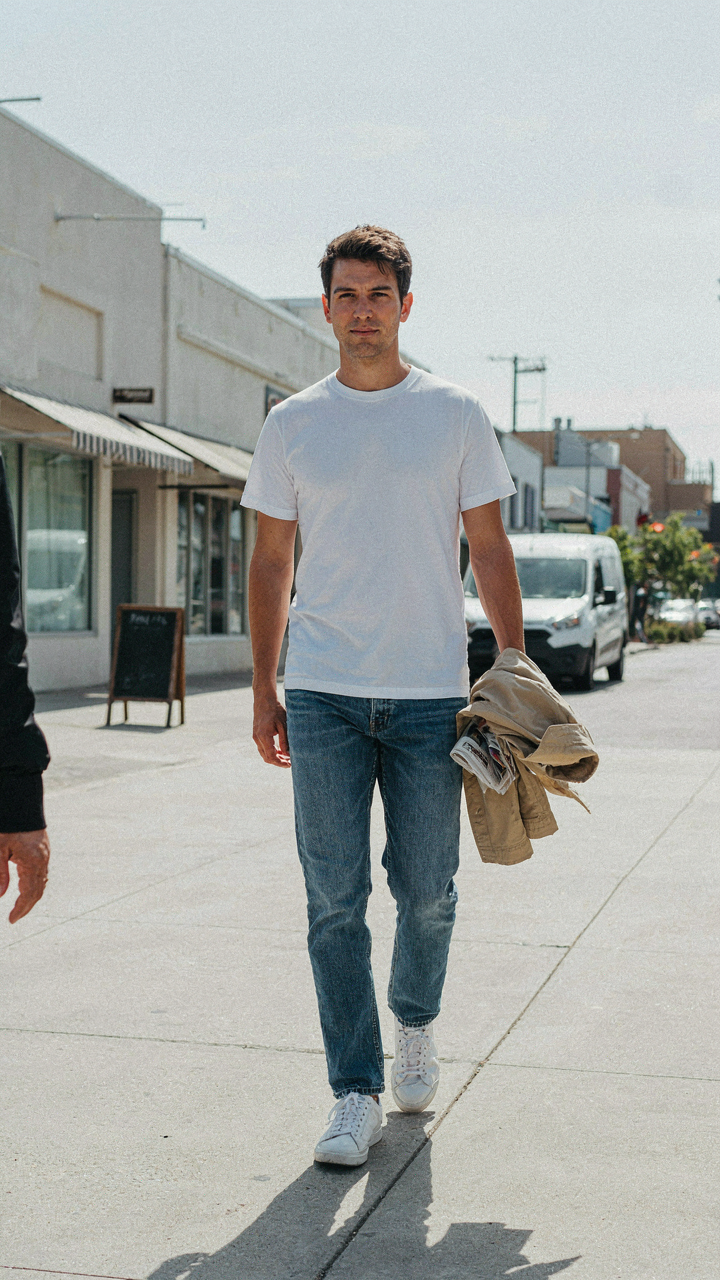
Build your straight leg outfit around pieces that solve functional problems first and look good second. A plain crew neck tee under a raw denim straight leg with white sneakers isn’t trendy because it’s boring—it’s durable because it doesn’t depend on a specific cultural moment to work. Repeat this formula: neutral base layer, structured top layer, neutral footwear, one accessory. When nothing competes for attention, the outfit holds across contexts and seasons.
Strategic Footwear For Straight Leg Jeans Outfits

Shoe Height And Volume Define The Fit
You care about this because the wrong shoe kills an outfit before you leave your door. The mechanism here is simple: shoe height and volume control visual weight distribution on your body. A straight leg jean sits consistently from hip to ankle, which means your footwear either anchors that proportion or disrupts it entirely. Think of it like load-bearing in architecture. Your shoe is either the foundation that stabilizes the structure or the unstable element that makes the whole thing feel off.
High volume shoes (chunky sneakers, combat boots, heavy loafers) compress the visual space at your feet and draw the eye down hard. This works when you want groundedness, but it shortens your line if you’re already a shorter build. Low volume shoes (pointed flats, thin-soled boots, minimalist sneakers) extend the visual line of your leg without competing for attention. Heel height matters too: a slight heel (half to full inch) elongates the leg without requiring the effort of high heels. The goal isn’t balance. The goal is control.
Elongation And Grounding Strategies
The conventional advice says “match your shoe to your outfit vibe.” That’s incomplete. Your shoe choice must solve a specific visual problem based on your body and the silhouette you’re building.
- Pointed flats or minimal sneakers with cropped or tapered tops: Creates an unbroken vertical line from torso to toe. Best for adding length to your frame when you want maximum leg extension.
- Ankle boots with a slight heel: Breaks up leg length strategically and grounds you without adding bulk. Works across body types because the heel lifts while the boot width stays controlled.
- White leather minimalist shoes: Acts as a reset button visually. Keeps the eye on your straight leg proportions instead of anchoring downward toward heavy footwear.
- Loafers or slip-ons in leather: Grounds the outfit with intentional weight without volume. Signals refinement and prevents the silhouette from feeling thin or weightless.
- Mules or slides with low profile: Lightens the overall silhouette while maintaining structure. Best when you want the straight leg to be the dominant visual element of the outfit.
The mechanism that matters: measure your inseam against your torso length first. If you’re proportionally shorter in the leg, avoid anything that adds visual width at the ankle. If you’re longer-legged, you can absorb more shoe volume without disrupting the line. Your shoe doesn’t just finish the outfit. It either extends your silhouette or grounds it based on one decision: does your footwear volume match or contrast with your proportions.
The Straight Ankle Jeans Outfit: A Precision Guide

Where Your Ankle Meets The Shoe
You care about this because a half-inch difference in inseam signals whether you know what you’re doing or you don’t. The visual break point works like a sight line in architecture: everything above and below it either harmonizes or clashes based on proportion, not preference. Most people obsess over fit in the thigh or rise and ignore the fact that the ankle is where the outfit either resolves or falls apart. Straight leg jeans demand exact inseam length because they don’t taper to hide mistakes.
The target is a clean break where the jeans hit your shoe without bunching or floating. Standard inseam for straight legs lands one-half inch above the heel or rests flat on the shoe’s vamp. Too long creates a stack that reads sloppy. Too short exposes too much shin and disconnects your proportions. Get your inseam measured standing in the shoes you’ll wear most, not barefoot. The break point isn’t negotiable because it’s the first thing someone’s eye lands on when they look down.
Boot And Sock Architecture
Boots change the entire visual math of straight leg jeans because the shaft height redefines where the jeans naturally sit. Think of it as negative space in graphic design: the visible ankle, calf, or shin becomes part of the outfit’s composition, not background. Generic advice says “wear ankle boots with straight legs,” but that ignores the fact that a six-inch boot and a twelve-inch boot create completely different proportions. The wrong pairing doesn’t just look off, it makes your legs look shorter or your torso longer.
Black socks under black boots under black jeans creates visual continuity, which elongates the line from hip to floor. Dark denim with a tall boot leaves minimal ankle exposure, which reads cleaner and more intentional than mismatched sock visibility. Wear crew-height socks with ankle boots to avoid the dead zone where sock and shin show. The protocol: choose boots first, then jeans length, then socks. Everything else flows from that decision tree.
Accessories: The Amplifier, Not The Crutch, For Jeans Outfit Women

High Leverage Pieces Over Volume
You want accessories to fix what feels incomplete about your outfit. That’s the real driver. But adding more items doesn’t solve the problem—it broadcasts it. Think in terms of mechanical advantage: in physics, you multiply force by reducing the load applied to it. One deliberately chosen accessory creates more visual impact than five mediocre ones. A structured leather belt or quality watch commands attention because it occupies visual real estate efficiently. Straight leg jeans demand restraint. The fit already speaks.
The mistake most people make is treating accessories as decoration. They’re actually punctuation. A single statement piece—a leather crossbody bag, quality boots, a wool coat—reframes the entire outfit. It doesn’t hide the jeans. It completes the sentence the jeans started. Remove the noise. Every accessory must justify its presence by either anchoring the look or adding dimension. If it does neither, it dilutes the signal.
Edit Before You Accessorize
The common advice is to layer your look. That’s incomplete. What actually works is choosing one focal point per outfit, then building constraint around it. If your bag is the hero, your belt recedes. If your shoes carry the weight, your bag becomes functional, not decorative. Accessories as focal points means they compete for attention. You can’t have two. Straight leg jeans work because they don’t demand accessories—they allow them to lead without distraction.
Most people add accessories after choosing the outfit. Reverse the order. Start with one piece that feels intentional, then build the jeans and the rest around it. This forces elimination. You’ll reject anything that fights for the same visual focus. A structured handbag prevents you from adding statement jewelry. Good boots mean your belt stays simple. The mechanism is constraint, not curation. Fewer pieces, higher intentionality, stronger result.
The Only Bad Outfit Is One That Ignores How Perception Works; Your Insecurity Is The True Limitation

Most people blame their body type or budget when a straight leg jeans outfit fails. Wrong. They blame everything except the real problem: they dressed for the person they think they are, not the person they’re becoming. Today, pick one outfit from this guide and wear it without editing yourself in the mirror. Stop negotiating with your doubt. The clothes aren’t the issue. Your belief is.