

The Turtleneck Lie: Why Most Looks Fall Flat

The Fit Trap Nobody Names
You’re looking for permission to believe a turtleneck will fix your silhouette. It won’t. The mechanism is simple: a turtleneck compresses the upper body, which means oversized proportions anywhere else become obvious by contrast. Most women pair turtlenecks with loose pants or skirts, creating a visual break that reads as unfinished. The turtleneck didn’t fail. The proportions did.
The real rule is borrowed from tailoring itself: balance is ratio, not symmetry. If your turtleneck hugs your torso, your bottoms need intentional shape too. A slim turtleneck demands bottoms that are either fitted or structured. A boyfriend-cut turtleneck works with straight-leg or wide-leg pants because the volume repeats. The fit of the turtleneck determines the fit of everything below it. Nothing else matters as much.
The Difference Between Intentional And Neglected

Casual doesn’t mean sloppy. This distinction kills most turtleneck outfits. The gap between them is context visibility. If your turtleneck looks chosen for this specific moment, the outfit reads polished. If it looks like you grabbed what was clean, it reads neglected. One detail determines this: whether the turtleneck sits properly on your frame or shifts during movement.
A turtleneck that rides up at the neck or bunches at the waist signals neglect immediately. Casual style requires a turtleneck that stays in place without adjustment. This means sleeve length to your wrist bone, torso length to your hip, and neckline snug but not choking. The fabric also matters. Thin, flimsy knits shift and wrinkle. Structured knits hold their shape. Structure is the mechanism that separates deliberate from careless.

The Contrast Principle: Elevating Your Turtleneck Sweater Outfit

Knit Against Unexpected Materials
You want people to notice you’ve thought about what you’re wearing—that’s the real reason this matters. In design, contrast is the mechanism that forces the eye to stop and register difference. A turtleneck sweater creates visual weight through texture and form. Pair it against materials that oppose its softness: leather, linen, denim, silk, or structured wool. The juxtaposition makes both elements sharper. A merino turtleneck against a tailored linen blazer reads as intentional, not accidental.
The mistake most people make is assuming turtleneck outfits women wear need matching textures throughout. Wrong. Matching creates visual noise. You need one dominant texture and one contrasting one. A chunky knit turtleneck with slim leather trousers. A fine merino turtleneck under a raw denim jacket. The contrast creates hierarchy. Your eye lands where you want it to land. Material opposition is how you signal that you understand proportion and restraint.
Color Layering For Visual Depth
Color theory borrowed from painting teaches one principle: adjacent colors on the wheel create harmony, while opposite colors create tension. Deploy tension strategically. A burgundy turtleneck against warm camel trousers uses analogous harmony and reads as safe polish. A charcoal turtleneck against mustard outerwear uses contrast and reads as deliberate. The second approach stops people. The first just doesn’t offend.
Most advice tells you to match or go neutral. That’s lazy thinking designed for people afraid to fail. Real polished comes from controlled opposition. A deep emerald turtleneck with navy outerwear sits at the edge of the color wheel—close enough to feel cohesive, far enough to create dimension. A cream turtleneck with warm brown creates understated richness without screaming for attention. Test the pairing by standing in natural light before committing. If your eye bounces between pieces instead of resting on the whole, you’ve found your contrast threshold.
The Architectural Method: Building A Polished Turtleneck Top

How Fabric Weight Controls Your Whole Outfit
You want people to assume you have your life together without saying anything. The real mechanism is this: fabric weight determines whether your turtleneck collapses into your frame or holds its own. Think of it like load-bearing walls in architecture. A cheap, thin knit buckles under its own shape. A structured knit maintains volume and posture. The difference isn’t subtle. It changes how your body reads to other people.
Merino wool and cashmere blends hold their shape because the fiber density creates actual internal structure. Cotton blends and synthetics need thickness to compensate, which adds bulk you don’t want. Mid-weight turtlenecks (around 400-600 gsm) create the polished effect because they sit on your shoulders without sagging or puffing outward. The fit matters less when the fabric does the work. Buy the heavier knit. It’s the non-negotiable foundation.
Negative Space Defines The Silhouette
Most women layer wrong because they fear empty space and fill every gap. Negative space isn’t wasted real estate. It’s the visual counterweight that makes a silhouette read as intentional rather than cluttered. A turtleneck under an open blazer works because the gap between them frames your neck and shoulders. A turtleneck under a fitted sweater works for the opposite reason: there’s no gap, so the line flows unbroken from collarbone to hip.
Strategic negative space forces the eye to register your actual proportions. Pair a fitted turtleneck with high-waisted trousers that sit at your natural waist. Leave visible skin at your hip bones before your pants start. This creates three distinct zones: torso, transition, legs. The zones read as deliberate. Add a long cardigan or coat that breaks at mid-thigh, and that same negative space now anchors the whole outfit. Negative space is what separates assembled from curated.
Winter Skirts Outfits: The Counter Intuitive Pairing

Skirt Fabrics Beyond Basic Tights
You’re worried a skirt makes you look less serious than pants. Here’s what actually determines that: fabric weight and drape, not the garment category itself. Heavy wool, linen blends, and structured cotton skirts don’t require tights to function. They hold shape independently, create visual mass, and read as intentional. The mechanism is simple: density signals competence more than silhouette does.
Pairing a turtleneck with a midi skirt in wool gabardine or structured cotton creates authority through material choice, not styling tricks. Tights become optional when the skirt fabric itself has substance. Lightweight skirts in rayon or cotton jersey collapse without leg coverage, which is why that pairing feels incomplete. The fabric choice determines whether you need reinforcement or whether the outfit stands on its own merit.
Proportion Hacks For Visual Balance
Proportion works like physics: mass distribution determines whether an object appears stable or top heavy. A fitted turtleneck stacked on a voluminous skirt creates visual imbalance unless you interrupt it. The fix isn’t to make the skirt smaller; it’s to add a defined waistline through a belt, tucking, or a jacket that cuts the silhouette at the hip. This creates a visual anchor point that makes the proportions read as intentional rather than accidental.
Tuck your turtleneck into a high waisted skirt and add a structured blazer that hits mid hip. This three layer approach creates distinct sections instead of one long column that overwhelms the frame. The belt sits at your natural waist, the blazer establishes shoulder width, and the skirt proportion stays generous without reading as unbalanced. Execute this as your baseline formula before experimenting with looser proportions.
The “Classic Turtleneck” Deconstruction: What They Won’t Tell You

Fiber Weight And Drape Reality
You want to know which turtleneck won’t betray you in public. That’s the real fear underneath. The mechanism is fiber weight and how it behaves under gravity. Merino wool at 16-18 microns holds shape better than cotton blends because the fiber diameter directly controls how much the fabric clings to body contours. Cashmere at 14-16 microns drapes differently again. Weight per square meter matters more than brand name. A 200gsm merino performs differently than a 280gsm cotton jersey on the same frame. The fiber type determines recovery, meaning how fast the fabric returns to its original position after stretching around your torso.
Most advice skips past this and jumps to “invest in quality.” That’s incomplete. You need to physically feel the weight of the knit in your hands before buying. Drape is not subjective if you understand the science. A dense knit holds structure. A loose knit collapses into wrinkles. The turtleneck that looks polished at 8 AM will still look polished at 6 PM only if the fiber weight sustains that shape throughout wear and movement.
Sleeve Length Breaks The Entire Fit
Sleeve length determines whether a turtleneck reads as intentional or accidental. The break point where the sleeve meets your wrist is the visual anchor that either grounds the outfit or makes you look like you’re drowning in fabric. Standard sizing assumes an average arm length that doesn’t account for shoulder width, torso proportion, or how you carry weight. A sleeve one inch too long creates a sloppy silhouette even if everything else fits perfectly. The cuff should sit at the base of your hand, revealing skin between the knit and your palm. Anything past that kills polish immediately.
Fit imperfections compound. If the sleeve is long and the body is also loose through the torso, the eye has nowhere to land. The outfit reads as formless. When you try on a turtleneck, raise your arms as if reaching for a shelf. Your wrist should show a quarter inch of skin. This single measurement determines whether the piece works with tailored pants or structured jackets. Get the sleeve wrong and no amount of styling fixes it.
The Ivory Sweater Outfit Strategy: Mastering Monochromatic Polish

Building Depth With Controlled Variation
You want ivory to read as expensive and intentional, not accidental or flat. That’s the real motive here. In color theory, monochromatic palettes rely on value contrast—the difference between light and dark within a single hue family—to create visual interest without looking chaotic. Ivory works because it sits at the lighter end of the neutral spectrum, which means you control depth by layering textures and shades rather than competing colors.
The mechanism is simple: pair your ivory turtleneck with pieces in warm beige, taupe, cream, or soft gray. These aren’t separate colors. They’re adjacent values on the same neutral axis. The eye reads them as intentional restraint, not indecision.
- Cream Blazer Over Ivory: Creates subtle separation at the shoulders without introducing new hues. The slight warmth difference registers as polish, not confusion.
- Taupe Trousers: Sits one shade darker than ivory. Grounds the outfit and prevents top-heavy visual weight.
- Warm Beige Outerwear: A camel or oatmeal coat adds depth through texture and undertone, not saturation. Reads as intentional layering.
- Soft Gray Skirt: Introduces cool contrast within neutrals. Works especially well for creating a defined silhouette without breaking the monochromatic logic.
- Ivory With Off-White Base: Combines two neutral whites with textural difference—knit versus smooth fabric. Depth comes from material quality, not color shift.
The mistake most people make is thinking monochromatic means identical. It doesn’t. You’re building a visual hierarchy through shade and texture. Start with your ivory turtleneck as the focal point, then add one piece in a darker neutral and one in a complementary texture. That’s the entire formula.
Adding Controlled Flair Through Strategic Accessories
Accessories determine whether your ivory turtleneck reads as boring or deliberate. The common advice says “add a pop of color.” That’s incomplete and usually wrong. A random colored scarf doesn’t make an outfit polished. It makes it look like you’re compensating.
The real play is metallics and structured accessories. Gold, silver, or bronze jewelry doesn’t compete with ivory—it frames it. A structured leather belt defines the waist and creates architectural interest. A watch with a leather band adds weight and credibility to the wrist. Scarves work, but only if they’re tonal or patterned in a way that doesn’t scream for attention. Herringbone, subtle plaids, or solid silks in your existing palette amplify, they don’t distract. A structured handbag in matching leather—cognac, black, or cream—anchors the entire look and signals intentionality. The ivory turtleneck becomes the platform. Everything else supports the frame without fighting for focus.
The “Turtleneck Women” Paradox: Effort Vs. Impact

Why Simplicity Signals Power
You want to look expensive without looking like you tried. That’s the real ask here. In physics, leverage is the ratio of output force to input force. A turtleneck outfit applies the same principle: minimal garment complexity produces maximum visual authority. The turtleneck itself does 70% of the work because it’s a complete visual statement on its own. You’re not assembling an outfit. You’re positioning a uniform.
Most advice tells you to “add layers” or “play with textures.” That’s wrong. More pieces create visual noise, which reads as uncertainty. The real mechanism is subtraction. A fitted turtleneck, tailored trousers, and a structured coat is not an outfit with three things. It’s a single coherent shape that your brain registers in under three seconds. That’s when people form judgments about competence.
The 20% That Changes Everything
Economics calls this the Pareto principle: 80% of results come from 20% of inputs. Applied to turtleneck outfits for women, those inputs are fit and fabrication. A mediocre turtleneck in premium wool reads better than a well-styled turtleneck in cheap acrylic, full stop. Your accessories don’t make the outfit. Your base layer does.
The single highest-leverage addition is one structured bag. Not multiple rings, not scarves, not belts. One bag in a complementary neutral that holds actual weight and volume signals purpose. Everything else gets cut. A woman in a black turtleneck and structured trousers looks polished. Add an expensive leather bag and she looks like she has somewhere important to be. That’s the mechanism: one intentional object that anchors the entire visual hierarchy.
Turtleneck Jumper: Beyond Loungewear The Elevated Approach

Comfort Without Sacrificing Structure
You want permission to wear soft clothes and still look intentional. Here’s what actually happens: the turtleneck jumper works because of contrast, not despite comfort. Pair a fitted merino wool or cotton blend turtleneck with high-waisted trousers or a structured midi skirt. The fitted neckline and sleeves create visual definition. The body absorbs wrinkles less than loose knits. Tuck it fully or half-tuck depending on whether you need vertical elongation or hip emphasis.
The mistake everyone makes is treating the jumper as the focal point. It isn’t. A turtleneck jumper is foundational. Its job is to create a clean line from neck to hip so everything else—your bottoms, accessories, outerwear—reads as intentional rather than thrown together. Wear it untucked only if your bottoms have a defined waistband and your proportions allow it. Otherwise, you’re creating visual noise instead of polish.
Footwear Changes Everything
Shoe choice determines whether a turtleneck jumper reads as casual or curated. Flat shoes without structure—slip-ons, ballet flats, unstructured sneakers—ground the outfit downward and flatten your silhouette. Pointed-toe flats, loafers with defined architecture, kitten heels, or minimal ankle boots create a vertical lift that works with turtleneck proportions. The heel doesn’t need to be high. It needs to exist as a design element.
Black or neutral footwear in leather or suede creates the polished signal. The material matters more than the style. A quality loafer in leather reads differently than a canvas version. Pair your turtleneck jumper with shoes that have closed construction and taper toward the ankle. Open sandals or heavily embellished shoes fight against the minimalist strength the turtleneck already provides. Your foot is the final visual anchor of the outfit.
The Accessory Algorithm: Optimizing Your Turtleneck Outfit Women
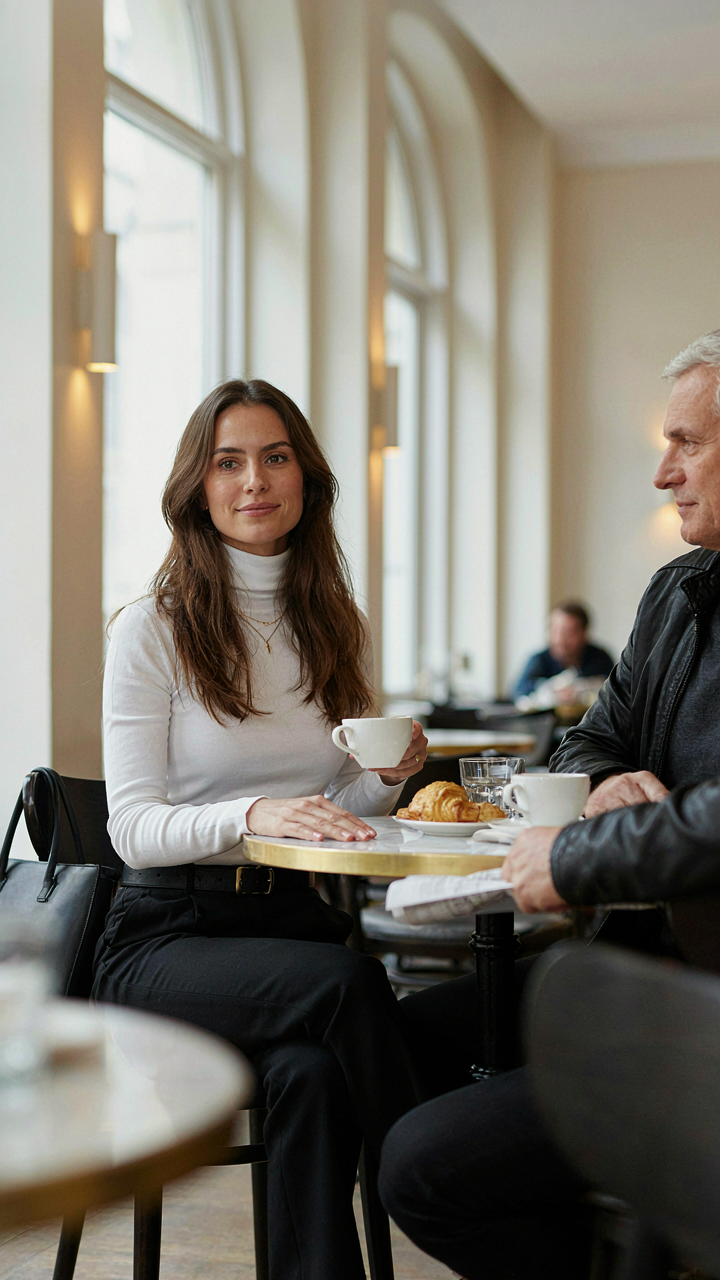
When One Piece Carries The Weight
You’re worried that a turtleneck outfit feels incomplete without the right add-ons. The mechanism is contrast: a turtleneck already occupies visual real estate at your neckline and shoulders, so accessories function like visual anchors that either compete for attention or reinforce hierarchy. Statement pieces dominate the frame. Subtle accents fade into supporting roles. The mistake most people make is treating both as interchangeable.
A turtleneck with a chunky gold chain and a bold printed bag creates noise, not polish. The turtleneck itself is already a statement piece because it fills the upper body. If you add another statement piece, you’ve split focus and lost authority. Polished means everything points in one direction. Either let the turtleneck be neutral and build outward with one bold accessory, or keep accessories minimal when the turtleneck carries color or texture.
Jewelry, Belts, And Bags As Strategic Anchors
Accessory anchors work like load-bearing columns in architecture: they distribute visual weight and create structure. A leather belt cinches a loose turtleneck and defines your silhouette, while jewelry either complements or contradicts the formality of your outfit.
- Narrow belts with minimal hardware: Sit high on the waist and create vertical line extension. Works best with oversized turtlenecks to restore proportion without adding visual bulk.
- Gold or silver jewelry paired consistently: Stick to one metal per outfit. Mixing metals adds confusion. A simple chain or structured earrings anchor the neckline without competing with the turtleneck’s fabric.
- Structured handbags over slouchy styles: A rigid silhouette (leather tote, satchel) grounds the outfit. Slouchy bags soften your frame and dilute the polished effect a turtleneck creates.
- Layered necklaces kept short: Keep chains at or above the collarbone, never competing with turtleneck neckline. Multiple delicate chains work; one chunky chain works. Never both in one outfit.
- Wide belts as secondary statement: A textured or colored belt functions as a second focal point only if your turtleneck is solid and neutral. Avoid this pairing with patterned or heavily textured knits.
The real move is treating each accessory as a supporting player with one clear job. Your bag carries weight literally and visually, so it should match the formality level of your turtleneck. Jewelry signals whether you’re going casual or elevated. A belt either enhances proportion or disrupts it. Before adding any accessory, ask what problem it solves. If it solves nothing, it creates noise instead.
Sweater Turtleneck: The Unspoken Rules Of Effortless Authority

The Posture Problem Nobody Admits
You want people to take you seriously without trying too hard. Here’s what actually happens: a turtleneck demands you show up physically. The neckline forces your chin up and your shoulders back. Slouch in a turtleneck and you look defeated. Stand straight and the garment does the work. This is biomechanics, not fashion theory. Your body position determines whether the piece reads as polished or lazy.
The turtleneck amplifies whatever energy you bring to it. If you’re hesitant, the high neckline traps that uncertainty around your throat like a visible constraint. If you’re grounded, it becomes a frame that strengthens your presence. The mechanism is simple: upright posture + turtleneck neckline creates visual alignment with your spine. Your neck and shoulders become one architectural unit. This compounds perceived authority faster than any other sweater cut.
Fit Is The Difference Between Wearing And Being Worn
Most advice says “get a fitted turtleneck.” That’s incomplete. A fitted turtleneck that’s too tight at the neck turns you into a trapped animal. A fitted turtleneck that’s loose through the body makes you look like you’re borrowing someone’s sweater. The real rule: the sweater fits your actual shoulder width, not what you think your shoulders should be. Your collarbone should sit at the sweater’s natural shoulder seam. This is where the garment takes control, not you.
Once the shoulders land right, everything else corrects itself. The neckline sits properly against your jawline without pulling or gaping. The torso length hits at your natural waist or hip without bunching. You can move your arms without the fabric riding up or restricting. This fit standard isn’t about being “slim” or “oversized.” It’s about the sweater responding to your frame instead of fighting it. When fit is right, you stop thinking about the garment and start using it as a tool for presence.
The Real Obstacle To Polished Style Isn’t The Garment; It’s Your Adherence To Generic Fashion Dictums

You don’t need more turtleneck outfit rules. You need permission to break them. Most women default to safe combinations because fashion magazines trained them to fear mistakes. Stop waiting for the perfect formula. Grab your turtleneck today and pair it with the one thing you actually want to wear, not what you think you should. The only outfit that looks polished is the one you stop apologizing for.