

Beyond “Eco Friendly”: The True Cost Of Cheap Choices

Who Actually Pays For Your Discount
You care about this section because buying cheap clothes lets you feel conscious without changing your behavior. The mechanism is simple: fast fashion outsources its true cost to people and ecosystems you never see. A shirt that costs twelve dollars doesn’t cost twelve dollars. Someone absorbed the difference. Textile production ranks among the most resource-intensive industries globally. Water consumption for cotton alone demands massive extraction. Chemical runoff from dyeing operations contaminates groundwater in producing regions for years. Garment workers in Bangladesh, Vietnam, and India earn wages that haven’t moved meaningfully in two decades despite inflation everywhere else.
The “eco-friendly” label on a cheap shirt is marketing cover for the same broken system. Brands slap certifications on products made through identical supply chains because the certification itself costs less than changing production. You’re not buying sustainability. You’re buying permission to keep shopping the way you always did. The capsule wardrobe model breaks this by forcing you to confront price as information about what you’re actually consuming. When you buy one shirt for sixty dollars instead of five shirts for twelve dollars each, you’re not spending more. You’re finally paying the actual price.
The Friction Between Your Closet And Your Mind

Decision fatigue compounds every time you open your closet to find nothing to wear despite owning thirty pieces. Economics recognizes this as the paradox of choice, but the real cost isn’t measured in seconds of browsing. It’s measured in the mental bandwidth you spend justifying purchases you don’t quite like. Cheap clothes feel provisional. You buy them half-convinced they’re mistakes, so you keep buying to offset the uncertainty. This loop creates a psychological tax: constant low-grade regret about what hangs in your closet.
Disposable fashion trains your brain to treat clothing as temporary. You don’t develop standards for fit, quality, or personal style because you assume the piece will fall apart anyway. That assumption becomes self-fulfilling. When you know a garment will last three years instead of three washes, you notice things differently. Seams matter. Fabric weight matters. Fit matters because you’ll wear it hundreds of times. The mental shift from “this will do” to “this works” eliminates the friction of constant rechoosing. Build your capsule around pieces that require zero justification when you reach for them.

The “Wardrobe As Weapon” Protocol: Intentionality Over Impulse
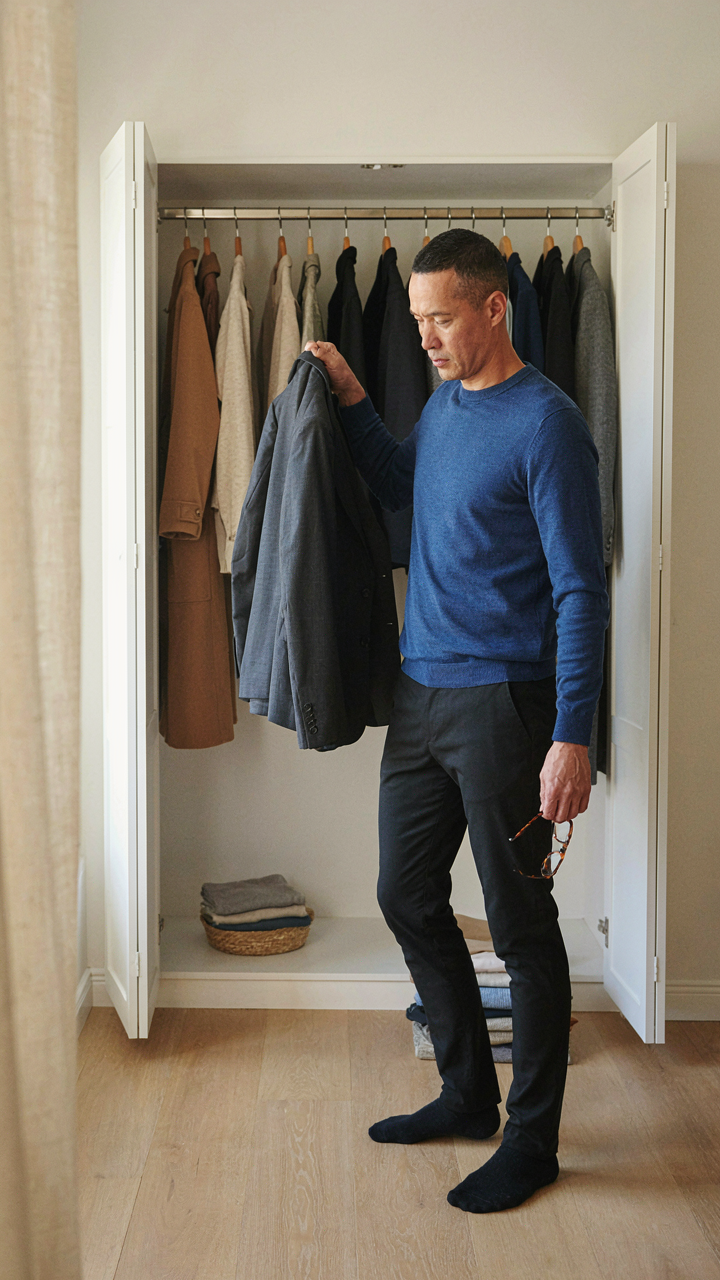
Define Your Core Aesthetic Uniform
You want permission to stop thinking about what to wear because you’re tired of decision fatigue disguised as choice. The mechanism is constraint, borrowed directly from systems design. In engineering, constraint forces optimization. In your closet, it forces coherence. You pick a visual identity first, then everything else flows from that single decision. This isn’t about finding your “true self.” It’s about choosing a deliberate visual language and sticking to it long enough that the decision-making stops.
Your core aesthetic uniform is five to seven foundational pieces that define your silhouette, color story, and material preference. Think of this as the skeleton. A structured blazer, straight-leg trousers, a white button-up, a neutral knit. These pieces work together across seasons and occasions. They’re not trendy. They’re not Instagram-worthy. They’re invisible in the best way, meaning they disappear into your daily routine. The uniform reduces acquisition options by 80 percent because any new piece you consider must work within this frame or it doesn’t enter your closet.
Strategic Acquisition: Quality, Not Quantity
The common advice here is garbage: buy less, choose well, make it last. That’s incomplete because it skips the hard part, which is how you actually identify quality before purchase and why it matters financially. Quality is material density combined with construction method. A 100-weight cotton will hold shape longer than 60-weight cotton. A garment sewn with a French seam or felled seam will outlast a simple flat seam because the seam itself is reinforced. You’re not paying for brand. You’re paying for fiber weight, stitch density, and how the pattern pieces fit together.
Strategic acquisition means buying one piece per season that serves a specific gap in your uniform. Not rotation. Replacement and extension only. A worn oxford needs replacing, so you buy one oxford that meets your quality threshold instead of three cheaper ones. This costs more upfront but costs less over five years because you’re not cycling inventory constantly. Document what you buy and when. Track failure points. If a seam splits in the armpit after six months, you know that manufacturer’s pattern work is weak. You don’t buy from them again. This turns shopping into data collection, not impulse.
Sustainable Wardrobe: The Investment Thesis Of Garments

Cost Per Wear Eliminates The Guessing Game
You want permission to spend more on clothes without feeling guilty about it. The mechanism that makes this work is borrowed from accounting: you’re not buying a garment, you’re renting utility from it over time. Cost per wear divides the price by actual wears, not theoretical maximum wears. A 200 dollar coat worn 100 times costs two dollars per wear. A 40 dollar shirt worn four times costs ten dollars per wear. The math exposes what your intuition already knows: cheap pieces worn rarely are the real waste.
Most cost per wear advice stops at simple division. That’s incomplete. You need a wear threshold before the calculation matters. Below roughly 30 wears, even expensive pieces underperform against cost. This threshold matters because it forces you to predict fit and lifestyle compatibility before buying. You’re not estimating; you’re committing to a wear pattern. Track actual wears for three months on any new piece. This data becomes your calibration tool for future purchases and kills the impulse buy cycle entirely.
Resale Architecture Extends The Garment Lifecycle
Resale value isn’t sentimental. It’s financial recovery that changes the acquisition equation. A 300 dollar jacket bought at full price and resold at 40 percent recovery actually costs 180 dollars. That 180 dollar cost spreads across 150 wears to 1.20 dollars per wear. Resale shifts the burden of depreciation away from you and onto demand. Natural fibers, classic cuts, and minimal branding hold resale value longest because they’re not trend-dependent and remain wearable across decades.
The protocol is straightforward: before buying, check resale prices for similar pieces on platforms like Vestiaire Collective or Grailed. If resale sits below 25 percent of retail price, the garment absorbs too much depreciation risk. If it sits above 40 percent, you have financial recovery built in. Documentation and condition preservation matter. Keep tags and receipts. Store properly. When you resell, the cycle extends into someone else’s wardrobe and your capital recycles into higher-quality replacements. This is the only mechanism that makes a capsule wardrobe economically rational rather than emotionally justified.
The Pareto Principle Of Outfit Building

Your Core Pieces Do The Heavy Lifting
You want permission to own less without feeling like you’re missing out. Here’s the mechanism: roughly 20 percent of your pieces generate 80 percent of your actual outfits. Most people never identify which pieces those are, so they keep buying more hoping randomness fixes the problem. It doesn’t. Economics calls this distribution the Pareto principle. In a capsule wardrobe, it means isolating the items that combine with everything versus those that sit dormant between occasional wears.
Start by tracking what you actually wore over thirty days. Don’t estimate. Write it down. You’ll notice five to seven core pieces appear constantly while twenty pieces barely surface. Those core pieces are your leverage points. They’re the neutral base layer, the versatile top, the pants that work everywhere. The rest are satellites. Most capsule advice ignores this and treats all pieces as equally important. They’re not. Strip the collection down to those core pieces first, then build outward from what actually works.
Combinations Over Quantity Breaks Decision Paralysis
Decision fatigue isn’t about having too many clothes. It’s about having too many unpredictable combinations. Your brain burns energy calculating whether pieces work together, not simply choosing between outfits. The fix is pre-deciding combinations and treating them as atomic units instead of mixing variables each morning. You’re not reducing choice. You’re organizing it into stable equations so your decision cost drops to near zero.
Map three to four core combinations that work for your life. A combination is not an outfit. It’s a formula: these three pieces always go together, in any season variation. One person’s formula might be neutrals plus one accent color. Another’s might be all-dark with texture variation. Lock these in. Then your actual decision becomes which formula fits today’s context, not whether those three pieces coordinate. Test each formula for fourteen days. If a piece in the formula fails or feels forced, swap it before the formula sets. Once locked, these combinations handle roughly eighty percent of your dressing needs.
Cultivating An Organic Wardrobe: The Biological Imperative Of Natural Fibers

Why Natural Fibers Actually Last
You want natural fibers because they feel premium and signal you care about the environment. The real mechanism is biological: natural fibers have breathability architecture that synthetics cannot replicate. Cotton, linen, and wool allow moisture vapor transmission, which means sweat moves through the fabric instead of pooling against your skin. This reduces bacterial growth and odor accumulation, which is why your clothes smell worse faster in polyester. The fiber structure itself degrades more predictably under sweat and friction.
Durability compounds when you understand fiber porosity. Wool crimps create natural elasticity, so garments recover their shape after wearing instead of sagging permanently. Linen gets softer and stronger with every wash because cellulose fibers swell and bond more efficiently. Synthetic blends suppress this cycle entirely. The rule: pure natural fibers in core pieces create a wardrobe that functions better in year three than year one, which is the only math that makes capsule economics work.
What Actually Happens When Clothes Disappear
The common advice says natural fibers are “better for the planet.” That’s incomplete. Biology has a decomposition timeline that matters for inventory planning. Cotton biodegrades in roughly six months under industrial composting conditions, but the real variable is soil microbes and temperature. A cotton shirt in a landfill takes years to break down because anaerobic conditions slow microbial activity dramatically. Wool decomposes faster in moist soil but can persist for several years in dry environments. This isn’t moral superiority, it’s material science: the fiber structure that synthetic requires 200 years to break cannot exist in natural materials.
The environmental impact hinges on your disposal protocol, not the material alone. A cotton shirt worn for five years then landfilled has lower impact than a synthetic shirt worn for two years then discarded because use-life dominates the calculation. Polyester creates microplastics that enter water systems immediately upon decomposition, while natural fibers release only carbon and nitrogen. Store pieces you actually wear in natural fibers, then commit to a donation or textile recycling pipeline when rotation ends. This turns decomposition time into a non-issue because the garment exits your home in usable condition.
The Slow Fashion Capsule Wardrobe: Mastering The Art Of Maintenance

Repair And Care Extend Your Garment’s Life
You want the status of owning fewer pieces without admitting you’re afraid of making the wrong purchase. The real mechanism is this: most people treat garments as disposable because repair seems harder than replacement. It’s not. The economics are inverted. A $200 sweater with a $15 repair costs less per wear than a $60 sweater you replace annually.
Garment deterioration follows predictable patterns. Seams fail first. Fabric pilling, color fading, and elastic breakdown follow. You interrupt this cascade through targeted intervention. Strategic care prevents 80 percent of damage before repair becomes necessary.
- Seam Reinforcement: Hand stitch stress points like armholes and crotch seams every 12 months. This adds years to high-wear garments before professional repair becomes needed.
- Fabric Pilling Treatment: Use a manual pill remover or fine-tooth comb on wool and synthetic blends. Do this after every 3-5 wears to prevent matting and restore surface texture.
- Washing Protocol: Cold water, delicate cycle, air dry. Machine drying destroys elastic and causes shrinkage. This single habit doubles garment lifespan across categories.
- Storage Conditions: Keep pieces in breathable cotton bags away from direct sunlight. Humidity and UV exposure fade color and weaken fibers faster than wear itself.
- Professional Mending: Hire a tailor for zipper replacement, hem extension, and significant seam repairs. This costs $20-60 per repair and keeps $150-300 pieces in rotation.
The math is simple: repair $200 garments, discard nothing under $80 in condition. This mindset shift eliminates the replacement impulse that kills capsule discipline. Track which pieces you repair. They’re your highest-value items. Buy more pieces like them.
Rotate Seasonally And Preserve In Between
Seasonal rotation isn’t about storage optimization. It’s about stress distribution. Wearing the same five pieces year-round accelerates fiber fatigue. Rotation spaces out wear cycles so materials recover between uses.
Store off-season pieces clean and dry. Dirt settles into fabric and creates oxidative damage during storage months. Wash garments before storing them. Use cedar blocks or lavender sachets instead of mothballs, which leave chemical residue and don’t extend life. Pack pieces loosely in breathable containers. Vacuum-sealed bags compress fibers permanently and trap moisture. Check stored items monthly for unexpected damage. Catch a developing problem before it compounds.
From Wardrobe Outfits To Personal Brand Architecture

Your Clothes Are A Signal System
You want people to know who you are without you having to say it. That’s the real reason you care about this section. Your wardrobe functions like semiotics in visual communication: a system where every piece transmits meaning. The message doesn’t come from individual items. It comes from the pattern people observe when they see you repeatedly. Consistency across pieces, colors, silhouettes, and materials creates that pattern. Randomness destroys it. A sustainable capsule wardrobe isn’t about minimalism for its own sake. It’s about eliminating the noise that clouds your intended signal.
Most people think a cohesive aesthetic means matching colors or following a mood board. Wrong. It means every piece you own answers the same underlying question about who you are. If you wear oversized linen one day and fitted tailoring the next, you’re not sending a confused message because of variety. You’re sending it because the pieces don’t align on their core principle. Your signal becomes static. Decide what you stand for sartorially, then buy only items that reinforce it. Your wardrobe becomes readable.
Intentional Selection Over Completeness
The conventional advice says build a capsule around coverage: enough basics to get through a month. This misses the mark. Coverage assumes you need to wear something every day. What you actually need is impact per wearing. Buy pieces you’ll reach for because they solve a real problem or make you feel capable. This eliminates the dead weight that sits in drawers. A smaller wardrobe of intentional pieces worn frequently outlasts a larger one of filler items worn twice. Frequency of wear drives durability anyway.
When you curate for impact, you’re curating for replacement cycles and resale value. High-wear pieces justify their cost because you use them until they break. They hold value because others want what you want. A neutral linen shirt you wear eighty times in a year justifies a premium price. A trendy piece you wear five times becomes landfill. Start by listing what you actually reach for now. Those are your impact pieces. Build around them with intentional additions, not aspirational coverage.
The Ecosystem Of Eco Friendly Wardrobe Essentials

Build Around Constraint, Not Abundance
You want permission to buy more things and feel righteous about it. Here’s what actually happens: constraint forces intentionality. In systems theory, bottlenecks determine output. Your wardrobe’s bottleneck is the number of items that work together. When you own fewer pieces, each one must earn its weight. This means you stop buying reactive replacements and start buying structural additions that multiply outfit combinations.
The math is simple. Five versatile basics generate more outfits than twenty pieces that don’t combine. A neutral base layer worn under different jackets, over different bottoms, creates exponential variation without exponential consumption. Most people reverse this: they buy variety in isolation instead of building systems where one piece extends the life and usability of five others. When you design around constraint, you eliminate the psychological drag of decision fatigue and the financial drain of dead inventory sitting in your closet.
Separate Marketing From Manufacturing
Sustainable brand claims are mostly theater. A company can use organic cotton, fair trade certification, and recycled packaging while still producing volume that contradicts sustainability. The real distinction is manufacturing density and stock turnover. Brands that produce small batches, make to order, or maintain minimal inventory actually reduce waste. Brands that produce large collections seasonally and mark down unsold stock are running the same destructive model with better PR.
Check two things: How many new styles does the brand release per year, and how much inventory sits in warehouses. A brand with twelve annual collections is functionally fast fashion regardless of fiber origin. A brand producing fifty items at scale for two years straight is building actual durability into their business model because returns and waste threaten their margins. Manufacturing discipline, not material choice alone, determines whether a brand is truly sustainable. Find the brands that sell out of items, not the ones that discount them.
Your Real Obstacle Isn’t Clutter Or Consumption; It’s A Failure To Recognize Your Wardrobe As A Lever For Personal Efficacy

Most people treat their closet like a mistake they’re perpetually cleaning up. They don’t realize it’s a decision-making machine. Every morning you either make choices that compound your agency or you don’t. A sustainable capsule wardrobe forces clarity. Pick three pieces you actually wear today. Put the rest away. Notice how that single constraint makes you sharper, faster, more deliberate about who you’re becoming. Your closet isn’t the problem to solve. It’s the tool you’ve been neglecting. Simplicity isn’t about having less. It’s about owning what you choose.