

The Preppy Paradox: Why Your ‘Effortless’ Look Takes Too Much Effort

Everyone Copies The Same Five Outfits
You want to look effortless because you’re terrified of looking like you tried. The mechanism is simple: preppy aesthetics borrowed their legitimacy from old money, which derives status from appearing unbothered by fashion itself. When everyone reads the same three style guides and buys from the same five brands, the result is uniformity masquerading as taste. You become indistinguishable from the person next to you, which defeats the entire purpose of dressing this way.
The common advice tells you to nail the classics: navy blazer, white button-down, loafers, repeat. That’s the trap. Classic pieces are the entry point, not the destination. Real preppy dressing requires understanding which specific items in your wardrobe can break the mold without breaking the code. This demands actual knowledge, not Pinterest boards.
The Real Cost Of Chasing What’s Trending Within Preppy

Economics calls it the sunk cost fallacy, but preppy outfits have a specific variant: you invest in expensive basics because they’re “timeless,” then watch micro-trends shift the silhouette, fabric weight, or color saturation every eighteen months. The wool pleated skirt you bought three years ago now reads dated not because pleats died, but because the pleat width changed. You’ve already paid the money. The garment is still intact. You stop wearing it anyway.
This isn’t about quality failing. This is about your brain updating its reference point faster than your closet can. The antidote isn’t buying more. It’s investing in fewer pieces that genuinely align with your body and lifestyle, then rotating intentionally rather than chasing every micro-shift in preppy interpretation. Pick three silhouettes that work for your frame and commit to them across seasons, ignoring what TikTok preppy accounts posted last week.

Deconstructing Female Preppy Style: Beyond The Instagram Filter

The Bones That Don’t Move
You want permission to spend money on clothes that signal you belong to something. The real mechanism is this: preppy style works because it’s built on constraint, not abundance. Every piece you own should function across at least three different outfits. That’s the filter. A crisp white button-down, a structured blazer, flat-front trousers, a wool sweater in navy or cream—these items don’t expire seasonally because they’re constructed on principles of proportion and fabric weight that predate fast fashion entirely.
The items that persist across decades aren’t the ones that trend. They’re the ones engineered to last and to layer predictably. A silk blouse from the 1970s cuts the same way a quality silk blouse cuts now because the fit serves a functional purpose: it won’t wrinkle excessively, it responds to tailoring, it pairs with structured outerwear without bunching. Preppy outfits women build around these anchors because they reduce decision friction and create compounding returns on your investment per piece.
The Invisible Hierarchy Of Execution
Status displays operate like information markets, according to economics. The “tell” in preppy style isn’t what you wear—it’s the gap between perfect and worn-in. A blazer that fits precisely through the shoulders costs more than one that fits “close enough.” The difference is measurable in sleeve pitch, armhole depth, and button placement. Most women misread preppy style as polished perfection when it’s actually the opposite: it’s the clarity of knowing exactly what works on your body and refusing everything else.
The mechanism that separates amateur from executed is fit discipline. This means getting pieces tailored specifically to your proportions rather than buying what’s available. It means wearing items until they show appropriate wear patterns rather than rotating constantly. A well-fitted Oxford cloth button-down worn consistently shows character through fabric breakdown; a poorly fitted one just looks cheap regardless of price. The power lies in the specificity of fit applied consistently across seasons.
The Anti Uniform: Crafting Your Signature Preppy Outfits For Women Aesthetic

Build Once, Buy Never
You’re afraid you’ll look cheap. That’s the real problem here, and it drives most women toward fast fashion loops that guarantee exactly that outcome. The mechanism is simple: preppy outfits for women work because they operate on uniform logic—not uniformity, but consistency of quality and fit. Once you establish your baseline pieces, you stop making purchase decisions. You just repeat.
Foundational pieces hold their shape, color, and structure through dozens of washes. They anchor your entire wardrobe because they’re designed to. Cotton blends and natural fibers in preppy staples cost more upfront but cost less per wear within eighteen months. The math favors investment every single time.
- Oxford cloth button downs: Natural fiber blend that softens with age rather than degrading. Choose white, light blue, and navy as your core rotation.
- Tailored trousers: Flat front, mid rise, natural fabrics. Fit matters more than brand. Get them hemmed to your exact inseam.
- Wool blend cardigans: V neck or crew neck in neutral tones. Wool blends resist pilling and maintain structure through multiple seasons of wear.
- Structured blazers: Wool or wool blend, unlined or half lined for breathability. A single navy or camel blazer solves half your outfit problems.
- Leather loafers or ballet flats: Genuine leather molds to your foot and lasts years. Skip synthetic alternatives that crack and flatten within months.
Building preppy outfits for women means refusing to chase trends. You buy the same pieces in rotation, which means you know exactly how they fit, how they behave after washing, and whether they work with your body. This eliminates decision fatigue and the waste that comes with constantly replacing worn items.
Perception Reads Your Closet Before You Speak
Clothing functions as behavioral economics in physical form. Your choices signal information before your mouth opens, and preppy outfits for women signal competence, stability, and intentionality because those qualities require consistent execution. This isn’t arbitrary. The preppy aesthetic emerged from institutional contexts where reliability mattered more than novelty.
What most advice gets wrong is treating clothing psychology as mystical. It’s not. Preppy pieces communicate through specificity. A tailored blazer with finished seams and proper weight tells an observer that you invested in quality and maintain standards. A wrinkled fast fashion shirt tells the opposite story, regardless of the label. The person reading your outfit is running pattern recognition, not making moral judgments. You control what pattern they see by controlling what you wear.
When you repeat the same foundational pieces with minor variation, observers process you as someone with a system. That system reads as competence. Competence shapes how people treat you in professional and social contexts—how they listen, what opportunities they extend, whether they take your opinions seriously. Your preppy outfits for women don’t change your abilities, but they change the frame through which others evaluate your credibility. Start by wearing the same three blazers in rotation for one month and track how your interactions shift.
Preppy Style 2026: Anticipating Trends, Not Just Reacting

Building Wardrobe Value Through Durability Logic
You want to know what to buy now so you don’t look foolish later. The real mechanism is treating your closet like an investment portfolio, not a consumption bin. In economics, assets appreciate or depreciate based on utility over time. A preppy outfit’s value works the same way: a navy blazer from 2020 worn 200 times beats a trend piece worn twice. The math is relentless.
Quality construction compounds returns. A silk-cotton blend blouse resists pilling and color fade across five years. A structured wool skirt holds its shape through dry cleaning cycles. Preppy silhouettes avoid exaggeration, which means a straight-leg pant from 2015 still functions in 2026 without looking dated. You’re not predicting trends. You’re removing the variables that kill cost-per-wear.
The Social Signals Shifting Underneath
Cultural momentum isn’t random. It follows what institutions and affluent communities actually do, not what influencers claim they do. Preppy style resurges when people want to project stability and belonging. Right now, that signal has evolved. The old preppy read as exclusive wealth. The new preppy reads as intellectual discipline and refinement. That shift changes what pieces dominate.
Minimalism taught women to strip down their wardrobes. Quiet luxury cemented the idea that restraint signals power. These aren’t passing fads. They’re expressions of a deeper cultural value: authenticity through simplicity. Preppy outfits for women now compete by emphasizing quality over volume, heritage over novelty, and classic proportion over trend extremity. Brands like Ralph Lauren and J.Crew adapted by showing preppy pieces in neutral palettes with technical fabrics. The formula won’t reverse.
The Wardrobe Ecosystem: Biological Principles For Sustainable Style

How Nature Builds With Constraints
You’re hoping a framework will solve the real problem: you buy too much and wear too little. Biology doesn’t work that way, and neither does your closet. In nature, efficiency emerges from constraint, not abundance. A preppy outfit operates on the same principle as an organism adapting to a specific niche. The cardinal wardrobe rule isn’t “own more options.” It’s build redundancy into core pieces so they function across multiple contexts without adding volume.
The capsule wardrobe trend borrowed this directly from systems ecology but then gutted it. Most advice tells you to buy ten basics and mix them. That’s not biomimicry. Real efficiency means each piece carries multiple functions, survives repeated use, and integrates with existing items through material compatibility and color restraint. A structured cotton blazer in navy works across seasons because the fabric weight and neutral tone eliminate waste. The mechanism is specificity, not versatility theater.
Durability Through Repetitive Stress
Garments fail not because they’re poor quality but because they can’t adapt to the demands placed on them. This is what evolutionary biologists call selection pressure, and it applies directly to preppy outfits women actually wear daily. A silk blouse demands dry cleaning; a cotton-blend alternative survives machine washing without degradation. The piece that survives isn’t the most expensive. It’s the one engineered for the actual environment it enters.
Preppy design traditionally prioritized fabrics and construction methods that endured repeated wear: oxford cloth button-downs, wool skirts with proper weight, leather accessories that age visibly without deteriorating. The modern version abandons this. Fast-fashion brands produce “preppy” pieces designed to look correct for six months then disintegrate. Choose garments with seam allowances you can see, natural fiber content above 70 percent, and hardware that won’t corrode. Resilience compounds over seasons; each piece you keep becomes more valuable relative to the cost-per-wear metric.
University Outfit: Leveraging Academic Aesthetics Without The Cliché

Strip The Uniform Of Its Predictability
You want the preppy look to signal intelligence without screaming “I’m trying to look smart.” The mechanism here is borrowed from semiotics: you’re replacing redundant signifiers with rare ones. Every other person in a college town wears the base uniform—blazer, loafers, pleated skirt. The signal collapses. You need to own the form while dismantling its cliché layer. That means keeping the silhouette but breaking the color harmony or fabric expectation that makes it feel costume-like.
Start by keeping one classic element anchored: a structured blazer in a neutral, or a crisp white button-down. Then deliberately undercut it. Pair the blazer with jeans that fit aggressively well instead of a plaid skirt. Swap the expected loafer for a minimalist leather shoe with a cleaner profile. Collegiate preppy died the moment everyone adopted it as a personal brand. The counter-move is to make it look accidental, like you grabbed these pieces because they work, not because you assembled a “look.” The outfit reads as authority because nothing in it screams performance.
When Craft Disrupts Expectation
High-quality, unexpected pieces work because they break the visual pattern your brain expects from the category. A merino wool turtleneck instead of a standard crew neck. A structured leather belt with unusual hardware. A bag in a neutral tone but with a construction detail—minimal quilting, precision topstitching—that signals cost without logos. These aren’t accessories bolted onto a costume. They’re the difference between an outfit that looks curated and one that looks considered.
The practical protocol: identify the two most predictable elements in your base look, then upgrade one of them with a piece that keeps the same color story but shifts the material or construction. A cashmere cardigan in cream instead of a cotton one. Wool trousers with a taper that actually fits your frame instead of a generic cut. The university aesthetic stays intact. The cliché dissolves because the quality forces people to register the pieces individually instead of lumping them into a category they’ve already dismissed.
Beyond Tennis Skirt Aesthetic: Strategic Sportswear Integration

When Performance Meets Precision
You’re drawn to this section because you sense that mixing athletic pieces with traditional preppy signals power—but you’re afraid it reads as confused instead of intentional. The mechanism is borrowed from architecture: load-bearing walls. A structured blazer or tailored trouser is your load-bearing element. Everything else—a technical fabric polo, a moisture-wicking base layer, sneakers with heritage DNA—hangs off that structure without collapsing the aesthetic. The blazer does the heavy lifting, so the sportswear elements read as deliberate choices, not gym overflow.
The gap between preppy and athletic isn’t philosophical. It’s functional. Traditional preppy emerged from country clubs where members actually participated in sports, then changed clothes. Modern preppy conflates the two because the audience never changes clothes anymore. A Loro Piana wool knit polo works because it maintains tailoring discipline while accepting technical yarn construction. A canvas sneaker works because it has visible structure, not cushioning foam bursting from every angle. The rule: sportswear enters only if its design logic aligns with preppy’s core premise—that clothing should telegraph competence and restraint.
The Weight Of What You Stack
Layering isn’t about temperature regulation, though that’s the excuse people use to avoid thinking. It’s about hierarchy and visual weight distribution. A lightweight quarter-zip pullover over a fitted button-down creates depth without bulk. The key distinction: the outer layer must be cleaner and more minimal than the piece beneath it. If you reverse that—busy pattern outside, solid inside—the outfit fragments and reads as indecisive.
Fabric weight compounds this. A heavy knit over a heavy shirt creates visual collapse. A medium-weight merino wool pullover over a thin silk blend works because the proportions create visual breathing room. The integration happens at the shoulder seam and the hem line. Stack pieces that have clear geometric boundaries rather than pieces that blur into each other. When you finish dressing, you should be able to trace each layer as its own element, not see a confused mass of textile.
Autumn Outfits Preppy: Mastering Seasonal Transitions With Intent
Layering As A Financial Strategy, Not An Aesthetic
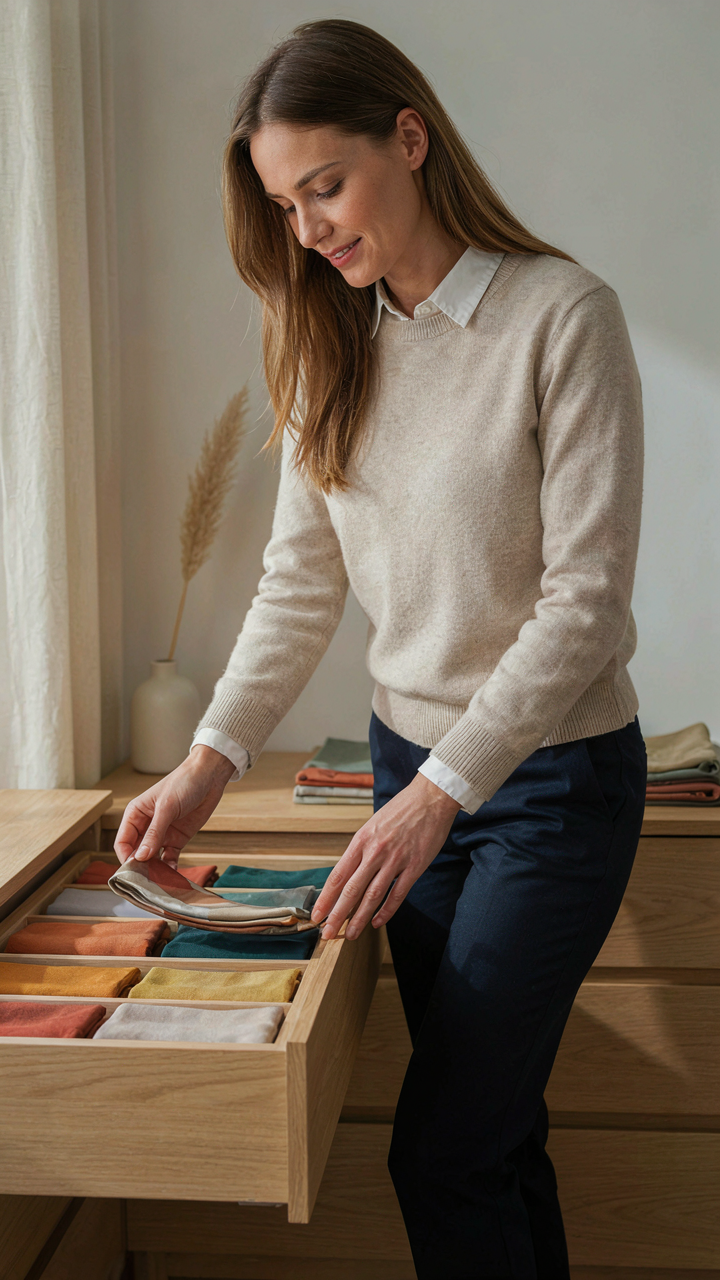
You’re afraid of buying a whole new wardrobe when seasons change. That’s the real problem here. The mechanism is modular construction: preppy autumn outfits work because they stack existing pieces rather than replace them. A cotton oxford under a wool sweater vest under a blazer isn’t layering for warmth—it’s financial efficiency dressed as style. You already own these items.
Build your autumn system around what you have now. That cream blouse works in July and October if you add a structured cardigan or a heritage-weight sweater. The navy trousers transition through seasons when paired with different tops and outerwear. Vertical stacking means you control the visual weight and temperature without shopping. This is inventory management applied to your closet.
Fabric Weight And Fiber Content
Texture signals luxury because raw material cost determines durability and feel. Merino wool costs more than acrylic because it regulates temperature and lasts years. Linen blends offer the preppy aesthetic while performing better than pure linen in unpredictable fall weather. Cotton-wool blends give you the crisp preppy structure without brittleness. The fiber drives the outcome, not the brand name.
- Merino Wool Cardigans: Breathable, temperature-regulating performance fiber that prevents the itching associated with standard wool. Holds shape through multiple seasons and washes.
- Cotton Oxford Cloth: Tightly woven fibers create natural structure. Autumn versions come in heavier weights that drape differently than summer shirts.
- Wool Blend Trousers: 70-80% wool with synthetic fibers adds durability and reduces wrinkles. Maintains the crisp preppy silhouette through repeated wear.
- Linen Cotton Blends: Pure linen wrinkles aggressively in variable humidity. Blending reduces this while keeping the breathable hand feel preppy outfits require.
- Cashmere Layering Pieces: Expensive but compressible. A single fine-gauge cashmere sweater replaces three standard cardigans in autumn rotation.
Autumn transitions demand intentional fiber selection because fall weather moves between temperatures hourly. You need pieces that perform across 45 to 65 degrees, not just look right. Touch the fabric before buying. Weight and drape matter more than color in seasonal pieces because they determine whether the outfit works on October 15 and November 2.
The Preppy Lifestyle Aesthetic Is A Choice, Not A Birthright

Excellence Through Deliberate Curation
You want this section because you suspect preppy style requires inherited wealth or social access you don’t have. That’s the fear talking. The mechanism is simpler: preppy aesthetics work because they encode restraint and intention into every choice. Restraint signals discipline. Discipline signals competence. You build this by treating your wardrobe like a finite system where each piece earns its place through repeated use and clear purpose, not through volume or trend chasing.
Curated excellence means owning fewer pieces that work together across contexts. A structured blazer functions in three settings. A quality oxford shirt layers under sweaters and stands alone. Neutral colors multiply outfits without multiplication of items. This isn’t about buying expensive things. It’s about buying things that compound in utility. When you choose a cream linen blend over a synthetic blend, you’re not buying status. You’re buying a garment that holds structure, breathes differently, and looks intentional after five wears instead of three. Every decision follows the same logic: does this expand what I can wear it with, or does it sit alone?
Taste As A Measurable Skill
Taste is not innate. Design and architecture schools teach it as a discipline, breaking it into contrast, proportion, repetition, and balance. You can train taste by studying how established preppy pieces combine—not to copy them, but to understand the underlying system. A well-fitted sweater next to a structured collar creates visual contrast. A midi skirt paired with a fitted top demonstrates proportion. Repeating a neutral palette with one intentional accent shows restraint. These are skills you develop through observation and deliberate repetition, the same way you develop any other skill.
Refine your taste weekly by assessing one worn outfit against these principles. Did the proportions work? Did the colors create contrast or muddy together? Did you reach for that piece again? Build a feedback loop. Document what you wore, how it performed, and whether you’d combine those items again. Over months, patterns emerge. You stop guessing. Your instincts become reliable because they’re based on data, not on what Instagram suggests is preppy this season. The goal is to reach a point where every outfit you build reflects a principle you chose, not a trend you followed.
The Only Outdated Aesthetic Is One You Passively Consume

Most women treat preppy outfits like museum pieces, copying exactly what they see. That’s the trap. The real move is stealing the framework and bending it to your life. Pull a vintage blazer, throw it over something nobody expects, own it like you designed the rule yourself. Stop asking if preppy still works. Start asking what preppy becomes when you refuse to follow the template. The clothes don’t make you credible. Your conviction does.