

The Law Of Inverse Proportionality: Less Choice, More Impact

Why Abundance Destroys Coherence
You want to believe more options make you more stylish. They don’t. In physics, inverse proportionality describes how two variables move in opposite directions: as one increases, the other decreases. Your wardrobe operates the same way. More pieces dilute signal. More colors scatter attention. More silhouettes prevent the eye from landing on what matters. A spring capsule of five neutrals worn across twelve pieces broadcasts identity. Fifty pieces across twenty colors broadcast confusion.
The mechanism is neurological, not aesthetic. Your brain processes visual information by detecting patterns and repetition. Abundance breaks pattern recognition. When someone sees you in the same soft beige linen shirt three times in two weeks, they register consistency. That consistency reads as intentional. Intentionality reads as authority. This is why people who wear limited palettes appear more deliberate, not more boring.
Fatigue Breeds Passivity, Not Freedom

The common narrative says choice equals empowerment. Wrong. Psychologists documented this years ago: unlimited options create decision paralysis and buyer’s remorse. You stand in front of a full closet and feel less confident, not more. You waste mental energy deciding between acceptable outfits instead of deploying that energy elsewhere. Spring minimalism solves this by establishing hard constraints before the season starts.
When you own three base layers, two outer pieces, and four bottoms in aligned neutrals, the outfit writes itself. You don’t decide; you execute. This frees your attention for what actually matters: how you move, how you carry yourself, how you show up. The person who spent five minutes assembling clothes arrives at the room present. The person who spent thirty minutes choosing between similar cardigans arrives depleted. Build your spring wardrobe so small that getting dressed requires zero willpower, then direct that willpower toward presence.

The ‘Over Tshirt Outfit’ Fallacy: Beyond Basic Layering

Layering For Control, Not Coverage
You want layering to signal you have your life together without trying hard. Here’s the real mechanism: layering is about compression and hierarchy, borrowed from information design. Just as dense information requires structure to avoid chaos, your outfit requires intentional depth to avoid looking accidental. Most people throw a shirt over a shirt and call it done. That’s not layering. That’s stacking.
Strategic layering means each piece compresses visual weight downward or creates defined zones. A linen overshirt worn open over a fitted base establishes authority through proportion, not bulk. The fabric weight matters more than the color. A heavyweight linen or cotton blend worn loose creates the silhouette. A lightweight layer worn fitted creates definition. The order you wear them determines whether you look composed or confused.
Texture Builds Depth Without Color
Forget the idea that minimalist means monochrome boredom with no dimension. That advice misses the actual tool: texture creates visual authority that color cannot. Raw linen reads differently than smooth cotton at the same neutral tone. Linen has inherent texture from its weave. Cotton twill has structural ridges. Wool jersey has brushed surface. Your eye registers these differences before it registers a color shift.
The mechanism is simple: contrasting textures create intentional contrast where color adds nothing. Pair a smooth cream silk base with a raw linen overshirt in the same cream tone. The outfit reads as deliberate composition, not default blandness. Silhouette amplifies this effect. A structured overshirt worn open over a slim base creates visual rhythm through shape hierarchy. Texture and silhouette together signal you understand how clothing works, which is the actual goal of minimalist spring outfits.
The Business Minimalist Outfits Code: Professionalism Without Pretense

Restraint As A Signal Of Control
You want people to assume you have authority without you having to announce it. That’s the real move here. In semiotics, the study of signs and meaning, restraint functions as a high-confidence signal. A soft neutral palette in business contexts communicates that you don’t need visual noise to establish presence. The absence of pattern, excess color, or trend-chasing reads as decision-making power. Beige, cream, warm gray, and muted taupe don’t whisper they roar through silence.
This works because the brain processes visual information in layers. Busy outfits demand explanation and justification. Restrained ones demand nothing and therefore project self-sufficiency. A cream linen blazer over a warm gray knit and neutral trousers stops conversation at competence. You’ve removed the variables that make people question your judgment. That’s not boring. That’s operational.
Authenticity Over Armor
Everyone gets this wrong. The common advice says wear neutral business clothes to “blend in” or “look professional.” That’s the costume trap. Real gravitas comes from wearing neutrals because they align with how you actually move through the world, not because you’re hiding behind a uniform. The difference is invisible but it broadcasts everything.
When your minimalist spring outfit reflects genuine preference rather than defensive strategy, people sense the difference immediately. A person wearing a soft neutral palette because they’ve eliminated decision fatigue reads differently than someone wearing it because they think they should. The first person owns the room. The second person apologizes for existing in it. Build your spring wardrobe around pieces you’d actually choose, then let neutrals amplify that authenticity instead of obscuring it.
The Classy Dressed Woman’s Gambit: Soft Neutrals As Strategic Camouflage

Why Soft Neutrals Dissolve Social Friction
You want people to trust you without knowing why. Soft neutrals work because they trigger zero cognitive load in the viewer’s brain. Color psychology isn’t mystical—it’s basic neuroscience. When someone sees beige, cream, or warm gray, their amygdala doesn’t fire. No alarm. No judgment. The brain categorizes the outfit as “safe” before it processes anything else about you. This is the mechanism most fashion advice skips. It’s not about looking good. It’s about removing obstacles to being heard.
Soft neutrals function like a social lubricant because they create agreement instead of debate. A bold red or statement pattern forces the viewer to have an opinion about your clothes. Now they’re distracted. Your words compete with their aesthetic judgment. Neutrals do the opposite—they become invisible. The attention stays on your face, your competence, your actual presence. When you wear a cream linen shirt and taupe trousers, you’re not dressing down. You’re strategically removing the noise so only your substance registers.
The Effortlessness Illusion That Actually Works
The halo effect isn’t about deception—it’s about baseline expectations. Psychology research shows people automatically assign competence and intelligence to individuals who appear to have exerted minimal effort in their appearance. This seems backward until you understand what effortlessness signals. It signals you don’t need to try hard because you already know what works. Soft neutral minimalist spring outfits activate this effect instantly because they read as intentional restraint, not limitation.
The real play is making this effortlessness deliberate without showing the work. A cream sweater, linen pants, and white leather sneakers should look thrown together in 60 seconds. Behind that lies curation—knowing exactly which neutrals work with your skin tone, which fabrics drape without wrinkling, which pieces combine into ten different outfits. Build your spring neutral base by selecting three anchor pieces: one cream piece, one warm taupe, one soft gray. Wear them in rotation so often they become your uniform.
The Daily Spring Outfits Protocol: Building A Modular System
Interchangeable Pieces Over Trends
You want permission to stop thinking about what to wear. That’s the real reason you’re reading this. Systems give you that permission by removing decisions, not multiplying them.
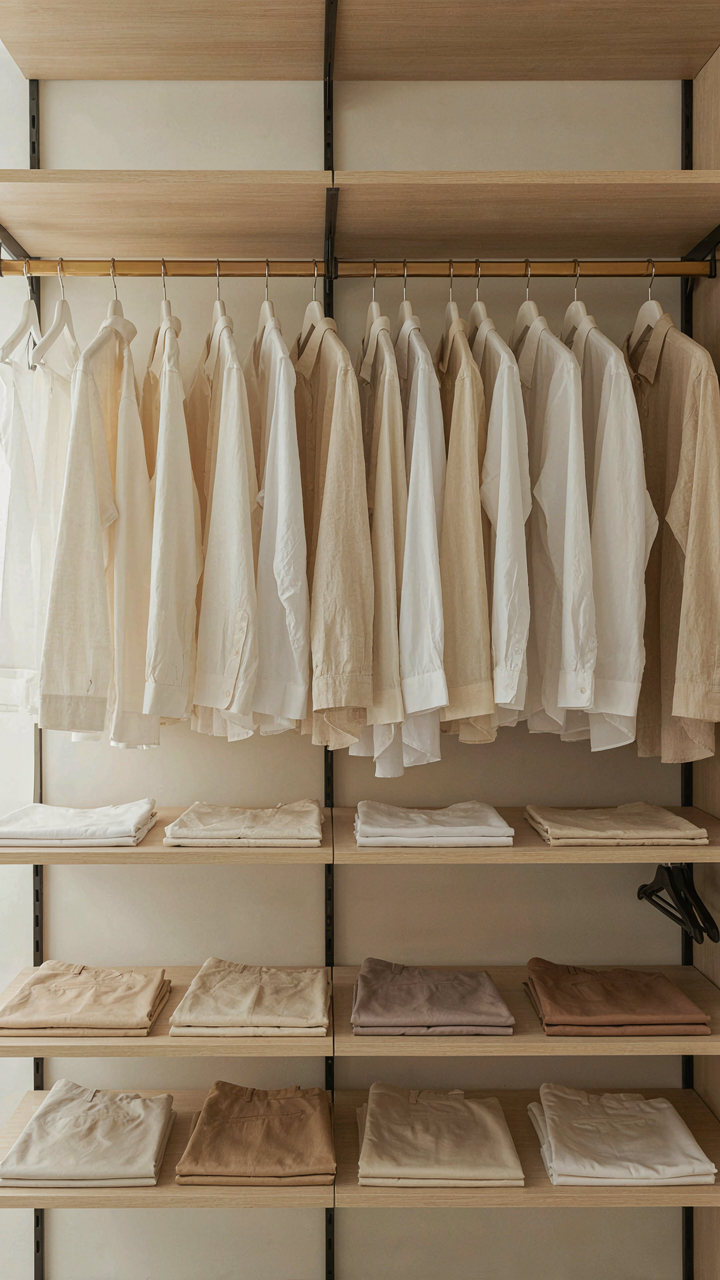
In engineering, interchangeability means one part functions across multiple assemblies without modification. Your spring wardrobe works the same way. A cream linen shirt pairs with tailored trousers, wide-leg pants, and linen shorts. The same oatmeal knit works over a slip dress or alone. This isn’t clever styling. It’s deliberate constraint. Every piece must earn its place by working with at least three other items already in rotation.
- Cream or ivory base layers: Linen shirts, cotton tees, lightweight sweaters that layer under or over other pieces without bulk or visual weight.
- Neutral bottoms in two weights: Lightweight trousers for warm days, structured shorts, and one pair of wide-leg pants in matching neutral tones.
- Single cardigan or overshirt: Beige or warm gray linen or cotton blend that extends temperature range without adding visual noise to the outfit.
- Slip dress or neutral maxi: Functions as standalone piece, layering base, or alternative to typical bottom in monochromatic combinations.
- Structured accessories: Minimal belt in matching neutral, simple tote bag in natural material, flat shoes in one or two neutral shades.
The mechanism is velocity. When every piece connects to every other piece, you move from closet to exit in under five minutes. No mental math. No outfit fails. This isn’t minimalism for aesthetics. It’s minimalism for function.
The Fastest Route To Getting Dressed
Most advice says “lay out your outfit the night before” or “create a mood board.” That’s friction disguised as preparation. The real critical path is simpler and invisible.
Your brain only processes outfits you can actually build. When you own eight pieces that form forty combinations, decision fatigue vanishes. You don’t think. You grab the lightest piece, the middle-weight piece, and the bottom. Spring outfits assemble themselves because the system eliminates wrong answers. No clashing. No temperature mismatch. No piece that sits unused because it doesn’t coordinate.
The protocol is immediate: open your closet and choose one item from each category (base layer, outer layer if needed, bottom, shoes) in your neutral palette. That’s the outfit. The speed comes from knowing your categories are pre-built. You never ask “what goes with this.” You ask “which option from each slot today.” This distinction collapses decision time from fifteen minutes to ninety seconds.
Relaxed Professional: The ‘Soft Jeans Outfit’ As An Edge

Casual Staples Work Harder Dressed Up
You want permission to dress down without losing authority. The mechanism is simple: soft jeans become professional when paired deliberately, not assembled by accident. Dark indigo or warm gray jeans in natural fibers signal intention. Pair them with a linen shirt or lightweight wool knit in cream, oatmeal, or sage. The fit matters more than the label. Slightly tapered through the leg, mid-rise, no distressing. This combination reads as someone who chose restraint, not someone who ran out of clean clothes.
The psychological shift happens because soft jeans lack the visual weight of structured trousers or the casual signal of typical denim. Borrowing from information design, think of them as medium gray: they carry no strong signal in either direction, so context determines meaning. A cream linen shirt transforms them into warm professionalism. Loafers or minimal sneakers in soft leather finish the outfit. The result feels intentional because it is. You’ve eliminated visual noise, which reads as competence in any environment where people notice what they wear.
Deconstruction Through Constraint
Most advice about mixing casual and professional treats it as a styling problem. It is not. It is a subtraction problem. Deconstruction in design means removing elements until only the functional structure remains. Your outfit should do the same. Start with one neutral base color for jeans and shirt. Add a single layering piece: an oversized linen blazer, a lightweight cardigan, or a minimal canvas jacket. Stop. No belts, no jewelry beyond a watch, no patterns. The outfit works because you have eliminated the visual decisions that make people unsure how to read you.
The constraint forces coherence. Soft jeans in warm taupe paired with a cream linen shirt and a natural wool overshirt creates visual continuity, not contrast. Your eye moves across the outfit without stopping. This is the opposite of what most people try to do, which is add pieces until they look complete. The real mechanism: fewer elements, higher quality each, creates the impression of sophistication faster than complexity ever will. Choose three colors maximum, all soft. Choose natural fibers. Choose fits that skim the body. That is the protocol.
Office Outfits Women Summer Classy: The Unseen Details Of Distinction

The Fabric Decision That Changes Everything
You’re worried people won’t notice you spent money. That’s the trap. The mechanism is simple: cheap fabric reads as cheap fabric, and no amount of styling fixes it. Borrowed from materials science, we call this the concept of “hand”—the tactile weight and drape of cloth determines how it sits on your body before anyone sees the label. Linen, cotton blends, and high-quality wool gabardine have density. Fast-fashion synthetics collapse. In spring minimalism, fabric quality does the work branding pretends to do.
Most people reverse-engineer outfits from the brand name backward. Wrong. Start with fiber content and weight. A 100-percent linen blazer in cream costs less than a polyester one at a luxury brand, drapes with actual structure, and breathes in heat. The difference compounds across your whole wardrobe. When every piece has real weight and movement, the outfit looks intentional instead of assembled. That’s not status signaling. That’s the material working.
Restraint As The Punctuation Mark
Accessories aren’t decoration. They’re editing. Most minimalist advice says “add one statement piece,” which is vague garbage that leads nowhere. The real mechanism: accessories function as interruption points for the eye. Syntax uses punctuation to control where readers pause and how they absorb meaning. Your outfit needs the same discipline. A single linen scarf, a minimal leather belt, or one pair of earrings doesn’t add detail—it creates a focal point and tells the eye where the outfit ends.
The mistake is thinking more restraint means more invisibility. It doesn’t. Strategic placement makes pieces louder. A cream linen shirt paired with nothing reads as incomplete. Pair it with a narrow belt in natural leather and the shirt becomes intentional. That belt says you chose this. It’s the pause in the sentence. Remove everything else and wear exactly that combination for a week. You’ll recognize when an accessory is working versus when it’s habit.
The T Shirt Classy Outfit Paradox: Redefining Understated Elegance

The Foundation Fabric That Does The Work
You want people to register that you have taste without announcing it. That’s the real reason you’re reading this. The mechanism is simple: a t-shirt becomes a foundation garment the moment you stop treating it as filler. In minimalist spring outfits, the t-shirt functions like load-bearing architecture in structural engineering. It must carry visual weight without bulk. Weight here means density of intention, not mass.
Most people grab whatever cotton blend hangs in their closet. Wrong move. Fabric weight matters more than brand. A 180 to 200 gsm cotton t-shirt holds shape and reads intentional. Lower weights collapse into formlessness. The weave structure—how threads interlock—determines drape and longevity. Pima or supima cotton holds these properties longer than standard cotton. A well-chosen t-shirt in ivory, stone, or warm white becomes invisible infrastructure that makes everything layered over it perform better.
Texture Stacking Without Clutter
The common advice says “add layers.” That’s lazy. Adding layers randomly creates visual noise, not sophistication. Strategic pairing means choosing secondary pieces based on surface contrast and weight distribution. A linen overshirt over a dense cotton tee creates distinction through texture alone. The eye registers two different materials, which reads as intentionality.
Neutral soft tones eliminate color as a distraction variable. This forces texture to do the work. Pair the foundation t-shirt with a lightweight linen jacket, an unstructured cardigan, or a tailored blazer in a complementary neutral. The pieces must sit at different distances from the body to create visual separation. A fitted tee under a loose overshirt works. A fitted tee under fitted layers reads costume. The rule: one fitted, one loose. Measure the silhouette before you purchase.
Minimalistic Business Casual Outfits: The Long Term Investment

The Math Behind What You Actually Wear
You want permission to spend more upfront without feeling guilty. Here’s the mechanism: cost per wear divides total price by actual usage. A 200 dollar cream linen blazer worn 120 times across three springs costs 1.67 dollars per wear. A 60 dollar fast fashion piece worn twice costs 30 dollars per wear. The expensive piece wins mathematically, and you stop lying to yourself about what “investment” means.
Soft neutrals compound this advantage because they pair with almost everything in your closet. You wear them more frequently, which lowers cost per wear faster than trendy colors ever could. Beige, cream, and warm gray aren’t boring. They’re compression algorithms for your wardrobe. The math forces a simple choice: buy pieces you’ll actually rotate, or keep buying garbage you wear once.
Quality That Refuses To Age Into Irrelevance
The consensus advice says “buy classic pieces.” Wrong. Classic is a meaningless word that changes every five years. What matters is material durability combined with structural design that doesn’t collapse. Linen softens with washing but never tears. Cotton blends lose shape. Wool holds structure for years if you care for it properly.
Business casual in soft neutrals survives because the silhouette is already neutral. A cream wool trouser with a straight leg won’t look dated in two years because it has no silhouette gimmick to become dated. You’re not fighting fashion cycles. You’re building a wardrobe that becomes more functional as it ages, not less. Start here: identify three core pieces, buy the highest linen or wool content you can afford, and stop shopping for six months.
The Real Obstacle Isn’t Finding The Perfect Neutral; It’s Your Fear Of Standing Out By Refusing To Chase Fleeting Trends

You already know what works. A cream linen shirt. Taupe trousers. White sneakers. The discomfort you feel isn’t about the outfit, it’s about appearing invisible in a world that rewards loud consumption. Stop waiting for permission to dress like you have taste instead of a shopping addiction. Today, delete one trending item from your cart and replace it with something you’ll wear in five years. That’s how you actually stand out.