

The Illusion Of “Minimalist” Clothing: Why Less Isn’t Always More

Scarcity As Strategy, Not Virtue
You want minimalism to feel like a moral choice because that makes your closet feel intentional instead of empty. Here’s the mechanism: scarcity signals restraint, which reads as taste. But Korean minimalist fashion doesn’t work through deprivation. It works through edited repetition with strategic texture and cut variation. The “less is more” framework collapses the moment you own three identical white shirts in different fabrics. That’s not scarcity. That’s precision.
Most minimalism advice treats clothing like mathematics: fewer items equals better results. Wrong. Korean designers understand that minimalism is about removal of decision friction, not removal of clothes. A person wearing five carefully chosen pieces rotated through seasons makes fewer decisions than someone with fifty random items. The strategy isn’t counting pieces. It’s eliminating options that don’t compound in your daily rotation.
Beyond Neutral: Color As Constraint

Color palette strategy in Korean minimalism borrows from graphic design’s concept of positive and negative space, which creates hierarchy through absence rather than decoration. The common advice says stick to beige, white, and black. This is lazy interpretation. Korean minimalist fashion uses intentional color palettes that repeat across seasons, usually built on one or two core tones plus white or cream. Think deep navy with white, or warm gray with charcoal. The constraint isn’t the palette’s size. It’s the palette’s consistency.
Brands like Uniqlo and COS built their model around color repetition across categories. A cream overshirt pairs with cream basics, not by accident but by system. When you buy into a palette, every new piece connects to existing pieces without negotiation. The mechanism is simple: limit your palette to what exists in your closet already, then add only pieces that work with that palette. This prevents the slow drift into chaos that kills most minimalist efforts.

The Korean Minimalist Outfit Matrix: Deconstructing Versatility

Core Pieces As System Components
You want to believe you need fewer clothes. What you actually want is permission to stop deciding. The mechanism behind Korean minimalism isn’t reduction—it’s constraint-based design. Think of it as applied systems theory: you’re building a closed loop where each piece functions as both a standalone unit and a connector to other units. Korean designers borrowed this from industrial efficiency, not fashion tradition.
The baseline pieces work like load-bearing walls in architecture. A cream linen shirt, black wool trousers, a camel coat, and white sneakers aren’t suggestions—they’re structural elements. Each one solves a specific function: layering, proportion, warmth, grounding. Remove one and the system collapses. The Korean approach demands you choose pieces that earn their place through multiple roles, not through visual interest. This eliminates the false choice between “having options” and “getting dressed quickly.”
Modular Design For Infinite Combinations
Most advice on outfit building treats combinations like math problems. Wrong. The real constraint is cognitive load, not wardrobe size. Korean minimalism solves this by establishing color anchors and proportion ratios that work across most pairings without requiring thought. A neutral base layer plus one accent piece plus one outerwear layer creates a decision tree with legitimate endpoints, not infinite paralysis.
The modularity works because Korean minimalist pieces follow a grammar: neutral fabrics in winter weight or linen, consistent proportions across silhouettes, and a maximum two-tone palette per outfit. You don’t mix textures recklessly or stack unexpected volumes. When you pair a straight-leg pant with a fitted top and an oversized coat, those three pieces were designed to speak the same language structurally. The number of viable combinations matters less than the reliability of every combination working. Your protocol: establish your three anchor colors, then buy pieces only in neutral shades or those three anchors, ensuring sleeve length and rise measurements stay consistent across brands.
Beyond Trends: The “Investment Principle” Of Korean Fashion Casual

The Math Behind Each Piece
You want permission to spend more on fewer items without feeling guilty about it. Here’s the mechanism: economics calls this cost per wear, and Korean minimalist fashion is built on it. You buy one $180 linen shirt and wear it 120 times over two years. That’s $1.50 per wear. You buy ten $25 fast fashion shirts and wear each five times. That’s $5 per wear. The expensive piece costs less in actual use. Stop thinking about price tags. Start tracking how many times something will leave your closet.
Korean brands engineer this math into design. A neutral oversized shirt in natural linen pairs with twenty different bottoms. The same shirt works in summer and layered in autumn. This isn’t accident. The minimalist constraint forces designers to build pieces that compound in value through versatility. Each additional outfit you create with that shirt cuts the cost per wear further. The formula doesn’t reward buying more. It rewards buying smarter.
Quality Becomes The Only Variable
Everyone says quality matters. That’s lazy. Here’s what actually happens: a natural fiber garment from a Korean minimalist brand maintains its structure because the material itself resists degradation. Linen strengthens when washed. Unbleached cotton develops character while holding its shape. A $40 synthetic shirt loses elasticity in the shoulder seam after thirty wears. A $120 linen shirt from a Seoul-based minimalist line gets better with use because fibers compress and soften without breaking down. The quality difference isn’t aesthetic. It’s durability stacked on top of design efficiency.
The return accelerates over time. In year one, that expensive piece justifies itself through cost per wear. In year two and three, it still holds color and fit while cheaper alternatives have moved to the back of the drawer. Korean minimalist fashion wins because it strips away decoration that deteriorates and leaves only construction that lasts. Your decision point isn’t whether to spend more upfront. It’s whether you want to buy the same item three times or buy it once and wear it for years. The math solves itself when you measure wear, not wallet sting.
Deceptive Simplicity: The Korean Street Fashion Layering Strategy

Texture And Proportion Work Harder Than Color
You want people to notice you’re put together without appearing like you tried. That’s the real game. Korean minimalism doesn’t flatten outfits into monochrome boredom because it uses fabric weight and silhouette variance as its primary tool, borrowing from architecture’s load-bearing principle: each layer must support the visual structure without adding unnecessary mass. A linen overshirt worn open over a fitted tee creates dimension through density difference, not color contrast. The fitted piece anchors; the loose piece frames.
Proportion stacking is mechanical. Tight on top, straight on bottom. Oversized cardigan, tapered trousers. Wide pants demand a tucked or cropped top to prevent visual collapse. Korean streetwear prioritizes this balance because it works across body types and doesn’t require expensive fabrics to read as intentional. The texture interplay between a matte cotton base and a subtle sheen overshirt signals control. Most Western minimalism fails here by assuming “less” means “flat.” It doesn’t.
The Unsung Third Layer
Adding a third piece isn’t decoration. It’s the difference between looking underdressed and looking deliberate. The common advice says “keep accessories minimal,” which misses the actual mechanism: the third piece solves proportion problems the first two layers create. A structured vest over a oversized sweater and slim pants doesn’t add busyness; it creates a defined silhouette that reads as intentional rather than accidentally loose.
Korean designers treat the third layer as a proportion corrector, not an afterthought. A simple linen jacket over basics doesn’t clutter the outfit; it creates a vertical line that lengthens the frame. The key is material restraint: linen, cotton canvas, or unstructured wool. Avoid texture saturation. One textured piece per outfit maximum. When you introduce the third layer, you’re not styling; you’re solving a structural problem the first two pieces revealed.
The Adaptive Wardrobe Protocol For Minimalist Outfits Women

Design Within Your Climate Boundaries
You want a wardrobe that works everywhere so you never have to think about getting dressed, but that’s actually the constraint that breaks most minimalist systems. Korean minimalist design treats climate like structural engineering treats load capacity: not as a problem to hide, but as the defining parameter that shapes everything else. Winter in Seoul demands different fabrications than summer. You don’t fight this. You design around it.
The protocol starts by mapping your actual climate across seasons, not months. Winter requires weight retention and layering compatibility. Summer requires breathability without bulk. Spring and fall are transition zones where overlap matters. Korean brands like Uniqlo and COS engineered this years ago by building base layers, mid-layers, and shells that stack without adding volume. You pick materials first, silhouettes second. Cotton and linen for warm months. Merino or wool blends for cold. This determines everything downstream, not the other way around.
Outfit Formulas For Real Situations
Most advice about minimalist capsules is useless because it ignores context. You don’t get dressed for an abstract “day.” You get dressed for a specific friction point: work meetings, grocery runs, coffee with someone who matters, gym commute, casual dinner. Korean minimalism solves this by building outfit recipes with clear input variables, not vague suggestions about “mixing pieces.”
- Work Professional: White or cream shirt, tailored trousers in navy or black, structured tote, minimal jewelry. One pair of flat shoes or loafers. This combination works across corporate and creative environments because it reads neutral without appearing unfinished.
- Weekend Casual: Fitted straight-leg jeans, oversized plain tee tucked in, canvas sneakers, thin belt. Outerwear is a simple overshirt or unstructured blazer. The formula prevents looking like you tried too hard or didn’t try at all.
- Layered Transit: Base layer plus button-up shirt you can remove, paired with clean trousers or dark jeans. Minimal pockets matter here because you’re moving between environments. The outfit adapts without requiring a bag change.
- Evening Compact: Black or neutral dress, simple shoes, one jewelry piece. This works because Korean minimalism abandons the idea that minimal equals casual. Clean silhouettes at night signal intention more than decoration.
- Gym To Errands: Matching set in neutral tones, minimal-branding sneaker, simple outerwear layer. The formula lets you move directly from activity to public space without stopping home. Coherence comes from color blocking, not matching logos.
The protocol isn’t a grid to memorize. It’s a decision tree you build once, then execute without friction. You identify your actual life contexts, not theoretical ones. Then you create a 2-3 outfit template for each. Materials, fit, and color stay consistent so you can mix components. This is how Seoul’s working professionals maintain minimalist closets without appearing repetitive. The system absorbs variation while maintaining visual economy.
Accessories As Multipliers: The Leverage Of Korean Outfit Ideas

Where You Direct The Eye
You want accessories to feel effortless because you’re afraid if people see you thinking about them, the whole minimalist thing collapses. Here’s the mechanism: in Korean minimalism, accessories function like focal points in composition. They interrupt negative space. A single silver ring on a neutral outfit doesn’t add clutter—it anchors attention exactly where you choose. This is precision, not decoration. The Bauhaus principle applies here: every element earns its place by controlling sight lines.
Korean fashion designers use this strategically. A structured bag in matte finish pulls focus downward, grounding a simple top and pants. A delicate bracelet draws eyes to your wrists, breaking the monotony of a monochrome sleeve. The real work happens before you wear it: deciding which body area deserves visual weight. Most people load accessories randomly and wonder why they look busy. Korean minimalist outfits work backward—they identify the focal point first, then place one accessory there.
The Arithmetic Of Strategic Addition
Common advice says “add one statement piece” and calls it done. That’s incomplete. The real mechanic is substitution, not addition. You’re not layering accessories onto a base outfit. You’re replacing visual complexity in fabric or cut with visual interest in hardware or material. A plain white shirt plus three rings equals the same visual weight as a textured shirt plus no rings. The math stays constant. What changes is where the eye lands and how intentional it feels.
This is why Korean minimalist fashion often pairs bare wrists with a deliberate bag, or nude tones with metallic jewelry—never both simultaneously. The constraint creates clarity. Test this: wear your neutral base with zero accessories for a baseline. Then add only metal accents. Notice how the outfit sharpens without feeling cluttered. That’s the mechanism. One strategic addition replaces ten pieces of visual noise.
The Psychology Of Uniforms: Why Minimal Fashion Reduces Decision Fatigue

Your Brain Is Hemorrhaging Energy On Clothes
You want permission to stop thinking about what you wear because you’re tired of being tired. Here’s the mechanism: biology treats decision-making like physical exertion. Your brain consumes glucose and oxygen proportional to the number of choices you process. Korean minimalist fashion operates on the same principle as military uniform protocol—you remove variables from the equation so the system preserves resources for work that matters. When your closet shrinks to a coherent palette, your prefrontal cortex doesn’t activate the same neural pathways it does when facing fifty options.
The science here isn’t controversial. Decision fatigue is documented across neuroscience and behavioral economics. You make roughly 35,000 decisions daily. Most are trivial. Most drain the same limited pool of executive function you need for actual priorities. A uniform—whether Steve Jobs’ black turtleneck or a Korean minimalist’s rotation of neutral basics—isn’t about aesthetics. It’s resource allocation. The brain stops parsing outfit combinations and redirects that computational power elsewhere.
The Mechanism Behind Reduced Cognitive Load
Most fashion advice tells you to “simplify your wardrobe” without explaining what happens neurologically when you do. The real mechanism operates in your working memory. Your working memory can hold approximately three to four distinct items simultaneously before it starts collapsing under load. Korean minimalist design respects this constraint by creating outfits where each piece is interchangeable across multiple combinations.
When you own twenty neutral basics instead of two hundred varied pieces, your morning decision tree flattens dramatically. You’re not choosing between styles, eras, or brand aesthetics. You’re selecting from a constrained set of silhouettes and colors that function as a system. This isn’t boring. This is efficiency. The reduction in choice architecture means your decision-making shifts from conscious deliberation to automatic pattern recognition, freeing up roughly 15 to 20 minutes of daily cognitive bandwidth and approximately 10 to 15 percent of the glucose your brain burns on trivial decisions.
Curating Your Korean Casual Outfits: The “Elimination Diet” Approach
What You Actually Own Versus What You Wear
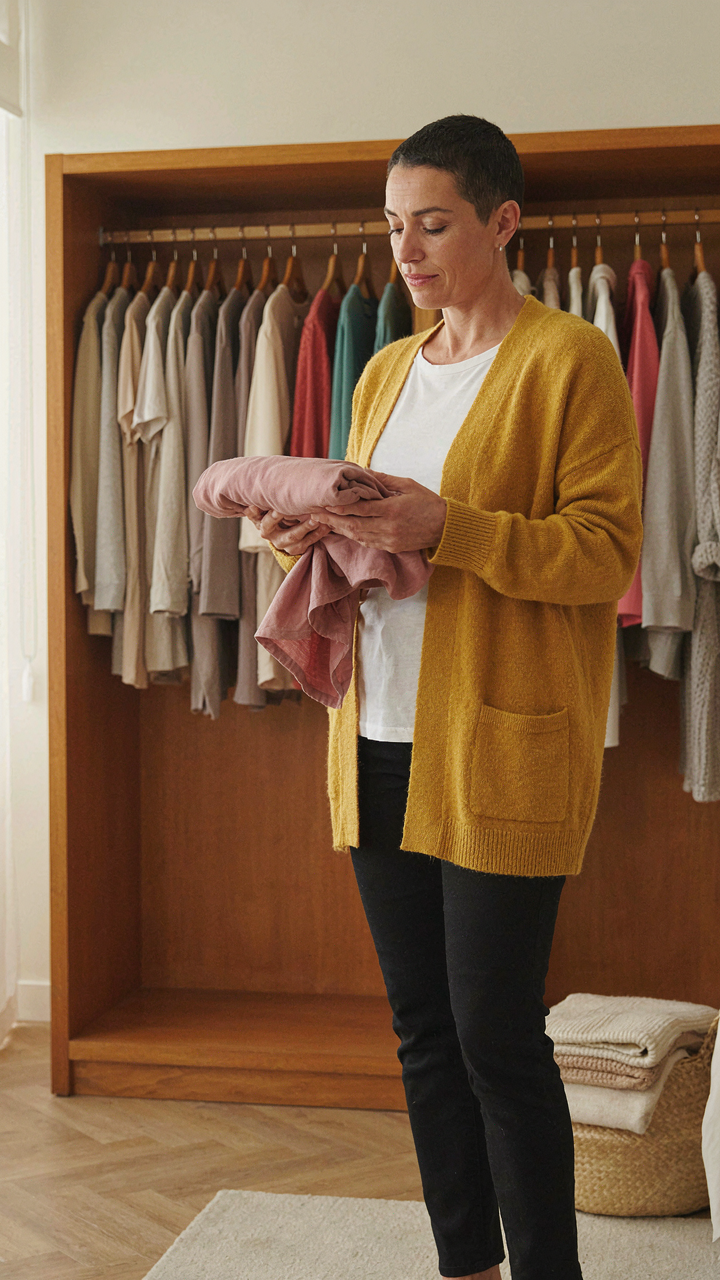
You’re hoping a wardrobe audit will solve your decision paralysis without forcing you to confront how much money you wasted on things that don’t work. Here’s the mechanism: Korean minimalism works because it operates on subtraction, not addition. Most Western wardrobes expand until they collapse under their own weight. You own pieces that cancel each other out, colors that fight, and fits that require mental gymnastics to wear. The real work isn’t finding new items. It’s identifying which existing pieces create friction in your daily routine.
Go through everything you’ve worn in the past month. Not what you intended to wear, but what actually made it onto your body. Separate those pieces into one pile. Everything else is dead weight. Dead weight items share a pattern: they require styling decisions, they don’t pair with your regular rotation, or they sit in a mental “maybe someday” category. Korean minimalist fashion removes the maybe. Every piece in your active wardrobe should work with at least three other pieces without thought. If a shirt requires perfect conditions to function, it’s gone.
When To Strip Your Closet Back Down
The common advice here is wrong: seasonal purges happen once a year and feel like a project. That’s not how Korean minimalists actually maintain their wardrobes. Think of it like enzyme saturation in biochemistry, where optimal function requires the right amount of material at the right density, not maximum accumulation. When your active wardrobe sits between 25 and 40 core pieces, you reach the threshold where you can dress intentionally without decision fatigue. Seasonal purges aren’t annual events. They’re maintenance cycles triggered when you can’t find what you want to wear.
- Spring refresh (March-April): Remove winter layering pieces that don’t work in mild temperatures. Korean spring fashion moves toward unlined linen and open silhouettes once average temperature hits 15°C.
- Summer edit (June): Pull out pieces that absorbed odor during warm months or show visible wear. Minimalist summer wardrobes shift toward breathable fabrics and neutral tones that won’t show sweat marks.
- Fall integration (September): Add back structured layers and closed silhouettes. Test pieces from storage before fully committing them to rotation.
- Winter consolidation (November): Remove anything that pilled, faded, or didn’t earn its place. Korean winter minimalism emphasizes quality outerwear over quantity.
- Mid-season culls: After two weeks of constant wear in any season, remove items that didn’t make the cut. Real preference reveals itself through repeated choice, not intention.
The mechanism is this: you purge when your closet stops serving you, not on a calendar date. Mark the moment you’ve opened your closet three times in a week and couldn’t find something that worked. That signals bloat. Remove one item per wearing session until you can dress in under five minutes without second-guessing.
The Real Power Of Less: Beyond Outfit Minimalist Aesthetics

Your Wallet Stops Bleeding When You Stop Looking
You think you want minimalism for aesthetic reasons. You don’t. You want it because spending money on clothes you don’t wear creates financial drag you feel but can’t name. Economics calls this the sunk cost fallacy, but Korean minimalism operates on the inverse principle: acquisition restraint compounds. Every piece you don’t buy is money that stays deployed toward actual wealth.
The mechanism is simple. A Korean minimalist wardrobe enforces a hard ceiling on impulse purchases because there’s no room for them. Your closet isn’t a display case for indecision. You own beige, black, white, and grey basics in natural fibers. You add one quality piece per quarter maximum. The friction of “does this fit my existing palette” kills 90 percent of checkout clicks. You save money not through willpower but through architecture.
Attention Becomes Your Scarcest Asset
The common take on minimalism is that fewer clothes reduce decision fatigue. Wrong. The real mechanism is that you free up mental bandwidth from managing surplus. Neuroscience calls this cognitive load reduction, and a Korean minimalist closet eliminates it by design. When you own 40 pieces instead of 140, you stop thinking about your wardrobe and start thinking about work that matters.
Every item in a minimal wardrobe earns its place through utility and coherence. You don’t browse your closet wondering what works. You reach for what functions. This isn’t about feeling calm. It’s about reclaiming the mental cycles you were burning on outfit assembly, comparison shopping, and the ambient guilt of unworn purchases. That clarity compounds into better decisions outside fashion entirely.
The Real Obstacle To True Style Isn’t Your Wardrobe; It’s Your Indecision

Most people own too many clothes because they refuse to commit to anything. Korean minimalist fashion wins because it forces commitment. You pick a palette. You pick a silhouette. You stop overthinking. Today, go through your closet and remove everything that doesn’t fit your actual life. Not your fantasy life. Your real one. The clarity you gain matters more than any piece you own. You don’t need a better wardrobe. You need to stop being afraid of boring yourself.