

The Myth Of “Sustainable Jeans Brands”: Labels Lie

What Marketing Calls “Sustainable”
You want to believe the brand cares because it makes you feel less guilty about consuming. That’s the real transaction happening. Here’s the mechanism: marketing operates on signal, not substance. A jeans brand slaps “eco” on the label, gets certified by a third-party that charges them for the audit, and moves inventory. The certification becomes the product, not the jeans.
The difference between marketing spin and actual impact is straightforward. A brand claims “sustainable” because the word has no legal definition. They use organic cotton for 30 percent of production, then broadcast it as their core identity. They reduce water by 10 percent through minor process changes and call it revolutionary. The gap between what they advertise and what changed in their supply chain is where the real story lives.
How Brands Hide The Actual Footprint
Greenwashing tactics operate like information asymmetry in economics: one side knows the truth, the other gets the narrative. Brands exploit this by controlling what data gets measured and reported. They’ll highlight their water savings in dyeing while staying silent on pesticide use in cotton farming. They celebrate carbon offsets they purchase instead of reducing emissions they actually cause.
Audit what they refuse to disclose. Real scrutiny means asking specific questions: What percentage of their cotton is organic, by year? Do they publish third-party supply chain verification? Can they name the farms where their cotton grows? Most brands dodge these questions because the answer reveals the gap between their marketing and their operations. If a brand won’t answer directly, they’re hiding the mechanism.
The 3 Step Denim Decryption Protocol For Eco Friendly Denim
Where Your Jeans Actually Come From
You want proof your jeans aren’t greenwashing. That’s not virtue signaling—it’s the only rational defense against throwing money at marketing. Traceability works like supply chain forensics in manufacturing: each step backward reveals whether the product’s claims hold up under scrutiny. Most eco denim brands stop at naming their factory. That’s insufficient.
Real traceability means tracking fiber origin, processing location, dyeing facility, and finishing methods. Brands like Patagonia and Nudie Jeans publish this data because they source from known mills. If a company won’t tell you where cotton grows, where it spins into yarn, or which facility applies indigo, assume they’re hiding something. The mechanism is simple: transparency removes the margin for deception. Check the brand’s website for a supply chain map before checkout.
Certifications That Separate Signal From Noise
The certification market is cluttered with standards that sound identical but measure different things. Most eco denim shoppers check one badge and call it research. That’s lazy. You need to know which certifications actually enforce water reduction, chemical limits, and labor standards versus which ones are marketing theatre.
- Global Organic Textile Standard (GOTS): Audits fiber from farm through finished garment. Restricts synthetic pesticides, enforces worker rights, limits heavy metals and dyes. Third-party verified annually.
- Bluesign: Focuses on chemical inputs during production. Bans hazardous substances upfront, tracks water usage, certified through independent audits. Doesn’t address fiber origin.
- Fair Trade Certified: Verifies labor practices and minimum pricing for farmers. Doesn’t guarantee environmental standards. Cotton can be Fair Trade and conventionally grown.
- OEKO-TEX Standard 100: Tests finished fabric for harmful residues. Doesn’t audit production methods. A pair can pass this and still be made with banned chemicals during manufacturing.
- EU Ecolabel: Requires reduced water, energy, and chemical use across production. Includes social criteria. European focus limits its reach on global supply chains.
Stack certifications instead of betting on one. A pair with both GOTS and Bluesign addresses fiber quality and manufacturing toxins. A brand showing GOTS plus Fair Trade handles environmental and labor concerns. No single standard covers everything—that’s why brands hiding behind a single logo are cutting corners elsewhere. Cross-reference the certifications before deciding a pair qualifies as genuinely eco.
Eco Friendly Denim Shopping: Beyond Organic Cotton

Water Footprint Matters More Than Cotton Type
You want to feel like you’re solving the problem without actually changing your consumption habits. Here’s the mechanism: denim production consumes water at every stage, and organic cotton alone doesn’t fix this. One pair of jeans requires roughly 2,000 gallons of water from seed to finished product. That number barely drops with organic certification because the real drain happens during dyeing and finishing, not growing.
Think of water consumption like supply chain economics. You optimize one input and ignore the bottleneck. Most eco-friendly denim brands tout their organic cotton while glossing over indigo dyeing, which traditionally wastes massive quantities of water and chemicals. Some manufacturers now use synthetic indigo or closed-loop dyeing systems that recycle water multiple times. Ask brands directly: what percentage of water gets reused in their finishing process. If they can’t answer, they’re hiding the bottleneck.
Alternative Fibers Change The Math
Recycled polyester and regenerated cellulose fibers like Tencel shift the problem rather than solve it, and the marketing rarely admits this distinction. Recycled polyester denim reduces new resource extraction but introduces microplastic shedding during washing. Tencel uses less water than cotton overall but requires chemical inputs and energy-intensive processing in facilities. Linen blends consume even less water than pure cotton and biodegrade faster, though linen production remains geographically limited and carries its own processing footprint.
The practical move: check what percentage of the fiber content comes from recycled sources and whether the brand discloses its facility certifications. Look for Cradle to Cradle or OEKO-TEX certifications, which verify chemical management across production. Recycled denim that uses post-consumer waste beats virgin fiber every time on carbon alone, but only if the manufacturer runs efficient cutting and sewing operations with minimal waste. Demand specificity on fiber sourcing, not just the raw material name.
How To Choose Eco Friendly Denim: The Lifecycle Lens
The Durability Standard
You want to feel like a conscious consumer without actually changing your behavior. Here’s the mechanism: a jean’s environmental impact isn’t determined by its marketing or certifications. It’s determined by how many times you wear it before it falls apart. Durability is a direct input into total carbon cost per wear. A pair that lasts five years versus one that lasts eighteen months doesn’t just reduce waste—it fundamentally changes the math of whether buying it made sense at all.
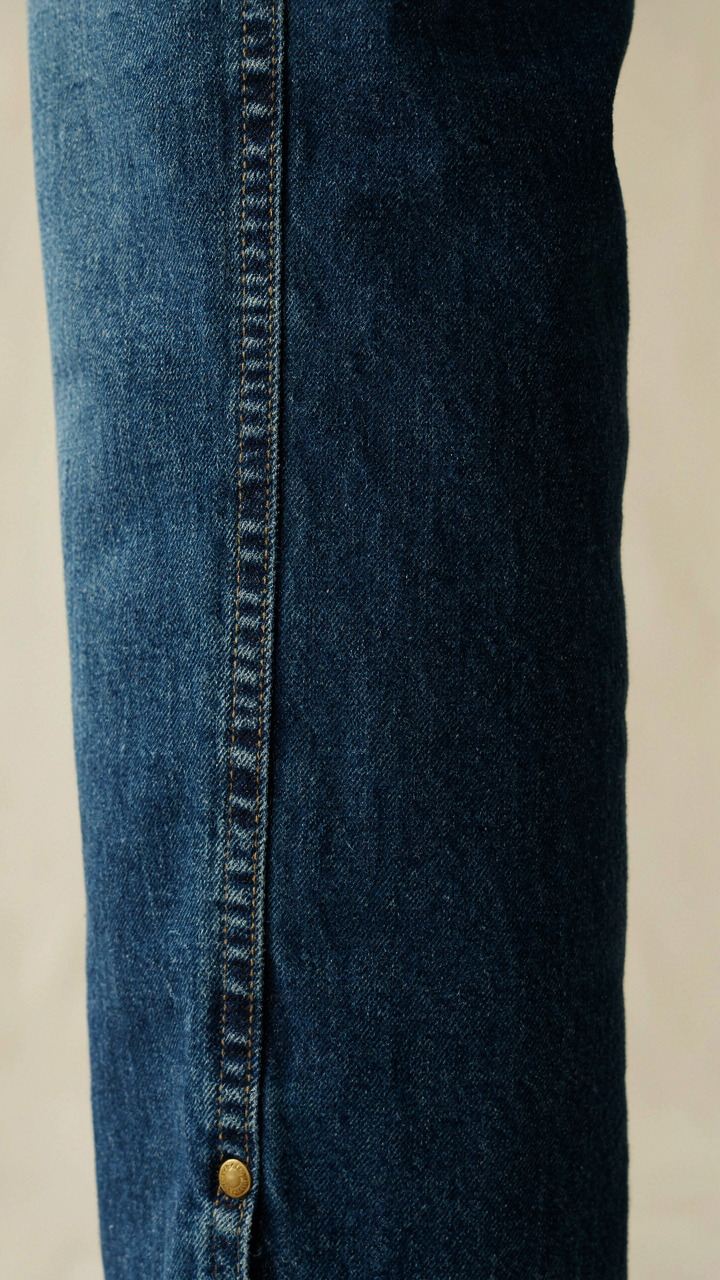
Most eco-friendly denim guidance skips this entirely, jumping straight to fiber type. Wrong priority. A recycled cotton pair that disintegrates at the seams in twelve months is worse than conventional denim that survives five years. Check the weight of the fabric in ounces per square yard. Heavier isn’t always better, but below twelve ounces indicates thin material prone to breakdown. Examine seam construction—look for chain stitching or lock stitching that won’t unravel, and verify that hems and inseams use thread rated for repeated wash cycles.
What Happens When Jeans End
- Repair infrastructure: Find brands that offer patching programs, replacement parts, or partner with repair services. This extends wearable life by years and signals the brand engineered for longevity rather than replacement cycles.
- Takeback programs: Some manufacturers operate mail-in systems where you return worn jeans for recycling or reuse. This closes a loop that usually breaks at your closet.
- Textile-to-textile recycling: Verify whether a brand uses closed-loop systems that break down denim into fiber and respun it into new fabric, rather than downcycling into insulation or industrial rags.
- Secondhand market fit: Choose styles that don’t rely on trend-specific cuts or washes. A straight-leg dark indigo jean resells or passes forward; a cropped acid-wash pair doesn’t.
- Biodegradability timeline: Natural fiber jeans (100 percent cotton) decompose in five to six months in industrial composting conditions. Synthetic blends take years. This matters if landfill disposal becomes your only option.
The lifecycle lens exposes a hard truth: most brands talk about sustainability at the front end (materials, production) and ignore the back end entirely. That’s not oversight. It’s business design. You buy the jean, wear it, throw it out, and buy another. The brand wins on volume. Choosing a brand that documents and facilitates repair, resale, or actual recycling isn’t virtue signaling—it’s selecting for a business model that makes money when your jean survives, not when it doesn’t.
Ethical Jeans: The Human Cost Of Cheap Denim

Who Actually Makes Your Jeans
You care about this section because you want to feel like a good person without actually changing your behavior. Here’s the mechanism: garment workers in Bangladesh, India, and Vietnam earn wages that don’t move with inflation or cost of living. A factory worker making jeans in Dhaka might earn 95 dollars per month. The brand you buy from sets the price they pay the factory. The factory cuts costs by cutting wages.
Economics has a principle called “race to the bottom.” In denim, this manifests as brands competing on price, which forces factories to compete on labor cost. Fair wage certification exists, but it’s voluntary. Most major brands ignore it because compliance reduces margin. When a brand claims ethical production, verify the third-party certification. Don’t accept marketing language.
The Physical Reality Inside The Factory
Factory conditions in cheap denim production aren’t theoretical problems. Workers spend twelve-hour shifts in poorly ventilated spaces with indigo dust, cotton particles, and chemical fumes. Respiratory damage accumulates over years. There’s no air filtration. Safety equipment is minimal because adding it cuts into the per-unit profit the factory receives from the brand.
Chemical exposure during the dyeing and finishing process causes chronic illness. Workers develop skin conditions, lung disease, and eye problems. Medical care isn’t provided. The worker absorbs the cost. When you buy a pair of jeans at a steep discount, you’re buying the externalized health cost of someone else’s body. Check if a brand uses low-impact dyes and whether workers have documented access to respiratory protection.
Sustainable Denim Brands: The Supply Chain Imperative

When Waste Loops Back Into Fiber
You want to feel like you’re buying the future, not complicit in landfill. Here’s the mechanism: closed-loop production takes denim scraps, recycles them back into usable fiber, and eliminates the linear waste model most brands rely on. Biomimicry in textiles applies nature’s principle of zero waste. In forests, nothing exits the system unused. Applied to denim, this means fibers don’t end at landfill. They recycle into new garments.
Brands claiming closed-loop systems actually operate at varying degrees of circularity. Renewcell’s Circulose process dissolves cotton scraps chemically and respins them into yarn, but requires virgin fiber blending for strength. True closed-loop requires infrastructure most brands don’t own. Check whether a brand operates its own recycling facility or outsources to third parties. Outsourcing means less control over the loop’s integrity and increased chance of contamination or incompleteness in the cycle.
Production Networks Built For Disruption
Decentralized manufacturing sounds idealistic until you realize it’s actually about risk mitigation. Conventional denim relies on massive mills in Asia. One geopolitical shift, one shipping crisis, one contamination event cascades through the entire supply chain and halts production. Regional production hubs spread that risk across multiple locations, each capable of operating independently.
Brands like Nudie Jeans maintain production partnerships in multiple countries instead of consolidating in one region. This model costs more per unit but protects against supply shock. When evaluating a brand, ask where production happens and whether they operate secondary facilities. A single facility means a single failure point. Multiple production sites mean the brand survives disruption and maintains quality standards even when one hub faces constraints.
Eco Friendly Denim Design: Innovation, Not Imitation

Minimalist Design Principles
You want to believe eco-friendly jeans exist so you don’t have to change your consumption habits. The mechanism is simpler: fewer design elements mean fewer production steps, lower material waste, and reduced complexity in the supply chain. This is constraint-based design, borrowed from systems engineering, where removing unnecessary parts increases efficiency and lowers failure points.
Five-pocket jeans became the default not because they’re optimal, but because Levi’s standardized them in the 1870s. Eco-conscious brands strip away decorative stitching, hardware variations, and multiple washes. A single, well-fitted cut repeated across sizes requires less pattern iteration. Fewer dye lots. Fewer SKUs in production. The math compounds: less waste at every stage isn’t virtuous, it’s mechanical.
Cut Strategy At The Source
Standard jeans waste 15 to 20 percent of raw fabric during cutting. Most brands accept this as normal. Eco-focused manufacturers redesign the cutting layout itself, nesting pattern pieces differently to eliminate scraps. Some use the offcuts for patch materials or sell them to recyclers instead of landfilling them. This isn’t innovation, it’s refusing to ignore what’s already happening in the factory.
The real lever is deciding pattern dimensions before fabric arrives, not after. Brands that commit to specific body proportions and eliminate size-run bloat reduce waste dramatically. A brand offering five sizes instead of fifteen cuts less fabric per unit and ships less dead inventory. When you buy jeans from a label with a narrow, intentional size range, you’re buying the output of a system designed to eliminate waste at the design stage, not hide it downstream.
Ethical Denim: Beyond Consumption, Towards Consequence

The Real Environmental Cost
You’re reading this section because you want to feel like you’re making the right choice. The mechanism most people miss is this: buying “eco-friendly” jeans doesn’t solve the problem if you don’t understand what you’re actually solving for. Think in terms of lifecycle analysis, the engineering field’s method for tracking total resource input from raw material to disposal. One pair of conventional jeans requires approximately 2,000 gallons of water. That number dominates the conversation. But it’s incomplete.
Water consumption is only one variable. Cotton farming consumes 16 percent of global insecticides despite using 2.5 percent of cultivated land. Synthetic dyes release heavy metals into waterways. Polyester blends shed microplastics during every wash. Transportation, warehousing, and retail markup all embed carbon. An “eco-friendly” jean that cuts water use by 30 percent but still contains synthetic indigo and polyester has solved for narrative, not consequence. The real environmental impact is a sum of extraction, processing, transportation, use, and end-of-life. Reducing one metric while ignoring others is playing accounting games.
What Your Purchase Actually Signals
The reason you matter here has nothing to do with individual virtue and everything to do with market structure. When enough buyers demand specific material sourcing and transparent manufacturing, manufacturers respond. Not because they care. Because revenue moves. Organic cotton producers exist at scale today because demand made it profitable. The same logic applies to water-saving technologies and chemical alternatives.
Your leverage is narrow but real: you redirect capital toward companies operating under production constraints that competitors avoid. Companies using lower-impact dyes, water reclamation systems, or regenerative cotton farming charge more because their costs are higher. Buying those jeans doesn’t offset your overall consumption. It signals to manufacturers that buyers will pay for compliance. Do this three times and you’ve moved nothing. Do this as part of a coordinated market shift, and you’ve changed the cost structure of an industry. The action is specific: identify the material difference in a jean before purchase, verify the claim is third-party certified, and repeat with the next brand.
The Real Cost Of Sustainable Denim Isn’t The Price Tag; It’s Your Willingness To Question Convenience

Most people won’t buy eco friendly jeans because they demand you make a choice instead of defaulting to whatever’s on sale. You have to care enough to research. You have to pay attention to fiber sourcing. You have to accept that the cheapest option funds the system you claim to oppose. Start today by picking one brand, reading their actual supply chain, and making one purchase from intention rather than impulse. The planet doesn’t need your guilt. It needs your discipline.