
The Myth Of The ‘Essential’ Shoe: Ditching Generic Capsule Footwear Lists

Deconstructing The Industry Fed Fiction
You want permission to stop feeling guilty about your shoes. That’s the real reason you’re reading this. The capsule shoe industry sells you a fixed list because fixed lists are easy to market, easy to write about, and easy to sell courses around. But a prescribed “essential” shoe lineup ignores the actual mechanism that determines whether you’ll wear something: friction between your lifestyle and the shoe’s design. What works for an office worker doesn’t work for someone who walks three miles daily. What works in winter doesn’t work in summer. The shoe industry knows this. They sell the myth anyway.
The mechanism is simple: clothing brands monetize guilt by creating artificial scarcity in your head. They convince you that owning five specific shoes makes you sophisticated, when really they’ve just locked you into their narrative. Generic capsule lists treat shoes like a universal formula when they’re actually lifestyle-specific tools. You need to reverse-engineer from your actual calendar and terrain, not from what a lifestyle influencer owns. The shoe you reach for is the one that solves a real problem in your day. Everything else is just sitting in your closet.
Why Most Capsule Footwear Advice Misses Your Lifestyle

Most capsule shoe advice is borrowed from fashion writing, which uses economics logic: scarcity equals value. But shoes aren’t scarce. Your time is. When a guide tells you that a white leather sneaker belongs in every capsule, they’re not accounting for the fact that you might have a ninety-minute commute on public transit, or you might work in a warehouse, or you might live somewhere it rains five days a week. The advice becomes useless the moment it stops mapping to your actual movement patterns. Generic frameworks fail because they optimize for aesthetics instead of wear-ability. A shoe you never wear isn’t part of your capsule. It’s inventory.
The real variable isn’t the shoe itself. It’s the gap between how you move through the world and what footwear reduces friction in that movement. A banker walking from a parking garage to an office building has different shoe needs than someone running errands on foot. A person in a humid climate needs different materials than someone in a dry one. Instead of starting with “what shoes should I own,” start with “what problems does my daily schedule create for my feet.” That’s where the useful shoe lives. Everything else you can discard without guilt.

Beyond The Hype: Defining Your Personal Shoe Capsule Wardrobe Needs

What Your Feet Actually Do Daily
You want permission to buy fewer shoes without feeling like you’re missing out. The real mechanism is this: most people design shoe capsules around aspirational activities, not actual ones. You need to reverse-engineer from your actual schedule, not from some lifestyle brand’s Instagram feed.
Start by tracking your feet for one full week. Document every location and surface you walk on. Work environments demand different sole durability than leisure time. A desk job requires different shoe stress patterns than construction or retail. The shoe you need isn’t determined by what you wish you did on weekends—it’s determined by where your body spends hours every single day. List the specific contexts: office, commute method, weather exposure, social settings, exercise type. Be granular about frequency. Once you see the pattern, you’ll stop buying shoes for imaginary versions of yourself.
Seasonal Reality And Practical Footwear
Climate isn’t just about aesthetics—it’s about material performance and traction chemistry. Cold temperatures change how rubber compounds grip. Wet seasons demand outsole patterns that channel water, not just look textured. Your shoe capsule needs to account for the actual weather your region experiences for significant portions of the year, not the ideal conditions you’d prefer.
Map your region’s climate into quarters. Identify the months when precipitation, temperature swings, or salt roads create real performance demands. A single pair of leather oxfords fails in winter slush. A single canvas sneaker fails in icy conditions. Build your capsule by anchoring one shoe to each seasonal reality your feet encounter. This isn’t about having a shoe for every aesthetic mood—it’s about having shoes that function when conditions change.
The 3 Tier Footwear Protocol: A Logical System For Capsule Shoes Women

Daily Drivers That Earn Their Spot
You want to believe three pairs is enough because it sounds efficient, but you’re really afraid of making the wrong choice and being stuck with dead inventory. The mechanism is simple: a base layer shoe absorbs 70 percent of your weekly wear. It needs to handle commute, office, errands, and casual evenings without complaint. This shoe isn’t fashionable. It’s invisible because it works.
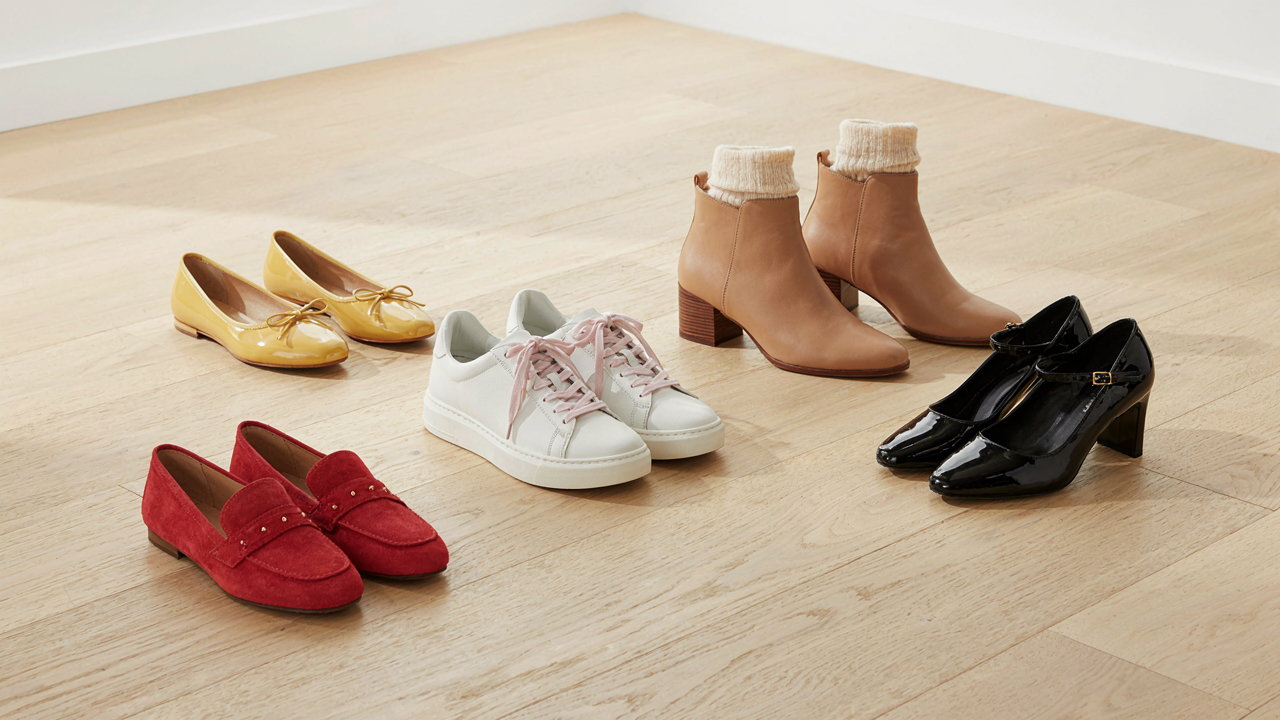
- Neutral Leather Flat or Low Heel: A closed toe in white, black, or tan leather that transitions from day to night. Wears with jeans, trousers, dresses. Handles 3 to 5 days per week reliably.
- Supportive Sneaker: Leather construction, minimal branding, neutral colorway. Not athleisure. This covers casual Fridays, weekend errands, and the days your feet need a break from structure.
- Loafer or Mule: Slip on or minimal fastening. Works over bare feet or with socks. Bridges formal and casual without requiring laces or buckles you’ll adjust repeatedly.
- Ankle Boot: Leather, minimal embellishment, 1 to 2 inch heel. Extends seasonality of dresses and trousers. One boot replaces multiple shoes across fall and winter.
These four shoes handle 90 percent of real life. Rotate them by day, not by outfit. Your brain stops deciding and your closet starts functioning. The redundancy isn’t waste. It’s the only way to avoid decision fatigue while maintaining flexibility.
Shoes For Specific Moments, Not Aspirations
The mistake everyone makes is buying “just in case” shoes for events that happen twice a year. You own the dress for the wedding. You don’t own the shoes for it, so you buy backup shoes you’ll wear six times in a decade. Situational shoes sit dormant because their purpose is too narrow. They need hard constraints: the event must recur predictably, the shoe must serve no other role, and you must own it only after you’ve booked the commitment.
A structured heel serves cocktail dinners and client meetings if those happen monthly. Athletic shoes designed for specific sports sit in closets because you don’t actually train regularly. Sandals in northern climates are pure speculation. Assign a situational shoe only when your calendar proves you need it. Check your actual schedule for the past year. How many times did you attend formal events? How many beach days did you take? How often do you genuinely exercise? Buy for the life you live, not the life you imagine living.
Timeless Shoes Vs. Trends: The Economic Imperative Of Longevity

Cost Per Wear Shifts From Price To Long Term Value
You’re afraid you’re throwing money away. That’s why you’re reading this section. But the actual mechanism that kills capsule wardrobes is confusing price with cost. Economics calls this the difference between unit cost and amortized cost. With shoes, the amortized cost is what matters: total price divided by actual wears before the shoe fails. A $300 shoe worn 200 times costs $1.50 per wear. A $80 shoe worn 40 times costs $2 per wear. Most people reverse this math and buy cheap.
The trap is believing sale price tells you anything about value. It doesn’t. What matters is how long the shoe stays wearable before the sole separates, the heel breaks down, or the upper creases permanently. Track this ruthlessly: buy a pair, note the date, count actual wears until failure. After three pairs, you’ll know your real cost per wear for each brand. This forces you to stop guessing and start calculating. The shoes that survive longest always cost less to own, even if the sticker price looks high.
The Real Signals Of Well Made Footwear
The common advice about shoe quality is incomplete. People talk about leather and stitching but miss the structure underneath. Well-made footwear has a specific construction method: the insole is glued and nailed to a wooden last-shaped form called the shank. The upper leather is then stretched and attached around this form. The sole is then either stitched (Goodyear welt) or glued permanently to the shank. This creates a shoe that maintains its shape for years because the internal structure doesn’t collapse.
To spot this durability, press the shoe’s heel and arch area firmly. Good shoes resist the pressure and spring back. Cheap shoes compress and stay dented. Check the toe box too: bend it sharply upward. Quality shoes crease cleanly in one place. Poor shoes wrinkle everywhere randomly, a sign the upper is unstable. Look at the sole where it meets the upper. Stitching visible here (not just glue) means the construction is reinforced. Shoes built this way last 300-500 wears. Shoes without this structure fail at 100-150 wears, making them economically worthless for a capsule wardrobe.
The Uniform Principle: Cultivating Your Signature Capsule Wardrobe Women

Sartorial Uniform Beyond Fashion
You want permission to stop thinking about clothes. That’s the real motive here, and it’s sound. The mechanism is borrowed from systems thinking: constraint breeds efficiency. Instead of chasing trends or rotating between dozens of shoes, you establish a deliberately limited set of silhouettes and colors that work together. This isn’t about looking boring. It’s about removing the variable so you can focus elsewhere. Steve Jobs wore the same outfit daily not for mystique but for cognitive bandwidth. The same principle applies to your shoe collection. You choose your core models once, then stop choosing.
A uniform approach to shoes means identifying three to five anchor pieces that cover your actual life, not your fantasy life. These aren’t aspirational. They’re functional anchors: the flat that handles commute and errand, the heel for meetings or events, the sneaker for movement, the boot for weather or transition seasons. You wear these repeatedly. You know their fit, their breaks, their weaknesses. You stop treating each shoe purchase as a standalone decision and start seeing it as adding to or replacing an existing anchor. The uniform doesn’t eliminate choice. It concentrates it.
Decision Fatigue Disappears When Options Shrink
Economics calls this the paradox of choice, but the real cost isn’t confusion. It’s the metabolic drain of deciding the same thing repeatedly. Every morning you decide which shoes work with today’s outfit. Every week you scan your closet wondering if you need another pair. Every season you justify why you bought something you never wear. That’s not freedom. That’s friction disguised as options. Capsule wardrobe shoes eliminate the decision loop by design. You own fewer pairs, each one purposeful, each one worn regularly.
Reduced options create predictable outcomes. If you own five pairs of shoes instead of twenty, you wear each pair roughly four times more often. That repetition breeds familiarity. You stop second-guessing fit or color coordination because the shoes already integrate into your existing wardrobe. The mental space you reclaim doesn’t feel minor until you actually reclaim it. You redirect that cognitive energy toward work, relationships, or actual priorities. The mechanism is simple: fewer choices mean fewer decision events, which means less depletion of your decision-making capacity throughout the day.
Deconstructing “Versatility”: The Strategic Value Of Multi Functional Shoe Wardrobe

The One Shoe That Actually Works
You want permission to buy fewer shoes without looking like you’re settling. The real mechanism here borrows from economics: opportunity cost. Every shoe slot in your rotation represents a decision against another shoe. The shoes that compress the most scenarios into one purchase are the ones that eliminate that guilt. A white leather sneaker isn’t versatile because it’s boring. It’s valuable because it bridges formal-casual contexts that would normally demand separate purchases. Think about where you actually spend time. Most people operate in three environments: professional, casual social, and errands. A shoe that performs adequately in two of those three eliminates one entire purchase from your budget.
The white leather low profile sneaker does this better than any other single shoe. It works with tailored trousers, jeans, casual dresses, and khakis. It doesn’t dominate the outfit. It doesn’t require explanation. Over five years, one shoe used in multiple contexts costs less per wear than two shoes used in isolated contexts. That’s not fashion philosophy. That’s mathematics.
Shoes That Actually Travel Across Your Real Life
Most “transitional” shoe advice ignores friction. You won’t wear a shoe in a context where it creates social or practical friction, no matter how versatile it claims to be. A Chelsea boot in black leather transitions from office to dinner to casual weekend plans, but only if those contexts already accept a boot. In an office where sneakers are normal, the Chelsea becomes redundant. A loafer solves this differently. It reads formal enough for business settings but casual enough for weekend social plans. The shoe doesn’t change. Your context changes, and the loafer doesn’t trigger recalibration in either space.
The real filter for transitional shoes is this: can you wear it twice in the same week to genuinely different contexts without feeling like the shoe is wrong for either occasion? If yes, it deserves a permanent spot. If you’re rotating it based on outfit matching rather than context switching, it’s not transitional. It’s just another specialized shoe taking up rotation space. Test this by wearing the shoe to your workplace, then directly to a casual social setting. If you adjust your behavior or feel self-conscious, the shoe isn’t actually transitional. It’s just acceptable in both places, which is weaker than what you need.
The Anti Hoarding Maneuver: Culling Your Current Shoe Collection Ruthlessly

The 90/90 Rule Applied To Shoes
You’re keeping shoes you don’t wear because throwing them out feels like admitting waste. Here’s the mechanism: economics uses the 90/90 rule to identify dead inventory. Apply it to your closet. If you haven’t worn a shoe in 90 days, or you’ve owned it for 90 days without wearing it, that shoe has no utility value to you. The money is already spent. Keeping it costs you nothing financially but everything practically: mental load, storage space, and decision friction when getting dressed.
The rule cuts through sentiment. A shoe sitting unworn isn’t potential. It’s a sunk cost pretending to be a backup. Most people rationalize: “I might wear it for X occasion.” That’s the voice of someone who hasn’t actually planned their life. Wear the 90/90 rule as a knife, not a guideline. Pull every shoe that fails it. You’re not losing options. You’re gaining clarity about what you actually use.
One In, One Out For Hard Limits
The amateur version of this says “add a new shoe, remove an old one” without teeth behind it. That’s not a system; that’s a nice idea. The real mechanism requires a constraint that forces choice. When you acquire a new shoe, you must immediately identify and donate the shoe you wear least from your remaining collection. This isn’t symbolic. This is math.
The discipline here prevents the slow creep back toward 50 pairs. You move at equilibrium or you move down. If you truly need a new shoe, the friction of removing another one will tell you whether you actually need it. That friction is the feature, not the flaw. Execute the removal before wearing the new shoe. Don’t negotiate timing or find exceptions.
The Investment Paradox: Why Buying Fewer, Better Essential Shoes For Women Pays Off

Maintenance And Replacement Reality
You want permission to spend more upfront because deep down you suspect cheap shoes will humiliate you after three months. That suspicion is accurate. In economics, this is called the replacement cycle—the interval between purchase and disposal. A sixty-dollar shoe worn twice weekly dies in four to six months. A two-hundred-dollar leather shoe with proper maintenance extends that cycle to three to four years. The math is simple: cost per wear flips when durability compounds.
Most capsule wardrobe advice skips the actual mechanics of why. It’s not about the shoe being “better quality.” It’s about what you don’t replace. A quality leather upper resists creasing that spreads into splits. A reinforced shank doesn’t collapse, which means heel wear stays localized and fixable instead of forcing sole replacement. You’re not paying more for status. You’re paying to stop the replacement treadmill.
True Cost Of Compromise
The consensus says cheap shoes save money. They don’t. Cheap shoes create hidden costs that spreadsheets don’t capture. A fast-fashion shoe breaks down in ways that require replacement, not repair—the sole separates, the upper stretches, the heel cups compress beyond recovery. Meanwhile, a well-constructed shoe accepts repair: re-heeling, re-soling, leather reconditioning. You decide when to replace it, not the shoe.
Environmental cost compounds this math further. Manufacturing one shoe generates carbon output equivalent to shipping it globally. Buying five cheap shoes over two years means five manufacturing cycles. Buying two quality shoes over the same period cuts that impact in half. Your capsule wardrobe budget becomes leverage over both your wallet and resource waste. The mechanism: buy shoes designed for repair, not disposal.
The Future Of Your Feet: Maintaining A Dynamic, Not Static, Fashion Capsule Wardrobe

When Your Life Changes, Your Shoes Should Too
You want to believe your capsule is permanent because permanence feels like you’ve solved the problem. You haven’t. A capsule wardrobe isn’t a museum exhibit—it’s an operating system that requires maintenance. Think of it in biological terms: your shoe rotation needs periodic renewal to stay functional. As your body changes, your job shifts, your commute alters, or your social circles evolve, the load you place on your footwear shifts with it. Ignoring this means wearing shoes designed for a life you no longer live.
The audit isn’t about shopping or trends. It’s about inventory. Every six to twelve months, pull your shoes out and ask three specific questions: Do I still move through my day in the same ways? Have my body’s needs changed—arches, width, heel height tolerance? Am I still reaching for these, or are they gathering wear in the closet while others collapse from overuse? One worn-out pair carried too much weight because you didn’t notice you’d stopped wearing two others. That’s the mechanism nobody states plainly: a capsule fails when the distribution of wear becomes unequal, signaling a mismatch between what you own and how you actually live.
Replace With Precision, Not Sentiment
Everyone says replace shoes when they wear out. What they don’t say is that most people replace them wrong—either buying the exact same thing out of habit or chasing something new out of boredom. Both are lazy. Replacement should be strategic. When a shoe reaches end-of-life, you have data. You know how many days a year you wore it, which fabrics held up and which didn’t, whether the silhouette still suits your frame. Use that data to decide if you need that category at all or if a different shoe can do the work better.
The replacement step is where most capsules bloat. You get sentimental about a pair and buy a backup before the original dies. You panic about gaps in your rotation and add redundant styles. Strategic replacement means one pair exits, one pair enters, and the entry is deliberate based on actual wear patterns. Track what you reach for under specific conditions—rainy commute days, standing meetings, evening plans—then select the replacement against that requirement, not against your mood or what’s on sale.
Your True Obstacle Isn’t The Number Of Shoes, But The Fear Of Defining Your Own Uniform

Most people don’t struggle with shoe math. They struggle with commitment. You already know five pairs work. You’re stalling because picking your five means rejecting every other option forever, and that feels like dying a little inside. Stop. Today, write down the three activities that consume 80 percent of your life. Find one shoe that dominates each. Buy it. Wear it until the decision becomes invisible. The person who owns their uniform owns their time, and everyone else just owns more shoes.