

Beyond Basics: The Intentional Beach Vacation Persona

Know Who You Are On The Sand
You want to feel like you belong there without thinking about it. That’s the real reason you’re reading this. The mechanism is simple: your beach wardrobe works when it matches your actual behavior, not some aspirational version of yourself. Most people pack for the person they wish they were. You’re on vacation to relax, not to perform a costume. Define this first: Are you swimming daily or mostly walking and eating? Reading poolside or exploring towns? Early sleeper or night person? These patterns determine everything you actually wear. The clothes that fit your real itinerary get worn. Everything else takes up space.
Your vacation persona isn’t about aesthetics. It’s about friction. High-friction beach vacations require different pieces than low-friction ones. If you swim twice daily, quick-dry fabrics matter more than style. If you eat dinner out most nights, one elevated piece matters more than five casual ones. Write down three specific activities you’ll do on this trip. Then write down what you’re actually wearing during each one. That’s your wardrobe. Everything else is clutter.
Pieces That Earn Their Weight

The mistake everyone makes is thinking versatility means looking different. It doesn’t. True versatility means the same piece functions across different contexts without looking wrong. Borrow from systems thinking: in engineering, elegant design solves multiple problems with a single component. Your beach wardrobe operates on the same principle. One linen shirt works for morning coffee, afternoon errands, and dinner if you roll the sleeves differently. One pair of shorts transitions from beach to town without changing. The piece must perform, not just exist in your suitcase.
Stop packing “backup” items. You don’t need five neutral shirts. You need three pieces that work together and actually get worn. A linen blend shirt over a simple tank creates layering options. The same shorts pair with different tops for visual variety without redundancy. Choose colors that overlap with your existing wardrobe at home, not arbitrary beach tones. Your multi-use piece works when it solves a real problem on your specific trip, not when it theoretically could work in an imaginary scenario. Test this before packing: wear each piece at home in three different ways to confirm it actually functions.

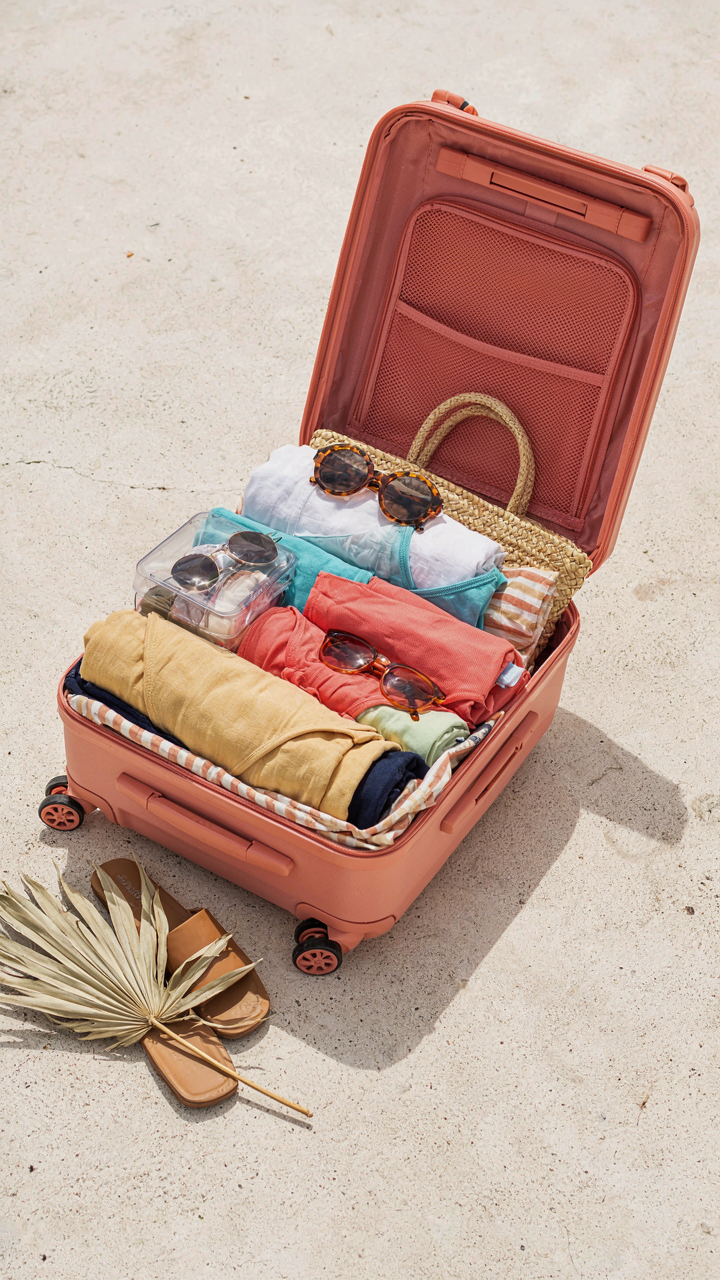
The 3 Tiered Packing Protocol: Maximizing Small Suitcase Space
Dressing For Heat, Sun, And Social Friction
You’re worried people will see you wearing the same outfit twice. That fear drives most overpacking. The real mechanism is this: you need clothes that perform across three distinct environments—water, sun exposure, and evening—not clothes that perform across three distinct days. Borrow from thermodynamics: heat transfer works differently in wet fabric versus dry fabric versus fabric in shade. Your pieces must shift function based on environment, not based on calendar. A linen shirt works at noon because it reflects heat and moves air. The same shirt works at sunset because layering it over a tank changes its insulation properties. You’re not building a wardrobe. You’re building a system where five pieces become fifteen outfits through environmental context.
The constraint of a small suitcase forces this clarity. You stop buying “backup” versions of the same thing. A navy swim shirt and a navy linen shirt aren’t redundant if one handles chlorine and the other handles UV reflection. Cotton-blend swim trunks dry slower than synthetic ones, so synthetic owns the water slot. Linen owns the afternoon slot because cotton holds sweat and wrinkles instantly in humidity. Each piece earns its space by performing a specific thermal or social function across multiple scenarios, not by sitting unused as insurance against repetition.
Compression Before Rolling, Rolling Before Folding
Packing advice usually says “roll your clothes, it saves space.” That’s incomplete and backwards. Rolling works only after you’ve removed air trapped in fabric structure. The real sequence comes from how compression actually works: you eliminate trapped air first, then organize by density, then contain the result. Start by laying each piece flat and pressing out wrinkles with your hands or a flat surface. This breaks the fabric’s memory and collapses the air pockets inside the weave. Only then roll items tightly, starting from one end and keeping tension constant. Synthetic fabrics compress better than naturals because they hold their compressed state longer without bouncing back.
The suitcase itself becomes your compression tool, not your storage container. Pack heavier items on the bottom—jeans, shoes, a light jacket. Layer your rolled clothes on top, then use compression cubes or ziplock bags only for items that wrinkle easily or that you’ll need to access mid-trip. Shoes go in their own slot because they take up disproportionate space relative to their weight. Your goal isn’t neat organization. Your goal is maximum usable depth in your suitcase, measured in actual outfit iterations you can pull without reshuffling everything. Pack in the order you’ll unpack, with essentials for day one on top and contingency items at the bottom.
Strategic Fabric Selection For Summer Packing Outfits

Breathable Materials For Heat And Humidity
You want to feel like you’re not sweating through your clothes because you don’t want to look undone in front of people who paid less to be there. The mechanism is simple: fabric fiber diameter determines how fast moisture moves away from skin. Linen and cotton have large hollow cores that wick sweat outward instead of trapping it. Polyester blends trap moisture closer to skin, which feels heavier and looks darker when wet. This isn’t opinion—it’s physics applied to thread.
Linen performs best in pure form, but it wrinkles aggressively and demands ironing you won’t do on vacation. Cotton-linen blends solve the wrinkle problem while keeping breathability high. A 55/45 cotton-linen ratio gives you the sweat management of linen without the constant creasing. Bring three pieces in linen blend: one button shirt, one loose pant, one lightweight sweater for air-conditioned spaces. Skip pure cotton basics—they absorb sweat and dry slowly, which defeats the entire purpose of a beach trip wardrobe.
Quick Dry Fabrics For Beach And Travel
Most travel guides tell you to buy “travel fabrics,” which is meaningless marketing speak for anything that isn’t 100% cotton. What actually matters is how fabric sheds water and dries. Nylon and polyester shed water faster because they’re hydrophobic—water slides off instead of absorbing. Merino wool blends dry quickly too, but they cost more and overkill for beach heat. Nylon is your workhorse because it packs small, weighs nothing, and transitions from wet to dry in hours instead of a full day.
One piece of nylon changes your entire trip efficiency: a lightweight cover-up or quick-dry shirt. Wear it wet from the ocean, let it air-dry while you’re at lunch, and it’s ready for evening. Avoid rayon and viscose entirely—they’re hydrophilic and will stay damp for extended periods. Your protocol is simple: choose one nylon item as your water layer, one cotton-linen piece as your heat layer, and build the rest of your capsule around those two anchors.
The Utility Maximization Principle: Applied To Travel Capsule Wardrobe Summer

Each Item Must Earn Its Place
You care about this because packing efficiently feels like winning, and losing means arriving wrinkled and improvising. Economics calls this marginal utility: the value gained from adding one more unit. In beach packing, each piece must justify its weight against what it replaces. A shirt that works alone is worthless. A shirt that combines with three other items is currency.
The math is unforgiving. Most travelers pack ten items with five use cases. A capsule works backward: identify use cases first, then find items that stack across multiple scenarios. A linen shirt covers sun protection, dinner layers, and beachwear. A swim brief works as underwear, workout wear, and casual shorts. When an item serves only one purpose, it’s dead weight. Calculate before you fold.
The True Cost Of Carrying Extra
Every excess pound costs something you never quantify: mobility, flexibility, laundry frequency, and decision bandwidth. This is opportunity cost from economics, applied directly to your suitcase. The extra jeans you packed “just in case” aren’t free. They consume space that could hold a high-utility piece. They force you to check luggage instead of carrying on. They create laundry decisions you don’t need.
The mechanism is simple: fewer items force better choices. With limited pieces, you naturally reach for combinations that work. With bloated luggage, you default to the same three outfits while the rest sits unused. You spend mental energy choosing instead of just getting dressed. Strip to what compounds across use cases, and every morning becomes automatic. Pack only what you’ll wear twice, and you’ll wear everything you pack.
Accessories: The Multiplier Effect For Holiday Capsule Wardrobe

The One Accessory Rule
You want accessories to make you look intentional without admitting you packed light. Here’s the mechanism: in economics, leverage is doing more with less input. Your accessories work the same way. One quality piece—a linen shirt, a structured bag, a simple belt—transforms three outfits into six by changing how people perceive what you’re wearing. The rest is distraction. Most people load accessories thinking quantity signals sophistication. It signals the opposite: you didn’t edit.
Pick pieces that solve problems, not ones that announce you. A wide-brimmed hat blocks sun and reshapes your silhouette between outfits. A lightweight scarf works as a cover-up, a shoulder wrap, or a makeshift beach bag divider. A simple gold or silver bracelet coordinates across every outfit without competing for attention. Each piece must earn its suitcase space by functioning across multiple contexts. This is not minimalism for aesthetics. It’s ruthless efficiency.
Shoes That Work Everywhere
Most people pack six shoes for a week. Wrong. You need three that handle every scenario from dinner to sand. A leather flip-flop or slide works for the beach, pool, and casual meals. A canvas sneaker or slip-on handles walking, exploring town, and any activity requiring actual footing. A dressier sandal or flat works for dinners and evening outings. Each fills a distinct functional gap. No overlap means no wasted space.
- Leather slides or flip-flops: Durable sole that doesn’t degrade in salt water. Slip on and off without fumbling. Works for both casual and semi-dressed settings.
- Canvas sneakers or deck shoes: Lightweight, pack small, and dry quickly. Handles uneven terrain and any activity where you need actual grip and support.
- Flat sandals in neutral color: Metallic or leather finishes work for evening without looking resort-casual. Pairs with both shorts and lightweight pants or dresses.
- Water shoes or athletic sandals: Optional third option if your itinerary includes reef walks, boat trips, or rocky beaches. Protects feet and doubles as gym footwear.
- Minimalist loafers or moccasins: For travelers visiting restaurants with dress codes or upscale venues. Takes minimal space and handles both pool cover-ups and dinner settings.
Rotate these three through your week. Wear one while packing the others. By day three, the first pair dries completely. By day five, you’ve cycled through all three multiple times without anyone noticing the repetition. This is how you pack one suitcase without looking like you did.
Color Theory For Cohesion: Beach Trip Capsule Wardrobe

Limit Your Palette To Three Base Colors
You want to look intentional without thinking. That’s the real reason this matters. Most people bring eight colors to the beach and create visual chaos that makes everything feel smaller and cheaper. Color theory borrowed from graphic design uses the term “harmony”—the principle that limiting your hue range creates coherence. Pick three base colors that sit next to each other on the color wheel or follow a neutral plus two accent structure.
White, navy, and tan form the tightest, most versatile triangle. Linen and cotton in these shades don’t compete for attention. Every piece works with every other piece because your eye registers them as intentional coordination, not accident. This reduces decision fatigue in the morning and maximizes outfit combinations from minimal items. You can swap one accent color midway through the trip if needed, but three total keeps your suitcase weight down and your visual coherence up.
Monochrome Layering For Texture Over Color
Wearing one color from neck to toe sounds boring. It’s actually the opposite. When you remove color variation, texture becomes the design element. A cream linen shirt over cream shorts with cream canvas shoes reads as sophisticated because the eye tracks weave, drape, and material instead of fighting multiple hues.
This solves the real problem: you can repeat outfits without looking lazy. Sand-colored shorts paired with white tee and white sneakers reads different from sand-colored linen pants with cream tank and tan slides—same palette, different textures. Pack one monochrome range per day if possible. Wash items in your hotel sink at night. One color family per outfit means laundry happens faster and your suitcase stays light.
The Unpack Repack Test: Optimizing Your Holiday Capsule Wardrobe 2026

Lay Out Every Combination Before You Leave
You’re worried you’ll look unprepared or boring on vacation. That fear is actually useful. It pushes you to test what you’re actually bringing instead of guessing. The mechanism is simple: your brain cannot reliably predict outfit math under travel conditions. You need to see it. Lay every piece on a bed or floor. Combine tops with bottoms. Bottoms with shoes. Accessories with each outfit. Document it with your phone. This removes the anxiety that kills vacations—standing in front of your suitcase realizing nothing works together.
The test surfaces two problems immediately. First, you find the orphan piece that only matches one thing. That’s a suitcase weight you cut. Second, you discover genuine gaps where you thought coverage existed. Now you swap before packing, not during vacation. This 20-minute exercise prevents the real disaster: arriving with pieces that looked versatile at home but form zero coherent outfits at the beach.
Pack It, Unpack It, Repack It The Same Way
Simulate travel conditions means this. Pack your suitcase exactly as you plan to travel. Then unpack it completely. Now repack it the same exact way. This reveals whether your packing method actually works or whether you’ve memorized an imaginary system. Most people pack poorly because they’ve never tested retrieval under real constraints—low light, cramped hotel closet, the piece you need buried under everything else.
The repeated packing drill shows you physical friction points. Can you reach that swimsuit without disturbing other items? Does your organization survive the airline baggage system? Do wrinkles settle the same way twice? Your packing method only works if it survives this test. After the second full repack, you’ve found the actual optimal arrangement. Use that exact sequence every time you travel.
Spain Vacation Outfits September: Adapting Your Capsule For Specifics

What September Actually Demands In Spain
You’re worried you’ll look like a tourist, or worse, underdressed for a country that cares about how you move through public space. Here’s the mechanism: September in Spain isn’t summer anymore, but travel guides still treat it that way. Coastal regions average 26-28°C (79-82°F) with lower humidity than August. Inland and northern areas drop closer to 20-23°C (68-73°F). Temperature variance, borrowed from meteorology, determines your layering system the same way pressure systems determine weather patterns. One suitcase survives this spread only if you abandon the idea that beach clothes work everywhere.
Spanish culture in September shifts tactically. Summer crowds thin, locals reclaim their cities, and dress codes tighten. You’ll see fewer bikinis on streets and more structured clothing at dinner. The capsule that worked in July fails here because you’re no longer operating in pure resort mode. Spanish women wear fitted jeans, leather jackets, and pointed shoes well into autumn. Your beach wardrobe needs translation pieces that signal you understand the season changed, not just the calendar.
Layering Without Bloat
Forget the advice that says bring a cardigan and call it solved. A cardigan takes up space and solves one temperature only. Use a linen overshirt instead, the kind that works unbuttoned over a tank at 28°C or buttoned over a t-shirt at 20°C. Linen wrinkles visibly, which actually helps in Spain because texture reads as intentional rather than sloppy. The overshirt packs flatter than a cardigan, functions as both top and layer, and moves between beach and dinner without looking transitional. Your second piece should be a lightweight bomber or harrington jacket in a neutral color. This handles the 15-degree swing from midday to evening without adding bulk. Pair these two layers with your base tank tops and t-shirts, and you’ve engineered temperature control inside five inches of suitcase depth.
Footwear determines the success of this system more than fabric does. Bring one pair of flat sandals for the beach, one pair of pointed-toe flats for walks and casual meals, and one pair of simple leather sneakers. Sneakers handle cooler mornings and uneven coastal streets. The pointed flats signal you’re not treating Spain like a resort. These three pairs cover every temperature and social context September throws at you. Everything else—shorts, linen pants, a simple dress—builds around these three layers and three shoes.
Your Fear Of Missing Out, Not Your Suitcase, Is The Real Weight

You pack seven outfits for a five-day trip because you’re terrified of repeating a photo. That’s the real problem. A beach vacation capsule wardrobe forces you to stop performing and start relaxing. You wear the same linen shirt three times. Nobody notices. Nobody cares. The only person judging your rotation is the anxious voice in your head. Kill that voice today: open your closet, grab five pieces you actually feel good in, and commit to wearing them again. The beach doesn’t reward variety. It rewards showing up.