

Beyond Beige: The True Purpose Of A Neutral Wardrobe

The Decision Tax You’re Paying
You want to look intentional without thinking about clothes every morning. The real mechanism here is cognitive load. Every choice you make drains a finite resource, and most people waste it on decisions that don’t matter. A neutral wardrobe is a system that removes the variable. You’re not building a capsule for Instagram. You’re buying back mental bandwidth.
Decision fatigue is documented in behavioral economics. The more choices you face, the worse your decisions become later in the day. Your wardrobe operates like a decision budget. Once you set the parameters, you stop hemorrhaging mental energy on color coordination and spend it on work that moves the needle. The goal is automation, not aesthetics.
What Gets Freed Up

You think the benefit is time in the morning. That’s small. The actual payoff lives in sustained focus on revenue-generating or meaningful work because you stopped context-switching between “what should I wear” and “what should I build.” Your brain stays in flow longer. Shallow decisions compound into lost productivity that you never notice or measure.
The neutral wardrobe operates like compound interest in reverse for most people. Every morning without a decision framework costs attention and willpower. Eliminate the framework gap and you recover 20 to 30 minutes of usable mental energy per day, plus the ability to maintain deep work without the ambient anxiety of “do these colors work together.” Stack that across a year and you’ve freed hours of actual productive time. The mechanism is simple: remove choice, preserve attention, execute at higher levels.

The Cognitive Offloading Protocol For Your Closet
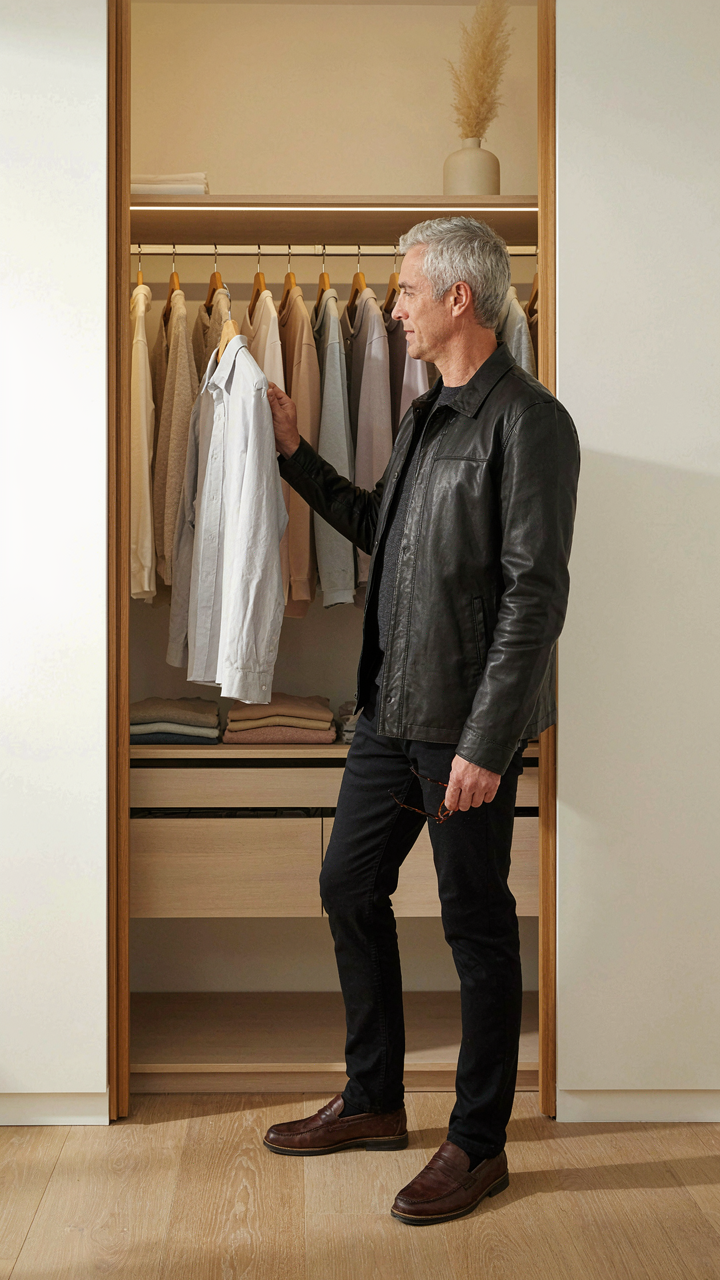
Limit Your Inputs To One System
You want to stop thinking about what to wear because deciding feels like work, and work feels like failure. The mechanism is simple: your brain has a fixed decision budget per day. Spend it on outfit selection and you starve everything else. The solution is inventory constraint. Instead of owning forty neutral pieces that theoretically match, own fifteen that mathematically must work together. This isn’t minimalism for aesthetic reasons. It’s a supply chain principle applied to fabric. Fewer SKUs mean fewer decision branches, which means zero friction at the moment of selection.
The standard advice says “buy pieces that go with everything.” That’s incomplete. Everything doesn’t go with everything equally. You need pieces that occupy the same color family, weight class, and formality tier. A cream linen shirt matches a cream cotton blend differently than it matches an off-white silk blend. Specificity is what makes the system work. Write down your core neutral: whether that’s warm beige, cool gray, or true black. Then buy every piece in that narrow band. Don’t hedge with multiple neutrals. One system eliminates the decision entirely.
Build The Assembly Line, Not The Wardrobe
Automation beats willpower every time. Most people think outfit variety comes from having many options. It doesn’t. It comes from having pieces that combine in repeatable sequences without active thought. The fashion industry calls this “capsule construction.” Military logistics calls it “modular load bearing.” Same principle: standardized components that stack in predictable ways. Your goal is three base layers, two mid layers, and two outer options. All in the same neutral. Wear them in rotation without deciding. Tuesday’s outfit is Wednesday’s outfit with the blazer instead of the sweater.
The protocol is mechanical: assign each piece a slot in your week before you own it. Monday needs a base plus structured layer. Wednesday needs a base plus soft layer. Friday needs a base plus outerwear. Once you decide these sequences once, you stop deciding them forever. Don’t grab items from your closet. Follow the assigned combination. This removes choice from the moment when you’re tired and the stakes feel high. You’re executing a system, not expressing yourself through fabric.
The Scarcity Mindset Of Color Palettes Clothing

More Options Mean Worse Decisions
You’re hoping a bigger wardrobe solves the problem of looking put-together. It doesn’t. Economics calls this constraint satisfaction, and it applies directly to color selection: the more choices you have, the harder your brain works to justify each one, and the weaker your final output becomes. You second-guess combinations because you know ten other combinations exist. That paralysis is the mechanism.
A neutral palette removes the decision surface entirely. You’re not choosing between navy and charcoal and slate and steel and midnight. You’re choosing navy. The constraint forces coherence. When you own forty pieces in five colors, you can justify bad matches because you’re focused on what fits rather than what works. Fewer options eliminate the mental tax that kills consistency.
The Paradox Isn’t What You Think It Is
The common take is that choice makes you happy. Wrong. Barry Schwartz proved this in retail environments years ago, and fashion is no exception. More options increase decision fatigue and lower satisfaction with whatever you pick. You convince yourself the shirt doesn’t match well enough, so you try something else, waste time, and still feel uncertain. That loop is the real cost.
A neutral wardrobe eliminates the paradox by eliminating the paradox. You can’t second-guess what works when everything is designed to work. Beige pairs with gray pairs with black pairs with cream because the palette is engineered for it. Build your neutral foundation first, then add one accent color if you must. That’s your protocol: constrain ruthlessly, then verify every new piece against existing items before buying.
The “Zero Waste” Wardrobe: Applying Economic Principles

What You Actually Lose By Chasing Options
You think a broader color palette gives you more freedom. It does the opposite. Economics calls this opportunity cost: every dollar spent on a color that doesn’t anchor your system is a dollar that can’t buy a piece that works with everything else. A neutral palette forces ruthless prioritization. You stop buying the “maybe” sweater in burgundy and start buying the third white oxford that actually gets worn.
The real mechanism is friction reduction. When you own twenty colors, you spend mental energy every morning deciding what matches. When you own five neutrals, there is no decision. The cognitive load disappears. Studies on decision fatigue show that removing low-stakes choices preserves mental resources for actual work. A neutral wardrobe isn’t about looking minimal. It’s about eliminating a daily tax on your thinking.
Density Over Breadth
Versatility isn’t about owning many pieces. It’s about owning pieces that work in multiple combinations. A charcoal sweater worn over a white shirt, under a navy blazer, with gray trousers looks completely different from that same sweater with black jeans and a camel coat. Same garment, four distinct outfits. Build that density within a narrow color band instead of spreading thin across the spectrum.
This is where most people fail. They think a neutral wardrobe means buying more basics. The opposite is true. Buy fewer items, but choose each one for maximum overlap with existing pieces. A single beige linen shirt worn as a standalone piece, layered under cardigans, or tied at the waist works harder than five colored shirts that each pair with only three items in your closet. The protocol: before buying anything, identify at least four ways to wear it with what you already own.
Building Your Anti Chaos Neutral Capsule Wardrobe

The Shades That Actually Work Together
You want to skip the mental tax of deciding what matches every morning. That’s the real reason this matters. The mechanism is constraint: fewer decisions mean faster execution and fewer regrets. Most people grab neutrals without understanding that not all neutrals sit on the same undertone axis. If you mix warm grays with cool blacks, they clash even though both are technically neutral. Your foundation shades must live on the same temperature spectrum.
- True Black: The coldest neutral. Works with cool grays, whites, and navy. Avoid pairing with warm beiges or camel in the same outfit unless separated by a neutral layer.
- Charcoal Gray: Sits between black and true neutral. Bridges warm and cool neutrals without friction. Most versatile single shade for stacking pieces.
- Warm Gray: Leans toward taupe. Anchors warm neutrals like cream and camel. Does not pair well with cool black in adjacent layers.
- Cream or Off White: Warmer than pure white. Pairs with warm grays, camel, and tan. Reads as softer and less clinical than bright white.
- Navy: Technically a neutral that reads darker. Functions like black but warmer. Works across both cool and warm neutral families when used as an anchor piece.
Start by picking two core shades that will form 60 percent of your outfits. Pick one from the cool family (charcoal or black) and one from the warm family (cream or warm gray). Every other piece you add must pass the test against both. This eliminates the false neutrals that look right in isolation but create visual noise when layered.
Maximum Interchangeability Through Fabric Intentionality
Everyone talks about “layering pieces” as if the concept is deep. It’s not. The real leverage is fabric weight and texture coherence. A lightweight cotton tee, a medium wool sweater, and a heavy coat can all be the same color but create visual confusion through texture chaos. Think in terms of structural hierarchy from fashion design: base layer, mid layer, outer layer. Each needs a distinct weight so the eye reads them as separate elements, not a blob.
Your first pieces should establish the weight tiers. Choose a heavyweight base like a wool or wool blend sweater in your core color. Add a midweight layer like a quality cotton shirt or lightweight knit. Then add a lightweight piece like a tee or tank. This gives you three legitimate outfit combinations before you add a single second color. The interchangeability multiplier comes from repeating this pattern: once you have base, mid, and light in core shade one, build the same three tiers in core shade two. Now you have six combinations with four pieces. This is the actual math behind “capsule wardrobes,” not the vague mixing and matching everyone assumes.
The Monochrome Advantage For Neutral Wardrobe

Single Tone Dressing Cuts Decision Friction
You want to look intentional without thinking about it. The real mechanism here is constraint. Wearing one color family head to toe eliminates the matching problem entirely because there is no matching problem. You pick a shade, you build around it, and every piece works. This isn’t about looking “simple”—it’s about removing the cognitive load that kills consistency.
Monochromatic dressing borrows from minimalist design, which relies on the principle of reduction: remove everything except what serves the core function. In wardrobe terms, that function is coherence. Wearing charcoal, gray, and black together reads as intentional because the eye reads it as a unified statement, not a random combination. You’re not trying. That’s the entire point.
Texture Does The Visual Work For You
The mistake most people make is thinking a monochromatic outfit needs to be boring. It doesn’t. You layer texture instead of color. Wool knit over linen shirt over cotton tee in the same neutral tone creates visual depth without adding complexity. The fabric weights and surface details do what color variation usually does—they give the eye something to land on.
This is where material selection becomes tactical. Pair a matte wool sweater with a silk-blend tee. Add a canvas jacket. Include a knit with a visible weave pattern. The tonal range stays tight, but the tactile variation keeps the outfit alive. You stop needing color contrast to look put together. Change texture instead. That’s your protocol: same shade, different fabric every layer.
The Investment Fallacy Of Fashion Capsule Wardrobe

Buying Better Costs Less Over Time
You want permission to spend more money upfront because it makes you feel smarter than people who don’t think ahead. Here’s the mechanism: a $200 linen shirt worn 150 times costs $1.33 per wear. A $40 synthetic shirt worn 20 times costs $2 per wear. Cost per wear is the only metric that matters. Quality fabrics and construction survive washing, maintain shape, and don’t pill or fade. Cheap pieces deteriorate fast, forcing replacement cycles that drain money and attention.
The math works because natural fibers and solid seams compound in value. Cotton, linen, and wool age into better versions of themselves. Synthetic blends break down predictably. A neutral palette amplifies this advantage because you’re not chasing seasonal colors that become unwearable. You’re building toward pieces that work in five years the same way they work today. Track actual wear by marking dates on tags. Most people dramatically underestimate how often they reach for the same three items.
The Wardrobe That Stops Demanding Money
Long-term value comes from pieces that don’t trend. The concept of “sunk cost” applies here, but inverted. Economics calls it irreversible investment. You’re not locked into bad choices because good neutral pieces stay functional across contexts. A cream wool sweater from 2015 isn’t dated. A gray wool trousers from 2010 still works. Trends in cut matter more than color, and neutrals tolerate slight variations in silhouette better than statement pieces.
The real mechanism is reduced decision load and reduced purchasing frequency. Once you stop buying to fill gaps, you stop analyzing every new product launch. You own what you need. Maintenance costs drop because you’re caring for fewer items with higher durability. Replace a single piece every 18 to 24 months instead of cycling through entire categories annually. Calculate your current annual clothing spend, divide by years kept, then compare to a neutral wardrobe’s replacement schedule. One quality piece replacing three disposable ones wins every time.
Liberation Through Limitation: A Neutral Outfit Imperative

Constraints Create Velocity
You want this because you’re tired of the friction. You’re afraid you’ll look boring. The mechanism is simple: constraints force prioritization. In decision theory, this is called the paradox of choice. Every additional option decreases decision speed and increases decision fatigue. A neutral color palette functions as a decision boundary. You eliminate color matching as a variable. This frees cognitive load for fit, fabric, and intentionality. The result isn’t limitation. It’s acceleration.
A neutral wardrobe removes the pretense of flexibility. Most people believe more options equal more outfits. They’re wrong. Forty pieces in ten colors create decision paralysis. Ten pieces in three colors create systems. You move faster when the rules are clear. You pick items faster. You combine them faster. You leave the house faster. This is not compromise. This is operational efficiency.
The Brain’s Actual Relief Response
The common advice here is garbage. Wellness writing treats a simplified wardrobe like meditation or self-care. That’s reductive. What actually happens is neurological: you reduce the load on your prefrontal cortex. The prefrontal cortex handles executive function, decision-making, and impulse control. It has limited bandwidth. Every decision depletes it. Neutral color matching requires zero decisions. This preserves your cognitive resources for work, relationships, and actual problems that matter.
The second order effect is social. You stop performing indecision in front of the mirror. You stop second-guessing color combinations. You stop comparing yourself to the neutral-color mythology you’ve built in your head. A neutral wardrobe shifts your identity from consumer to operator. You wear clothes as tools, not status signals. This changes how you move through the world, and the world senses it. Document this shift for yourself: track how many outfit decisions you make over a week, then again after three weeks of a neutral system. Write down the number. The gap is your actual gain.
Your Wardrobe Isn’t The Problem; Your Cluttered Decision-making Is. The True Obstacle Is An Undisciplined Mind, Not A Lack Of Fashionable Options

Stop blaming your closet. You already own everything you need. The real problem is you make decisions like a person drowning in options instead of someone with a system. A neutral color palette wardrobe works because it removes the noise your brain creates. Pick one neutral base today. Wear it for a week without thinking. You’ll realize the friction was never about what you owned, it was about the permission you refused to give yourself to stop choosing.