

Beyond Declutter: The True Cost Of “Maybe” Clothes

The Cognitive Weight You’re Actually Carrying
You keep those “maybe” pieces because you’re afraid of committing to who you actually are. The real mechanism comes from cognitive load: every unworn item in your closet competes for mental resources. Decision fatigue isn’t about choosing between outfits. It’s about your brain processing the gap between the person who bought that item and the person wearing clothes today. That gap costs energy every time you open your closet.
Psychology research on choice overload shows that excess options decrease satisfaction with final selections. Your “maybe” pile isn’t a safety net. It’s interference. Each piece you haven’t worn in a year represents a micro-decision you’re postponing, and postponed decisions stack into paralysis. Remove the items. The anxiety you fear losing? It vanishes the moment you eliminate the option.
The Math On Dead Capital

Most people underestimate the sunk cost fallacy applied to clothing, then double down on it. You bought that blazer for 180 dollars. You wore it twice. That money is gone. What matters now is opportunity cost: those dollars could have purchased items you actually wear. Calculate the cost-per-wear for each piece. Divide purchase price by actual wears. If a shirt cost 40 dollars and you’ve worn it 15 times, that’s 2.67 per wear. If you own something you wore once, you paid full retail for a single memory.
The real loss isn’t the purchase. It’s the closet space, mental overhead, and the repeated decision friction every time you search for something to wear. Track your cost-per-wear on five pieces you genuinely reach for versus five you haven’t touched in six months. The gap will show you exactly how much dead capital you’re storing. Build a spreadsheet with purchase price, number of wears, and cost-per-wear. Update it quarterly. This forces brutal honesty about what you actually value versus what you tell yourself matters.

The Minimum Viable Wardrobe Protocol

What Actually Counts As Essential
You want permission to keep most of your closet. The real mechanism is this: your brain confuses “I might wear it” with “I need it.” Necessity is not a feeling. It’s a constraint. Define what you actually do each week, then reverse-engineer the clothes that solve for those activities. Work, errands, sleep, one social event. That’s your audit scope. Everything else is inventory waste masquerading as optionality.
Start with your last two weeks of photos or memory. What did you actually wear? Not what you think you wear. Not your aspirational self. Write down the contexts where clothes matter: office meetings, gym, home, client calls, weekend socializing. Be specific. “Going out” means nothing. “Saturday dinner at a restaurant with existing friends” means something. This becomes your functional baseline. You’re not building a fantasy wardrobe. You’re building a working one.
The Brutal Deletion Phase
Common advice says keep anything you “might wear someday.” That’s how you end up with 200 items you rotate between five. Economics calls this the sunk cost fallacy, and your closet runs on it. You keep the dress you paid for but never wore because the money is already spent. The money is gone. The dress staying in your closet doesn’t recover it. Deletion is not loss. It’s clarity. Remove anything that doesn’t solve for the specific contexts you defined. If it doesn’t fit your actual life, it’s taking up space that could hold something that does.
The protocol: Pull everything that doesn’t match your functional activities. Don’t negotiate. Don’t create a “maybe” pile. If you haven’t worn it in six months and it wasn’t for seasonal storage, it doesn’t belong in the core rotation. This sounds harsh because it is. But harshness is the only tool that prevents you from sliding back into “just in case” thinking. The goal is a wardrobe you can see entirely at once and justify every piece.
Wardrobe Organisation: The Antifragile Closet

Things That Gain From Disorder
You want a closet that works without thinking about it, because constant decision-making costs money and time you’ll never get back. Nassim Taleb’s antifragility framework applies here: most wardrobes are fragile, meaning they break under stress. Antifragile systems don’t just survive chaos—they improve from it. A truly antifragile closet gains optionality when constraints tighten, not loses it.
The mechanism is simple. You build redundancy into the fundamentals: neutral colors, overlapping function, pieces that pair with everything. When life demands fast outfit assembly, travel, or sudden weather changes, a fragile wardrobe forces panic purchases or failed combinations. An antifragile one absorbs the shock and surfaces three good options instantly. The cost per wear drops because each piece compounds with others rather than standing alone.
Built To Weather Everything
The conventional advice says buy what you love and wear it fearlessly. That’s incomplete. What you actually need is pieces engineered for stress: fabric that holds shape after fifty washes, cuts that work across body fluctuations, colors that don’t fade or scream trend-death in two seasons.
Durability isn’t romance—it’s math. A merino wool sweater costs more upfront but survives a decade of real use. A fast-fashion equivalent fails in two years. That sweater works across seasons, layering systems, and casual-to-professional contexts. Timelessness isn’t about avoiding personality. It’s about choosing silhouettes and proportions that don’t anchor themselves to a specific moment. Then you audit what actually remains functional after six months of real wear, and you build the next layer from that data, not from what looked good in a store.
Unmasking The Gap: It’s Not What You Lack

Your Style Has No Rules Yet
You think you need more clothes. You’re actually afraid of looking inconsistent. Here’s the real mechanism: a gap isn’t a missing item. It’s the friction between the clothes you own and the aesthetic identity you haven’t defined. Most people buy to fill perceived holes. They accumulate without principle. Then they wonder why nothing works together.
Style consistency requires a system. That system is your personal aesthetic. Without it, you’re shopping blind. Every piece you buy is a guess based on impulse or trend. You end up with scattered items that photograph well individually but clash when worn. The wardrobe audit exposes this. It forces you to name what you actually stand for visually, not what marketing tells you to want.
Define The Aesthetic First
Common advice says audit your closet, then buy what’s missing. Wrong. You’ll just repeat the same mistake. Start by identifying your actual aesthetic references and constraints. Look at what you consistently choose and what you consistently ignore. Notice patterns in fabric, silhouette, and color you gravitate toward. This isn’t about mood boards. It’s about what your body and life actually demand.
Once you name your aesthetic, gaps become obvious and legitimate. A minimal wardrobe built on principles has fewer gaps than a 200-piece closet built on whim. You’ll spot real absences: a structured blazer when your aesthetic demands tailoring, or a neutral base layer when your palette requires it. The audit now works backward from identity instead of forward from scarcity. This reversal changes everything about what you buy next.
The Capsule Wardrobe Fallacy: More Rules, Less Style

The Rigidity Problem
You want permission to stop thinking about what you wear. That’s the real draw of capsule wardrobe rules. The mechanism is constraint framed as liberation. Someone tells you “33 pieces” or “neutrals only” and suddenly you’ve outsourced the hard work of knowing yourself to a formula. The formula fails because it assumes your body, your life, and your actual taste fit the template. They rarely do. Rigid systems work for inventory management, not for humans who change jobs, seasons, and preferences.
The advice to follow capsule rules strictly is incomplete and lazy. It mistakes minimalism for clarity. What you actually need is a framework that respects individual variance. Your audit should surface what you genuinely reach for, not what some blogger’s system says you should reach for. Capsule wardrobe rules turn getting dressed into following instructions instead of making decisions based on your real constraints and preferences.
Utility Over Inventory Count
The real question isn’t “how many items should I own” but “does each item solve a problem I actually have.” Discard the numerical targets entirely. A person in a cold climate needs different utility from their wardrobe than someone in a warm one. A person in meetings needs different coverage than someone in a studio. The constraint that matters is fit and functionality in your specific context, not hitting an arbitrary piece count. Capsule doctrine gets this backwards by starting with a number and forcing your life into it.
When you audit, log what each item does. Does it work for your commute? Your social life? Your body proportions right now? Does it pair with enough other pieces to justify the closet space? That last question matters. One unworn blazer takes up the same space as three worn shirts. You’re not building a collection for a mood board. You’re building a system that reduces friction between waking up and leaving the house. Count backwards from utility, not forwards from ideology.
Outfit Formulas: The Algorithmic Approach To Dressing
Build Your Personal Outfit System
You want this because randomness feels like failure, and failure feels like wasted money. The real mechanism is simple: your brain runs on patterns. A style algorithm is just a documented pattern you’ve tested and know works. It removes decision fatigue and guarantees you leave the house looking intentional instead of confused.
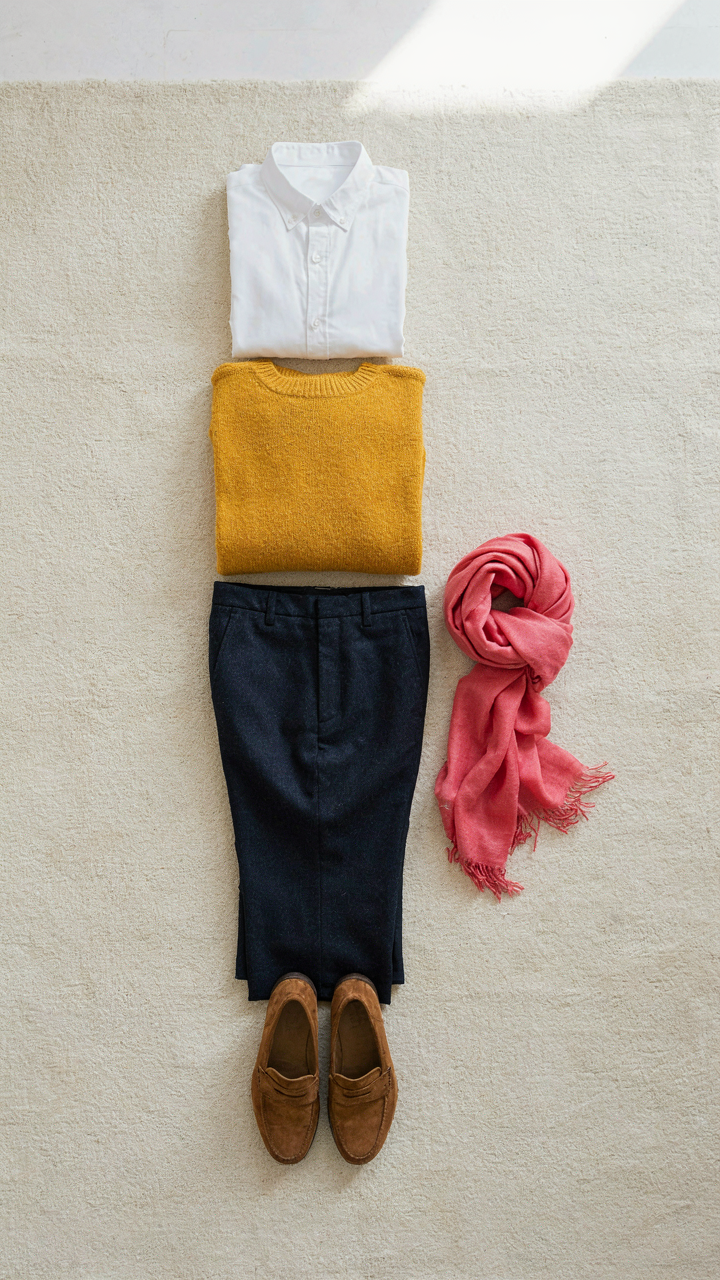
Think of this like computer science uses the term “algorithm”—a repeatable sequence that produces consistent output. Your outfit algorithm is a formula: [Base Layer] + [Secondary Layer] + [Shoes] + [Accessory]. You run this formula with different pieces and always get a wearable result.
- The Five-Piece Rotation: Choose one base color (navy, black, gray, white, or camel). Build five complete outfits using only pieces in that color family plus one complementary neutral. Each outfit uses different pieces but follows the same structure.
- The Work Uniform Template: Identify one silhouette that works for your body and role (tailored blazer plus straight-leg pant, or fitted sweater plus A-line skirt). Lock this template. Swap only the top and bottom within it across the week.
- The Occasion Stack: Create three separate formulas—casual, professional, social. Write down the exact pieces for each: specific jeans plus specific shirt plus specific shoes. When getting dressed, pick the occasion, pick the formula, get dressed.
- The Layering Sequence: Document your weather-based layers in order of priority. Winter example: base tee, then sweater, then coat. You always apply them in sequence, never guessing combinations.
- The Accessory Rule: Choose one primary accessory category per formula (belt, bag, watch, scarf). Use only that one per outfit. This prevents over-accessorizing and keeps combinations predictable.
Document your formulas in a note or spreadsheet. Include piece names, colors, and the exact order you layer them. Reference this before getting dressed for two weeks. Your brain will internalize the pattern. After that, muscle memory takes over and you stop thinking.
Stack Pieces For Invisible Combinations
Most advice says “buy versatile pieces.” Useless. Versatile means nothing until you test the actual combinations. You need interchangeable pieces—items that work with every other item you own in that category. This is the inverse of what most people do.
Start by picking your color palette first, not the pieces. This is non-negotiable. Choose three to four colors that sit in the same tonal family. Warm neutrals (beige, brown, cream, rust) or cool neutrals (gray, white, black, navy). Every single piece you own must exist within that palette. When everything shares the same tonal temperature, any combination works visually. The piece doesn’t need to be “versatile” in some abstract sense. It just needs to match the other pieces in color and tone.
Test combinations before buying anything new. Pull ten existing pieces from your closet. Lay them out. Try each top with each bottom. Note which combinations look intentional and which look accidental. The combinations that work visually are your interchangeable pieces. The ones that fail reveal your gaps. Buy to fill the gaps, not to add variety. You’re building a closed system, not a collection.
Building A Wardrobe From First Principles

Deconstruct Your Life Before You Shop
You want permission to buy things that finally make you look pulled together. Here’s the real mechanism: you can’t identify gaps until you know what your actual life demands, not what Pinterest demands. Your wardrobe must solve specific problems in specific contexts. A lawyer needs courtroom armor. A remote worker needs video-call tops and real pants for in-person meetings. A parent needs clothes that survive repeated washing and kid chaos. None of these requirements overlap. Start by listing every context you occupy in a typical week, not the aspirational ones.
Once contexts are clear, map what each one requires. Ignore trends entirely at this stage. You’re reverse-engineering necessity from your schedule, not importing someone else’s aesthetic. A five-day work week at a conservative firm creates one demand profile. Freelancing from home with occasional client calls creates a completely different one. The gaps in your wardrobe aren’t random holes—they’re missing solutions to problems you already have. Identify the problem first. The clothes follow.
Longevity Economics Over Fashion Cycles
The consensus says “invest in basics.” That’s incomplete advice that misses the actual calculation. Economics teaches sunk cost versus total cost of ownership. Most people track purchase price but ignore replacement frequency, repair costs, and the mental friction of constant shopping. A forty-dollar shirt you replace twice yearly costs more than a hundred-dollar shirt you wear for five years. Longevity isn’t about brand names or pretension. It’s about construction, fabric weight, seam quality, and fit.
Prioritize garments built to survive use, not impression. Natural fibers like cotton, linen, and wool age better than synthetics because they maintain structure through repeated wear and washing. Seam construction matters more than thread count. Double-stitched seams and reinforced stress points determine whether a piece lasts two years or ten. When you identify a gap in your wardrobe, buy the version designed to solve that problem for the longest possible period, then stop shopping in that category until it actually fails.
Practical Wardrobe: The ROI Of Every Hanger

The Math Behind What You Actually Wear
You want permission to keep things. That’s the real reason you’re reading this. The mechanism is simple: most people price clothing by what they paid, not by what they use. Economics calls this the sunk cost fallacy—you’re anchored to the past price instead of the present value. A sweater you wore twice costs more per wear than one you’ve worn fifty times, regardless of the original price tag. Stop counting backwards from purchase price. Start counting forwards from actual use.
Cost-per-wear flips the math on its head. Take the price you paid and divide it by the number of times worn. A hundred-dollar coat worn one hundred times costs one dollar per wear. A fifty-dollar shirt worn twice costs twenty-five dollars per wear. The expensive item wins. The items earning their keep are the ones in rotation. The ones gathering dust are the ones actually costing you. Track this for every piece that’s been in your closet more than three months. You’ll see patterns you didn’t notice before.
Cutting The Dead Weight
The common advice here is useless: “if you haven’t worn it in a year, get rid of it.” That’s lazy. A winter coat worn twice yearly isn’t dead weight—it’s seasonal. What actually matters is whether an item pulls its weight relative to what you paid or what space it occupies. This is returns on investment, applied to fabric. An item with diminishing returns is one that doesn’t solve problems anymore or creates new ones—wrinkles you don’t want to deal with, a fit that shifted, a color that stopped working with your updated wardrobe.
The removal rule: if an item requires negotiation before wearing it, it’s gone. Negotiation means hesitation—you’re deciding whether the hassle is worth it. That hesitation is the signal that the return inverted. It’s now costing you energy instead of saving it. Go through your closet and mark every piece that makes you pause. Those are your candidates for removal. After removal, the items left require no internal argument. You grab them and wear them.
The Minimalist Wardrobe: Not For Aesthetes, But Achievers

Fewer Pieces, More Momentum
You want minimalism to feel like an identity upgrade, a signal that you’ve transcended consumerism. The real mechanism is simpler: constraint forces prioritization. Fewer items mean you stop negotiating with yourself every morning. Decision fatigue dissolves. You move faster. This is borrowed from systems design: reducing variables increases output. In wardrobe terms, each piece you remove forces the remaining pieces to work harder, which means they must align functionally and aesthetically or get cut.
The minimalist wardrobe isn’t about owning less stuff for virtue points. It’s about engineering a system where your clothes make decisions for you instead of the reverse. When you own thirty shirts, you waste cognitive energy picking one. When you own five, the choice is already made. This efficiency compounds across months. You reclaim that mental bandwidth for work that matters. Minimalism becomes a productivity tool disguised as a aesthetic philosophy.
Decision Velocity Beats Variety
The consensus advice is that more options make you happier. Research on choice paralysis proves the opposite. You already know this intuitively. More choices in wardrobe mean more friction before you leave the house, more second-guessing during the day, more nights reorganizing pieces that don’t work together. Minimalism cuts through this by eliminating the negotiation phase entirely.
When every piece in your wardrobe coordinates with every other piece, you stop thinking about clothes altogether. You grab combinations without hesitation. This isn’t deprivation. This is liberation from a decision you didn’t need to make in the first place. Document your final wardrobe audit by photographing outfit combinations laid flat. Use that as your daily reference guide, eliminating the visual search cost each morning.
The Real Obstacle Isn’t Your Clothes; It’s Your Inability To Define What You Actually Want

Most people never finish a wardrobe audit because they don’t know what they’re actually building toward. You can’t find gaps in a puzzle you haven’t sketched out. Before you touch another piece of clothing, write down three specific contexts where you spend real time: work, social, personal. For each one, describe the version of yourself you want to be. Not who Instagram says you should be. Who you actually want to become. Do that today. Everything else follows from clarity, not from more clothes.